

Egypt is increasing its campaign against the Nile dam being built by Ethiopia, which Cairo fears would significantly cut its vital share of the river’s water.
Cairo has also intensified international and regional diplomatic efforts for support on the matter.
Egypt has over the past week sent its foreign and water ministers to fellow downstream nation Sudan for urgent talks on the dam.
Cairo has also written a long letter to the UN Security Council spelling out Egypt’s position after a decade of fruitless talks with Ethiopia over the dam.
It put the blame on the Horn of Africa nation for the failure to reach an agreement.
Egyptian Foreign Minister Sameh Shoukry at the weekend said Egypt and Sudan would deal “very decisively” with any action by Ethiopia to proceed with a second filling of the dam this summer without a prior agreement.
Mr Shoukry said that by going ahead with the filling, Addis Ababa would be in breach of international laws governing trans-national rivers and a 2015 declaration by Egypt, Sudan and Ethiopia that stipulated no action should be taken in regard to the dam.
“Egypt and Sudan will, with all decisiveness, confront it in a political framework and take all measures to safeguard their water rights,” he said in a Saturday night TV interview.
Egypt has called for an urgent meeting of Arab foreign ministers to be convened in Doha, Qatar, on Tuesday to discuss the long-running dispute over the Grand Ethiopian Renaissance Dam.
Egypt and Sudan have for years unsuccessfully tried to persuade Ethiopia to enter a legally binding agreement on the operation and filling of the dam, and a system to resolve future disputes and deal with droughts.
Addis Ababa says guidelines should suffice.
The two allies fear the hydroelectric dam would reduce their share of the river’s water, although Cairo’s concern is much graver than Khartoum’s.
-
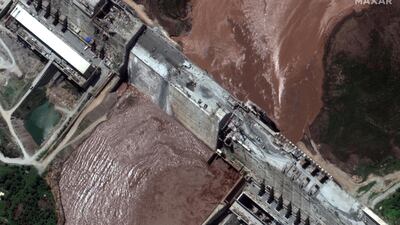
A satellite image taken on June 26, 2020 shows a close-up view of the Grand Ethiopian Renaissance Dam on the Blue Nile. Maxar Technologies via Reuters -
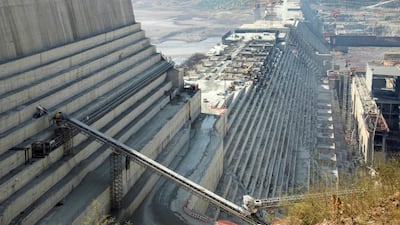
The construction site of the Grand Ethiopian Renaissance Dam in Guba in the North West of Ethiopia, seen in November 2017. AP -
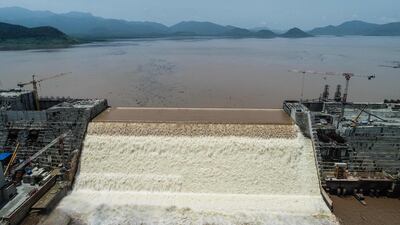
The Grand Ethiopian Renaissance Dam on the Blue Nile River in Guba, northwest Ethiopia. AFP -
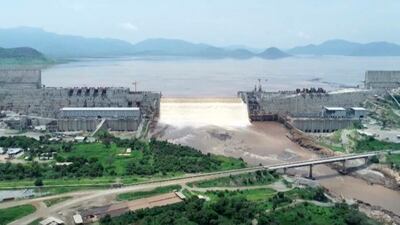
An aerial view of water levels at the Grand Ethiopian Renaissance Dam in Guba, Ethiopia, 2020. AFP -
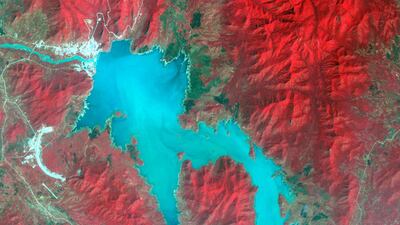
The Blue Nile River is seen as the Grand Ethiopian Renaissance Dam reservoir fills near the Ethiopia-Sudan border, in this broad spectral image taken on November 6, 2020. Reuters -
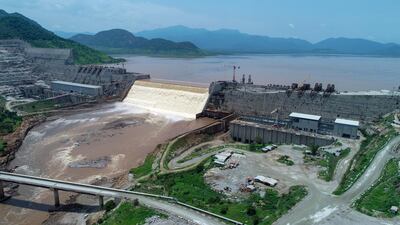
The Grand Ethiopian Renaissance Dam has been a source of discord for years. AP -

The GERD dam on the Blue Nile in Ethiopia has been under construction since 2011. EPA/MAXAR TECHNOLOGIES -
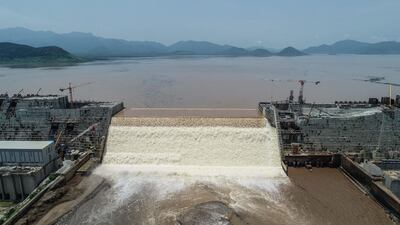
The Grand Ethiopian Renaissance Dam on the Blue Nile River is considered by Ethiopia to be integral to its energy supply, but neighbouring countries say it jeopardises their own water resources. AFP -
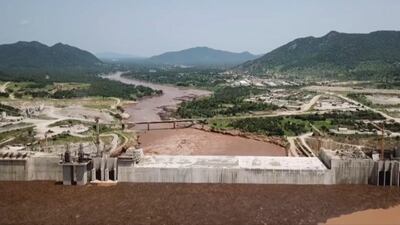
This frame grab from a video obtained from the Ethiopian Public Broadcaster (EBC) on July 20 and July 21, 2020 and released on July 24, 2020 shows an aerial view of water levels at the Grand Ethiopian Renaissance Dam in Guba, Ethiopia. AFP -
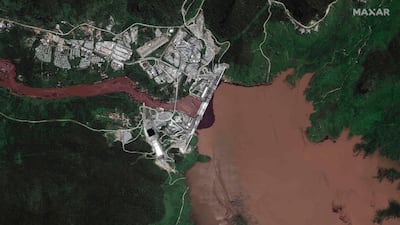
A view of northwestern Ethiopia that focuses on the status of the Grand Ethiopian Renaissance Dam (GERD) and the Blue Nile River on July 11, 2020. AFP -
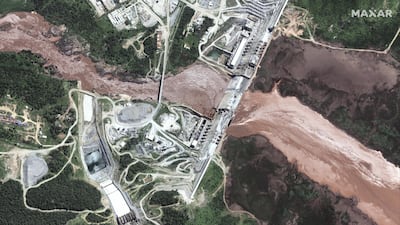
A handout satellite image shows a closeup view of the Grand Ethiopian Renaissance Dam (GERD) and the Blue Nile River in Ethiopia June 26, 2020. Maxar Technologies via Reuters -
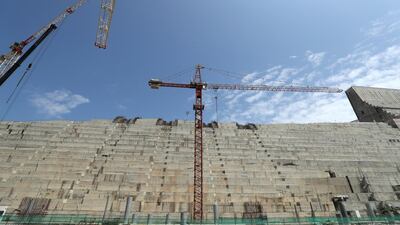
The foreign ministers of Egypt, Ethiopia and Sudan will return to Washington this week for another round of talks to reach an agreement on the Grand Ethiopian Renaissance Dam after missing the deadline last month. Reuters -
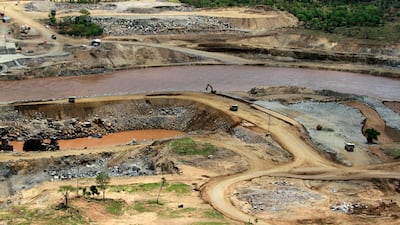
The Blue Nile river flows near the site of the planned Grand Renaissance Dam near Assosa in Ethiopia. AP -
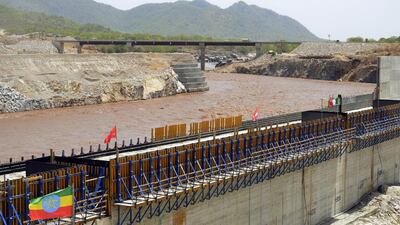
The Grand Renaissance Dam hydroelectric project in Ethiopia. Egypt belives Adis Abbaba is being deliberatley slow in negotiations. William Lloyd George / AFP -
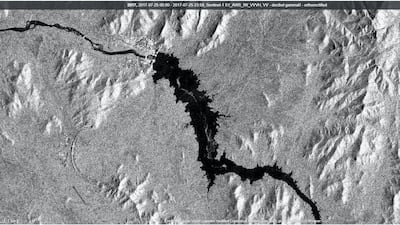
A combination picture of handout satellite images shows a view of the Grand Ethiopian Renaissance Dam (GERD) July 25, 2017 (top left), July 20, 2018 (top right), July 3, 2019 (bottom left), July 9, 2020 (bottom right) in Ethiopia, in these Sentinel-1 satellite imageries obtained by Reuters on July 14, 2020.


With a growing population of more than 100 million, Egypt depends on the Nile for more than 90 per cent of its fresh water.
Sudan’s chief fear is that, without close co-ordination with Ethiopia, its own power-generating dams on the Blue Nile would be at risk.
There have been assertions by experts that, due to construction delays, the second filling would involve much less water than the declared 13.5 billion cubic metres announced by Ethiopia.
The experts also said that a negligible filling would give talks a chance and defuse some of the rising tensions.
Mr Shoukry has also said that the second filling of the dam's reservoir would be unlikely to affect Egypt despite his previous warnings to Addis Ababa, a prediction that has raised eyebrows.

Last year’s first filling did not affect Egypt because of a bumper flood that kept its large water reservoir behind the Aswan dam near capacity.
But Sudan had work at its water treatment plants disrupted, leaving thousands of households without running water for days.
Khartoum said the second filling could devastate the lives of millions in eastern Sudan.
The dam, which is 80 per cent complete, is about 20 kilometres from the Sudanese border.
Egypt’s President, Abdel Fattah El Sisi, has not spoken publicly about the dam since May 11 when he told Egyptians to keep faith with diplomacy and not to fear the loss of water.
In March, he said that Egypt would not be bogged down indefinitely in negotiations and that no one should assume to be out of his military’s reach.

