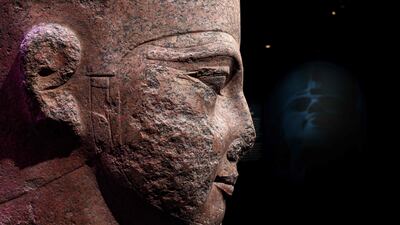
A section of a limestone statue of Ramses II unearthed by an Egyptian-U. S. archaeological mission in El Ashmunein, south of the Egyptian city of Minya, Egypt in this handout image released on March 4, 2024. The Egyptian Ministry of Antiquities/Handout via REUTERS THIS IMAGE HAS BEEN SUPPLIED BY A THIRD PARTY.
A section of a limestone statue of Ramses II unearthed by an Egyptian-U. S. archaeological mission in El Ashmunein, south of the Egyptian city of Minya, Egypt in this handout image released on March 4

Archaeologists find missing top half of Ramses II statue in Egypt


Kamal Tabikha
  • English
  • Arabic

The top half of a statue of Egyptian pharaoh Ramses II has been unearthed in southern Egypt, the Ministry of Tourism and Antiquities has revealed.

The discovery by an Egyptian-US mission completes the statue after the lower half was discovered in the same area, the Ashmunein region of Al Minya province, almost a century ago.

The top section, 3.8 metres tall, depicts Ramses II’s head, shoulders and upper torso.

The pharaoh is portrayed wearing the dual crown indicating his rule over both Egypt’s Upper and Lower kingdoms. A cobra, a symbol of royalty in ancient Egypt, can be seen at the front of the crown.

Preliminary scans of the limestone block have confirmed that it is part of the statue of Ramses II statue unearthed in 1930 by German archaeologist Gunther Roeder.

Once the two parts are joined, the statue is expected to stand seven metres, said Dr Bassem Gehad, head of the Egyptian team taking part in the excavation mission.

Ramses II, also known as Ramses the Great, was the third pharaoh of the 19th Dynasty of Egypt and ruled from 1,279 to 1,213 BC.

The Egyptian team, working under the authority of the Supreme Council of Antiquities, and with counterparts from the University of Colorado mission, began an excavation in Ashmunein last year to find a religious complex believed to date back to Egypt’s New Kingdom era (1550-1070 BC) before collapsing during Roman rule centuries later.

“Though we have not found the complex we were initially looking for, a statue of such importance is a sign that we are digging in the right place,” said Adel Okasha, an antiquities official who oversaw the dig.

He said more notable discoveries are expected.

  • The sarcophagus of Ramses II is displayed on the opening day of the exhibition 'Ramses and the Gold of the Pharaohs' at the Grande Halle de la Villette in Paris. AFP
    The sarcophagus of Ramses II is displayed on the opening day of the exhibition 'Ramses and the Gold of the Pharaohs' at the Grande Halle de la Villette in Paris. AFP
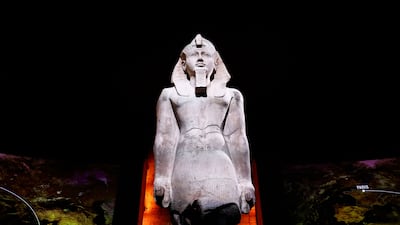
  • A Colossus of Ramses II in limestone on display. The exhibition, which is on tour in 10 cities and explores the life of Ramses the Great, runs until September 6. AFP
    A Colossus of Ramses II in limestone on display. The exhibition, which is on tour in 10 cities and explores the life of Ramses the Great, runs until September 6. AFP
  • A journalist takes a photograph of the wooden coffin of Pharaoh Ramses II. AP
    A journalist takes a photograph of the wooden coffin of Pharaoh Ramses II. AP
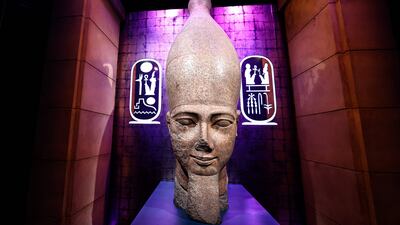
  • The head of a colossal statue of Ramses II. AFP
    The head of a colossal statue of Ramses II. AFP
  • The upper part of a granodiorite statue of Pharaoh Merneptah. AFP
    The upper part of a granodiorite statue of Pharaoh Merneptah. AFP
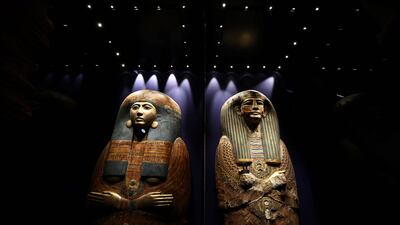
  • The painted and gilded cedar outer coffin lid of Pinudjem II's wife, Princess Nesikhonsu, left, and the inner coffin lid or mummy board of Pinudjem I. AFP
    The painted and gilded cedar outer coffin lid of Pinudjem II's wife, Princess Nesikhonsu, left, and the inner coffin lid or mummy board of Pinudjem I. AFP
  • A gilded wooden mask from the coffin of Amenemope. Reuters
    A gilded wooden mask from the coffin of Amenemope. Reuters
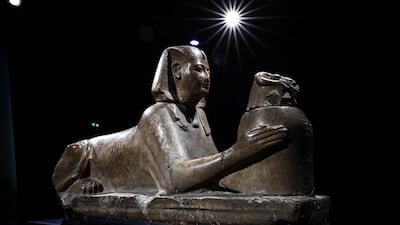
  • A statue featuring Pharaoh Ramses II as a Sphinx offering a ram-headed vessel. AFP
    A statue featuring Pharaoh Ramses II as a Sphinx offering a ram-headed vessel. AFP
  • The head of a colossal statue of Ramses II. AFP
    The head of a colossal statue of Ramses II. AFP
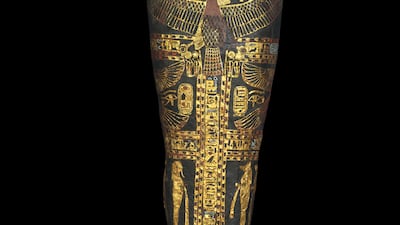
  • The Coffin of Ramses II. Photo: World Heritage Exhibitions
    The Coffin of Ramses II. Photo: World Heritage Exhibitions
  • Gold bracelets of Sheshonq I with a Wedjat Eye. Photo: World Heritage Exhibitions
    Gold bracelets of Sheshonq I with a Wedjat Eye. Photo: World Heritage Exhibitions
  • Funerary mask of King Amenemopet. Photo: World Heritage Exhibitions
    Funerary mask of King Amenemopet. Photo: World Heritage Exhibitions
  • Coffin of Sheshonq II. Photo: World Heritage Exhibitions
    Coffin of Sheshonq II. Photo: World Heritage Exhibitions
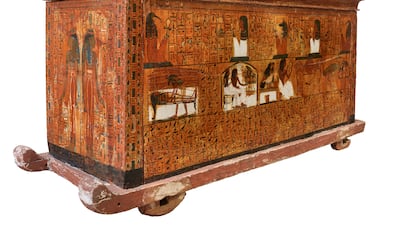
  • Sennedjem's outer coffin. Photo: World Heritage Exhibitions
    Sennedjem's outer coffin. Photo: World Heritage Exhibitions

The city of El Ashmunein, on the west bank of the Nile, was known in ancient Egypt as Khemnu and in the Greco-Roman era was the regional capital of Hermopolis Magna.

Dr Salima Ikram, a professor of Egyptology at the American University in Cairo, said the discovery was notable because "it completes the half found many, many years ago".

"Not only is it a wonderful opportunity to have a whole other massive statue of the famed king, it also adds to our general understanding and fills gaps in our data on the large corpus of Ramses II's statuary," Dr Ikram told The National.

"Through each discovery, we have been able to trace changes in the style during the course of his very long reign."

Statues of Ramses II, the longest-reigning pharaoh and one of ancient Egypt's most depicted figures, draw visitors to a number of the country's historical sites including the dual temples of Abu Simbel, in Egypt’s southernmost province of Aswan.

The four giant statues of Ramses II that flank the main entrance, each 20 metres tall, gained international fame in the 1960s during an operation to move the temples to higher ground to prevent them being submerged by Lake Nasser, the reservoir of the High Aswan Dam.

Thousands of tourists visit the temples to see the Sun light up a wall engraving of Ramses II in a small chamber inside twice a year. The alignment takes place on February 22 and October 22, said to be the dates of Ramses II's birthday and his coronation day, respectively.

Another statue of the Ramses II once stood in a busy square in central Cairo near its largest train station, both named after the pharaoh, before it was moved to be the centrepiece of the main hall in the Grand Egyptian Museum, a vast complex near the Pyramids of Giza, which has been under construction since 2002 and is nearing completion.

Ramses II’s mummy, along with the remains of 21 other ancient kings and queens, was transferred from the Egyptian Museum in Tahrir Square in Cairo in 2021 in a grand parade that was covered by international media and renewed interest in Egyptian heritage worldwide.


The%20specs
%3Cp%3E%3Cstrong%3EEngine%3A%3C%2Fstrong%3E%206.4-litre%20V8%0D%3Cbr%3E%3Cstrong%3ETransmission%3A%20%3C%2Fstrong%3E8-speed%20auto%0D%3Cbr%3E%3Cstrong%3EPower%3A%20%3C%2Fstrong%3E470bhp%0D%3Cbr%3E%3Cstrong%3ETorque%3A%20%3C%2Fstrong%3E637Nm%0D%3Cbr%3E%3Cstrong%3EPrice%3A%20%3C%2Fstrong%3EDh375%2C900%20(estimate)%0D%3Cbr%3E%3Cstrong%3EOn%20sale%3A%3C%2Fstrong%3E%20now%3C%2Fp%3E%0A
How Islam's view of posthumous transplant surgery changed

Transplants from the deceased have been carried out in hospitals across the globe for decades, but in some countries in the Middle East, including the UAE, the practise was banned until relatively recently.

Opinion has been divided as to whether organ donations from a deceased person is permissible in Islam.

The body is viewed as sacred, during and after death, thus prohibiting cremation and tattoos.

One school of thought viewed the removal of organs after death as equally impermissible.

That view has largely changed, and among scholars and indeed many in society, to be seen as permissible to save another life.

The biog

Favourite films: Casablanca and Lawrence of Arabia

Favourite books: Start with Why by Simon Sinek and Good to be Great by Jim Collins

Favourite dish: Grilled fish

Inspiration: Sheikh Zayed's visionary leadership taught me to embrace new challenges.

Mercer, the investment consulting arm of US services company Marsh & McLennan, expects its wealth division to at least double its assets under management (AUM) in the Middle East as wealth in the region continues to grow despite economic headwinds, a company official said.

Mercer Wealth, which globally has $160 billion in AUM, plans to boost its AUM in the region to $2-$3bn in the next 2-3 years from the present $1bn, said Yasir AbuShaban, a Dubai-based principal with Mercer Wealth.

Within the next two to three years, we are looking at reaching $2 to $3 billion as a conservative estimate and we do see an opportunity to do so,” said Mr AbuShaban.

Mercer does not directly make investments, but allocates clients’ money they have discretion to, to professional asset managers. They also provide advice to clients.

“We have buying power. We can negotiate on their (client’s) behalf with asset managers to provide them lower fees than they otherwise would have to get on their own,” he added.

Mercer Wealth’s clients include sovereign wealth funds, family offices, and insurance companies among others.

From its office in Dubai, Mercer also looks after Africa, India and Turkey, where they also see opportunity for growth.

Wealth creation in Middle East and Africa (MEA) grew 8.5 per cent to $8.1 trillion last year from $7.5tn in 2015, higher than last year’s global average of 6 per cent and the second-highest growth in a region after Asia-Pacific which grew 9.9 per cent, according to consultancy Boston Consulting Group (BCG). In the region, where wealth grew just 1.9 per cent in 2015 compared with 2014, a pickup in oil prices has helped in wealth generation.

BCG is forecasting MEA wealth will rise to $12tn by 2021, growing at an annual average of 8 per cent.

Drivers of wealth generation in the region will be split evenly between new wealth creation and growth of performance of existing assets, according to BCG.

Another general trend in the region is clients’ looking for a comprehensive approach to investing, according to Mr AbuShaban.

“Institutional investors or some of the families are seeing a slowdown in the available capital they have to invest and in that sense they are looking at optimizing the way they manage their portfolios and making sure they are not investing haphazardly and different parts of their investment are working together,” said Mr AbuShaban.

Some clients also have a higher appetite for risk, given the low interest-rate environment that does not provide enough yield for some institutional investors. These clients are keen to invest in illiquid assets, such as private equity and infrastructure.

“What we have seen is a desire for higher returns in what has been a low-return environment specifically in various fixed income or bonds,” he said.

“In this environment, we have seen a de facto increase in the risk that clients are taking in things like illiquid investments, private equity investments, infrastructure and private debt, those kind of investments were higher illiquidity results in incrementally higher returns.”

The Abu Dhabi Investment Authority, one of the largest sovereign wealth funds, said in its 2016 report that has gradually increased its exposure in direct private equity and private credit transactions, mainly in Asian markets and especially in China and India. The authority’s private equity department focused on structured equities owing to “their defensive characteristics.”

SPEC SHEET

Display: 10.9" Liquid Retina IPS, 2360 x 1640, 264ppi, wide colour, True Tone, Apple Pencil support

Chip: Apple M1, 8-core CPU, 8-core GPU, 16-core Neural Engine

Memory: 64/256GB storage; 8GB RAM

Main camera: 12MP wide, f/1.8, Smart HDR

Video: 4K @ 25/25/30/60fps, full HD @ 25/30/60fps, slo-mo @ 120/240fps

Front camera: 12MP ultra-wide, f/2.4, Smart HDR, Centre Stage; full HD @ 25/30/60fps

Audio: Stereo speakers

Biometrics: Touch ID

I/O: USB-C, smart connector (for folio/keyboard)

Battery: Up to 10 hours on Wi-Fi; up to 9 hours on cellular

Finish: Space grey, starlight, pink, purple, blue

Price: Wi-Fi – Dh2,499 (64GB) / Dh3,099 (256GB); cellular – Dh3,099 (64GB) / Dh3,699 (256GB)

No.6 Collaborations Project

Ed Sheeran (Atlantic)

Three trading apps to try

Sharad Nair recommends three investment apps for UAE residents:

  • For beginners or people who want to start investing with limited capital, Mr Nair suggests eToro. “The low fees and low minimum balance requirements make the platform more accessible,” he says. “The user interface is straightforward to understand and operate, while its social element may help ease beginners into the idea of investing money by looking to a virtual community.”
  • If you’re an experienced investor, and have $10,000 or more to invest, consider Saxo Bank. “Saxo Bank offers a more comprehensive trading platform with advanced features and insight for more experienced users. It offers a more personalised approach to opening and operating an account on their platform,” he says.
  • Finally, StashAway could work for those who want a hands-off approach to their investing. “It removes one of the biggest challenges for novice traders: picking the securities in their portfolio,” Mr Nair says. “A goal-based approach or view towards investing can help motivate residents who may usually shy away from investment platforms.”
Iftar programme at the Sheikh Mohammed Centre for Cultural Understanding

Established in 1998, the Sheikh Mohammed Centre for Cultural Understanding was created with a vision to teach residents about the traditions and customs of the UAE. Its motto is ‘open doors, open minds’. All year-round, visitors can sign up for a traditional Emirati breakfast, lunch or dinner meal, as well as a range of walking tours, including ones to sites such as the Jumeirah Mosque or Al Fahidi Historical Neighbourhood.

Every year during Ramadan, an iftar programme is rolled out. This allows guests to break their fast with the centre’s presenters, visit a nearby mosque and observe their guides while they pray. These events last for about two hours and are open to the public, or can be booked for a private event.

Until the end of Ramadan, the iftar events take place from 7pm until 9pm, from Saturday to Thursday. Advanced booking is required.

For more details, email openminds@cultures.ae or visit www.cultures.ae


Tamkeen's offering
  • Option 1: 70% in year 1, 50% in year 2, 30% in year 3
  • Option 2: 50% across three years
  • Option 3: 30% across five years 
THE SPECS

Engine: 1.5-litre turbocharged four-cylinder

Transmission: Constant Variable (CVT)

Power: 141bhp 

Torque: 250Nm 

Price: Dh64,500

On sale: Now

CABINET%20OF%20CURIOSITIES%20EPISODE%201%3A%20LOT%2036
%3Cp%3E%3Cstrong%3EDirector%3A%20%3C%2Fstrong%3EGuillermo%20del%20Toro%3Cbr%3E%3Cstrong%3EStars%3A%3C%2Fstrong%3E%20Tim%20Blake%20Nelson%2C%20Sebastian%20Roche%2C%20Elpidia%20Carrillo%3Cbr%3ERating%3A%204%2F5%3C%2Fp%3E%0A
TEACHERS' PAY - WHAT YOU NEED TO KNOW

Pay varies significantly depending on the school, its rating and the curriculum. Here's a rough guide as of January 2021:

- top end schools tend to pay Dh16,000-17,000 a month - plus a monthly housing allowance of up to Dh6,000. These tend to be British curriculum schools rated 'outstanding' or 'very good', followed by American schools

- average salary across curriculums and skill levels is about Dh10,000, recruiters say

- it is becoming more common for schools to provide accommodation, sometimes in an apartment block with other teachers, rather than hand teachers a cash housing allowance

- some strong performing schools have cut back on salaries since the pandemic began, sometimes offering Dh16,000 including the housing allowance, which reflects the slump in rental costs, and sheer demand for jobs

- maths and science teachers are most in demand and some schools will pay up to Dh3,000 more than other teachers in recognition of their technical skills

- at the other end of the market, teachers in some Indian schools, where fees are lower and competition among applicants is intense, can be paid as low as Dh3,000 per month

- in Indian schools, it has also become common for teachers to share residential accommodation, living in a block with colleagues

Updated: March 05, 2024, 12:08 PM