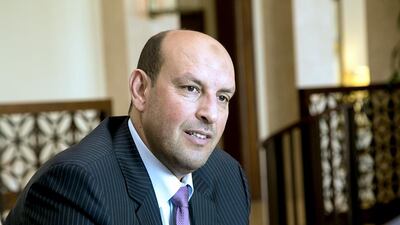
Osama Rabie, Chairman of the Suez Canal Authority, at a news conference in March 2021. Reuters

Suez Canal chief responds to fears over bid to form $4bn private fund


Kamal Tabikha
  • English
  • Arabic

Egypt’s government does not have the right to transfer ownership of the Suez Canal to any foreign entities, the waterway’s chief said on Thursday.

Admiral Osama Rabie held a special news conference in response to mounting public outrage over a draft law submitted by the government to parliament on Monday seeking to allow the waterway's authority to launch a 100-billion-Egyptian-pound ($4 billion) private fund to increase its revenue.

The draft law, which was preliminarily approved in parliament pending a final vote at a later date, was strongly opposed by several MPs, many of whom expressed concerns over the involvement of foreign entities in the fund’s projects and the possible privatisation of business activities related to the canal.

If approved, the fund would allow the authority — whether independently or in partnership with third parties — to use its capital to establish companies and invest in securities and private ventures.

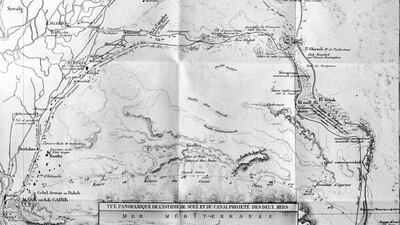
  • The Isthmus of Suez with the plan of the Canal of two Seas and of the diverted auxiliary canal of the Nile. From the pilot study of Misters Linant Bey and Mougel Bey, engineers of viceroy of Egypt, 1855. In 1809 topographical data on the Suez Canal was published by French academics in Description de l'Égypte. Contained one of the first maps of the Suez Canal, and formed the basis for an early French plan to construct a canal, later abandoned. Fieldwork was conducted during Napoleon's 1798 – 1801 military campaign in Egypt. Napoleon's surveyers incorrectly believed that the Red Sea was 9 metres higher than the Mediterranean sea, making construction impossible. Roger Viollet Collection / Getty Images
    The Isthmus of Suez with the plan of the Canal of two Seas and of the diverted auxiliary canal of the Nile. From the pilot study of Misters Linant Bey and Mougel Bey, engineers of viceroy of Egypt, 1855. In 1809 topographical data on the Suez Canal was published by French academics in Description de l'Égypte. Contained one of the first maps of the Suez Canal, and formed the basis for an early French plan to construct a canal, later abandoned. Fieldwork was conducted during Napoleon's 1798 – 1801 military campaign in Egypt. Napoleon's surveyers incorrectly believed that the Red Sea was 9 metres higher than the Mediterranean sea, making construction impossible. Roger Viollet Collection / Getty Images
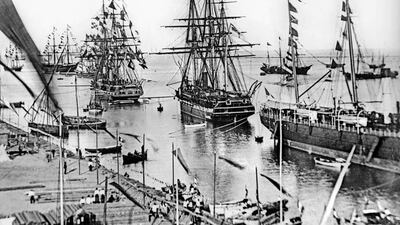
  • The inaugural ceremony of the Suez Canal in 1869. Frederic-Auguste Bartholdi pitched the Suez Canal Company on a large copper statue, modelled after the Colossus of Rhodes, of an 80 foot woman wearing Egyptian peasant robes and bearing a torch which would double as a lighthouse. The Suez Canal Company wasn't interested – but the French government and New York state were. Bartholdi's project became the Statue of Liberty. Getty Images
    The inaugural ceremony of the Suez Canal in 1869. Frederic-Auguste Bartholdi pitched the Suez Canal Company on a large copper statue, modelled after the Colossus of Rhodes, of an 80 foot woman wearing Egyptian peasant robes and bearing a torch which would double as a lighthouse. The Suez Canal Company wasn't interested – but the French government and New York state were. Bartholdi's project became the Statue of Liberty. Getty Images
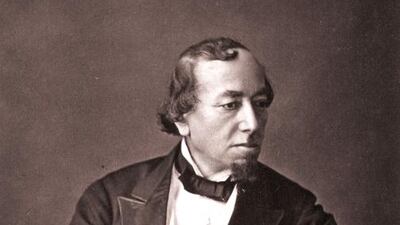
  • English statesman and novelist, Benjamin Disraeli, (1804 - 1881) created Earl of Beaconsfield in 1876. In 1876, Ismail Pasha, Khedive of Egypt, declared bankruptcy, and put his controlling stake in the Suez Canal Company up for sale. Disareli, the British prime minister, bought the Khedive's stake. The canal became a major trade route and strategic waterway for Britain, and helped to facilitate the British Empire's conquest and rule over its colonies in India and East Asia. Jabez Hughes / Getty Images
    English statesman and novelist, Benjamin Disraeli, (1804 - 1881) created Earl of Beaconsfield in 1876. In 1876, Ismail Pasha, Khedive of Egypt, declared bankruptcy, and put his controlling stake in the Suez Canal Company up for sale. Disareli, the British prime minister, bought the Khedive's stake. The canal became a major trade route and strategic waterway for Britain, and helped to facilitate the British Empire's conquest and rule over its colonies in India and East Asia. Jabez Hughes / Getty Images
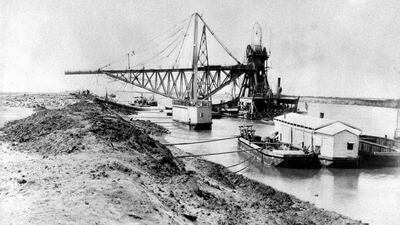
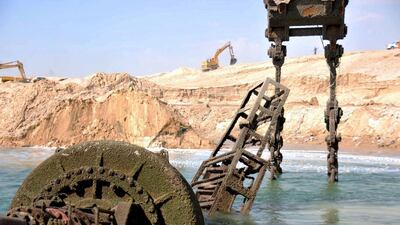
  • A picture dated 1869 shows machinery during the construction of the Suez Canal in Egypt. AFP
    A picture dated 1869 shows machinery during the construction of the Suez Canal in Egypt. AFP
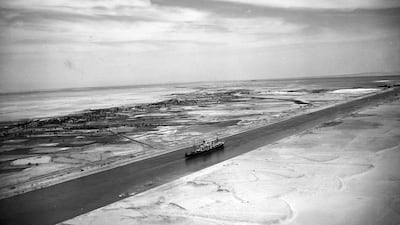
  • An aerial view of the Suez Canal zone near Ismailia, Egypt taken in May 1953. Jim Pringle / AP Photo
    An aerial view of the Suez Canal zone near Ismailia, Egypt taken in May 1953. Jim Pringle / AP Photo
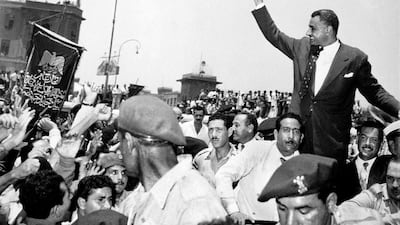
  • The Egyptian president Gamal Abdel Nasser announcing the nationalisation of the Suez Canal to a crowd of 250,000 people during a celebration of the fourth anniversary of the July 26, 1956 revolution. He also announced that the property of the Universal Suez Canal Company would be sequestrated. Britain, France and Israel launched a combined assault on the Suez Canal and Sinai in a bid to return the waterway to Western control and force Nasser to resign. The invasion was successful, but US pressure leads the three countries to withdraw. Keystone-France / Gamma-Keystone via Getty Images
    The Egyptian president Gamal Abdel Nasser announcing the nationalisation of the Suez Canal to a crowd of 250,000 people during a celebration of the fourth anniversary of the July 26, 1956 revolution. He also announced that the property of the Universal Suez Canal Company would be sequestrated. Britain, France and Israel launched a combined assault on the Suez Canal and Sinai in a bid to return the waterway to Western control and force Nasser to resign. The invasion was successful, but US pressure leads the three countries to withdraw. Keystone-France / Gamma-Keystone via Getty Images
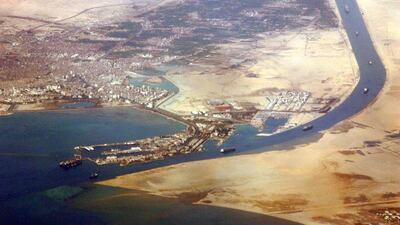
  • An aerial view of the southern entrance of Egypt's Suez Canal taken in 2007. Jack Guez / AFP
    An aerial view of the southern entrance of Egypt's Suez Canal taken in 2007. Jack Guez / AFP
  • In August 2014, the Government of Abdel Fattah El-Sisi ordered the beginning of construction of the New Suez Canal – which adds a parallel route to part of the canal's length, and widens and deepens some of the existing canal. The $8 billion project, funded by bonds issued to Egyptian citizens, was to be completed in a year, and would see traffic through the canal increase to 97 ships per day by 2023 – up from 49 ships per day currently. Amr Abdallah Dalsh / Reuters
    In August 2014, the Government of Abdel Fattah El-Sisi ordered the beginning of construction of the New Suez Canal – which adds a parallel route to part of the canal's length, and widens and deepens some of the existing canal. The $8 billion project, funded by bonds issued to Egyptian citizens, was to be completed in a year, and would see traffic through the canal increase to 97 ships per day by 2023 – up from 49 ships per day currently. Amr Abdallah Dalsh / Reuters
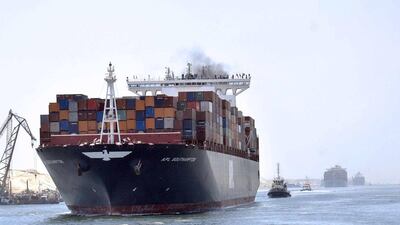
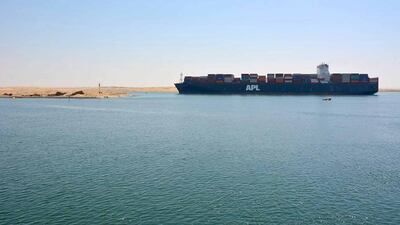
  • The first container ship to use the New Suez Canal. The opening of the New Suez Canal, after exactly 12 months of construction work "was an epic," said Admiral Mohab Mamish, chairman of the Suez Canal Authority, in reports. "It was a very hard job. We invited experts of dredging and we had no time to waste and we feel that we have succeeded.” Courtesy NMDC
    The first container ship to use the New Suez Canal. The opening of the New Suez Canal, after exactly 12 months of construction work "was an epic," said Admiral Mohab Mamish, chairman of the Suez Canal Authority, in reports. "It was a very hard job. We invited experts of dredging and we had no time to waste and we feel that we have succeeded.” Courtesy NMDC
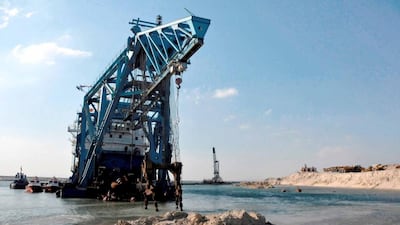
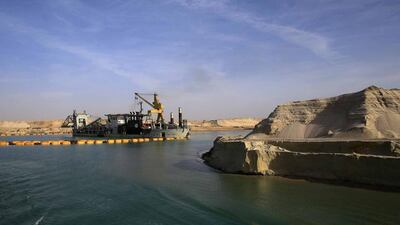
  • A dredger at work on the New Suez Canal. Courtesy NMDC
    A dredger at work on the New Suez Canal. Courtesy NMDC
  • A dredger at work on the New Suez Canal. Courtesy NMDC
    A dredger at work on the New Suez Canal. Courtesy NMDC
  • Work on the New Suez Canal continues. Courtesy NMDC
    Work on the New Suez Canal continues. Courtesy NMDC
  • Yasser Zaghloul, CEO of NMDC. The company worked alongside Belgium’s Jan De Nul and Dutch companies Boskalis and Van Oord on the dredging works. Courtesy NMDC
    Yasser Zaghloul, CEO of NMDC. The company worked alongside Belgium’s Jan De Nul and Dutch companies Boskalis and Van Oord on the dredging works. Courtesy NMDC
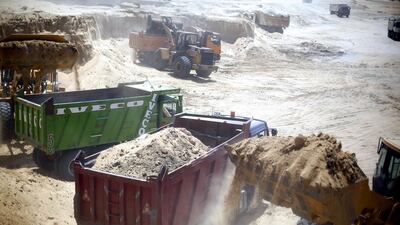
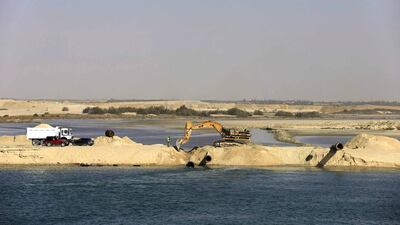
  • Bulldozers and trucks work on a new section of the New Suez Canal in Ismailia, Egypt. Hassan Ammar / AP Photo
    Bulldozers and trucks work on a new section of the New Suez Canal in Ismailia, Egypt. Hassan Ammar / AP Photo
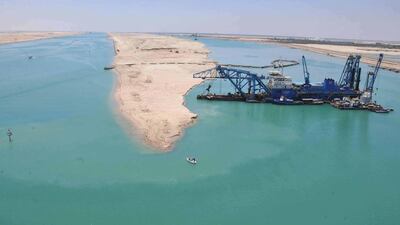
  • A dredger works on a section of the New Suez Canal during a media tour in Ismailia, Egypt. Hassan Ammar / AP Photo
    A dredger works on a section of the New Suez Canal during a media tour in Ismailia, Egypt. Hassan Ammar / AP Photo

“The fund has nothing to do with the canal or the authority,” Admiral Rabie said at Thursday’s press conference, adding: “It is an entirely independent entity with its own budget and operation plan.”

Since Monday, Egypt’s social media channels have also been flooded with posts from people worried that one of the country’s most important patriotic symbols is being privatised.

The creation of the fund would reduce the financial burden on the state’s coffers, Admiral Rabie said, as the authority would only be transferring whatever was left over from its annual budget into the fund each year, after giving the lion’s share to the central bank and paying its operational costs.

“This is the portion of our budget that President El Sisi said we should set aside or possibly grow into a fund for a rainy day,” Admiral Rabie said. “We wouldn’t need to resort to state funds for anything, the fund would have a separate budget.”

He said the authority intends to use the fund to launch mega projects to benefit the canal, including a plant to build giant container vessels.

Thursday’s conference, broadcast live on television and online, was also attended by Diaa Rashwan, the head of Egypt’s journalists’ syndicate and the general co-ordinator of the National Dialogue, a forum set up by Mr El Sisi as a means of conversing with the country’s disgruntled opposition parties, many members of which are imprisoned or in pretrial detention.

The dialogue was convened following repeated complaints from western governments about Egypt’s human rights record.

Rashwan said: “Just 48 hours after parliament discussed the matter, President El Sisi directed us to convene an open meeting about the fund which would be broadcast live.” He added that indicated the President could appreciate that the canal concerns all Egyptians.

The issue of the large number of private funds that exist in Egypt, which many see as an impediment to financial transparency on state and private-sector spending, was also addressed on Thursday.

“Some economists in the country feel that private funds are not included in the national budget and other economists feel that they are,” Rashwan said. “Disagreements on the issue emerge from this difference in economic perspective.”

Admiral Rabie and Rashwan both spoke passionately about the importance of the canal to Egyptians’ national identity, since it was dug up in the 1850s by 1 million Egyptians, at that time about 25 per cent of the country’s population.

Admiral Rabie noted on Thursday that 120,000 Egyptians died digging up the waterway.

“To anyone who has doubts that establishing the fund will diminish Egypt’s sovereignty of the canal, I will respond with what is plain as day, at least to me — there is not a single inch of Egyptian land being relinquished to anyone,” Rashwan asserted.

“President El Sisi, like the leaders who came before him, is the custodian of the canal and the blood that was spilt to dig it.”


Disability on screen

Empire — neuromuscular disease myasthenia gravis; bipolar disorder; post-traumatic stress disorder (PTSD)

Rosewood and Transparent — heart issues

24: Legacy — PTSD;

Superstore and NCIS: New Orleans — wheelchair-bound

Taken and This Is Us — cancer

Trial & Error — cognitive disorder prosopagnosia (facial blindness and dyslexia)

Grey’s Anatomy — prosthetic leg

Scorpion — obsessive compulsive disorder and anxiety

Switched at Birth — deafness

One Mississippi, Wentworth and Transparent — double mastectomy

Dragons — double amputee

Engine: 5.6-litre V8

Transmission: seven-speed automatic

Power: 400hp

Torque: 560Nm

Price: Dh234,000 - Dh329,000

On sale: now

Mercer, the investment consulting arm of US services company Marsh & McLennan, expects its wealth division to at least double its assets under management (AUM) in the Middle East as wealth in the region continues to grow despite economic headwinds, a company official said.

Mercer Wealth, which globally has $160 billion in AUM, plans to boost its AUM in the region to $2-$3bn in the next 2-3 years from the present $1bn, said Yasir AbuShaban, a Dubai-based principal with Mercer Wealth.

Within the next two to three years, we are looking at reaching $2 to $3 billion as a conservative estimate and we do see an opportunity to do so,” said Mr AbuShaban.

Mercer does not directly make investments, but allocates clients’ money they have discretion to, to professional asset managers. They also provide advice to clients.

“We have buying power. We can negotiate on their (client’s) behalf with asset managers to provide them lower fees than they otherwise would have to get on their own,” he added.

Mercer Wealth’s clients include sovereign wealth funds, family offices, and insurance companies among others.

From its office in Dubai, Mercer also looks after Africa, India and Turkey, where they also see opportunity for growth.

Wealth creation in Middle East and Africa (MEA) grew 8.5 per cent to $8.1 trillion last year from $7.5tn in 2015, higher than last year’s global average of 6 per cent and the second-highest growth in a region after Asia-Pacific which grew 9.9 per cent, according to consultancy Boston Consulting Group (BCG). In the region, where wealth grew just 1.9 per cent in 2015 compared with 2014, a pickup in oil prices has helped in wealth generation.

BCG is forecasting MEA wealth will rise to $12tn by 2021, growing at an annual average of 8 per cent.

Drivers of wealth generation in the region will be split evenly between new wealth creation and growth of performance of existing assets, according to BCG.

Another general trend in the region is clients’ looking for a comprehensive approach to investing, according to Mr AbuShaban.

“Institutional investors or some of the families are seeing a slowdown in the available capital they have to invest and in that sense they are looking at optimizing the way they manage their portfolios and making sure they are not investing haphazardly and different parts of their investment are working together,” said Mr AbuShaban.

Some clients also have a higher appetite for risk, given the low interest-rate environment that does not provide enough yield for some institutional investors. These clients are keen to invest in illiquid assets, such as private equity and infrastructure.

“What we have seen is a desire for higher returns in what has been a low-return environment specifically in various fixed income or bonds,” he said.

“In this environment, we have seen a de facto increase in the risk that clients are taking in things like illiquid investments, private equity investments, infrastructure and private debt, those kind of investments were higher illiquidity results in incrementally higher returns.”

The Abu Dhabi Investment Authority, one of the largest sovereign wealth funds, said in its 2016 report that has gradually increased its exposure in direct private equity and private credit transactions, mainly in Asian markets and especially in China and India. The authority’s private equity department focused on structured equities owing to “their defensive characteristics.”

Qosty Byogaani

Starring: Hani Razmzi, Maya Nasir and Hassan Hosny

Four stars

Company%20Profile
%3Cp%3E%3Cstrong%3EName%3A%3C%2Fstrong%3E%20Raha%3Cbr%3E%3Cstrong%3EStarted%3A%3C%2Fstrong%3E%202022%3Cbr%3E%3Cstrong%3EBased%3A%3C%2Fstrong%3E%20Kuwait%2FSaudi%3Cbr%3E%3Cstrong%3EIndustry%3A%3C%2Fstrong%3E%20Tech%20Logistics%3Cbr%3E%3Cstrong%3EFunding%3A%3C%2Fstrong%3E%20%2414%20million%3Cbr%3E%3Cstrong%3EInvestors%3A%3C%2Fstrong%3E%20Soor%20Capital%2C%20eWTP%20Arabia%20Capital%2C%20Aujan%20Enterprises%2C%20Nox%20Management%2C%20Cedar%20Mundi%20Ventures%3Cbr%3E%3Cstrong%3ENumber%20of%20employees%3A%3C%2Fstrong%3E%20166%3C%2Fp%3E%0A

Sting & Shaggy

44/876

(Interscope)

Desert Warrior

Starring: Anthony Mackie, Aiysha Hart, Ben Kingsley

Director: Rupert Wyatt

Rating: 3/5

The%20Roundup%20%3A%20No%20Way%20Out
%3Cp%3E%3Cstrong%3EDirector%3A%3C%2Fstrong%3E%20Lee%20Sang-yong%3Cbr%3E%3Cstrong%3EStars%3A%3C%2Fstrong%3E%20Don%20Lee%2C%20Lee%20Jun-hyuk%2C%20Munetaka%20Aoki%3Cbr%3E%3Cstrong%3ERating%3A%20%3C%2Fstrong%3E3%2F5%3Cbr%3E%3Cbr%3E%3C%2Fp%3E%0A
Updated: June 20, 2023, 5:50 AM