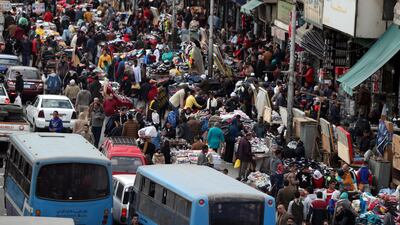
El Ataba market in Cairo. Egypt has succeeded in reducing births from 3.5 per woman in 2014 to 2.8 in 2021, but the government says that is not enough to address overpopulation. Photo: AFP

Egypt's population grows by a million in 221 days


Nada El Sawy
  • English
  • Arabic

Egypt’s population grew by another million in 221 days, the country’s statistics agency said.

It exceeded 104 million on Saturday, with a baby born every 19 seconds, or 4,525 births a day.

The Arab world’s most populous country reached 100 million in February 2020 and has been adding a million to its population every 240 days on average thereafter.

It took less time for the latest one million increase because of “the noticeable decrease in the number of deaths, reaching 1,566 per day, compared to 1,858 per day in the previous period”, the Central Agency for Public Mobilisation and Statistics (Capmas) said.

President Abdel Fattah El Sisi has previously said that rapid population growth hinders national progress and initiatives to improve the lives of citizens.

World population hits 8 billion - in pictures

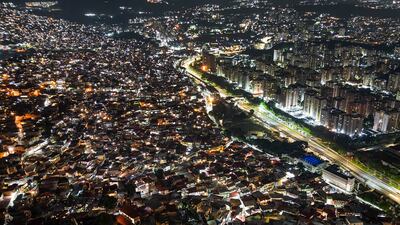
  • Houses cover a hillside in the Petare neighbourhood of Caracas, Venezuela. The world's population hit an estimated eight billion people on November 15, according to the United Nations. AP
    Houses cover a hillside in the Petare neighbourhood of Caracas, Venezuela. The world's population hit an estimated eight billion people on November 15, according to the United Nations. AP
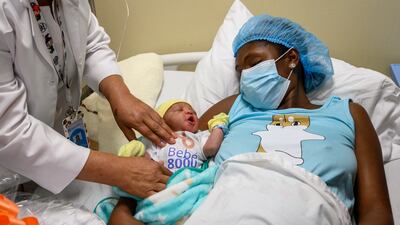
  • Damaris Ferrera with her baby at Damian Ferrera Altagracia Hospital – in Santo Domingo, Dominican Republic – which symbolically named him the eight billionth inhabitant of the world. AP
    Damaris Ferrera with her baby at Damian Ferrera Altagracia Hospital – in Santo Domingo, Dominican Republic – which symbolically named him the eight billionth inhabitant of the world. AP
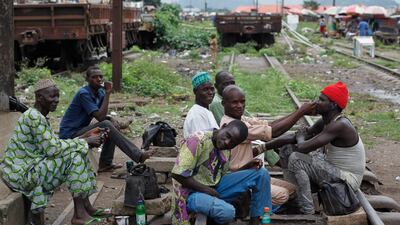
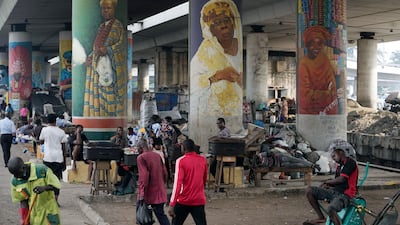
  • Barbers on an abandoned train track in Abeokuta, about 70km outside Lagos, Nigeria. More than half of the projected increase in the global population up to 2050 will be concentrated in eight countries: the Democratic Republic of Congo, Egypt, Ethiopia, India, Nigeria, Pakistan, the Philippines and Tanzania. EPA
    Barbers on an abandoned train track in Abeokuta, about 70km outside Lagos, Nigeria. More than half of the projected increase in the global population up to 2050 will be concentrated in eight countries: the Democratic Republic of Congo, Egypt, Ethiopia, India, Nigeria, Pakistan, the Philippines and Tanzania. EPA
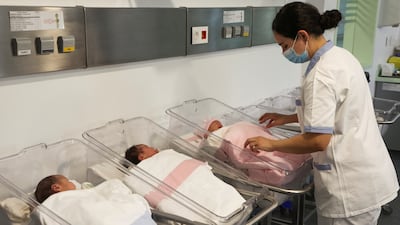
  • Newborn babies at Hotel Dieu hospital in Beirut, Lebanon, as the world population surges past eight billion. Reuters
    Newborn babies at Hotel Dieu hospital in Beirut, Lebanon, as the world population surges past eight billion. Reuters
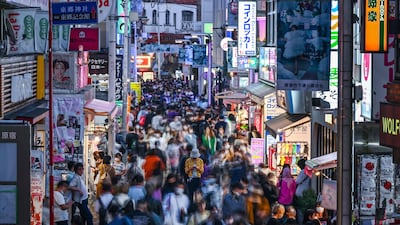
  • Crowds on Takeshita Street in Tokyo, considered to be the world's most populous metropolitan area. AFP
    Crowds on Takeshita Street in Tokyo, considered to be the world's most populous metropolitan area. AFP
  • Nigeria is a significant contributor to world population growth. Countries in sub-Saharan Africa are expected to contribute more than half of the increase anticipated up to 2050, according to the UN. AP
    Nigeria is a significant contributor to world population growth. Countries in sub-Saharan Africa are expected to contribute more than half of the increase anticipated up to 2050, according to the UN. AP
  • A packed Ipanema beach in Rio de Janeiro, Brazil. AP
    A packed Ipanema beach in Rio de Janeiro, Brazil. AP
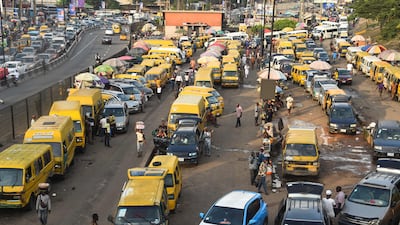
  • Traffic chaos at Ojodu-Berger bus station in Lagos, Nigeria's commercial capital, which has a population of about 15 million. AFP
    Traffic chaos at Ojodu-Berger bus station in Lagos, Nigeria's commercial capital, which has a population of about 15 million. AFP
  • A crowded market in Jalandhar, India. AFP
    A crowded market in Jalandhar, India. AFP
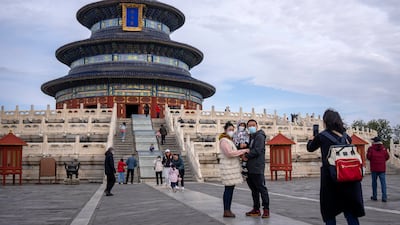
  • A family taking pictures at the Temple of Heaven in Beijing. AP
    A family taking pictures at the Temple of Heaven in Beijing. AP
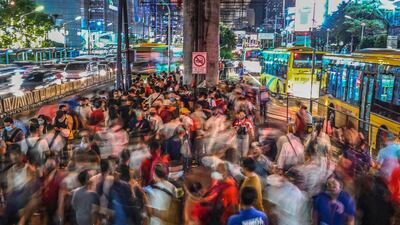
  • Commuters waiting for buses in Manila, Philippines, where the city's 12 million population swells by three million during working hours. AFP
    Commuters waiting for buses in Manila, Philippines, where the city's 12 million population swells by three million during working hours. AFP
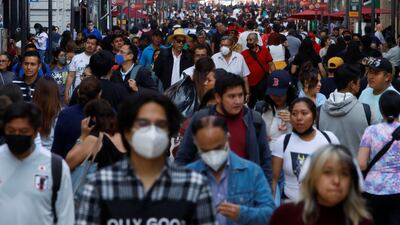
  • Mexico City is home to more than 20 million people. Reuters
    Mexico City is home to more than 20 million people. Reuters
  • Times Square in Manhattan. About nine million people live in New York's five boroughs. Reuters
    Times Square in Manhattan. About nine million people live in New York's five boroughs. Reuters
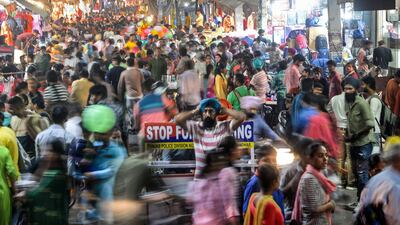
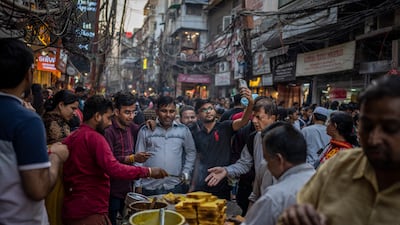
  • A busy market in New Delhi, India, part of an urban area where the population is estimated to be 32 million. AP
    A busy market in New Delhi, India, part of an urban area where the population is estimated to be 32 million. AP
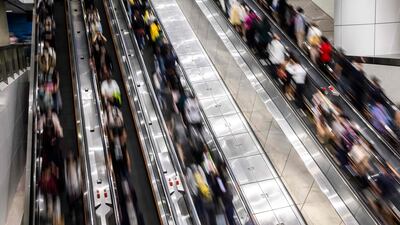
  • Commuters at a train station in Hong Kong. AFP
    Commuters at a train station in Hong Kong. AFP
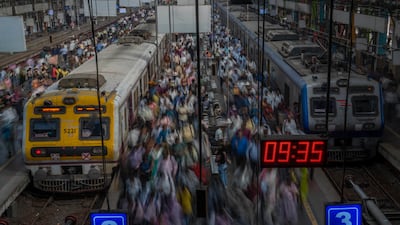
  • Indian commuters get off trains at the Church Gate railway station in Mumbai, India. AP
    Indian commuters get off trains at the Church Gate railway station in Mumbai, India. AP
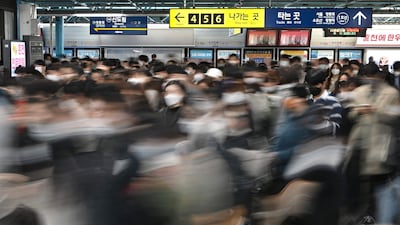
  • A subway station in Seoul. The South Korean capital has a population approaching 10 million. AFP
    A subway station in Seoul. The South Korean capital has a population approaching 10 million. AFP

Overpopulation constitutes a “burden on the national economy” and “generates many economic, social, environmental and security challenges”, Capmas said.

The Ministry of Health and Population has encouraged families to have fewer children, spending more than 100 million Egyptian pounds ($5.1m) annually to offer family planning methods at no charge or at a discount.

In 2020, Egypt launched a two-year initiative called Two Is Enough.

Egypt has succeeded in reducing the rate from 3.5 births per woman in 2014 to 2.8 in 2021. In other words, every 10 women produce 28 children.

“That’s a good number, but it’s not enough,” Hussein Abdel Aziz, adviser to the head of Capmas, told Egyptian TV station Sada El Balad on Saturday night.

He said the goal is to reduce the rate to 1.6 children per woman, or 16 babies for every 10 women, “like in developed countries”.

At the current fertility rate, Egypt’s population will reach 165 million in 2050. If the rate is reduced to 1.6, the population will reach 139 million in 2050.

The governorates with the highest birth rates are mainly in Upper Egypt, including Assiut, Sohag, Qena, Minya and Beni Suef.

The areas with the lowest birth rates included the port cities of Port Said and Suez, and the Nile Delta governorates of Damietta, Dakahlia and Qalyubia.

The country’s three most populous governorates are Cairo with more than 10.1 million people, Giza with 9.4 million, and Sharqia in the northern part of the country with 7.8 million.

Egypt is the most populous African country after Nigeria and Ethiopia, and 14th worldwide.

Egypt's tourist attractions - in pictures

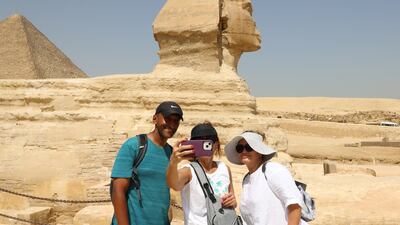
  • Tourists visit the Giza Pyramids and the Sphinx, in Egypt. EPA
    Tourists visit the Giza Pyramids and the Sphinx, in Egypt. EPA
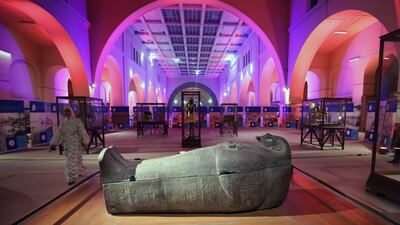
  • The black granite sarcophagus of King Psusennes I, discovered in 2018, on display at the Museum of Egyptian Antiquities, in Cairo. EPA
    The black granite sarcophagus of King Psusennes I, discovered in 2018, on display at the Museum of Egyptian Antiquities, in Cairo. EPA
  • Egypt's tourism industry drew in $13 billion in 2021. EPA
    Egypt's tourism industry drew in $13 billion in 2021. EPA
  • Seeing underwater fish from a submarine in the Red Sea, in Sharm El Sheikh. Reuters
    Seeing underwater fish from a submarine in the Red Sea, in Sharm El Sheikh. Reuters
  • Unwinding at the beach in Alexandria, about 220 kilometres north of Cairo, Egypt. EPA
    Unwinding at the beach in Alexandria, about 220 kilometres north of Cairo, Egypt. EPA
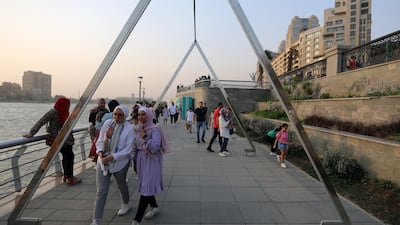
  • Walking by the Nile, in Cairo. EPA
    Walking by the Nile, in Cairo. EPA
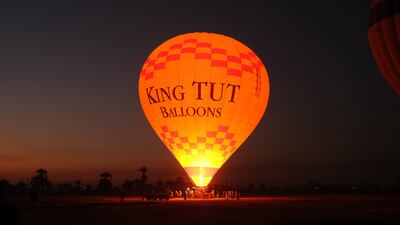
  • A balloon is filled with hot air before take-off for a ride with tourists on the west bank of the Nile, in Luxor. AFP
    A balloon is filled with hot air before take-off for a ride with tourists on the west bank of the Nile, in Luxor. AFP
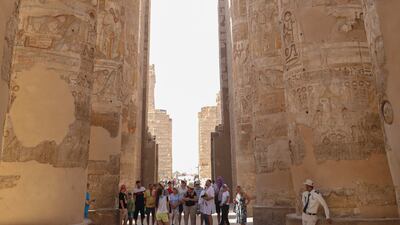
  • Tourists visit the Karnak Temple, a day after the reopening of the Avenue of Sphinxes, in 2021. AP
    Tourists visit the Karnak Temple, a day after the reopening of the Avenue of Sphinxes, in 2021. AP
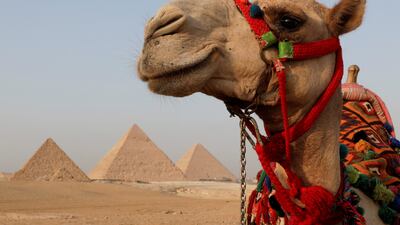
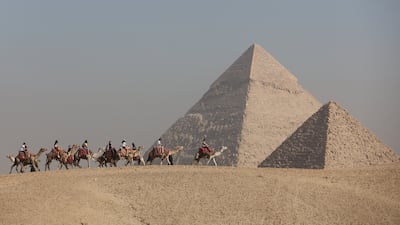
  • Camel rides are a popular activity at the pyramids. Reuters
    Camel rides are a popular activity at the pyramids. Reuters
  • Camel rides are a popular activity at the pyramids. Reuters
    Camel rides are a popular activity at the pyramids. Reuters
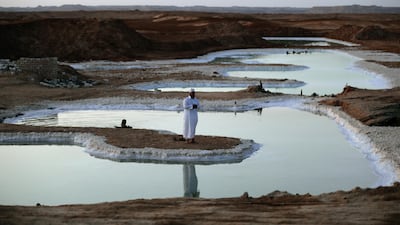
  • Prayer time by a salty lake, near the Siwa Oasis. EPA
    Prayer time by a salty lake, near the Siwa Oasis. EPA
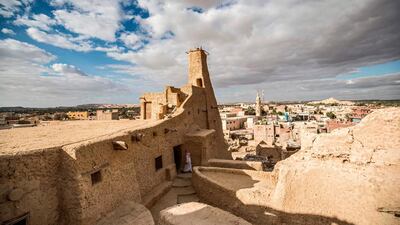
  • The recently restored fortress of Shali and its surroundings, near the desert oasis of Siwa, about 600km south-west of the capital Cairo. AFP
    The recently restored fortress of Shali and its surroundings, near the desert oasis of Siwa, about 600km south-west of the capital Cairo. AFP
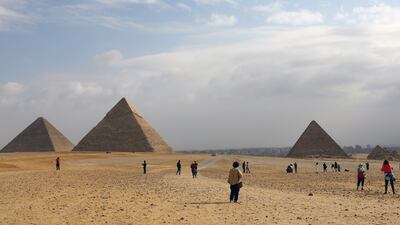
  • Tourists visit the area of the Great Pyramids, in Giza. Reuters
    Tourists visit the area of the Great Pyramids, in Giza. Reuters
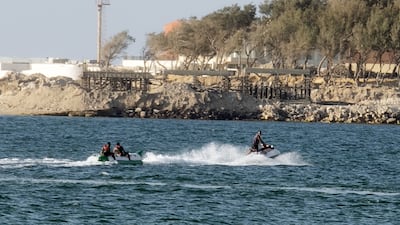
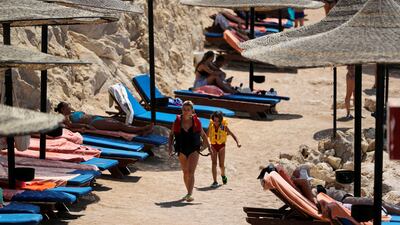
  • Time to relax in the Red Sea resort of Sharm El Sheikh. Reuters
    Time to relax in the Red Sea resort of Sharm El Sheikh. Reuters
  • By the beach in the Aqaba Gulf, Sharm El Sheikh. Reuters
    By the beach in the Aqaba Gulf, Sharm El Sheikh. Reuters
  • Snorkelling near a beach in Sahl Hasheesh, Hurghada. Reuters
    Snorkelling near a beach in Sahl Hasheesh, Hurghada. Reuters

Mercer, the investment consulting arm of US services company Marsh & McLennan, expects its wealth division to at least double its assets under management (AUM) in the Middle East as wealth in the region continues to grow despite economic headwinds, a company official said.

Mercer Wealth, which globally has $160 billion in AUM, plans to boost its AUM in the region to $2-$3bn in the next 2-3 years from the present $1bn, said Yasir AbuShaban, a Dubai-based principal with Mercer Wealth.

Within the next two to three years, we are looking at reaching $2 to $3 billion as a conservative estimate and we do see an opportunity to do so,” said Mr AbuShaban.

Mercer does not directly make investments, but allocates clients’ money they have discretion to, to professional asset managers. They also provide advice to clients.

“We have buying power. We can negotiate on their (client’s) behalf with asset managers to provide them lower fees than they otherwise would have to get on their own,” he added.

Mercer Wealth’s clients include sovereign wealth funds, family offices, and insurance companies among others.

From its office in Dubai, Mercer also looks after Africa, India and Turkey, where they also see opportunity for growth.

Wealth creation in Middle East and Africa (MEA) grew 8.5 per cent to $8.1 trillion last year from $7.5tn in 2015, higher than last year’s global average of 6 per cent and the second-highest growth in a region after Asia-Pacific which grew 9.9 per cent, according to consultancy Boston Consulting Group (BCG). In the region, where wealth grew just 1.9 per cent in 2015 compared with 2014, a pickup in oil prices has helped in wealth generation.

BCG is forecasting MEA wealth will rise to $12tn by 2021, growing at an annual average of 8 per cent.

Drivers of wealth generation in the region will be split evenly between new wealth creation and growth of performance of existing assets, according to BCG.

Another general trend in the region is clients’ looking for a comprehensive approach to investing, according to Mr AbuShaban.

“Institutional investors or some of the families are seeing a slowdown in the available capital they have to invest and in that sense they are looking at optimizing the way they manage their portfolios and making sure they are not investing haphazardly and different parts of their investment are working together,” said Mr AbuShaban.

Some clients also have a higher appetite for risk, given the low interest-rate environment that does not provide enough yield for some institutional investors. These clients are keen to invest in illiquid assets, such as private equity and infrastructure.

“What we have seen is a desire for higher returns in what has been a low-return environment specifically in various fixed income or bonds,” he said.

“In this environment, we have seen a de facto increase in the risk that clients are taking in things like illiquid investments, private equity investments, infrastructure and private debt, those kind of investments were higher illiquidity results in incrementally higher returns.”

The Abu Dhabi Investment Authority, one of the largest sovereign wealth funds, said in its 2016 report that has gradually increased its exposure in direct private equity and private credit transactions, mainly in Asian markets and especially in China and India. The authority’s private equity department focused on structured equities owing to “their defensive characteristics.”

Formula%204%20Italian%20Championship%202023%20calendar
%3Cp%3EApril%2021-23%3A%20Imola%3Cbr%3EMay%205-7%3A%20Misano%3Cbr%3EMay%2026-28%3A%20SPA-Francorchamps%3Cbr%3EJune%2023-25%3A%20Monza%3Cbr%3EJuly%2021-23%3A%20Paul%20Ricard%3Cbr%3ESept%2029-Oct%201%3A%20Mugello%3Cbr%3EOct%2013-15%3A%20Vallelunga%3C%2Fp%3E%0A
Living in...

This article is part of a guide on where to live in the UAE. Our reporters will profile some of the country’s most desirable districts, provide an estimate of rental prices and introduce you to some of the residents who call each area home.

Paris%20Agreement
%3Cp%3EArticle%2014%3C%2Fp%3E%0A%3Cp%3E1.%20%5BThe%20Cop%5D%20shall%20periodically%20take%20stock%20of%20the%20implementation%20of%20this%20Agreement%20to%20assess%20the%20collective%20progress%20towards%20achieving%20the%20purpose%20of%20this%20Agreement%20and%20its%20long-term%20goals%20(referred%20to%20as%20the%20%22global%20stocktake%22)%3C%2Fp%3E%0A%3Cp%3E2.%20%5BThe%20Cop%5D%20shall%20undertake%20its%20first%20global%20stocktake%20in%202023%20and%20every%20five%20years%20thereafter%C2%A0%3C%2Fp%3E%0A
Ten tax points to be aware of in 2026

1. Domestic VAT refund amendments: request your refund within five years

If a business does not apply for the refund on time, they lose their credit.

2. E-invoicing in the UAE

Businesses should continue preparing for the implementation of e-invoicing in the UAE, with 2026 a preparation and transition period ahead of phased mandatory adoption. 

3. More tax audits

Tax authorities are increasingly using data already available across multiple filings to identify audit risks. 

4. More beneficial VAT and excise tax penalty regime

Tax disputes are expected to become more frequent and more structured, with clearer administrative objection and appeal processes. The UAE has adopted a new penalty regime for VAT and excise disputes, which now mirrors the penalty regime for corporate tax.

5. Greater emphasis on statutory audit

There is a greater need for the accuracy of financial statements. The International Financial Reporting Standards standards need to be strictly adhered to and, as a result, the quality of the audits will need to increase.

6. Further transfer pricing enforcement

Transfer pricing enforcement, which refers to the practice of establishing prices for internal transactions between related entities, is expected to broaden in scope. The UAE will shortly open the possibility to negotiate advance pricing agreements, or essentially rulings for transfer pricing purposes. 

7. Limited time periods for audits

Recent amendments also introduce a default five-year limitation period for tax audits and assessments, subject to specific statutory exceptions. While the standard audit and assessment period is five years, this may be extended to up to 15 years in cases involving fraud or tax evasion. 

8. Pillar 2 implementation 

Many multinational groups will begin to feel the practical effect of the Domestic Minimum Top-Up Tax (DMTT), the UAE's implementation of the OECD’s global minimum tax under Pillar 2. While the rules apply for financial years starting on or after January 1, 2025, it is 2026 that marks the transition to an operational phase.

9. Reduced compliance obligations for imported goods and services

Businesses that apply the reverse-charge mechanism for VAT purposes in the UAE may benefit from reduced compliance obligations. 

10. Substance and CbC reporting focus

Tax authorities are expected to continue strengthening the enforcement of economic substance and Country-by-Country (CbC) reporting frameworks. In the UAE, these regimes are increasingly being used as risk-assessment tools, providing tax authorities with a comprehensive view of multinational groups’ global footprints and enabling them to assess whether profits are aligned with real economic activity. 

Contributed by Thomas Vanhee and Hend Rashwan, Aurifer

Section 375

Cast: Akshaye Khanna, Richa Chadha, Meera Chopra & Rahul Bhat

Director: Ajay Bahl

Producers: Kumar Mangat Pathak, Abhishek Pathak & SCIPL

Rating: 3.5/5

Jetour T1 specs

Engine: 2-litre turbocharged

Power: 254hp

Torque: 390Nm

Price: From Dh126,000

Available: Now

Living in...

This article is part of a guide on where to live in the UAE. Our reporters will profile some of the country’s most desirable districts, provide an estimate of rental prices and introduce you to some of the residents who call each area home.

The biog

Birthday: February 22, 1956

Born: Madahha near Chittagong, Bangladesh

Arrived in UAE: 1978

Exercise: At least one hour a day on the Corniche, from 5.30-6am and 7pm to 8pm.

Favourite place in Abu Dhabi? “Everywhere. Wherever you go, you can relax.”

Updated: December 30, 2022, 2:40 PM