


A branch of the Nile that flowed past the site of the Great Pyramid of Giza before drying up thousands of years ago may have been used to transport the 2.3 million stone blocks that make up the landmark, research has found.
A report by researchers from France, Egypt and China has strengthened the long-held theory that boats were used to ferry the stones used to build the pyramids from quarries in Giza and the Red Sea region.
The study, published in the Proceedings of the National Academy of Sciences journal in August, suggested a former tributary of the Nile known as the Khufu branch was used to transport stones to a port complex on the western bank of the river.
The research team studied vegetation patterns in the area and the surrounding topography to construct an approximated 8,000-year history of the Giza floodplain.
The researchers said an "ingenious” network of canals and basins were dug on the plateau to make the port complex during the construction of the pyramids in Giza, which took place at about 2,650 BC.
-
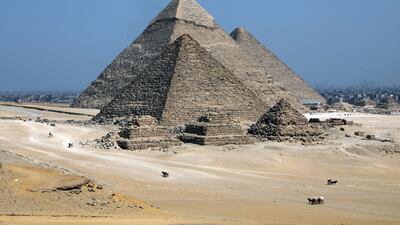
Tourists ride a horse-drawn cart by the pyramids in Giza, Egypt. All photos: EPA -
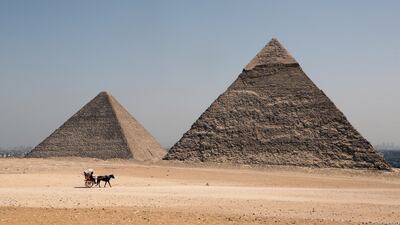
Egypt’s tourism ministry has intensified efforts to develop the Giza Plateau ahead of the inauguration of the nearby Grand Egyptian Museum. -

UN World Tourism Day is observed on 27 September and this year the focus was on Tourism for Inclusive Growth. Thousands of people in the Giza area rely on tourism-related work for their livelihoods. -

The 4,700 year old southern tomb of King Djoser in Giza reopened to the public in September after a 15-year restoration, Egypt’s Tourism Ministry said. -
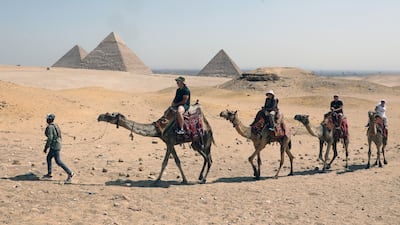
Tourism to the pryamids declined rapidly during the pandemic, but has started to recover. -

The tourism sector accounts for 9 per cent of Egypt's GDP, but less than a quarter of the usual number of tourists visited Egypt in 2020, official figures show. -
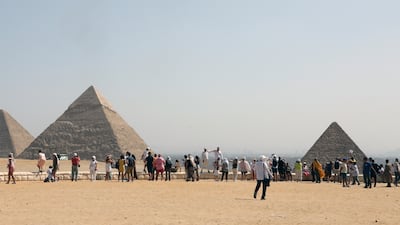
Egypt's government made the vaccination of tourism workers in the region a top priority.


Workers had to ensure the canals and basins were deep enough to accommodate shallow-draft vessels all year round.
Larger vessels could probably only use the waterways during the annual flood season, which takes place from August to October, when water levels in the Nile channel rose by about seven metres.
That was when heavier cargo was transported, the report said.
The theory about stones being transported by boat is also supported by 4,000-year-old fragments of papyrus found in 2013 at the Wadi Garaf stone quarry in Sinai, about 240 kilometres south-east of Suez.
Writing on the fragments recounts the journey of stone-carrying boats to the Giza plateau.
“The scrolls were found buried underneath these large boulders in the Wadi Garaf quarry," said Ali Abu Dshish, an Egyptologist and media adviser to former Egyptian antiquities minister Zahi Hawass.
"We believe the boulders were put there to close up the large open pits used to carry out the mined rock from the quarry, signifying the end of the work."
He said the fragments included the names of some of the people who built the pyramids and that all had Egyptian names.
That has cast doubt on theories that the pyramids were built by foreign slaves, he said.

