

Luxor's Avenue of Sphinxes finally opened as a tourist attraction on Thursday in a ceremony filled with pomp, glitz and star appearances.
The two-hour affair featured an appearance by Egyptian President Abdel Fattah El Sisi, before a documentary about the site was shown and thousands of dancers, musicians and actors paraded down the 2.7 kilometre, 3,000-year-old avenue from Karnak Temple to Luxor Temple.
The televised event had few live spectators, who gathered with Mr El Sisi at the courtyard of the Luxor Temple to watch live performances, something people would have done in Ancient Egypt, Dr Khaled El Enany, the Minister of Tourism and Antiquities, told the crowd.
The ceremony to inaugurate the area was part of a series of high-profile investments in Egypt’s historical sites, designed to attract tourists and revive a sector struggling to bounce back from the Covid-19 pandemic.
Years of painstaking restoration work led to Thursday’s celebration. Many believed the project, considered a white elephant for more than 70 years since the first stone sphinx was found on site in 1949, would never come to fruition.
Throughout the evening, which was designed to replicate ancient celebrations of the autumn festival Opet, there were messages of thanks to Mr El Sisi and the government for the investment in the site and in Egypt’s tourism and heritage.
The Parade of Mummies through Cairo in April drew millions of viewers around the world, but the smaller ceremony in Luxor looked unlikely to have the same effect.

The ancient walkway, variously known as the Avenue of Sphinxes, the Way of the Rams and the Path of the Gods, is in what was the city of Thebes, Egypt’s capital in antiquity.
It is believed to have been the path that pilgrims trod to visit the temples and pay tribute to their deities.
Some streets in the city were completely cleared for the event, particularly around both temples. Perimeters were set up along the length of the avenue on both sides, with hundreds of security officials throughout the city.
Egyptian officials had been told not to reveal any details about the spectacle to keep it a surprise to viewers, and the avenue was hidden from view by grey street hoardings before the show began.
Mr El Sisi featured prominently in the celebration, arriving with his wife Entissar Amer in a black car driven slowly up the avenue.
After being greeted by a group of blue-clad schoolchildren, he toured the Luxor temple site guided by Dr El Enany.
Later, thousands of actors, dancers and drummers walked in time to musical performances against the inviting backdrop of both temples.
Three golden, pharaonic-style model boats dedicated to the ancient sun god Amun Ra, moon god Khonsu and mother goddess Mut, were carried by men in sheer gold and black robes, replicas of what would have been worn for the same festival in ancient Egypt.
A song and dance
-
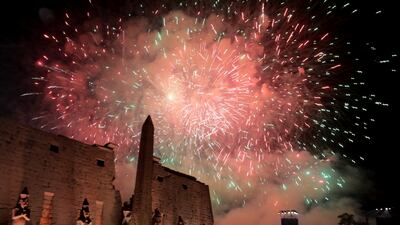
Fireworks explode during the opening ceremony for the restored Avenue of the Sphinxes, or Road of the Rams, a 3,000-year-old path that connects Luxor Temple with Karnak Temple, on November 25, 2021. Reuters -

After years of renovation and in a bid to reinvigorate Egypt's tourism sector, the 2,700-metre Avenue of the Sphinxes was reopened in a grand ceremony. Getty Images -
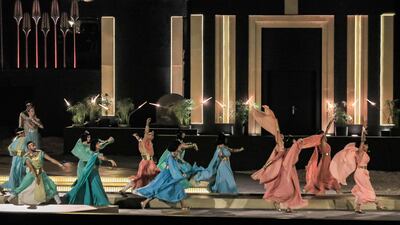
Performers dance during the official ceremony outside Luxor Temple. AFP -

The 2,700-metre Avenue of the Sphinxes is lit up for the event. Getty Images -
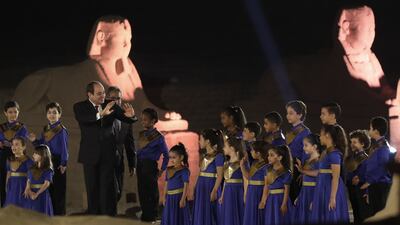
Egyptian President Abdel Fattah El Sisi attends the opening ceremony at Luxor Temple. EPA -
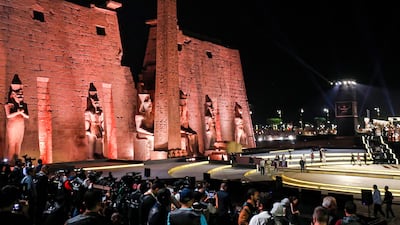
Journalists wait by the pylon and remaining obelisk at the entrance of the temple. AFP -
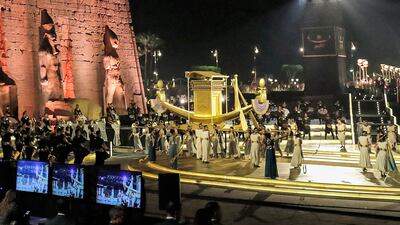
Egypt unveiled the sandstone-paved path lined with ram-headed statues and sphinxes dating back more than 3,000 years. AFP -

Thousands of actors, dancers and drummers participated in the parade. Getty Images -

Dancers take part in the performance, which featured songs composed specially for the occasion. Getty Images -
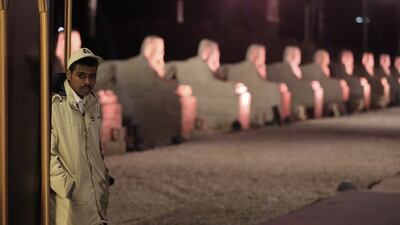
A guard stands at the restored Avenue of Sphinxes. EPA -

The grand ceremony marked the official reopening of the Avenue of Sphinxes. EPA -

A procession of hundreds of costumed performers set out from Luxor Temple to Karnak Temple. EPA -
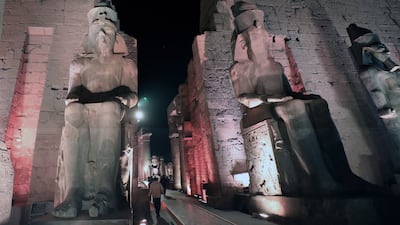
The procession winds its way between the two temples. EPA -
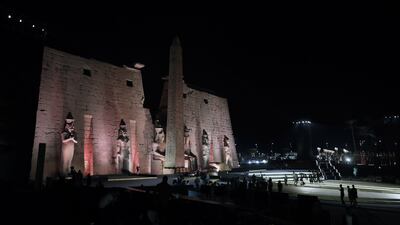
The avenue has been carefully restored in a bid to reinvigorate Egypt's tourism sector. EPA -
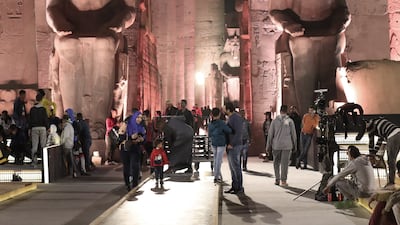
The avenue, as well as the two temples it connects, are set to be an open-air museum after years of excavation and restoration. EPA -

The day after the parade, the entire length of the avenue and all the temples it includes opened to visitors free of charge. EPA -

Luxor Temple before the start of the parade. Getty Images -

Sphinxes sit near Luxor Temple before the celebration. Getty Images -

The entrance of the Avenue of the Sphinxes. Getty Images -

Sphinxes line the 2,700-meter avenue. Getty Images


Ancient artefacts were presented with a modern flourish as Egyptian singers Mohamed Hamaki and Lara Scandar took to the stage, singing a composition in English, Arabic and French that was written especially for the occasion.
Dancers dressed in ombre turquoise and white robes danced inside the restored Luxor Temple, while a screen showed yet more festive events in markets and with hot air balloons.
Respect for the ancient also permeated the festivities. A chant dedicated to Queen Hatshepsut, one of Egypt’s only two female pharaohs, traditionally performed during the ancient Opet Festival, accompanied a more solemn section of the festivities.
The oldest ruins on the pathways are six structures built by the queen about 1400 BC.
Another song was made up of lyrics inspired by hymns written on the walls of the two Nile-side city temples.

The eyes of the world were on the city of Luxor, but Egyptologist Bassam El Shammae said the best is yet to come.
"2021 was a huge year for Egypt's archaeology and for it to culminate with this celebration is nothing short of spectacular," he told The National.
"But next year is going to be even better. I anticipate 2022 will be the year of Egypt.
"Not only will it mark the much-anticipated opening of the Grand Egyptian Museum, it will also mark 100 years since Howard Carter unearthed the remains of King Tut and 200 years since Champollion in 1822 deciphered the mysteries of ancient Egyptian languages using the famed Rosetta stone."
After suffering amid the coronavirus pandemic, there are high hopes in Egypt that reopening the archaeological site in Luxor, the country’s second most-visited site after the Pyramids of Giza, will give the tourism industry a much-needed shot in the arm.
“Tonight is an artistic celebration of the ancient Opet festival," Dr El Enany told the inauguration ceremony.
"One of the most important festivals in Ancient Egypt, it happened on the second month of the flood every year.
"Its name is also the name of the second month in the Coptic calendar. We are all part of one fabric throughout thousands of years.”

