More than 200 people were wounded after Israeli riot police fired rubber bullets and stun grenades at Palestinian worshippers at the Al Aqsa Mosque compound, in an escalation of weeks of violence in Jerusalem that has reverberated across the region.
The Palestinian Red Crescent emergency service said 205 people were injured in clashes with police there and elsewhere in Jerusalem, including near the Sheikh Jarrah neighbourhood, late on Friday night.
The Red Crescent said it had opened a field hospital because emergency rooms were full.
Most of the injuries were to the face and eyes, caused by rubber-coated bullets and shrapnel from stun grenades, it said. One person lost an eye, two suffered serious head wounds and two had their jaws fractured.
Israel said 17 police officers were wounded.
The US said it "is extremely concerned about ongoing confrontations in Jerusalem ... which have reportedly resulted in scores of injured people".
"There is no excuse for violence, but such bloodshed is especially disturbing now, coming as it does on the last days of Ramadan," State Department spokesman Ned Price said.
-
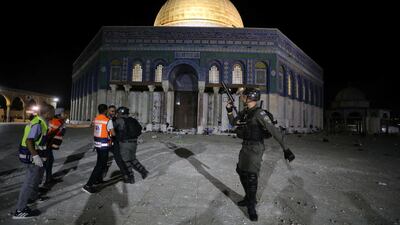
An Israeli police officer scuffles with a Palestinian man in front of the Dome of the Rock shrine at Haram Al Sharif – the Al Aqsa Mosque compound – in Jerusalem. Reuters -

Israeli police aim their weapons during clashes with Palestinians at the Al Aqsa Mosque compound. Reuters -
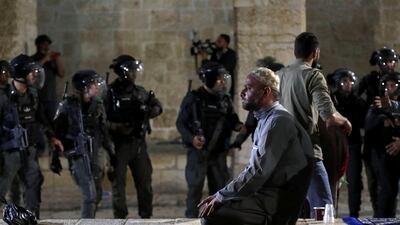
A Palestinian man prays as Israeli police gather during clashes at the Al Aqsa Mosque compound. Reuters -

Palestinians demonstrators react as Israeli police fire stun grenades. Reuters -
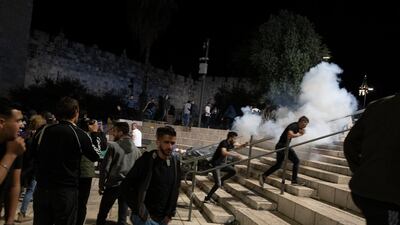
Palestinians react as Israeli police fire stun grenades at the Damascus Gate to the Old City of Jerusalem, following clashes at the Al Aqsa Mosque compound. AP Photo -
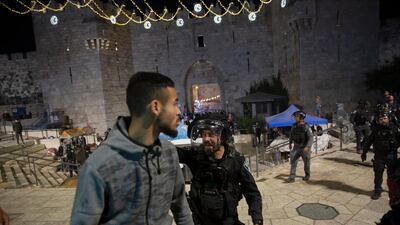
An Israeli policeman tells a Palestinian man to leave the Damascus Gate. The Palestinian Red Crescent said more than 160 people were injured in clashes with police on Friday night. AP Photo -

Palestinian youths watch clashes between protesters and Israeli security forces in Jerusalem. Israel said six police officers were injured. AFP -
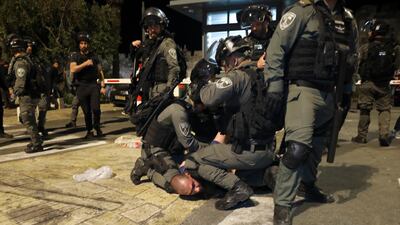
Israeli police officers detain a Palestinian demonstrator during clashes. Tensions have been running high over the possible eviction of Palestinian families near the Damascus Gate. AP Photo -
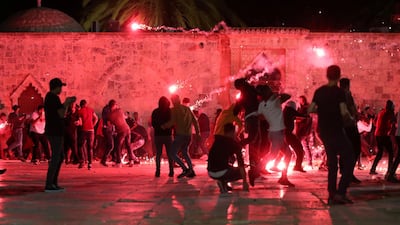
Palestinians react as Israeli police fire stun grenades during clashes. Reuters -
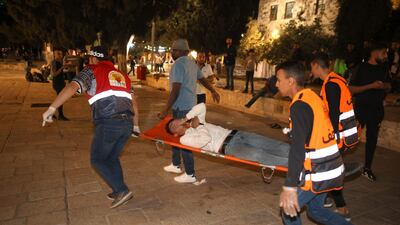
An injured man is carried away as Israeli security forces clash with Palestinian protesters. AFP


Mr Price said Washington was calling on Israeli and Palestinian officials to "act decisively to de-escalate tensions and bring a halt to the violence".
And he warned it was "critical" to avoid any steps that could worsen the situation – such as "evictions in East Jerusalem, settlement activity, home demolitions, and acts of terrorism".
Palestinian President Mahmoud Abbas said he held Israel responsible "for the dangerous developments and sinful attacks taking place in the holy city" and called on the UN Security Council to hold an urgent session on the issue.
Earlier Friday, Israeli troops shot and killed two Palestinians and wounded a third after the men opened fire on a base belonging to Israel’s paramilitary Border Police force in the occupied West Bank, the latest in a series of deadly confrontations in recent weeks that has coincided with Ramadan.
More unrest appears likely next week.
At the beginning of Ramadan, Israel blocked off access to the Damascus Gate near the Al Aqsa compound, a popular gathering spot where Palestinians traditionally socialise at the end of their day-long fast.
The move set off two weeks of clashes before Israel lifted the restrictions.
The Al Aqsa mosque compound is the third holiest site in Islam.
Israeli police deployed in large numbers as tens of thousands of Palestinians packed into the hilltop compound surrounding the mosque earlier on Friday for prayers.
Many stayed on to protest against the potential evictions of Palestinian families from the Sheikh Jarrah neighbourhood, which sits near the walled Old City's Damascus Gate.
Following the evening meal that breaks the Ramadan fast, clashes broke out at Al Aqsa with smaller scuffles near Sheikh Jarrah.
Police used water cannon mounted on armoured vehicles to disperse several hundred protesters gathered near the homes of families facing eviction.
"If we don't stand with this group of people here, [evictions] will [come] to my house, her house, his house and to every Palestinian who lives here," protester Bashar Mahmoud, 23, from the nearby Palestinian neighbourhood of Issawiya, told Reuters.
Israel's Supreme Court will hold a hearing on the Sheikh Jarrah evictions on Monday.
-
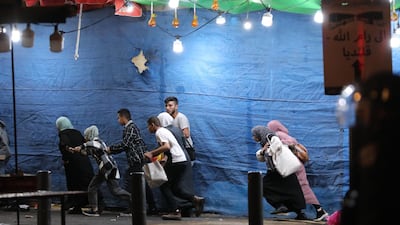
Palestinians run away from Israeli border police during a demonstration in support of Palestinian families that face eviction from their homes at Sheikh Jarrah neighbourhood in the Damascus gate in Jerusalem. EPA -
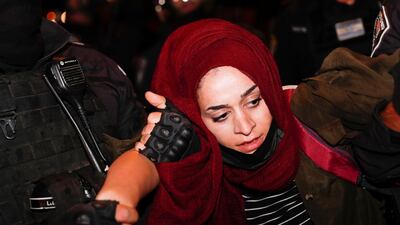
Israeli police arrest a Palestinian demonstrator during a protest in support of Palestinian families that face eviction from their homes at Sheikh Jarrah neighbourhood, near Damascus gate in Jerusalem. EPA -
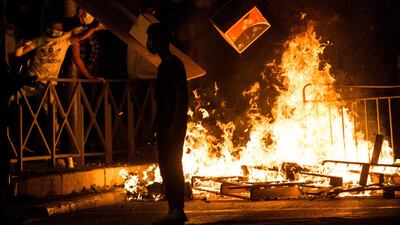
Palestinians throw carton box to a burning barricade during clashes with Israeli police in Jerusalem. Tension continues in Jerusalem's Old City after clashes in Al Aqsa Mosque left dozens of Palestinians were seriously injured. Getty Images -
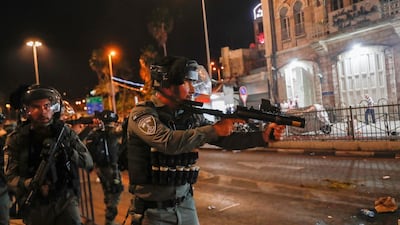
Israeli border police during a demonstration in support of Palestinian families that face eviction from their homes at Sheikh Jarrah neighbourhood, near Damascus Gate in the Old City of Jerusalem. EPA -
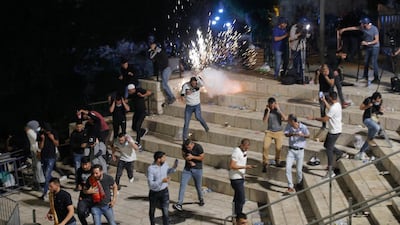
Palestinians run for cover as Israeli police officers fire stun grenades during clashes at Damascus Gate outside Jerusalem's Old City. AP Photo -
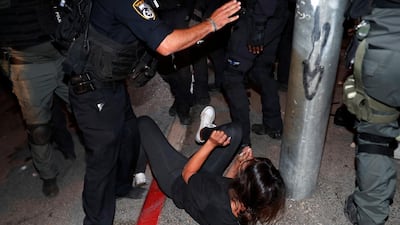
Israeli police arrest a Palestinian demonstrator during a protest in support of Palestinian families that face eviction from their homes at Sheikh Jarrah neighbourhood, near Damascus Gate in the old city of Jerusalem. EPA -
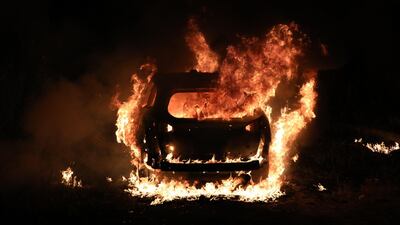
A car belonging to Israeli settlers goes up in flames during a protest in support of Palestinian families facing eviction in Sheikh Jarrah neighbourhood in East Jerusalem. EPA -

Supporters of Palestinian revolution factions rally in support of the Palestinians in Jerusalem, at Bourj Al Barajneh Palestinian camp in the southern suburb of the Lebanese capital Beirut. EPA -

Palestinians assist a wounded protester run amid clashes with Israeli security forces outside the Damascus Gate in Jerusalem's Old City. EPA -
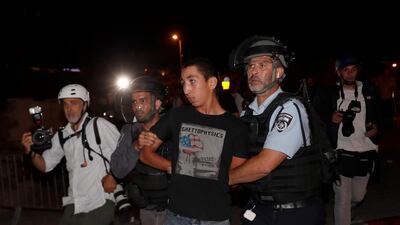
Israeli police arrest a Palestinian activist during a demonstration in support of Palestinian families that face eviction from their homes at Sheikh Jarrah neighbourhood, near Damascus Gate in the Old City of Jerusalem. EPA -
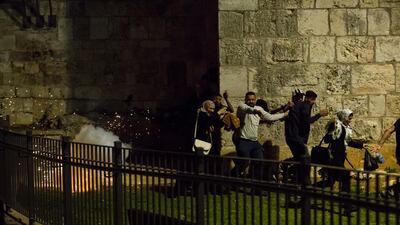
Palestinians run for cover after Israeli police officers fire stun grenades during clashes at Damascus Gate in Jerusalem's Old City. Getty Images -
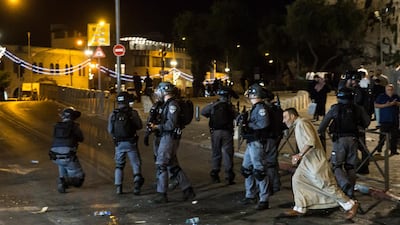
A Palestinian man flees as Israeli police officers watch during clashes in Jerusalem's Old City. Getty Images -
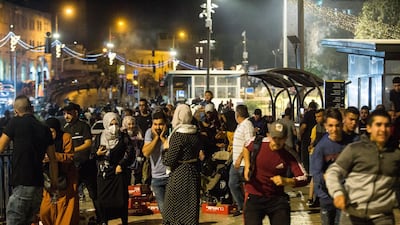
Palestinians run for cover during clashes with Israeli police officers in Jerusalem. Getty Images -
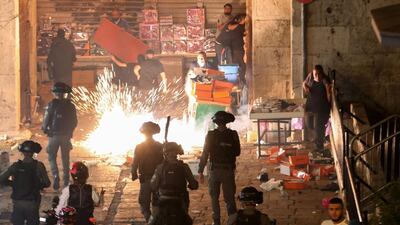
Palestinians react as Israeli police fire a stun grenade during clashes at Damascus Gate on Laylat Al Qadr during the month of Ramadan, in Jerusalem's Old City. Reuters -
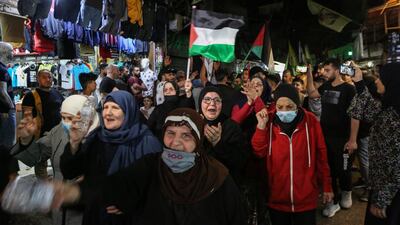
Supporters of Palestinian factions demonstrate in support of the Palestinians facing eviction in a Jerusalem neighbourhood, at Bourj Al Barajneh Palestinian camp in the southern suburb of Beirut, Lebanon. EPA


International condemnation
Arab League Secretary General Ahmed Aboul Gheit said the timing of the Israeli actions showed a deliberate attempt to provoke Palestinians during Ramadan.
The EU also issued a statement, highlighting concern over the possible evictions.
"Acts of incitement around Haram Al Sharif must be avoided and the status quo has to be respected", the EU said.
"The situation with regard to the evictions of Palestinian families in Sheikh Jarrah and other areas of East Jerusalem is also of serious concern," it said.
The spokesman for the UN High Commissioner for Human Rights also condemned the evictions, saying that "if ordered and implemented" they would "violate Israel's obligations under international law".
In the region, the UAE, Saudi Arabia, Bahrain, Egypt and Jordan also issued strongly worded statements.
UAE Minister of State Khalifa Al Marar said that the UAE "expresses its grave concern about the violence that took place in occupied East Jerusalem and strongly condemns the storming of the Al Aqsa Mosque and the displacement of Palestinian families from the Sheikh Jarrah neighborhood, which resulted in the injury of a number of civilians."
Bahrain's foreign ministry said that "Israel’s plan to evict people from Jerusalem violates the resolutions of international legitimacy, and undermines the chances of resuming the peace process to achieve security and stability in the region."
Jordanian Foreign Minister Ayman Safadi condemned Israel's "provocative steps in occupied Jerusalem and violation of Palestinian rights, including the rights of the people of Sheikh Jarrah in their homes, is playing with fire."
Saudi Arabia said that Israel's actions in East Jerusalem would be "unilateral" and that evictions would be an attempt to "impose Israel's sovereignty".
Egypt's foreign ministry also warned that the evictions would violate "international humanitarian law."

