

In a run-down farmhouse deep in Lebanon’s Bekaa valley, a man with a greying beard wearing camouflage runs his hands delicately through a pile of pills.
The small, beige tablets are Captagon, an amphetamine that amid a suffocating economic collapse has become one of Lebanon’s most lucrative exports.
The man in camouflage is a Captagon producer and smuggler, one of many making a small fortune trading in the pills that are sold across the region.
He agreed to meet with The National in the Bekaa valley – rugged territory that has long been associated with the drug trade.
Captagon in the Middle East
Straddling the country’s eastern border with Syria, the valley has been a greenhouse for some of the most treasured hashish in the world.
The road leading up to the ancient ruins of Baalbek, a major tourist attraction in the valley, are flanked by fields of the tall green plant. Four-by-fours with blacked-out windows shuttle between non-descript farmhouses and suspicious children stare at unfamiliar faces.
This is Lebanon’s most important agricultural area, but it has now become a vast production house for a drug that is ravaging the region.
Known as the “poor man’s cocaine” by those who buy, sell and produce it, Captagon has been made in and smuggled through Lebanon for years – though few here have an appetite for it.
Earlier this year however, a shipment of pomegranates stuffed full of pills made the drug a household name in Lebanon after it was intercepted by customs officials in Saudi Arabia.

Until the pomegranate seizure in April, after which Saudi Arabia banned imports of fruit and vegetables from Lebanon, few in the country were aware of the scale of the trade in the tiny pills.
Such is the extent of Captagon smuggling and production in Lebanon today, that Saudi Arabia’s ambassador to Lebanon, Walid Al Bukhari, warned it could “drown” the Arab world.
Syria's drug production spills over into Lebanon
Retired Brigadier General Michel Shakour, a former head of Lebanon’s Central Anti-Narcotics Bureau, said that, in the later years of the war, Syrian drug producers have increasingly gone into business with individuals on the Lebanese side of the border, shifting production to areas in the Bekaa out of the control of the Lebanese state.
“Before the Syrian war, Lebanon used to act mostly as a conduit for Syrian production but after the conflict broke out in Syria, many production facilities were gradually moved to the Bekaa region,” Mr Shakour said.
Under the new model, Syrian producers “have entered into partnerships” with Lebanese smugglers, Mr Shakour explains. “Most of the drug production is then smuggled through Beirut port to markets such as Saudi Arabia.”
-
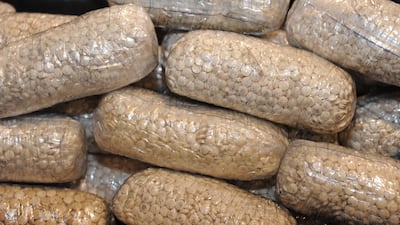
According to the United Nations Office on Drugs and Crime, trafficking in amphetamines has increased in the Middle East in recent years. Photo: Dubai Customs -
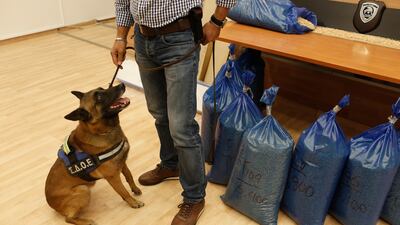
Specially trained K-9 units are often used by border forces to intercept shipments. EPA -
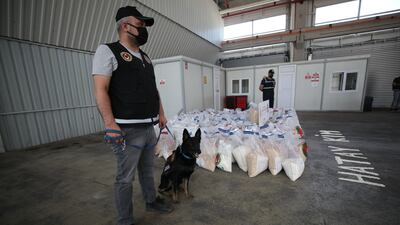
Experts believe the amount intercepted accounts for only around a tenth of the total quantity of pills being smuggled out of places like Syria and Jordan. EPA -
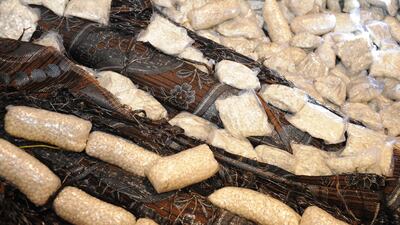
Dubai Customs thwarted 398 attempts to smuggle drugs into the city in the first three months of this year. Photo: Dubai Customs -
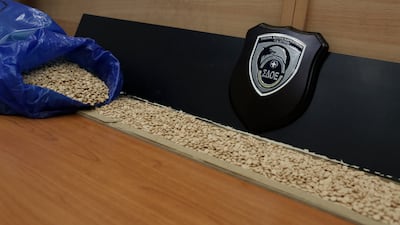
Captagon pills on display after being seized in Greece in 2019. EPA -
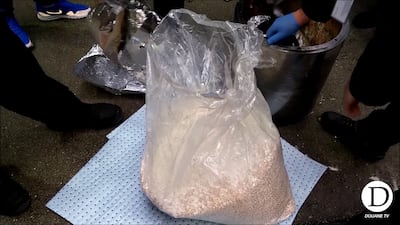
Captagon became synonymous with the Syrian Civil War. AFP -

The small, off-white pills have quickly become one of the most widely consumed drugs in the Middle East. EPA -

Millions of Captagon pills are seized around the world each year. EPA -
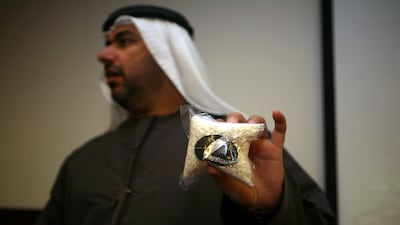
Captagon pills on display after a major interception of a shipment in 2009. Nicole Hill / The National -
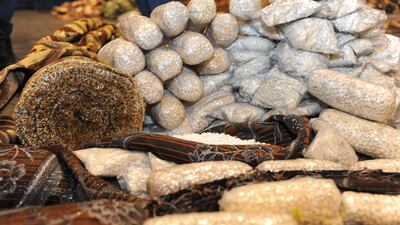
Customs officers say Captagon smugglers prefer to use sea ports rather than airports because of the size of shipping containers, enabling them to conceal larger quantities of drugs. Photo: Dubai Customs


A smugglers' paradise
The man in the farmhouse goes by the name of Abu Nowaris, and he has been in this game a long time. A decade of producing and running Captagon has made him wise of an industry that has made him more money than he could have possibly imagined. He says he’s currently on a production hiatus, but he’ll fire up the rudimentary catering equipment that has already baked him a fortune again very soon.
Perhaps one of the reasons for its incredible proliferation is that Captagon is cheap, fast, and almost unbelievably easy to produce. “Let’s say you ordered a million pills. I can produce these in no time,” he boasts.
“24-48 hours and they will be packed and ready. If you ordered one hundred million pills – in five days, they’ll be packed. It doesn’t take a lot of time,” he says.
The real challenge for producers like Abu Nowaris is getting the drugs out of the country.
The appetite for Captagon in Lebanon is limited, but if the pills can make it to the Gulf, high demand means there is a great deal of money to be made.
“Production is easy. The dangerous part is the smuggling and this is where the challenge is.”
The pre-war days when Abu Nowaris would pack his pills into thick plastic bags, feed them to sheep, and pay shepherds to walk his drugs through Syria and Jordan to the Saudi border are long over, he said.
Today, the audacious tricks used to get Captagon out of the country reveal an arms race between the smugglers and the customs agents working to catch them.
Sheltered from the pounding summer sun of the Bekaa, the aged-smuggler described how he once paid off a farmer and placed small plastic bags loaded with pills on top of the newly planted seeds of a cabbage crop.
It was painstaking work. Several weeks later he returned to see the cabbages had grown around the pills, hiding the Captagon within the vegetables – a near-perfect form of camouflage. All that was left was to do was ship his cabbages to a receiver in Saudi Arabia.
Recent interceptions have found millions of pills hidden in everything from diesel generators to sheets of metal and fruit and vegetable shipments.
A collapsing state
Under pressure from Saudi Arabia, Lebanese authorities claim to have launched a crackdown on the drug’s production and transport.
But despite limited victories, those on both sides of this war admit the state has barely been able to make a dent in the country’s production and smuggling networks.
“The government doesn’t have the power to control it all. Now they are trying to clean their image in the eyes of Saudi Arabia. They cannot destroy the whole industry. Out of every ten drug dealers, they’ll catch maybe three. Out of ten shipments, they might catch three,” said Abu Nowaris.
The sentiment that Lebanese officials are constantly playing catch up is echoed by regional and Lebanese officials. One GCC diplomat told The National: “We banned fruit and vegetables. We can’t ban everything, it’s not realistic”.
Meanwhile, Gen Shakour says the key to fighting the Captagon trade is raiding production facilities.
But undertaking raids “requires the state to exercise its authority over all its territory,” Mr Shakour said.
This is barely achievable for Lebanon’s security forces, which have not been spared from Lebanon’s economic crisis.
-
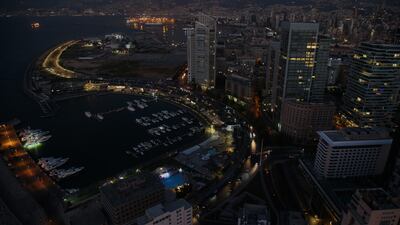
A view of Lebanon's capital, Beirut, with the lights on only in some buildings. Lebanese rely on highly polluting diesel generators run by private neighbourhood operators to make up for shortfalls in electricity supply from the state utility. EPA -
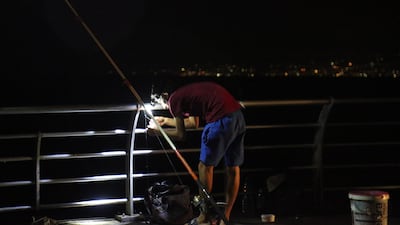
A fisherman uses a headlamp at the seaside corniche in Beirut, Lebanon. EPA -

A vendor sells LED balloons in full darkness at the corniche in Beirut. EPA -
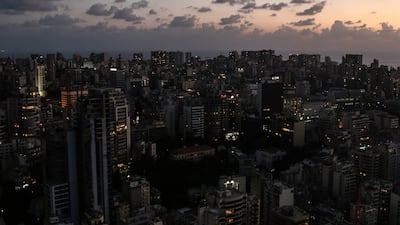
The near collapse of the national grid has increased the duration of power cuts across Lebanon. EPA -
Residents of Beirut are experiencing power cuts of up to 20 hours a day. EPA


Salaries in the army, police, and customs departments have shrunk by more than 90 per cent, leaving officials more vulnerable than ever to the lure of a bribe.
Compounding the problem, most areas of production and the vital nodes in the smuggling networks lie outside of the government’s de-facto jurisdiction.
“Collecting and analysing information is key to the success of security forces in cracking down on the drug trade,” said Gen Shakour.
“The fact that security forces are stretched too thin due to the crisis and security instability is also facilitating the trade,” he said.
Though they are on opposite sides of the war, both officials and smugglers appear to agree, the chances of Lebanon bringing its Captagon problem under control anytime soon is unlikely.
Lebanon is facing a financial crisis, it has an army unable to feed its soldiers and growing unrest to deal with in streets across the country.
Regardless of what the international community has to say, Beirut’s priorities lie elsewhere.
As the gruff Abu Nowaris says, “They will never completely stop it. They might catch me, but there will always be someone else. There’s too much money to be made.”

