Sir Magdi Habib Yacoub OM FRS. Egyptian retired professor of cardiothoracic surgery at Imperial College London, best known for his early work in repairing heart valves with surgeon Donald Ross. Photographed at Harefield Hospital London. Rob Greig for The National
Sir Magdi Habib Yacoub OM FRS. Egyptian retired professor of cardiothoracic surgery at Imperial College London, best known for his early work in repairing heart valves with surgeon Donald Ross. Photog

Egypt's Magdi Yacoub on life as the maverick surgeon who came in from the cold


  • English
  • Arabic

It is not often that Prof Sir Magdi Yacoub finds himself as the patient prone on an operating trolley looking up into the face of a surgeon instead of being on the other side of proceedings.

The scenario, though, played out recently when the pioneering cardiothoracic specialist went under the scalpel to have his left hip replaced after slipping while pushing a luggage cart through Rome’s Fiumicino airport.

Yet Yacoub, 87, who has arguably touched more hearts with his “magic hands’’ than anyone else in the world, was not the least bit perturbed by the reversal in positions of trust.

“It's a privilege, almost, to be at the receiving end,” he tells The National. “It is a massive responsibility, the patient-doctor relationship. I consider it sacred. It's very important for me to know how patients feel. Sometimes we take it for granted.”

The injury occurred when, delayed by a throng of admirers keen to take a selfie with the Egyptian-born heart surgeon known affectionately as “Prof’’, he was rushing to reach passport control.

“I always say that people think of surgeons as heroes. We're not at all. We are applying what is, in effect, a very noble profession, to the community,” he says. “And the community thinks that we're fantastic. We are just the vehicle.”

Diagnosis of the fracture that led to the surgery in London took two weeks, the most painful period in Yacoub’s long memory, leaving him so discombobulated by painkillers that “it made me wonder if I wanted to live any more”.

Fast forward seven weeks from the operation and he has just returned from Egypt after one of his regular trips to the heart centre he founded in Aswan, having been passed fit to travel thanks to a rigorous regime of physiotherapy.

When we met last month, he was walking with the aid of crutches into his office at Harefield, the former village hospital in Hillingdon that over decades he transformed into a transplant centre of international renown.

Asked about success, Yacoub modestly puts much of his own down to P, P and H. “Passion,” he says, by way of explanation. “You should really believe in what you’re doing.

A mural by artist Hany Gendy in the Nile delta province of Sharqia immortalises Egypt’s favourite sons, Magdi Yacoub and footballing great Mo Salah. Reuters

“Second P: Persistence. And, finally, H for humility, because humility is very important in being able to talk to the most desolate patient or individual on planet Earth, or to royalty or the most intelligent person. You have to be humble.”

Despite his best efforts to throw off the heroic mantle, he is nonetheless internationally revered; nowhere more so than in the land of his birth where a mural in the Nile delta province of Sharqia immortalises Egypt’s two favourite, albeit contrasting, sons, Yacoub and footballing great Mo Salah.

“I am uncomfortable with the attention,” he says. “I'm only doing my duty. I am a very ordinary man who loves his family, loves food, loves life, but equally takes his job very seriously.”

I feel more and more enthusiastic the more I learn

He continues to drive forward the search for novel treatments and techniques in the state-of-the-art on-site laboratories at The Magdi Yacoub Institute.

There, scientists are hard at work trying to grow living heart valves and organs from a scaffold of stem cells, and explore the potential for gene editing to combat cardiac failure.

“I feel more and more enthusiastic the more I learn,” he says. “I always look forward to the next day to find out what new things I can think about.”

As the conversation turns to the subject of A Surgeon and a Maverick, his authorised biography, a line of commendations, mementoes, photographs and statuettes on a windowsill stands testament to the distinguished life he has led.

One figurine is particularly conspicuous: a rendering of Imhotep, known as the first physician, a non-royal Egyptian belatedly deified for his skills as a healer centuries after he died circa 2611 BC.

Magdi Yacoub at Harefield Hospital, London, 1999. Photo: Harefield Hospital/Guy’s and St Thomas’ NHS Foundation Trust

That Yacoub considers him inspirational should come as no surprise to anyone familiar with the ups and downs of his own journey to eventually become recognised as a world-leading cardiothoracic surgeon and prolific transplanter of hearts.

When the title of the book was first posited, he admits to having had to look up the word maverick in the dictionary to fully appreciate what it meant. The definition of an unorthodox or independent-minded person “appealed to me”, he says with a smile that acknowledges he has always done things his own way.

To Yacoub, advances in medicine are possible only by taking risks, and for the most part he has been vindicated. He has been responsible for many firsts: one of the first switch operations to save babies born with their aortic and pulmonary arteries the wrong way round; Europe’s first heart-lung transplant in 1983; the world’s first “domino” heart transplant in 1987; the first living lobe transplant for a cystic fibrosis patient in the UK in 1995; and developing innovative operations for many complex congenital heart anomalies.

Ismail El-Hamamsy, a former PhD student of Yacoub’s and now director of aortic surgery at New York’s Mount Sinai Hospital, said: “He tends to go to places that others fear to tread.”

Patrizia Barbieri, whose heart Magdi Yacoub transplanted when she was 22 in 1984, and her husband, Vito, with their daughter, Eleonora, now a cardiologist after promising as a child 'to give back all of that magnificent love'. Photo: Eleonora Ruscio

There were those, such as Kenneth Clarke, who when Britain's secretary of health under prime minister Margaret Thatcher, branded him the “mad surgeon at Harefield”.

“They used to call me the controversial doctor who has no ethics, experimenting on patients and doing transplantation,” Yacoub recalls. “If you're crossing the boundary, you go out into an area which has not been charted before.”

Asked if the approach required bravery, he talks about a book on the subject written by Gordon Brown in which the chancellor of the exchequer defined courageous people as those who do the right thing against the odds when far less harmful alternatives are open to them.

Magdi Yacoub as a child in Egypt in 1941. Photo: Yacoub family archive

He was born in Belbeis, a remote village on the banks of the River Nile, to Coptic Christian parents Habib, a general surgeon, and Madeleine, a judge’s daughter whose accomplishments included playing piano and painting oils on canvas.

At the age of five, the young Magdi pledged himself to become a surgeon after the untimely death of his beloved aunt Eugenie, aged 22, from rheumatic heart disease. Yet when he was first at school he appeared to pay no attention and refused to participate.

The teachers for years thought he had significant learning difficulties because of his reticence. Asked once why he didn’t talk, he answered: “Because I’ve got nothing to say.”

An itinerant life following his father around the country taught him the need to be adaptable and that interactions with different people can bring great enjoyment. They were lessons that would stand him in good stead.

He was accepted into medical school in Cairo on scholarship at the age of 15, and another formative experience came when he fainted while observing a thyroid operation being performed by his surgeon uncle. “He started cutting the neck,” Yacoub says.

The Yacoub family, from left, mother Madeleine, Magdi, his siblings Mohga, Sami, Jimmy, and father Habib in 1954. Photo: Yacoub family archive

“There was bleeding everywhere. To me, it looked uncontrollable, and I suddenly just could not face it. I was going to the floor, and they all said: ‘Ha, ha, ha. You want to be a surgeon?’

"Later on, I discovered why. I have to feel I am in control. Then, I can stop anything. I can modify my techniques in any way.”

After a three-year residency in general surgery at Cairo University Hospital, Yacoub set sail from Alexandria for London in 1961, where he worked with Prof Sir Russell Brock, one of Britain’s leading heart surgeons, and Donald Ross, who carried out the first heart transplant in the UK seven years later.

But his progress was stymied by the unwritten rules of the British medical establishment, with its nuances of language and old boys’ network. Hard for him to fathom and, he felt, a waste of time away from his patients, they were to prove costly, too.

Either because Yacoub could not or would not play the game, he missed out on a senior role at North Staffordshire Royal Infirmary and then, more devastatingly, the post of consultant cardiothoracic surgeon at the Royal Brompton to replace Lord Brock.

Magdi Yacoub with Marianne Boegel on their wedding day in Chicago in 1968. Photo: Yacoub family archive

Yacoub opted to spend a year at the University of Chicago as an assistant professor.

During this time, he married Marianne Boegel, known to him as Anne, a German nurse with a penchant for flared trousers who he met at the Brompton. The couple went on to have three children – Andrew, now an estate agent; Lisa, who works for Chain of Hope, the charity her father founded, and co-ordinates the evolution of the Rwanda Heart Centre in Kigali; and Sophie, a physician in infectious diseases and tropical medicine.

His experiences in the United States were to inform the way he later developed the cardiac unit when he returned to the UK at Harefield.

But America’s loss was to be the UK’s gain when the disillusionment that Yacoub felt about the health system there confirmed him as a champion of the NHS. Despite inherent problems in the country’s biggest state employer, he still holds up the National Health Service as a beacon for the world, and strongly disagrees with ongoing strike action by consultants, junior doctors, nurses and ambulance workers as almost a betrayal of the Hippocratic oath.

During an audience at Buckingham Palace, Magdi Yacoub is presented with the Insignia of a member of the Order of Merit in 2014, the highest honour in the gift of Queen Elizabeth II. Getty Images

“I'm totally dedicated to it,” he says. “I adore it. It feels a good thing for my patients to know that I will never, never go on strike for whatever reason because the NHS is by far the best system both in the developed but obviously in the developing world."

At the peak of his powers, Yacoub’s work rate was prodigious, leaving the rest of the team at Harefield trailing exhausted in his wake. It was not unusual for him to undertake 16 operations a week late into, and sometimes through, the night, with the reward at the conclusion a takeaway tandoori chicken curry and a few hours’ snatched sleep before returning to his desk to throw himself into more research.

He has rubbed shoulders with the rich and the famous, and on occasion even saved their lives, among them Eric Morecambe (heart bypass), one of Britain’s greatest comedians, the Egyptian actor Omar Sharif (triple heart bypass), and the Greek Prime Minister, Andreas Papandreou (aortic valve surgery).

His relationship with the British royal family runs deep. Opposite the window in his office are the chairs where Diana, Princess of Wales, a great supporter and ardent friend of Yacoub’s, used to sit to give comfort and inspiration to some of the youngest and most ill patients.

The Egyptian actor Omar Sharif, left, with Magdi Yacoub during a Chain of Hope event in London. Photo: WireImage

“I would go on my midnight rounds and hear giggles, and I knew exactly what that meant,” Yacoub says, trying and failing to feign disapproval. “She’d be in the ward talking to the children!

“I would say to her, ‘What are you doing? It’s midnight. Do you have security?’

“‘No, I drove myself.’

“‘Oh, my goodness,’ I’d say. ‘Will you be safe?’

‘She said: ‘It’s OK – I'll ring you when I get home!’”

Diana had, he says, a passion for helping others, “and people realised that. They are not stupid. They felt that this princess, this People's Princess, actually did love them”.

Diana, Princess of Wales, an ardent friend and supporter, used to sneak into Harefield Hospital without her security team to comfort the youngest and most ill patients. Photo: Hans Murmann

Yacoub would like to think that her eldest son might one day consider carrying on her involvement in some kind of capacity with his continuing work and charities. “Of course I’d like that,” he says, “because William is like his mother.”

The reason that he has finally consented to an authorised biography now after all these years is not, he stresses, out of self-aggrandisement, but in the hope that it will inspire others to follow in his footsteps.

Long troubled by inequities in healthcare delivery around the world and the lack of availability for many people who probably need it most, he decided to take matters into his own hands after being forced into retirement by the NHS at the age of 65 in 2001.

“I wanted to continue. I sympathise with the idea that young people should be given a chance to lead, but that doesn't mean that experience of 40 or 50 years should be thrown to the ground.

“Out of a bad place, something very positive has come.

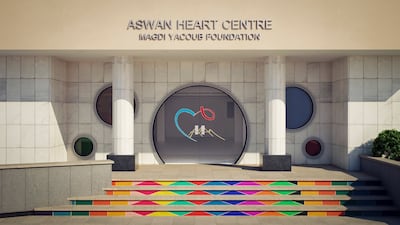
  • The Magdi Yacoub Heart Foundation’s Aswan Heart Centre in Cairo. Photo: Facebook
    The Magdi Yacoub Heart Foundation’s Aswan Heart Centre in Cairo. Photo: Facebook
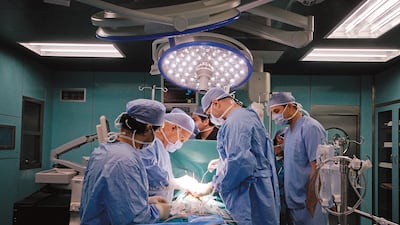
  • The operating theatre. Photo: Magdi Yacoub Heart Foundation
    The operating theatre. Photo: Magdi Yacoub Heart Foundation
  • The centre is scheduled to open next year. Photo: Magdi Yacoub Foundation
    The centre is scheduled to open next year. Photo: Magdi Yacoub Foundation
  • The 300-bed centre was funded by the Mohammed bin Rashid Global Initiatives charity. Photo: Dubai Media Office
    The 300-bed centre was funded by the Mohammed bin Rashid Global Initiatives charity. Photo: Dubai Media Office
  • Funding for the paediatric intensive care unit was donated in memory of Sheikh Khalid bin Sultan Al Qasimi, who died in London last year. Wam
    Funding for the paediatric intensive care unit was donated in memory of Sheikh Khalid bin Sultan Al Qasimi, who died in London last year. Wam

“I asked myself this simple question: ‘Why are we working day and night to find new things and new discoveries?’ And it dawned on me – it's less than 10 per cent of the population of the world who will benefit. That was totally unacceptable.

“It’s no good building something beautiful if you can't sustain it, and sustainability is knowing how to make it available to the poor and the desolate.”

Through The Magdi Yacoub Foundation, he set up a heart centre in Aswan in 2009 through which Chain of Hope is training doctors from across Africa; he helped to open the first cardiac centre in Ethiopia and another, with a research unit, in Mozambique; and is leading the development of the new heart centre in Kigali.

Next year, the Magdi Yacoub Global Heart Centre designed by Norman Foster will open in Cairo after Mohammed bin Rashid Global Initiatives, a charity foundation in Dubai, raised $24 million to support its construction for the provision of free care to patients across the Arab region.

“I have a strong belief that we are all the same,” Yacoub says. We should not have privileged people because of money, religion, power or whatever.“

Along the way, Yacoub has overcome much scepticism – not least that of his own father, who thought his son was too disorganised and had the wrong temperament to make a success of himself as a heart surgeon.

What is perhaps most striking about him are his hands, out of all proportion to the rest of him as he forms a pyramid with his fingertips in front of his weathered face.

“My hands are slightly bigger than usual,” he concedes. “But the co-ordination of the hands is very important. I have, from a very young age, tried to link my brain to my hands.”

In theatre, his surgical performance has been likened to that of a virtuoso conductor, with the methodical and calming strains of JS Bach invariably playing in the background. “I am the leader of the group,” he says, “and I have learnt from previous experience, where some of my chiefs used to start by saying, ‘This is a very difficult and dangerous operation.’ And guess what? It puts everybody on edge, and we ended up with a dead patient almost every time.

Magdi Yacoub with, from left, his son Andrew, daughters Lisa and Sophie, wife Marianne, and brother Jimmy at a restaurant in 1987. Photo: Yacoub family archive

“Now, I start operations by saying: 'This will be an easy and safe operation. Everybody relax. Guys, let us play Bach. No small talk, though.'”

Yacoub shared his passion for classical music as well as gardening with his beloved Anne, who he lost to ovarian cancer in 2011, and still finds immersion in nature relaxing as he tends rare orchids and epiphytes – plants that grow harmoniously and harmlessly on other plants.

The allotment at his home near Harefield also contains apples, beans, raspberries and herbs, and help these days is provided by Haile, 21, an orphan from a remote Ethiopian village who owes his life to Yacoub.

Haile was operated on and treated for advanced rheumatic heart disease by the man he calls “Dad-Dad”. He was fostered by Yacoub’s daughter, Lisa, nine years ago and is studying to be a doctor so he can return to Sidamo, where there is no medical support.

If Yacoub has one great indulgence, it is fast cars. He started the love affair with a Lotus Elan Plus 2, enamoured of its torque, handling and elegance. Next was a Lamborghini Urraco Aramco, the windscreen of which he went through in an accident, nearly losing his life. Then there was a Maserati and, finally, a Ferrari Testarossa.

Haile, an orphan from an Ethiopian village who Magdi Yacoub regards as his adopted grandson, after the surgeon received an honorary degree at the University of Oxford in 2015. Photo: Yacoub family archive

In 2011, Egypt awarded Yacoub the Order of the Nile. He was knighted by Queen Elizabeth in the New Year’s Honours of 1992, was awarded Fellowship of the Academy of Medical Sciences in 1998, made a Fellow of the Royal Society in 1999, received a lifetime outstanding achievement award by the Secretary of State for Health in the same year, and, in 2014, was appointed to the prestigious Order of Merit, which has only 24 members worldwide.

“I was an outsider and now outsider no more,” Yacoub says.

Being finally accepted into the fold has brought satisfaction, he says: “Having dinner with the queen and then the new king. I am moved to see how he is adopting exactly the same spirit as his mother. That of ‘service'.’’

I have destroyed my back. I have shrunk due to the years of operating

Of his own continuing service, Yacoub feels an urgent need to impart everything he has learnt to the younger generation. There is, he says, an epidemic of heart failure affecting all ages and nationalities, the basic mechanisms of which are still unknown.

He feels as though the problem is only being treated on the surface but has faith that there are tools coming that will be effective in the future.

If that is the case, would he like to live for ever?

“It is a wish,” Yacoub says, playfully, “but it is against nature!”

Whenever he stands, the toll that dedication to his patients has taken becomes apparent. Countless hour after painstaking hour of stooping during surgery has diminished Yacoub’s height from just over 6ft at his tallest to barely 5ft 10in now.

“I have destroyed my back,’’ he says. "I have shrunk due to the years of operating.’’

That may well be so but in the eyes of the world Prof Sir Magdi Yacoub will always be a giant.

‘A Surgeon and a Maverick: The Life and Pioneering Work of Magdi Yacoub’, by Simon Pearson and Fiona Gorman (The American University in Cairo Press, £24.95), is available now. A percentage of royalties will go to the Magdi Yacoub Heart Foundation myf-egypt.org


A Surgeon And A Maverick. The Life and Pioneering Work of Magdi Yacoub. Photo: Midas
RESULTS

Bantamweight:
Zia Mashwani (PAK) bt Chris Corton (PHI)

Super lightweight:
Flavio Serafin (BRA) bt Mohammad Al Khatib (JOR)

Super lightweight:
Dwight Brooks (USA) bt Alex Nacfur (BRA)

Bantamweight:
Tariq Ismail (CAN) bt Jalal Al Daaja (JOR)

Featherweight:
Abdullatip Magomedov (RUS) bt Sulaiman Al Modhyan (KUW)

Middleweight:
Mohammad Fakhreddine (LEB) bt Christofer Silva (BRA)

Middleweight:
Rustam Chsiev (RUS) bt Tarek Suleiman (SYR)

Welterweight:
Khamzat Chimaev (SWE) bt Mzwandile Hlongwa (RSA)

Lightweight:
Alex Martinez (CAN) bt Anas Siraj Mounir (MAR)

Welterweight:
Jarrah Al Selawi (JOR) bt Abdoul Abdouraguimov (FRA)

In 2018, the ICRC received 27,756 trace requests in the Middle East alone. The global total was 45,507.


There are 139,018 global trace requests that have not been resolved yet, 55,672 of these are in the Middle East region.


More than 540,000 individuals approached the ICRC in the Middle East asking to be reunited with missing loved ones in 2018.


The total figure for the entire world was 654,000 in 2018.

Company%20profile
%3Cp%3E%3Cstrong%3EName%3A%3C%2Fstrong%3E%20WallyGPT%3Cbr%3E%3Cstrong%3EStarted%3A%20%3C%2Fstrong%3E2014%3Cbr%3E%3Cstrong%3EFounders%3A%20%3C%2Fstrong%3ESaeid%20and%20Sami%20Hejazi%3Cbr%3E%3Cstrong%3EBased%3A%3C%2Fstrong%3E%20Dubai%3Cbr%3E%3Cstrong%3ESector%3A%20%3C%2Fstrong%3EFinTech%3Cbr%3E%3Cstrong%3EInvestment%20raised%3A%20%3C%2Fstrong%3E%247.1%20million%3Cbr%3E%3Cstrong%3ENumber%20of%20staff%3A%3C%2Fstrong%3E%2020%3Cbr%3E%3Cstrong%3EInvestment%20stage%3A%20%3C%2Fstrong%3EPre-seed%20round%3C%2Fp%3E%0A
Infiniti QX80 specs

Engine: twin-turbocharged 3.5-liter V6

Power: 450hp

Torque: 700Nm

Price: From Dh450,000, Autograph model from Dh510,000

Available: Now

Kill%20
%3Cp%3E%3Cstrong%3EDirector%3A%3C%2Fstrong%3E%20Nikhil%20Nagesh%20Bhat%3C%2Fp%3E%0A%3Cp%3E%3Cstrong%3EStarring%3C%2Fstrong%3E%3A%20Lakshya%2C%20Tanya%20Maniktala%2C%20Ashish%20Vidyarthi%2C%20Harsh%20Chhaya%2C%20Raghav%20Juyal%3C%2Fp%3E%0A%3Cp%3E%3Cstrong%3ERating%3A%3C%2Fstrong%3E%204.5%2F5%3Cbr%3E%3C%2Fp%3E%0A

Bournemouth 0

Manchester United 2
Smalling (28'), Lukaku (70')

Most F1 world titles

7 — Michael Schumacher (1994, ’95, 2000, ’01 ’02, ’03, ’04)

7 — Lewis Hamilton (2008, ’14,’15, ’17, ’18, ’19, ’20)

5 — Juan Manuel Fangio (1951, ’54, ’55, ’56, ’57)

4 — Alain Prost (1985, ’86, ’89, ’93)

4 — Sebastian Vettel (2010, ’11, ’12, ’13)

John%20Wick%3A%20Chapter%204
%3Cp%3E%3Cstrong%3EDirector%3A%3C%2Fstrong%3E%20Chad%20Stahelski%3C%2Fp%3E%0A%3Cp%3E%3Cstrong%3EStars%3A%3C%2Fstrong%3E%20Keanu%20Reeves%2C%20Laurence%20Fishburne%2C%20George%20Georgiou%3C%2Fp%3E%0A%3Cp%3E%3Cstrong%3ERating%3A%20%3C%2Fstrong%3E4%2F5%3C%2Fp%3E%0A
THE BIO:

Sabri Razouk, 74

Athlete and fitness trainer 

Married, father of six

Favourite exercise: Bench press

Must-eat weekly meal: Steak with beans, carrots, broccoli, crust and corn

Power drink: A glass of yoghurt

Role model: Any good man

The five pillars of Islam
Third Test

Result: India won by 203 runs

Series: England lead five-match series 2-1

SPECS
%3Cp%3E%3Cstrong%3EEngine%3A%3C%2Fstrong%3E%201.5-litre%204-cylinder%3Cbr%3E%3Cstrong%3EPower%3A%3C%2Fstrong%3E%20101hp%3Cbr%3E%3Cstrong%3ETorque%3A%3C%2Fstrong%3E%20135Nm%3Cbr%3E%3Cstrong%3ETransmission%3C%2Fstrong%3E%3A%20Six-speed%20auto%3Cbr%3E%3Cstrong%3EPrice%3A%3C%2Fstrong%3E%20From%20Dh79%2C900%3Cbr%3E%3Cstrong%3EOn%20sale%3A%3C%2Fstrong%3E%20Now%3C%2Fp%3E%0A
Our legal columnist

Name: Yousef Al Bahar

Advocate at Al Bahar & Associate Advocates and Legal Consultants, established in 1994

Education: Mr Al Bahar was born in 1979 and graduated in 2008 from the Judicial Institute. He took after his father, who was one of the first Emirati lawyers

West Asia Premiership

Dubai Hurricanes 58-10 Dubai Knights Eagles

Dubai Tigers 5-39 Bahrain

Jebel Ali Dragons 16-56 Abu Dhabi Harlequins

hall of shame

SUNDERLAND 2002-03

No one has ended a Premier League season quite like Sunderland. They lost each of their final 15 games, taking no points after January. They ended up with 19 in total, sacking managers Peter Reid and Howard Wilkinson and losing 3-1 to Charlton when they scored three own goals in eight minutes.

SUNDERLAND 2005-06

Until Derby came along, Sunderland’s total of 15 points was the Premier League’s record low. They made it until May and their final home game before winning at the Stadium of Light while they lost a joint record 29 of their 38 league games.

HUDDERSFIELD 2018-19

Joined Derby as the only team to be relegated in March. No striker scored until January, while only two players got more assists than goalkeeper Jonas Lossl. The mid-season appointment Jan Siewert was to end his time as Huddersfield manager with a 5.3 per cent win rate.

ASTON VILLA 2015-16

Perhaps the most inexplicably bad season, considering they signed Idrissa Gueye and Adama Traore and still only got 17 points. Villa won their first league game, but none of the next 19. They ended an abominable campaign by taking one point from the last 39 available.

FULHAM 2018-19

Terrible in different ways. Fulham’s total of 26 points is not among the lowest ever but they contrived to get relegated after spending over £100 million (Dh457m) in the transfer market. Much of it went on defenders but they only kept two clean sheets in their first 33 games.

LA LIGA: Sporting Gijon, 13 points in 1997-98.

BUNDESLIGA: Tasmania Berlin, 10 points in 1965-66

Ten tax points to be aware of in 2026

1. Domestic VAT refund amendments: request your refund within five years

If a business does not apply for the refund on time, they lose their credit.

2. E-invoicing in the UAE

Businesses should continue preparing for the implementation of e-invoicing in the UAE, with 2026 a preparation and transition period ahead of phased mandatory adoption. 

3. More tax audits

Tax authorities are increasingly using data already available across multiple filings to identify audit risks. 

4. More beneficial VAT and excise tax penalty regime

Tax disputes are expected to become more frequent and more structured, with clearer administrative objection and appeal processes. The UAE has adopted a new penalty regime for VAT and excise disputes, which now mirrors the penalty regime for corporate tax.

5. Greater emphasis on statutory audit

There is a greater need for the accuracy of financial statements. The International Financial Reporting Standards standards need to be strictly adhered to and, as a result, the quality of the audits will need to increase.

6. Further transfer pricing enforcement

Transfer pricing enforcement, which refers to the practice of establishing prices for internal transactions between related entities, is expected to broaden in scope. The UAE will shortly open the possibility to negotiate advance pricing agreements, or essentially rulings for transfer pricing purposes. 

7. Limited time periods for audits

Recent amendments also introduce a default five-year limitation period for tax audits and assessments, subject to specific statutory exceptions. While the standard audit and assessment period is five years, this may be extended to up to 15 years in cases involving fraud or tax evasion. 

8. Pillar 2 implementation 

Many multinational groups will begin to feel the practical effect of the Domestic Minimum Top-Up Tax (DMTT), the UAE's implementation of the OECD’s global minimum tax under Pillar 2. While the rules apply for financial years starting on or after January 1, 2025, it is 2026 that marks the transition to an operational phase.

9. Reduced compliance obligations for imported goods and services

Businesses that apply the reverse-charge mechanism for VAT purposes in the UAE may benefit from reduced compliance obligations. 

10. Substance and CbC reporting focus

Tax authorities are expected to continue strengthening the enforcement of economic substance and Country-by-Country (CbC) reporting frameworks. In the UAE, these regimes are increasingly being used as risk-assessment tools, providing tax authorities with a comprehensive view of multinational groups’ global footprints and enabling them to assess whether profits are aligned with real economic activity. 

Contributed by Thomas Vanhee and Hend Rashwan, Aurifer

Superliminal%20
%3Cp%3EDeveloper%3A%20Pillow%20Castle%20Games%0D%3Cbr%3EPublisher%3A%20Pillow%20Castle%20Games%0D%3Cbr%3EConsole%3A%20PlayStation%204%26amp%3B5%2C%20Xbox%20Series%20One%20%26amp%3B%20X%2FS%2C%20Nintendo%20Switch%2C%20PC%20and%20Mac%0D%3Cbr%3ERating%3A%204%2F5%3C%2Fp%3E%0A

Frankenstein in Baghdad
Ahmed Saadawi
​​​​​​​Penguin Press

Tips for newlyweds to better manage finances

All couples are unique and have to create a financial blueprint that is most suitable for their relationship, says Vijay Valecha, chief investment officer at Century Financial. He offers his top five tips for couples to better manage their finances.

Discuss your assets and debts: When married, it’s important to understand each other’s personal financial situation. It’s necessary to know upfront what each party brings to the table, as debts and assets affect spending habits and joint loan qualifications. Discussing all aspects of their finances as a couple prevents anyone from being blindsided later.

Decide on the financial/saving goals: Spouses should independently list their top goals and share their lists with one another to shape a joint plan. Writing down clear goals will help them determine how much to save each month, how much to put aside for short-term goals, and how they will reach their long-term financial goals.

Set a budget: A budget can keep the couple be mindful of their income and expenses. With a monthly budget, couples will know exactly how much they can spend in a category each month, how much they have to work with and what spending areas need to be evaluated.

Decide who manages what: When it comes to handling finances, it’s a good idea to decide who manages what. For example, one person might take on the day-to-day bills, while the other tackles long-term investments and retirement plans.

Money date nights: Talking about money should be a healthy, ongoing conversation and couples should not wait for something to go wrong. They should set time aside every month to talk about future financial decisions and see the progress they’ve made together towards accomplishing their goals.

Day 1 results:

Open Men (bonus points in brackets)
New Zealand 125 (1) beat UAE 111 (3)
India 111 (4) beat Singapore 75 (0)
South Africa 66 (2) beat Sri Lanka 57 (2)
Australia 126 (4) beat Malaysia -16 (0)

Open Women
New Zealand 64 (2) beat South Africa 57 (2)
England 69 (3) beat UAE 63 (1)
Australia 124 (4) beat UAE 23 (0)
New Zealand 74 (2) beat England 55 (2)

MOTHER%20OF%20STRANGERS
%3Cp%3EAuthor%3A%20Suad%20Amiry%3Cbr%3EPublisher%3A%20Pantheon%3C%2Fp%3E%0A%3Cp%3EPages%3A%20304%3Cbr%3EAvailable%3A%20Now%3C%2Fp%3E%0A
How to donate

Send “thenational” to the following numbers or call the hotline on: 0502955999
2289 – Dh10
2252 – Dh 50
6025 – Dh20
6027 – Dh 100
6026 – Dh 200

THE%20SWIMMERS
%3Cp%3E%3Cstrong%3EDirector%3A%20%3C%2Fstrong%3ESally%20El-Hosaini%3C%2Fp%3E%0A%3Cp%3E%3Cstrong%3EStars%3A%20%3C%2Fstrong%3ENathalie%20Issa%2C%20Manal%20Issa%2C%20Ahmed%20Malek%20and%20Ali%20Suliman%C2%A0%3C%2Fp%3E%0A%3Cp%3E%3Cstrong%3ERating%3A%20%3C%2Fstrong%3E4%2F5%3C%2Fp%3E%0A
About RuPay

A homegrown card payment scheme launched by the National Payments Corporation of India and backed by the Reserve Bank of India, the country’s central bank

RuPay process payments between banks and merchants for purchases made with credit or debit cards

It has grown rapidly in India and competes with global payment network firms like MasterCard and Visa.

In India, it can be used at ATMs, for online payments and variations of the card can be used to pay for bus, metro charges, road toll payments

The name blends two words rupee and payment

Some advantages of the network include lower processing fees and transaction costs

Specs
Engine: Electric motor generating 54.2kWh (Cooper SE and Aceman SE), 64.6kW (Countryman All4 SE)
Power: 218hp (Cooper and Aceman), 313hp (Countryman)
Torque: 330Nm (Cooper and Aceman), 494Nm (Countryman)
On sale: Now
Price: From Dh158,000 (Cooper), Dh168,000 (Aceman), Dh190,000 (Countryman)
Ain Dubai in numbers

126: The length in metres of the legs supporting the structure

1 football pitch: The length of each permanent spoke is longer than a professional soccer pitch

16 A380 Airbuses: The equivalent weight of the wheel rim.

9,000 tonnes: The amount of steel used to construct the project.

5 tonnes: The weight of each permanent spoke that is holding the wheel rim in place

192: The amount of cable wires used to create the wheel. They measure a distance of 2,4000km in total, the equivalent of the distance between Dubai and Cairo.

'Lost in Space'

Creators: Matt Sazama, Burk Sharpless, Irwin Allen

Stars: Molly Parker, Toby Stephens, Maxwell Jenkins

Rating: 4/5

McLaren GT specs

Engine: 4-litre twin-turbo V8

Transmission: seven-speed

Power: 620bhp

Torque: 630Nm

Price: Dh875,000

On sale: now

MATCH INFO

Manchester City 1 (Gundogan 56')

Shakhtar Donetsk 1 (Solomon 69')

BEACH SOCCER WORLD CUP

Group A

Paraguay
Japan
Switzerland
USA

Group B

Uruguay
Mexico
Italy
Tahiti

Group C

Belarus
UAE
Senegal
Russia

Group D

Brazil
Oman
Portugal
Nigeria

FINAL LEADERBOARD

1. Jordan Spieth (USA) 65 69 65 69 - 12-under-par
2. Matt Kuchar (USA) 65 71 66 69 - 9-under
3. Li Haotong (CHN) 69 73 69 63 - 6-under
T4. Rory McIlroy (NIR) 71 68 69 67 - 5-under
T4. Rafael Cabrera-Bello (ESP) 67 73 67 68 - 5-under
T6. Marc Leishman (AUS) 69 76 66 65 - 4-under
T6. Matthew Southgate (ENG) 72 72 67 65 - 4-under
T6. Brooks Koepka (USA) 65 72 68 71 - 4-under
T6. Branden Grace (RSA) 70 74 62 70 - 4-under
T6. Alexander Noren (SWE)  68 72 69 67 - 4-under

Abu Dhabi race card

5pm Abu Dhabi Fillies Classic Prestige Dh110,000 1,400m

5.30pm Abu Dhabi Colts Classic Prestige Dh110,000 1,400m

6pm Abu Dhabi Championship Listed Dh180,000 1,600m

6.30pm Maiden Dh80,000 1,600m

7pm Wathba Stallions Cup Handicap Dh80,000 1,400m

7.30pm Handicap (TB) |Dh100,000 2,400m

Updated: February 02, 2024, 3:25 PM