Grain goes into a grinder to make flour for bread in Gaza city, as beleaguered Palestinians become increasingly desperate for food. AFP

Desperate Gazans grind animal feed to make bread as threat of famine looms


  • English
  • Arabic

Live updates: Follow the latest news on Israel-Gaza

A looming famine is forcing Gazans in the northern part of the besieged enclave to resort to grinding animal feed to make bread for desperate families.

Sari Abu Khater, an internally displaced Palestinian in Jabalia camp in northern Gaza, is one of hundreds who have replaced scarce wheat with barley and corn – typically used to feed animals – to bake bread for his 18 family members.

“For two months we have been deprived of white flour and the world is witnessing our struggle as we face literal starvation,” Mr Abu Khater told The National.

“We cannot find anything to feed our children.”

However, the cost of grinding the grain is steep, which means families can make only a small amount of bread each day. Mr Abu Khater gives one piece of bread to each family member in the morning and another in the evening.

“We eat it with thyme, lentils, or something similar because there are no other options in the north [of Gaza],” he said.

About a month ago, he found some animal-feed grains. Determined to provide food for his desperate family, he began the process of grinding corn and barley to bake bread.

A video circulating on social media shows people at a mill in northern Gaza grinding animal feed to make flour.

“We used to wait at the mill for three days until our turn finally arrived,” Mr Abu Khater said of queuing to get some corn or barley.

After last week's decision by some western countries to pause funding for the UN agency for Palestinian refugees (UNRWA), Michael Fakhri, UN special rapporteur on the right to food, said “famine was inevitable” for the 2.3 million people in the Gaza Strip, which remains under intense Israeli attacks.

“This collectively punishes over 2.2 million Palestinians,” he said of the sustained bombardment and lack of aid entering the enclave.

Before the war started almost four months ago, an average of 500 aid lorries entered the Gaza Strip each day, according to the UN, which even then was hardly enough to properly feed Palestinians.

“The average number of trucks entering daily for about a week is estimated at around five to seven, loaded with food supplies,” UNRWA spokesman Adnan Abu Hasna told The National.

But this level of relief does not “meet any of the needs of the residents of Gaza and the northern provinces”, Mr Abu Hasna added. “Tens of thousands of them are starving,” he said.

UNRWA has said its aid buses have been hit by Israeli gunfire, compounding the crisis.

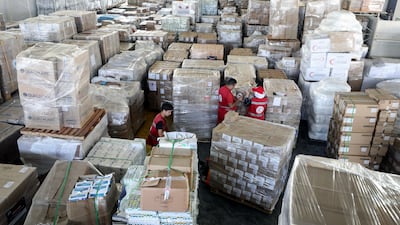
  • Egyptian Red Crescent workers and volunteers organise humanitarian aid bound for the Gaza Strip, at a warehouse in Arish, Egypt. EPA
    Egyptian Red Crescent workers and volunteers organise humanitarian aid bound for the Gaza Strip, at a warehouse in Arish, Egypt. EPA
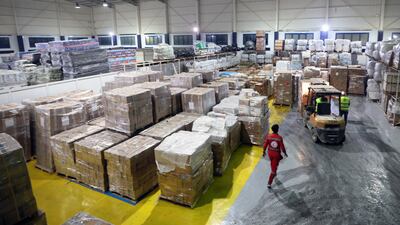
  • Aid is being stored at locations across Arish after filling storage facilities at the airport. EPA
    Aid is being stored at locations across Arish after filling storage facilities at the airport. EPA
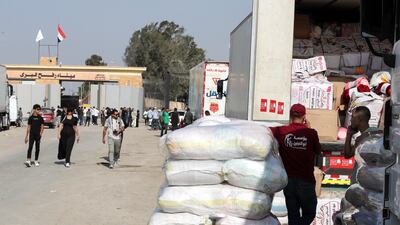
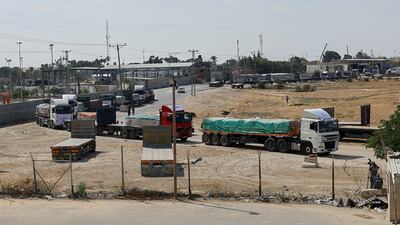
  • Lines of lorries carrying humanitarian aid wait to pass through the Rafah border crossing into Gaza. EPA
    Lines of lorries carrying humanitarian aid wait to pass through the Rafah border crossing into Gaza. EPA
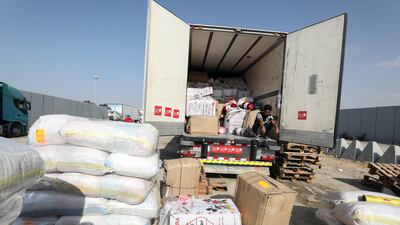
  • Egyptian volunteers with cargoes of aid bound for Palestinians in the Gaza Strip, at the Rafah border crossing. EPA
    Egyptian volunteers with cargoes of aid bound for Palestinians in the Gaza Strip, at the Rafah border crossing. EPA
  • Egyptian volunteers handle humanitarian aid bound for Palestinians in the Gaza Strip, at the Rafah border crossing. EPA
    Egyptian volunteers handle humanitarian aid bound for Palestinians in the Gaza Strip, at the Rafah border crossing. EPA
  • Volunteers handle humanitarian aid bound for Gaza, at the Rafah border crossing in Egypt. EPA
    Volunteers handle humanitarian aid bound for Gaza, at the Rafah border crossing in Egypt. EPA
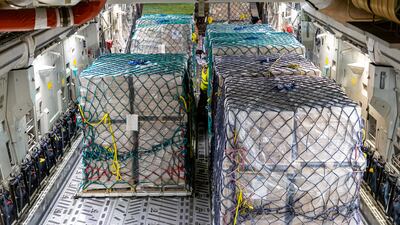
  • An RAF C-17 aircraft carrying 21 tonnes of UK humanitarian supplies for Gaza has landed in Egypt. EPA
    An RAF C-17 aircraft carrying 21 tonnes of UK humanitarian supplies for Gaza has landed in Egypt. EPA
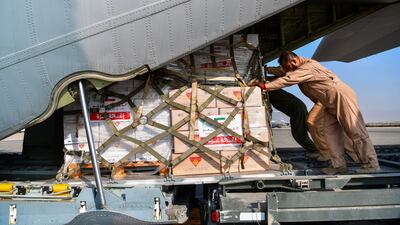
  • Humanitarian aid bound for Gaza via Egypt being loaded into a military aircraft at Kuwait International Airport. AFP
    Humanitarian aid bound for Gaza via Egypt being loaded into a military aircraft at Kuwait International Airport. AFP
  • Lorries carrying aid wait to exit on the Gaza side of the Rafah border crossing with Egypt. Reuters
    Lorries carrying aid wait to exit on the Gaza side of the Rafah border crossing with Egypt. Reuters

Palestinians are also facing soaring market prices due to border closures and the shortage of goods.

“Everything is expensive,” seller Hashem Barghout told The National. “I'm attempting to negotiate with the trader I purchase from but they insist there are no goods available.”

Mr Barghout, who fled Gaza city to seek refuge in Deir Al Balah in central Gaza, now tries to sell food at a market.

“People cannot afford the prices and I strive to keep them reasonable,” he said. “However, it's challenging because I acquire the goods from the trader at high prices.”

Mr Barghout said costs have tripled and numerous items, including sugar and salt, have vanished from the market.

“We urgently need the Ministry of Economy to regulate market prices so we can assist the people,” he added.

Murad Al Ghandor, an internally displaced Palestinian now living in Jabalia camp, has been trying to buy wheat for six weeks. But with one bag costing about $200 he is no longer able to afford it.

“What fate will we face?” he said. “Will we die of hunger, or will God relieve us and end this war?”


How to help

Send “thenational” to the following numbers or call the hotline on: 0502955999
2289 – Dh10
2252 – Dh 50
6025 – Dh20
6027 – Dh 100
6026 – Dh 200

German intelligence warnings
  • 2002: "Hezbollah supporters feared becoming a target of security services because of the effects of [9/11] ... discussions on Hezbollah policy moved from mosques into smaller circles in private homes." Supporters in Germany: 800
  • 2013: "Financial and logistical support from Germany for Hezbollah in Lebanon supports the armed struggle against Israel ... Hezbollah supporters in Germany hold back from actions that would gain publicity." Supporters in Germany: 950
  • 2023: "It must be reckoned with that Hezbollah will continue to plan terrorist actions outside the Middle East against Israel or Israeli interests." Supporters in Germany: 1,250 

Source: Federal Office for the Protection of the Constitution

Global state-owned investor ranking by size

1.

United States

2.

China

3.

UAE

4.

Japan

5

Norway

6.

Canada

7.

Singapore

8.

Australia

9.

Saudi Arabia

10.

South Korea

Desert Warrior

Starring: Anthony Mackie, Aiysha Hart, Ben Kingsley

Director: Rupert Wyatt

Rating: 3/5

Most%20polluted%20cities%20in%20the%20Middle%20East
%3Cp%3E1.%20Baghdad%2C%20Iraq%3Cbr%3E2.%20Manama%2C%20Bahrain%3Cbr%3E3.%20Dhahran%2C%20Saudi%20Arabia%3Cbr%3E4.%20Kuwait%20City%2C%20Kuwait%3Cbr%3E5.%20Ras%20Al%20Khaimah%2C%20UAE%3Cbr%3E6.%20Ash%20Shihaniyah%2C%20Qatar%3Cbr%3E7.%20Abu%20Dhabi%2C%20UAE%3Cbr%3E8.%20Cairo%2C%20Egypt%3Cbr%3E9.%20Riyadh%2C%20Saudi%20Arabia%3Cbr%3E10.%20Dubai%2C%20UAE%3C%2Fp%3E%0A%3Cp%3E%3Cem%3ESource%3A%202022%20World%20Air%20Quality%20Report%3C%2Fem%3E%3C%2Fp%3E%0A
MOST%20POLLUTED%20COUNTRIES%20IN%20THE%20WORLD
%3Cp%3E1.%20Chad%3Cbr%3E2.%20Iraq%3Cbr%3E3.%20Pakistan%3Cbr%3E4.%20Bahrain%3Cbr%3E5.%20Bangladesh%3Cbr%3E6.%20Burkina%20Faso%3Cbr%3E7.%20Kuwait%3Cbr%3E8.%20India%3Cbr%3E9.%20Egypt%3Cbr%3E10.%20Tajikistan%3Cbr%3E%3Cbr%3E%3Cem%3ESource%3A%202022%20World%20Air%20Quality%20Report%3C%2Fem%3E%3C%2Fp%3E%0A
What is blockchain?

Blockchain is a form of distributed ledger technology, a digital system in which data is recorded across multiple places at the same time. Unlike traditional databases, DLTs have no central administrator or centralised data storage. They are transparent because the data is visible and, because they are automatically replicated and impossible to be tampered with, they are secure.

The main difference between blockchain and other forms of DLT is the way data is stored as ‘blocks’ – new transactions are added to the existing ‘chain’ of past transactions, hence the name ‘blockchain’. It is impossible to delete or modify information on the chain due to the replication of blocks across various locations.

Blockchain is mostly associated with cryptocurrency Bitcoin. Due to the inability to tamper with transactions, advocates say this makes the currency more secure and safer than traditional systems. It is maintained by a network of people referred to as ‘miners’, who receive rewards for solving complex mathematical equations that enable transactions to go through.

However, one of the major problems that has come to light has been the presence of illicit material buried in the Bitcoin blockchain, linking it to the dark web.

Other blockchain platforms can offer things like smart contracts, which are automatically implemented when specific conditions from all interested parties are reached, cutting the time involved and the risk of mistakes. Another use could be storing medical records, as patients can be confident their information cannot be changed. The technology can also be used in supply chains, voting and has the potential to used for storing property records.

Company%20profile
%3Cp%3E%3Cstrong%3EName%3A%3C%2Fstrong%3E%20Envi%20Lodges%0D%3Cbr%3E%3Cstrong%3EStarted%3A%20%3C%2Fstrong%3ESeptember%202021%0D%3Cbr%3E%3Cstrong%3ECo-founders%3A%3C%2Fstrong%3E%20Noelle%20Homsy%20and%20Chris%20Nader%0D%3Cbr%3E%3Cstrong%3EBased%3A%3C%2Fstrong%3E%20UAE%0D%3Cbr%3E%3Cstrong%3ESector%3A%3C%2Fstrong%3E%20Hospitality%0D%3Cbr%3E%3Cstrong%3ENumber%20of%20employees%3A%3C%2Fstrong%3E%2012%20to%2015%0D%3Cbr%3E%3Cstrong%3EStage%20of%20investment%3A%20%3C%2Fstrong%3ESeries%20A%3C%2Fp%3E%0A
Company Fact Box

Company name/date started: Abwaab Technologies / September 2019

Founders: Hamdi Tabbaa, co-founder and CEO. Hussein Alsarabi, co-founder and CTO

Based: Amman, Jordan

Sector: Education Technology

Size (employees/revenue): Total team size: 65. Full-time employees: 25. Revenue undisclosed

Stage: early-stage startup 

Investors: Adam Tech Ventures, Endure Capital, Equitrust, the World Bank-backed Innovative Startups SMEs Fund, a London investment fund, a number of former and current executives from Uber and Netflix, among others.

The five pillars of Islam

1. Fasting 

2. Prayer 

3. Hajj 

4. Shahada 

5. Zakat 

What vitamins do we know are beneficial for living in the UAE

Vitamin D: Highly relevant in the UAE due to limited sun exposure; supports bone health, immunity and mood.Vitamin B12: Important for nerve health and energy production, especially for vegetarians, vegans and individuals with absorption issues.Iron: Useful only when deficiency or anaemia is confirmed; helps reduce fatigue and support immunity.Omega-3 (EPA/DHA): Supports heart health and reduces inflammation, especially for those who consume little fish.

Updated: January 31, 2024, 10:21 AM