


Syrian dissident Riad Al Turk, a staunch opponent for five decades of the iron rule of Hafez Al Assad and subsequently his son President Bashar Al Assad, has died in exile in France.
His daughter confirmed Al Turk's death on Monday in Paris, where he had lived since 2018.
“My father died peacefully and satisfied of what he has accomplished, surrounded by his two daughters and his grandchildren,” Khuzama Al Turk told AFP.
The 93-year-old Al Turk was a political prisoner for more than two decades.
His non-violent campaign for human rights in Syria attracted support from Jacques Chirac, France's former prime minister and president, who intervened twice to have Al Turk released.
French ambassador to Syria Brigitte Curmi compared Al Turk to the late South African freedom fighter Nelson Mandela.
Al Turk was incarcerated without charge between 1980 and 1998, mostly in a two-square-metre underground room at a military intelligence branch in Damascus, where he was tortured, like many other dissidents.
Mr Chirac ultimately secured his release in 1998.
-
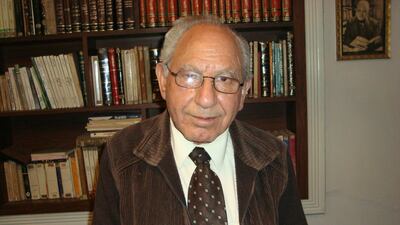
Riad Al Turk, in Damascus, in 2009. -

Riad Al Turk, in Damascus, 2009. -
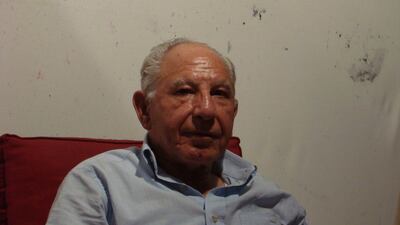
Riad Al Turk, in Damascus, 2009. -
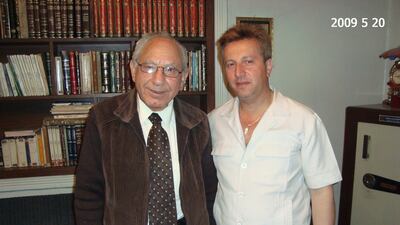
Riad Al Turk with Syrian human rights lawyer Mohannad Al Hassani, in Damascus in 2009. -
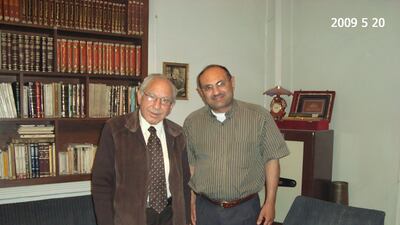
Riad Al Turk with Syrian opposition figure Fawaz Tello, in Damascus in 2009 -
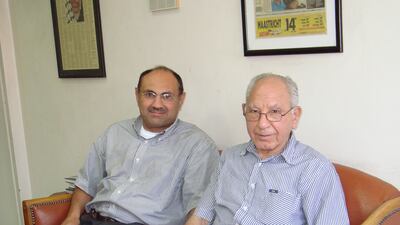
Riad Al Turk with Fawaz Tello, who had shared a prison cell with Turk, in the early 2000s. Photo taken in Damascus in 2009. -
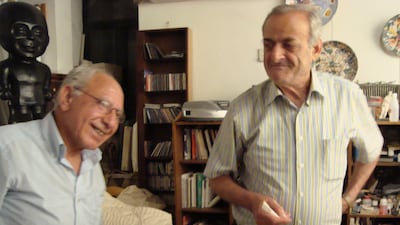
Riad Al Turk with Araf Dalila, former Dean of Economics a Damacus University, who was also a political prisoner. -
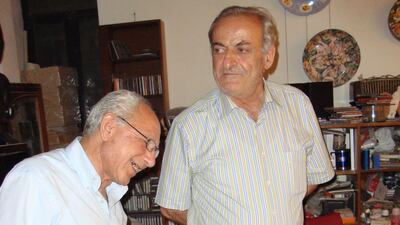
Riad Al Turk with Araf Dalila, former Dean of Economics a Damacus University, who was also a political prisoner.


He was one of the last surviving Syrian politicians who were active during a period of multiparty democracy that preceded the Baath party coup in 1963.
The coup, led by mostly Alawite officers, plunged the country into prolonged military rule, and a 1970 takeover by then air force officer Hafez Al Assad.
Being deeply knowledgeable of the nature of the Syrian system, Al Turk was cautious not to predict its end when a peaceful pro-democracy revolt broke out in March 2011.
It was the last in a wave of Arab uprisings that marked the decade.
“All what I know is that Syria will not remain the kingdom of silence,” said Turk, who was 80 at the time.
When President Bashar Al Assad succeeded his father in 2000, Al Turk urged him to lead Syria on a path to democracy or possibly face a political “earthquake” that could lead to a sectarian bloodbath, due to pent-up anger by many of the majority Sunnis against the Alawite-dominated ruling elite.
The authorities responded by imprisoning Al Turk, until Chirac intervened to have him released again, two-and- a half years later.
'Did not keep silent'
Veteran Syrian opposition figure Fawaz Tello said that Al Turk was careful to call for the inclusion of Alawites in a pluralistic Syria, despite the transgressions of the ruling elite.
“Even when the regime incarcerated him underground, and he did not see the sun for more than a decade, he remained solid, keeping up his call for a democratic Syria,” Mr Tello told The National from Berlin.
“He did not keep silent,” he added.
Born in the central city of Homs in 1930, Al Turk was a lawyer by training.
He later became a leader in Syria's fractured Communist movement, which was persecuted by the authorities following the Baathist coup, despite an alliance between Damascus and the Soviet Union at the time.
Al Turk was secular, and pursued what he described as the simplest of solutions, in politics and in life.
In 2000, Al Turk told Syrian writer Ali Atassi that he dealt with his imprisonment “very simply” by recognising that he had to withstand torture so as not to divulge information that could harm his comrades.
The approach helped him deal with incarceration in some of the most abject conditions faced by prisoners of conscience in the world.
He also had to train himself not to think outside the two square metres he was locked up in, so as not to “go crazy”, he told Mr Atassi in the 2001 documentary Ibn El Am, which loosely translates to Cousin.
Exile and the uprising
When Al Turk took a liking to someone, he called them “my cousin”. If an argument in his view did not hold up, he called it “rusty chew”, according to his friends.
He had numerous surgeries in the late 1990s to help him deal with the effects of imprisonment and prolonged torture.
Khuzama and Nisren, his two daughters, and his wife Asma, a doctor and former political prisoner who died in 2018, convinced him to flee from Syria.
That same year, rebels in northern Syria helped smuggle him to Turkey, and then to Paris, where he lived with Khuzama.
The Russian intervention, three years before, had tilted the balance of the Syrian civil war in favour of Mr Assad.
Al Turk went in hiding to avoid any attempt by the authorities to arrest him again, although he remained non-violent.
The revolt had militarised in late 2011, after the Assad government suppressed the protest movement with deadly force. The armed resistance against the regime, however, was taken over by religious extremists.
Some of these factions were supported by Turkey, which carved a zone in northern Syria to limit the territorial expansion of US-backed Kurdish militias.
Meanwhile, Russia, Iran and the US built their own zones of influence in the country.
Al Turk blamed what he termed the brutality of the regime for the radicalisation of some of Syria’s Sunnis. However, he also warned the younger generation of anti-Assad Syrians against being drawn into the orbit of Ankara.
In Paris in 2018, he said that Turkey’s violent handling of the Kurdish issue in Syria was not in the opposition‘s interest because it alienated it from the West.
Instead, Assad’s opponents should recognise Kurdish collective rights as a prelude for a rapprochement with the Kurds, one of Syria‘s many minorities.
He also advised opponents of Assad to present to international powers a political framework in support of the return of refugees.
Their return would counter what he called the regime’s drive to empty the country and boost the long-term struggle against it.
Once back in Syria, the refugees would continue their quest for “freedom, security and livelihood”, he said.

