


The Abraham Accords signed by the UAE, Bahrain and Israel in 2020 broke a barrier between Arabs and Israelis, which is reflected in the rapid growth of the Jewish community in the Emirates since then, a senior rabbi told The National.
The deal signed in Washington on September 15 three years ago established ties between Israel and parts of the Arab world.
“The Abraham Accords broke an artificial barrier and allowed the normal commingling together and certainly we have had so many gatherings of Jews and Arabs and Muslims, even in our community centre, synagogues and our place of worship,” Dr Elie Abadie, a senior rabbi in the Association of Gulf Jewish Communities, told The National.
The association was established in 2021 to serve the Jewish populations in the UAE, Bahrain, Kuwait, Qatar, Oman and Saudi Arabia.
"We are rekindling and rediscovering how to speak each other. And we have found, as I said – not me, personally, because I have lived here before, but for many people – they have found this kinship, this closeness again, theologically, socially, culturally and historically," he said.
Dr Abadie was born in Lebanon in 1960 to Syrian parents from a Jewish community that had lived in the country since the 1940s.
"You know, having been born and raised in Lebanon, I lived that life before and to me, it was just rekindling all the old traditions," he said.
"This has been a great plus for humanity."
-
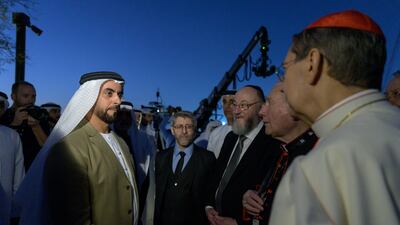
The Abrahamic Family House, a new centre for learning, dialogue and the practice of faith in Abu Dhabi, was officially opened on Thursday by Sheikh Saif bin Zayed, Deputy Prime Minister and Minister of Interior, and Sheikh Nahyan bin Mubarak, Minister of Tolerance and Coexistence. All photos: Wam -
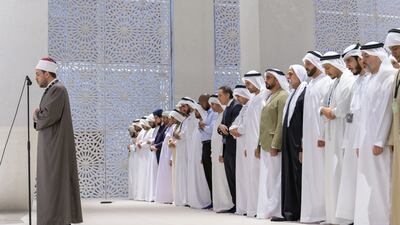
Encompassing three separate houses of worship – a mosque, a church and a synagogue – it will welcome visitors from March 1 -
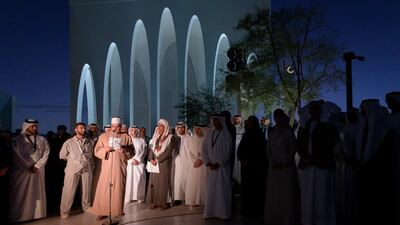
The Abrahamic Family House embodies the diversity of Abu Dhabi and the wider UAE, home to vibrant multicultural communities of various faiths -
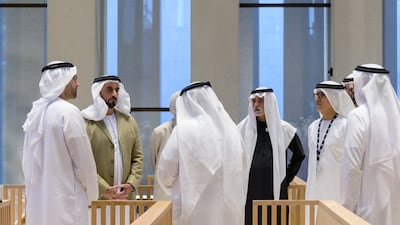
The project was inspired by the principles in the Document on Human Fraternity, signed by Pope Francis and Grand Imam Ahmed El Tayeb in Abu Dhabi in 2019 -

At the Abrahamic Family House, visitors are invited to participate in religious services, guided tours, celebrations and opportunities to explore faith -

The complex’s central forum functions as a visitor experience centre, where an immersive exhibition will introduce visitors to the Abrahamic Family House and invite reflection on the three faiths -

The three houses of worship are of equal stature and share external dimensions, and were designed by Sir David Adjaye


The UAE had fewer than 200 Jewish residents at the time the accords were signed, but the numbers have increased more than fivefold, Dr Abadie said.
“Before the Abraham Accords, when I visited the UAE twice, and then [when] I came as the senior rabbi, the Jewish community numbered less than 200 people. Now, I would estimate it to be probably around 1,200 to 1,500 people that we know,” he said.
“There might be many more that we don't know about."
The Jewish community in the UAE previously used makeshift synagogues, but now have five places of worship – two in Abu Dhabi, including the synagogue at the Abrahamic Family House, and three in Dubai.
Between Dubai and Abu Dhabi there are at least seven kosher restaurants that have opened in the past three years, as well as several supermarkets that comply with the dietary restrictions of Judaism.
"These are very tangible changes that have supported and have made life for a Jewish community very welcoming and much easier so that they could feel at home," Dr Abadie said.
The UAE is a very welcoming country where "all what a human being would want and would need and would desire is present", he said.

