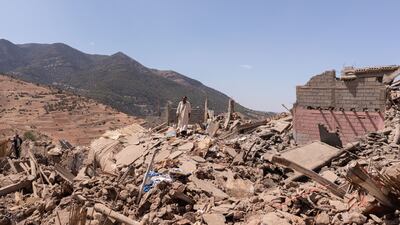
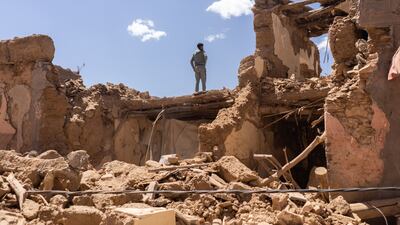
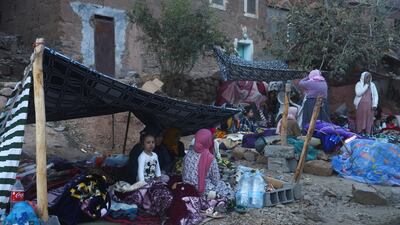
A child plays next to relief tents near a military field hospital in the village of Asni, in the Atlas Mountains of central Morocco. AFP

Morocco earthquake survivors tell of horror, grief and narrow escapes


Ghaya Ben Mbarek
  • English
  • Arabic

Khadija Baouzi had no time to run outside when the massive earthquake hit last Friday, levelling the buildings in her town, including her home, within seconds.

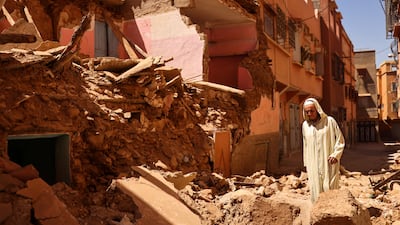
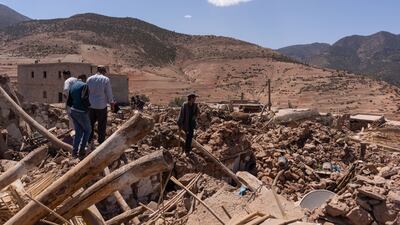
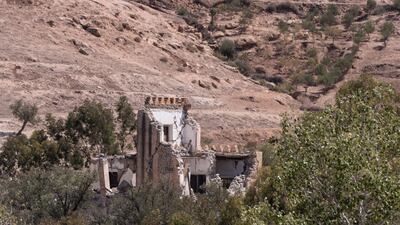
Her town of Ijjoukak, near Marrakesh, became a sea of destruction, with structures collapsing on to residents.

Ms Baouzi, who was severely injured in the earthquake, is being treated at King Mohamed VI University Hospital in Marrakesh.

In front of the hospital, her niece, Mouna, told The National about her aunt’s plight and that of others in the town.

“Her husband died on the spot while my aunt was crushed, both her arm and leg were crushed … may God have mercy on her,” Mouna said as she sat on the ground with her daughter, near the main emergency entrance of the hospital.

“Only a few people remain alive in that village – my aunt’s husband, his sister and her daughters were killed that night. They [the sister and daughters] were visiting from Casablanca and they were going to leave the next morning."

Mouna also became homeless when her house in the old Marrakesh Medina trembled and cracked due to the earthquake.

Now she has to decide whether she will spend the night at the hospital waiting for news about her aunt or return to the area near her home to sleep for a few hours in an alley.

Escaping the rubble

Many others are in the same bleak situation, having not only lost loved ones but also their homes.

Hassine Boukhris, from Douar Tinezert village in Al Haouz district, one of the villages closest to the epicentre of the earthquake, is now living in front of the Marrakesh University Hospital.

His head is bandaged, his shirt stained with his blood as well as dust from his ruined home.

“Everything fell and was flattened, nothing was standing any more,” Mr Boukhris told The National.

He alone was able to climb out of the rubble of his house. His wife, her brother and his family all died in the disaster.

After freeing himself, Mr Boukhris pulled out his two children and tried to save others, but he was only able to get four people out.

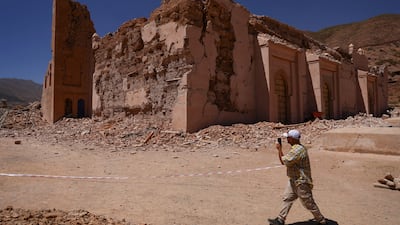
  • A man walks near Tinmel Mosque, which was damaged by the deadly earthquake, in Tinmel, Morocco. Reuters
    A man walks near Tinmel Mosque, which was damaged by the deadly earthquake, in Tinmel, Morocco. Reuters
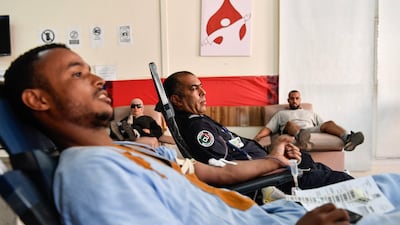
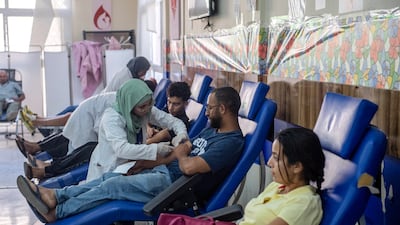
  • People make donations at a blood transfusion centre in Marrakesh after the powerful earthquake. EPA
    People make donations at a blood transfusion centre in Marrakesh after the powerful earthquake. EPA
  • Efforts to help earthquake survivors in the village of Moulay Brahim in central Morocco. AFP
    Efforts to help earthquake survivors in the village of Moulay Brahim in central Morocco. AFP
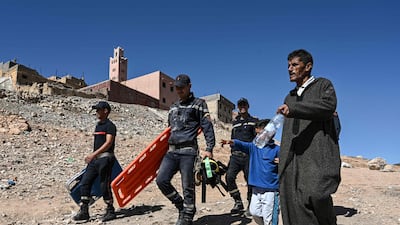
  • People are carried from rubble in Talat Yaqoub. Reuters
    People are carried from rubble in Talat Yaqoub. Reuters
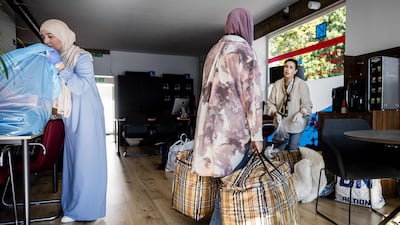
  • Items are donated to Morocco at a collection point in Eindhoven, the Netherlands. AFP
    Items are donated to Morocco at a collection point in Eindhoven, the Netherlands. AFP
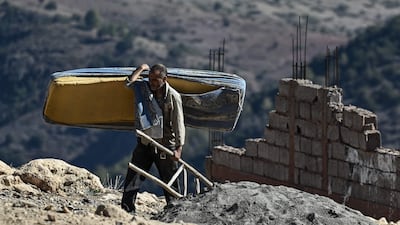
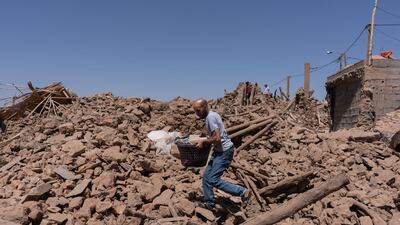
  • A man carries some of his belongings after his home was destroyed in the earthquake in Moulay Brahim. AFP
    A man carries some of his belongings after his home was destroyed in the earthquake in Moulay Brahim. AFP
  • People queue to donate blood in Marrakesh. EPA
    People queue to donate blood in Marrakesh. EPA
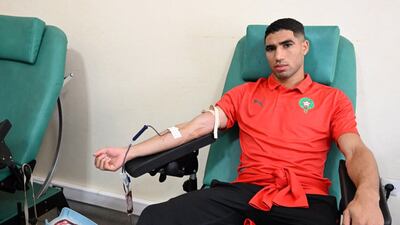
  • The Morocco football team's star defender Achraf Hakimi donates blood at a clinic in Agadir. AFP
    The Morocco football team's star defender Achraf Hakimi donates blood at a clinic in Agadir. AFP
  • The earthquake in Morocco has killed at least 2,122 people, according to the country’s Interior Ministry. Reuters
    The earthquake in Morocco has killed at least 2,122 people, according to the country’s Interior Ministry. Reuters
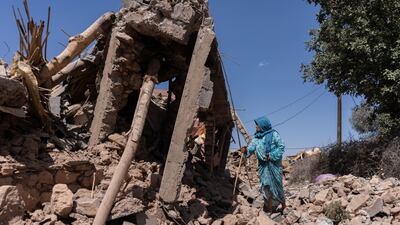
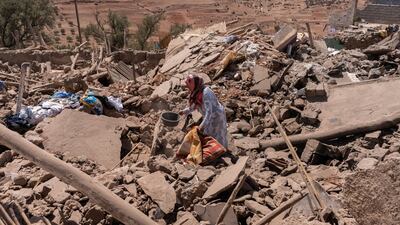
  • A villager in the rubble of destroyed buildings in El Haouz region of Morocco. Bloomberg
    A villager in the rubble of destroyed buildings in El Haouz region of Morocco. Bloomberg
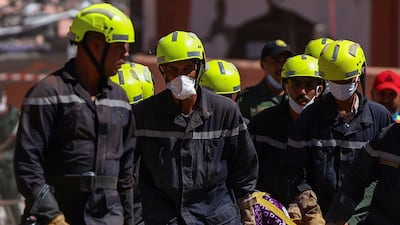
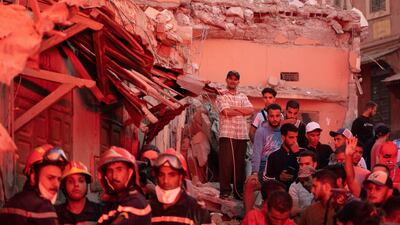
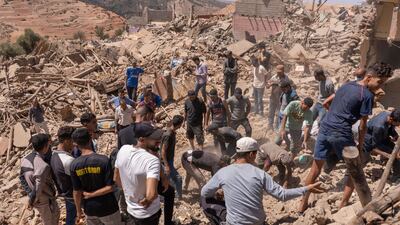
  • Rescue teams and villagers during search and rescue operations after the earthquake in Tafeghaghte, in El Haouz region of Morocco. Bloomberg
    Rescue teams and villagers during search and rescue operations after the earthquake in Tafeghaghte, in El Haouz region of Morocco. Bloomberg
  • Villagers search the rubble of destroyed buildings after the earthquake near Amizmiz, in El Haouz region of Morocco. Bloomberg
    Villagers search the rubble of destroyed buildings after the earthquake near Amizmiz, in El Haouz region of Morocco. Bloomberg
  • Villagers carry out a search and rescue mission in the rubble of destroyed buildings after the earthquake in Tafeghaghte, in El Haouz region. Bloomberg
    Villagers carry out a search and rescue mission in the rubble of destroyed buildings after the earthquake in Tafeghaghte, in El Haouz region. Bloomberg
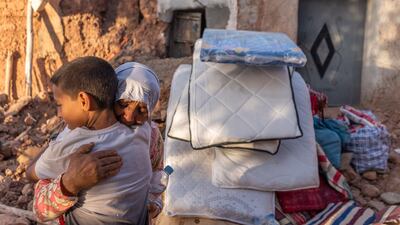
  • A woman comforts a child outside a destroyed house in Tafeghaghte, in El Haouz region. Bloomberg
    A woman comforts a child outside a destroyed house in Tafeghaghte, in El Haouz region. Bloomberg
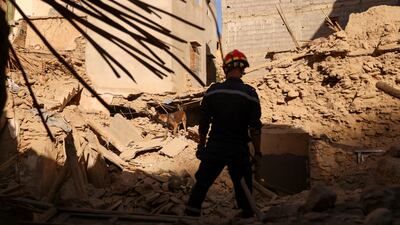
  • An emergency worker and a dog search for bodies in the rubble in Amizmiz, Morocco. Reuters
    An emergency worker and a dog search for bodies in the rubble in Amizmiz, Morocco. Reuters
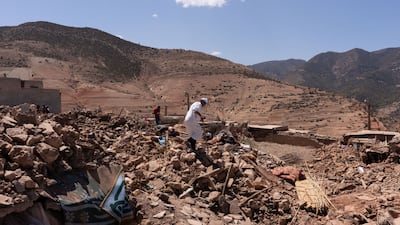
  • Villagers survey the rubble of destroyed buildings after the earthquake near Amizmiz, in El Haouz district. Bloomberg
    Villagers survey the rubble of destroyed buildings after the earthquake near Amizmiz, in El Haouz district. Bloomberg
  • Villagers survey the rubble of destroyed buildings after the earthquake near Amizmiz. Bloomberg
    Villagers survey the rubble of destroyed buildings after the earthquake near Amizmiz. Bloomberg
  • A destroyed building near Amizmiz, in El Haouz region. Bloomberg
    A destroyed building near Amizmiz, in El Haouz region. Bloomberg
  • Villagers among the rubble of destroyed buildings near Amizmiz, in El Haouz region. Bloomberg
    Villagers among the rubble of destroyed buildings near Amizmiz, in El Haouz region. Bloomberg
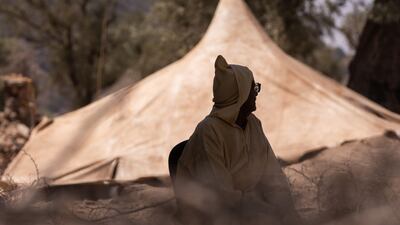
  • A villager near tents outside their destroyed house following an earthquake in Tafeghaghte, in the El Haouz region. Bloomberg
    A villager near tents outside their destroyed house following an earthquake in Tafeghaghte, in the El Haouz region. Bloomberg
  • Villagers walk among the rubble near Amizmiz. Bloomberg
    Villagers walk among the rubble near Amizmiz. Bloomberg
  • A villager near Amizmiz, in El Haouz region. Bloomberg
    A villager near Amizmiz, in El Haouz region. Bloomberg
  • People camp on the roadside after the deadly earthquake in Imgdal, Morocco. Reuters
    People camp on the roadside after the deadly earthquake in Imgdal, Morocco. Reuters
  • The Adnoc building in Abu Dhabi lights up in the colours of the Moroccan flag in solidarity with those affected by the earthquake. Abu Dhabi Media Office
    The Adnoc building in Abu Dhabi lights up in the colours of the Moroccan flag in solidarity with those affected by the earthquake. Abu Dhabi Media Office

“I kept digging a tunnel for almost one hour. I don’t know what kind of force God gave me in those moments but I kept fighting to save my kids,” Mr Boukhris said.

Some members of his family are in hospital, clinging to life after sustaining grave injuries.

“I have nothing any more, all of my belongings are under the rubble … all I have now is this bloody shirt I’m wearing,” Mr Boukhris said.

He now sleeps on the side of the car park at the hospital, alongside many other homeless survivors, spending the days under the shade of a few trees.

Trying to heal wounds

Many more people remain under the rubble as rescue teams continue to hold on to the hope that some are still alive. Some families, however, are only waiting to retrieve the bodies of those they have lost.

“I hope they can reach the people that are still buried in dirt till this hour, lots of them are scared, hungry and bearing the cold that even us here cannot handle,” Mouna said.

“Imagine how they feel when no one is turning to them.”

Volunteers distribute water and food to families of earthquake survivors at King Mohamed VI University Hospital. The National

As the humanitarian impact of the crisis fully emerges, Moroccans did not hesitate to come together and help those affected.

Ghadir, 41, came to Marrakesh from Jdida, about 200km away.

She told The National she had left her children behind, jumping in a car with her brother to bring aid to people who had lost everything in the earthquake.

“This the least we can do. I spent the night in my car in the mountains yesterday and today I came to this hospital as I knew that many people are camping out here,” she said.

“I went crying and came back hopeful. We can see the cars delivering aid going one after another on our way to Taroudant [another damaged town], the place we were trying to reach.”

Despite having to sleep in her vehicle for the past few days, Ghadir said that like many others, she would work to fulfil what she saw as her civic duty.

She is also hopeful that more people will start thinking about ways to help survivors rebuild their lives.

“I really hope that we all come together and think about rebuilding their [survivors'] homes,” she said. “The cold weather is nearing and we would not want to see them struggle.”


Ten tax points to be aware of in 2026

1. Domestic VAT refund amendments: request your refund within five years

If a business does not apply for the refund on time, they lose their credit.

2. E-invoicing in the UAE

Businesses should continue preparing for the implementation of e-invoicing in the UAE, with 2026 a preparation and transition period ahead of phased mandatory adoption. 

3. More tax audits

Tax authorities are increasingly using data already available across multiple filings to identify audit risks. 

4. More beneficial VAT and excise tax penalty regime

Tax disputes are expected to become more frequent and more structured, with clearer administrative objection and appeal processes. The UAE has adopted a new penalty regime for VAT and excise disputes, which now mirrors the penalty regime for corporate tax.

5. Greater emphasis on statutory audit

There is a greater need for the accuracy of financial statements. The International Financial Reporting Standards standards need to be strictly adhered to and, as a result, the quality of the audits will need to increase.

6. Further transfer pricing enforcement

Transfer pricing enforcement, which refers to the practice of establishing prices for internal transactions between related entities, is expected to broaden in scope. The UAE will shortly open the possibility to negotiate advance pricing agreements, or essentially rulings for transfer pricing purposes. 

7. Limited time periods for audits

Recent amendments also introduce a default five-year limitation period for tax audits and assessments, subject to specific statutory exceptions. While the standard audit and assessment period is five years, this may be extended to up to 15 years in cases involving fraud or tax evasion. 

8. Pillar 2 implementation 

Many multinational groups will begin to feel the practical effect of the Domestic Minimum Top-Up Tax (DMTT), the UAE's implementation of the OECD’s global minimum tax under Pillar 2. While the rules apply for financial years starting on or after January 1, 2025, it is 2026 that marks the transition to an operational phase.

9. Reduced compliance obligations for imported goods and services

Businesses that apply the reverse-charge mechanism for VAT purposes in the UAE may benefit from reduced compliance obligations. 

10. Substance and CbC reporting focus

Tax authorities are expected to continue strengthening the enforcement of economic substance and Country-by-Country (CbC) reporting frameworks. In the UAE, these regimes are increasingly being used as risk-assessment tools, providing tax authorities with a comprehensive view of multinational groups’ global footprints and enabling them to assess whether profits are aligned with real economic activity. 

Contributed by Thomas Vanhee and Hend Rashwan, Aurifer

Gulf rugby

Who’s won what so far in 2018/19

Western Clubs Champions League: Bahrain
Dubai Rugby Sevens: Dubai Hurricanes
West Asia Premiership: Bahrain

What’s left

UAE Conference

March 22, play-offs:
Dubai Hurricanes II v Al Ain Amblers, Jebel Ali Dragons II v Dubai Tigers

March 29, final

UAE Premiership

March 22, play-offs: 
Dubai Exiles v Jebel Ali Dragons, Abu Dhabi Harlequins v Dubai Hurricanes

March 29, final

MAIN CARD

Bantamweight 56.4kg
Abrorbek Madiminbekov v Mehdi El Jamari

Super heavyweight 94 kg
Adnan Mohammad v Mohammed Ajaraam

Lightweight 60kg
Zakaria Eljamari v Faridoon Alik Zai

Light heavyweight 81.4kg
Mahmood Amin v Taha Marrouni

Light welterweight 64.5kg
Siyovush Gulmamadov v Nouredine Samir

Light heavyweight 81.4kg
Ilyass Habibali v Haroun Baka

MATCH INFO

Champions League quarter-final, first leg

Ajax v Juventus, Wednesday, 11pm (UAE)

Match on BeIN Sports

Our legal consultants

Name: Hassan Mohsen Elhais

Position: legal consultant with Al Rowaad Advocates and Legal Consultants.

Mercer, the investment consulting arm of US services company Marsh & McLennan, expects its wealth division to at least double its assets under management (AUM) in the Middle East as wealth in the region continues to grow despite economic headwinds, a company official said.

Mercer Wealth, which globally has $160 billion in AUM, plans to boost its AUM in the region to $2-$3bn in the next 2-3 years from the present $1bn, said Yasir AbuShaban, a Dubai-based principal with Mercer Wealth.

Within the next two to three years, we are looking at reaching $2 to $3 billion as a conservative estimate and we do see an opportunity to do so,” said Mr AbuShaban.

Mercer does not directly make investments, but allocates clients’ money they have discretion to, to professional asset managers. They also provide advice to clients.

“We have buying power. We can negotiate on their (client’s) behalf with asset managers to provide them lower fees than they otherwise would have to get on their own,” he added.

Mercer Wealth’s clients include sovereign wealth funds, family offices, and insurance companies among others.

From its office in Dubai, Mercer also looks after Africa, India and Turkey, where they also see opportunity for growth.

Wealth creation in Middle East and Africa (MEA) grew 8.5 per cent to $8.1 trillion last year from $7.5tn in 2015, higher than last year’s global average of 6 per cent and the second-highest growth in a region after Asia-Pacific which grew 9.9 per cent, according to consultancy Boston Consulting Group (BCG). In the region, where wealth grew just 1.9 per cent in 2015 compared with 2014, a pickup in oil prices has helped in wealth generation.

BCG is forecasting MEA wealth will rise to $12tn by 2021, growing at an annual average of 8 per cent.

Drivers of wealth generation in the region will be split evenly between new wealth creation and growth of performance of existing assets, according to BCG.

Another general trend in the region is clients’ looking for a comprehensive approach to investing, according to Mr AbuShaban.

“Institutional investors or some of the families are seeing a slowdown in the available capital they have to invest and in that sense they are looking at optimizing the way they manage their portfolios and making sure they are not investing haphazardly and different parts of their investment are working together,” said Mr AbuShaban.

Some clients also have a higher appetite for risk, given the low interest-rate environment that does not provide enough yield for some institutional investors. These clients are keen to invest in illiquid assets, such as private equity and infrastructure.

“What we have seen is a desire for higher returns in what has been a low-return environment specifically in various fixed income or bonds,” he said.

“In this environment, we have seen a de facto increase in the risk that clients are taking in things like illiquid investments, private equity investments, infrastructure and private debt, those kind of investments were higher illiquidity results in incrementally higher returns.”

The Abu Dhabi Investment Authority, one of the largest sovereign wealth funds, said in its 2016 report that has gradually increased its exposure in direct private equity and private credit transactions, mainly in Asian markets and especially in China and India. The authority’s private equity department focused on structured equities owing to “their defensive characteristics.”

War and the virus
How to become a Boglehead

Bogleheads follow simple investing philosophies to build their wealth and live better lives. Just follow these steps.

•   Spend less than you earn and save the rest. You can do this by earning more, or being frugal. Better still, do both.

•   Invest early, invest often. It takes time to grow your wealth on the stock market. The sooner you begin, the better.

•   Choose the right level of risk. Don't gamble by investing in get-rich-quick schemes or high-risk plays. Don't play it too safe, either, by leaving long-term savings in cash.

•   Diversify. Do not keep all your eggs in one basket. Spread your money between different companies, sectors, markets and asset classes such as bonds and property.

•   Keep charges low. The biggest drag on investment performance is all the charges you pay to advisers and active fund managers.

•   Keep it simple. Complexity is your enemy. You can build a balanced, diversified portfolio with just a handful of ETFs.

•   Forget timing the market. Nobody knows where share prices will go next, so don't try to second-guess them.

•   Stick with it. Do not sell up in a market crash. Use the opportunity to invest more at the lower price.

RESULTS

Cagliari 5-2 Fiorentina
Udinese 0-0 SPAL
Sampdoria 0-0 Atalanta
Lazio 4-2 Lecce
Parma 2-0 Roma
Juventus 1-0 AC Milan

Brief scores:

Manchester United 4

Young 13', Mata 28', Lukaku 42', Rashford 82'

Fulham 1

Kamara 67' (pen),

Red card: Anguissa (68')

Man of the match: Juan Mata (Man Utd)

Updated: September 12, 2023, 7:01 AM