


Israeli Cabinet minister Itamar Ben-Gvir on Thursday visited a sensitive Jerusalem holy site that has been a flashpoint for violence between Israel and the Palestinians.
The Israeli National Security Minister's visit to Al Aqsa compound comes during a period of heightened violence in the West Bank and threatens to inflame already surging tension.
The site is revered by Jews and Muslims, and the competing claims lie at the heart of the Palestinian-Israeli conflict.
Mr Ben-Gvir joined hundreds of Jews visiting Al Aqsa compound to mark the holiday of Tisha B'Av.
The Waqf, an Islamic trust that runs civil matters at the holy site, said that 2,240 Jews had entered the compound for the holiday – the highest number recorded in five years.
“This is the most important place for the people of Israel which we must return to and show our rule,” Mr Ben-Gvir said in a video released by his office, with the golden Dome of the Rock, one of the most revered shrines in Islam, in the background.
The Palestinian Authority’s Jerusalem Affairs Ministry warned that the government and extremists such as Mr Ben-Gvir would “push things towards religious war” by provoking Muslims worldwide.
The Palestinian Ministry of Foreign Affairs said it considered Mr Ben-Gvir’s visit an attempt to impose Israeli sovereignty over the site.
Neighbouring Jordan, which acts as a custodian over the site and has a peace agreement with Israel, said such visits “threaten to trigger new cycles of violence”.
The UAE strongly condemned Mr Ben-Gvir's storming of Al Aqsa Mosque, noting his “previous racist positions and statements”.
The Ministry of Foreign Affairs called on “Israeli authorities to halt escalation and avoid exacerbating tension and instability in the region”.
It “affirmed the UAE's rejection of all practices that violate resolutions on international legitimacy and threaten further escalation”.
The ministry said it supported “all regional and international efforts to advance the peace process in the Middle East, end illegal practices that threaten the two-state solution and establish an independent Palestinian state on the 1967 borders with East Jerusalem as its capital”.
Saudi Arabia, the custodian of Islam’s two holiest cities and a country with which Israel hopes to normalise ties, denounced the visit as “a provocation of the feelings of Muslims around the world”.
Turkey demanded that Israeli authorities “restrain these provocations”.
Al Aqsa Mosque – in pictures
-
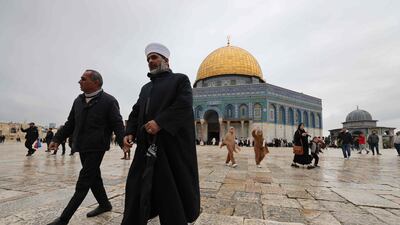
Palestinians in Al Aqsa mosque compound after Friday's noon prayer in Jerusalem, January 6, 2023. AFP -
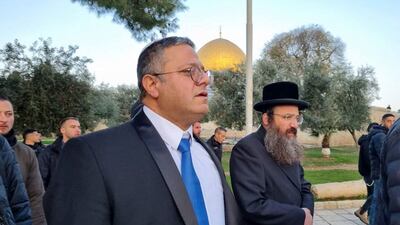
Israeli minister and Jewish Power party leader Itamar Ben-Gvir on a tour of Al Aqsa mosque compound on January 3, 2023. AFP -

Pope Benedict XVI in front of the Dome of the Rock in Jerusalem's Old City in May 2009. Reuters -
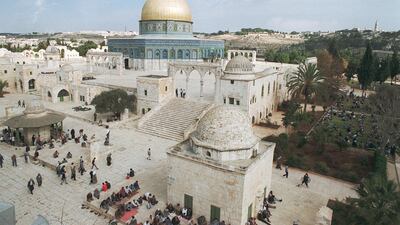
The Dome of the Rock at Al Aqsa mosque compound in 1987. AFP -
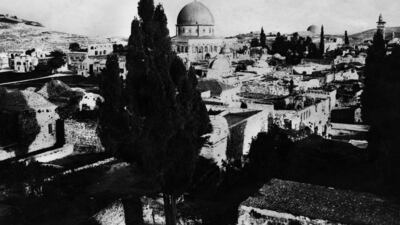
The walled city of old Jerusalem with the Dome of the Rock in the background, circa 1948. AFP -
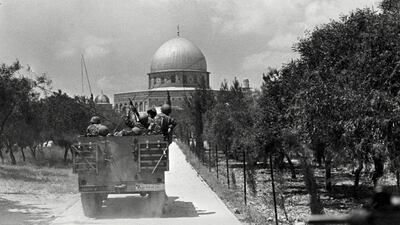
An Israeli military vehicle approaches the Dome of the Rock in June 1967. AFP -
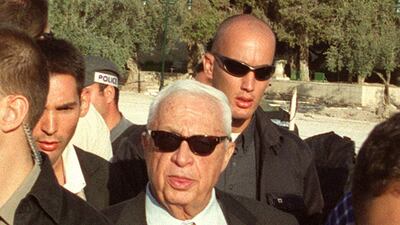
Israeli right-wing opposition leader Ariel Sharon flanked by security guards on a visit to Al Aqsa mosque compound in September 2000. AFP -
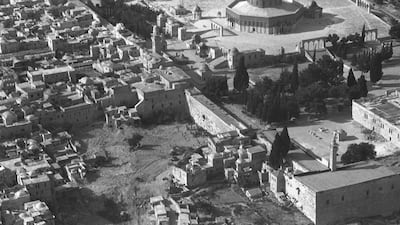
A view of Jerusalem on June 12, 1967 shows the Mughrabi Quarter after the Arab-Israeli war that year. AFP -
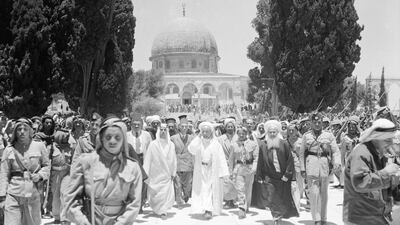
King Abdullah of Jordan on his way to Al Aqsa mosque in June 1948, with the Dome of the Rock in the background. Getty Images -
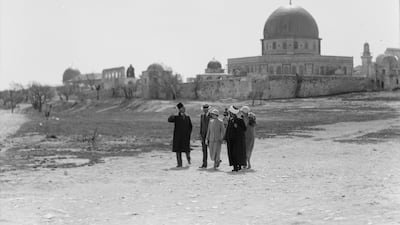
Royal guests Princess Mary and the Earl of Harwood in March 1934 leave the temple area. Photo: Library of Congress -
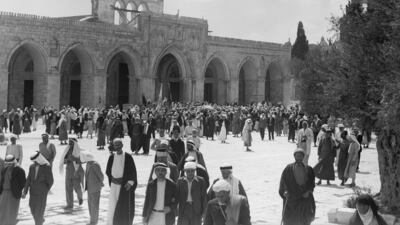
Crowds outside Al Aqsa mosque in the 1930s. Photo: Library of Congress


Waqf officials said crowds of Jewish visitors danced, whistled and sang the Israeli national anthem as they streamed through the compound.
“The government is giving cover to these extremists,” said Bassam Abu Labda, a Waqf official. “This is very dangerous.”
Mr Ben-Gvir, a former West Bank settler leader and far-right activist who years ago was convicted of incitement and supporting a Jewish terror group, now oversees the country’s police force.
Thursday was his third public visit to the contested site since joining Prime Minister Benjamin Netanyahu's far-right government.
Police said they had arrested 16 people for violating “visitation regulations” at the site.
Under long-standing arrangements, Jews are permitted to visit the site but not to pray there.
But in recent years, a growing number of Jewish visitors have begun to quietly pray, raising fears among Palestinians that Israel is plotting to divide or take over the site.
Mr Ben-Gvir has long called for increased Jewish access.
As Palestinian anger rose over his visit, the Palestinian Health Ministry said Fares Abu Samra, 14, was killed by Israeli forces in the West Bank town of Qalqilya.
The Israeli military said Palestinians threw rocks and firebombs at troops, who responded by firing into the air. It said the incident was being reviewed.
Residents of Qalqilya accused the Israeli military of opening fire towards civilians after storming into the town to arrest a Palestinian.
Fares's father, Sharhabeel Abu Samra, a Palestinian security officer, claimed his son was walking in the street and “not doing anything” when Israeli soldiers shot at him and then hit him with their jeep.
“Where are the human rights?” Mr Abu Samra said, crying.
Also on Thursday, the Hamas military wing in the West Bank released a video purporting to show militants in the northern city of Jenin firing a rocket towards northern Jewish settlements across Israel’s separation barrier.
The group identified the rocket as a Qassam-1, a primitive and notoriously inaccurate type of rocket with a range of about 4 kilometres.
The Israeli military said it had found remains of an improvised rocket near the Palestinian village of Silat Al Harithiya, to the north-west of Jenin.
While Hamas's military wing launches hundreds of rockets from the Gaza Strip during skirmishes with Israel, rocket fire from the West Bank remains rare.
But last month, Palestinian militants similarly tried to fire rockets into Israeli settlements from Jenin, which also fell short.
Since early last year, Israel has been staging near-nightly raids into Palestinian areas which it says are meant to stamp out militancy and thwart future attacks.
More than 160 Palestinians have been killed in the fighting this year, according to a tally by the Associated Press.
At least five of them, including the boy killed on Thursday, were age 14 or under.
The military said most of those killed have been militants. But stone-throwing youths protesting against the incursions and others not involved in the confrontations have also been killed.
At least 26 people have been killed in Palestinian attacks against Israelis since the start of 2023.
Israel captured East Jerusalem, where Al Aqsa compound lies, along with the West Bank and the Gaza Strip in the 1967 war.
The Palestinians seek those territories for a future independent state, with East Jerusalem as its capital.
Israel annexed East Jerusalem in a move unrecognised by most of the international community and considers the city its undivided, permanent capital.
Mr Netanyahu's government has intensified steps to solidify Israel's hold on the Palestinian territories, angering Israel's top ally, the US, and dimming hopes for Palestinian statehood.

