

A controversial legal bill to reform Israel's judiciary has plunged the country into chaos — airports are closed, thousands have taken to the streets and a minister has been sacked, all in one day.
But this saga has been rumbling for months. Here's what you need to know about Israel's judicial reform bill and why the situation exploded this week.
What is Israel's judicial reform bill?
The government has been pushing for changes that would limit the Supreme Court's powers to rule against the legislature and the executive, while giving coalition lawmakers more power in appointing judges.
The panel for selecting judges requires politicians and judges who sit on it to agree on appointments. The present proposal would change that, giving coalition governments decisive sway.
Prime Minister Benjamin Netanyahu, though formally barred from involvement in the initiative because he is on trial for graft charges he denies, has said such changes aim to balance and diversify the bench. He has also accused the media of misrepresenting the plan and fanning the flames of protest to topple his government.
Israeli lawmakers are due to vote on a central part of the government's proposals next week, which foresees changing the way judges are appointed.
What do critics of the bill say?

Israel's democratic “checks and balances” are relatively fragile. It has no constitution, only “basic laws” meant to safeguard its democratic foundations. In its one-chamber Knesset, the government controls a majority.
Critics say that the changes will weaken the courts and hand unbridled power to the government, endangering rights and liberties with catastrophic effects for the economy and relations with Western allies, who have already voiced concern.
A judiciary no longer seen as independent could also strip Israel of one of its main defences in international legal cases.
Even Mr Netanyahu's own Defence Minister Yoav Gallant came out against the legal change on Saturday calling on the government to halt legislation on changes to the judiciary. He said the bitter dispute over the measures poses a danger to national security.
“The deepening split is seeping into the military and defence institutions — this is a clear, immediate and real danger to Israel's security,” said Mr Gallant, in a brief televised statement.
He was promptly removed from his post on Monday.
Will the government take the bill off the table?
-

Israeli police disperse demonstrators blocking a road in Tel Aviv during a protest against plans by the government to overhaul the judicial system. AP -
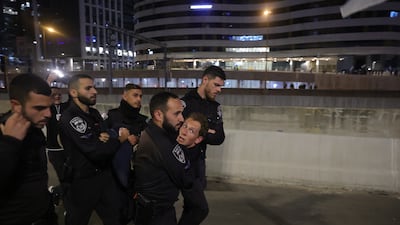
Police arrest a protester in Tel Aviv. EPA -
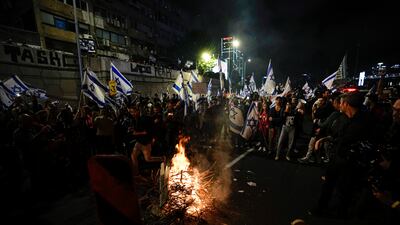
Demonstrators set up a bonfire on a road. AP -

Israeli security forces use a water cannon to disperse protesters. AFP -
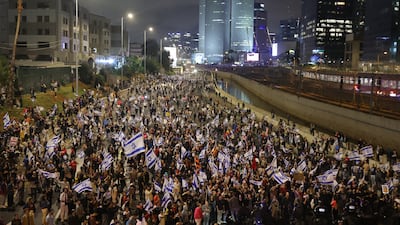
Thousands of protesters block the Ayalon main road. EPA -
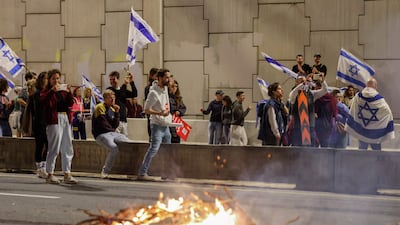
The Tel Aviv protest swelled on Saturday to about 200,000 demonstrators, according to Israeli media estimates. AFP -
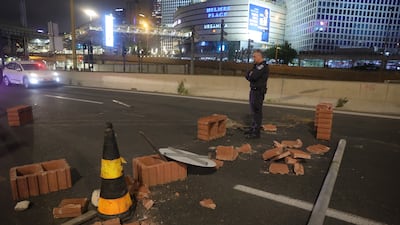
A roadblock placed by protesters on the Ayalon main road. EPA -
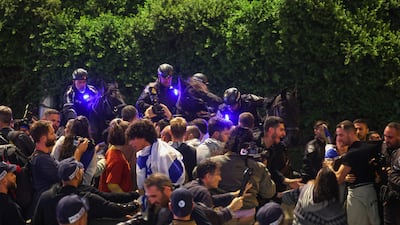
Demonstrations erupted in January after the coalition government announced its package of changes. AFP -
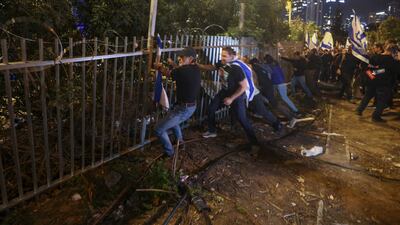
Israeli protesters dislodge a fence. AFP -
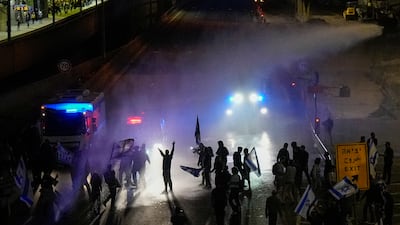
Police use a water cannon to disperse protesters. AP -

An aerial view of the protest. Reuters -
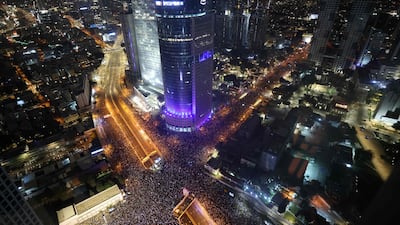
Plans to hand more control to politicians and diminish the role of the court have been questioned by Israel’s allies including the US. AFP -

Protesters with placards of Prime Minister Netanyahu saying 'We will not forget, we will not forgive'. EPA


A row back looks unlikely, despite mounting calls for one.
Mr Netanyahu said last week that the legislation “does not take control of the court but balances and diversifies it”.
He and other critics of the Supreme Court say the bench is left-leaning and elitist and has become too interventionist in the political sphere, while often putting minority rights before national interests.
A parliamentary committee has amended the draft law with the aim of making it more palatable to opponents, but the opposition has ruled out backing any part of the reform package until all legislative steps are halted.
How does the move affect Mr Netanyahu?
Critics fear Mr Netanyahu wants to leverage the judicial push to freeze or void his trial. He has denied having any such plan.
The opposition also says his nationalist allies want to weaken the Supreme Court to establish more settlements on land the Palestinians seek for a state. Ultra-Orthodox Jewish parties in the coalition want to pass a law exempting their community from service in the conscript military, which they worry may be struck down by the court if its powers are not cut back.
What happens next?
Mr Netanyahu's governing coalition is aiming for final ratification of the changes to bench selection by April 2, when lawmakers go on spring break time. Other changes, some of which have been approved at the Knesset's plenum in the first of three readings required for ratification, have been deferred until parliament reconvenes on April 30.

