

US President Joe Biden had a “candid” call with Israeli Prime Minister Benjamin Netanyahu as protests over Israel's controversial legal reforms become increasingly violent, a senior American official has said.
Mr Biden called for “as broad a consensus as possible” as Mr Netanyahu's coalition rapidly advances a number of measures to curb the power of the country's judiciary, which opponents say could end Israeli democracy.
Mr Netanyahu told Mr Biden that “Israel was, and will remain, a strong and vibrant democracy”, a government press release said.
The call from Israel's most important ally comes after Israeli President Isaac Herzog released a compromise package on the legal reforms last week to prevent a “civil war” and “blood in the streets”.
The government had swiftly rejected the proposals, and on Sunday said it will bring a key part of the legislation which deals with judicial appointments to the Supreme Court to a final parliamentary vote before the Jewish holiday of Passover.
Reports emerged in Israeli media that Mr Netanyahu allegedly said that if civil war broke out in Israel it would be the fault of Mr Herzog. The Prime Minister's Office said the story was a “disgusting lie”.
-

Israelis demonstrate during 'Day of Resistance' against the government's judicial overhaul, outside the US consulate in Tel Aviv. Reuters -

Israeli naval reservists and volunteers in Haifa use flares to demonstrate during the Day of Resistance. Reuters -
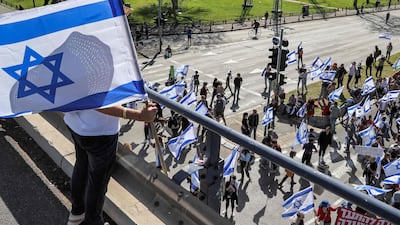
A demonstrator stands with an Israeli flag on an overpass above others march in Tel Aviv. AFP -
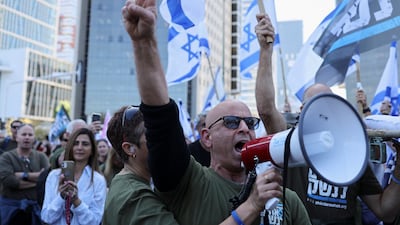
Israelis demonstrate in Bnei Brak. Reuters -

Demonstrators in Tel Aviv. AFP -

A woman rides with a cart-cycle with children in Tel Aviv. AFP -
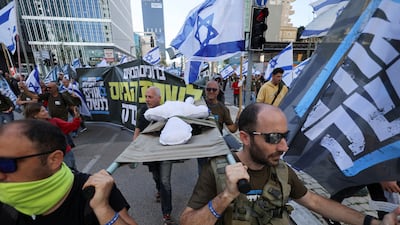
Prime Minister Benjamin Netanyahu's nationalist coalition government is pressing on with its judicial overhaul. Reuters -

Israelis demonstrating outside the US Consulate in Tel Aviv. Reuters


In recent days, there have been signs of growing desire within the coalition to make a compromise. At Sunday's meeting of coalition leaders, lawmakers debated a proposal made by senior politician Simcha Rothman to tone down a current proposal that would give the government more power over judicial appointments.
It is the first public suggestion by the coalition that they are potentially ready to compromise on their original package.
The news followed a senior politician from the Prime Minister's Likud party claiming that “at least five” of its lawmakers want to stop the package to allow time for a consensus to be found.
But on Monday opposition leaders sharply rejected the coalition's proposed modifications suggested by Mr Rothman.
Opposition leader Yair Lapid said the idea was a front for a “hostile political takeover of the judicial system”.
The mounting calls for compromise come after an 11th consecutive week of increasingly violent anti-government protests across the country.
On Saturday, police arrested a man who allegedly drove his vehicle into a group of protesters in the central city of Herzliya, injuring a demonstrator.
Another man was detained for driving his motorcycle into a crowd of demonstrators in Tel Aviv.
In recent weeks, protesters have taken increasingly direct action to purposefully disrupt daily life, including blocking motorways, airports and ports, as well as surrounding the homes of government figures.

Tensions are also erupting along religious lines. Last week, a number of protesters demonstrated outside the house of a Jewish ultra-Orthodox coalition lawmaker in the city of Bnei Brak, provoking counterdemonstrations in the deeply conservative city.
Protesters set up a mock “draft office”, symbolising the anger of many Israelis that young people in the ultra-Orthodox community are exempt from military service, to pursue religious training.
Speaking to a crowd in the city of Haifa on Saturday, a former IDF chief of staff said the ultra-Orthodox, who are also allowed to study a purely religious curriculum that does not include subjects such as English and maths, should “begin to learn core studies because F-16 fighter jets are only in English”.
Key institutions are also becoming increasingly politicised.
On Thursday, Israel's New York Consul General Asaf Zamir spoke of his “deep concern” about the country's political situation, which led to him being summoned to Israel's foreign ministry in Jerusalem to explain the comments, according to The Times of Israel.
In the military community, hundreds of air force reservists have said they will not attend training sessions this week. The announcement followed a similar one made by intelligence reservists.
Volunteer forces are critical for Israel, which maintains a relatively small full-time military.
The judicial overhaul is also raising concerns about the future of the Israeli economy. On Saturday, former Bank of Israel head Jacob Frenkel said that the plans are “destroying the Zionist enterprise from within”.

