

Follow the latest news on the earthquake in Turkey and Syria
Ahmad sleeps on a small mattress on the ground protected by a blue tarpaulin he attached to his car, while his two young daughters sleep in the back of a car.
Around him, dozens of families are staying in the same car park turned into a makeshift settlement, some huddled in tents, others in cars.
“We have nothing left and the government barely helped us,” said Ahmad, 42, whose house collapsed in the massive twin earthquakes that shook southern Turkey and parts of northern Syria last week, killing at least 37,000 people.
This is the scene in Samandag, a coastal town in southern Turkey near the Syrian border in the province of Hatay, where earthquake survivors are fighting for tents.
“I just want to have a decent place for them to sleep," Ahmad said of his children. "We sometimes bring them to the hospital so they can have some rest in this freezing cold.”
Hatay province is one of the regions worst affected by the earthquake and its aftershocks.
Ahmad is mourning five members of his family. Turkey's official disaster relief agency Afad finally pulled the last body from the rubble a week after the disaster. Ahmad said his family might still be alive if they had arrived earlier in the city.
-
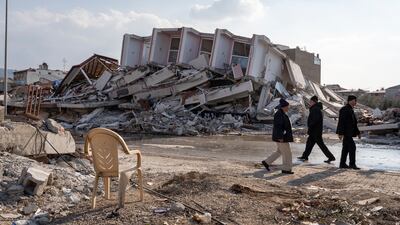
The town of Samandag, in Hatay province, Turkey is largely in ruins after the earthquake on February 6. All photos: Matt Kynaston / The National -
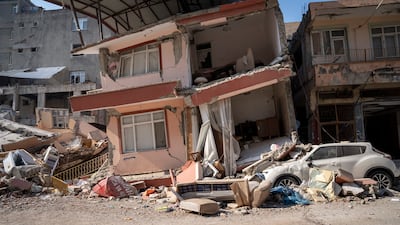
The coastal town is in the country's south, near the Syrian border -
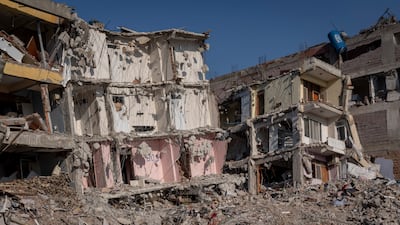
More than a week after the catastrophe, there is still little presence of government assistance in the city -
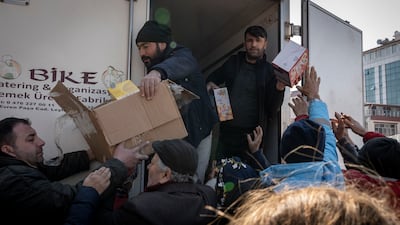
Those who remain in Samandag are almost completely dependent on aid groups and local NGOs for food, and basic provisions -
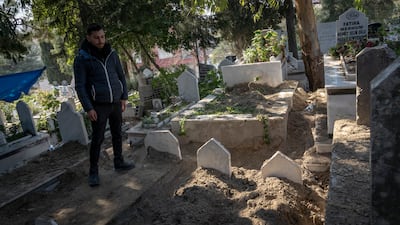
Baris Yapar stands by his grandparents' graves. He believes they could have been saved had rescue and recovery teams arrived faster -
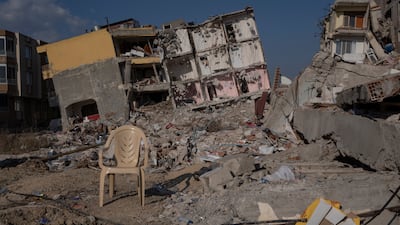
Most residents with relatives in other cities have left -
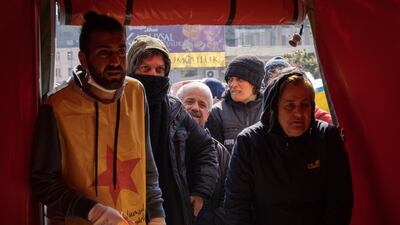
Those who remain in Samandag are almost completely dependent on aid groups and local NGOs for food, and basic provisions -
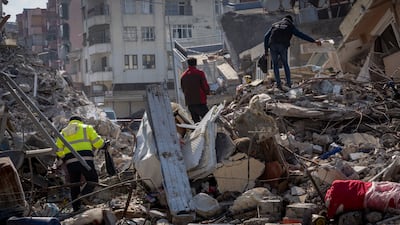
Survivors search through the rubble of what was once their homes -
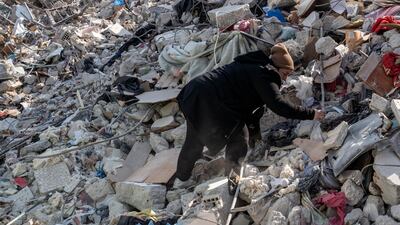
The city was one of the hardest-hit by the earthquake -
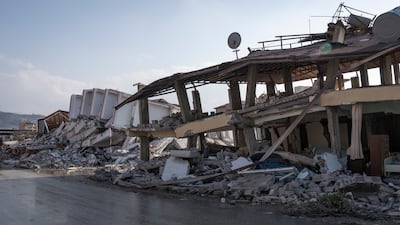
The usually busy streets are now empty, filled with rubbish, broken glass and debris -
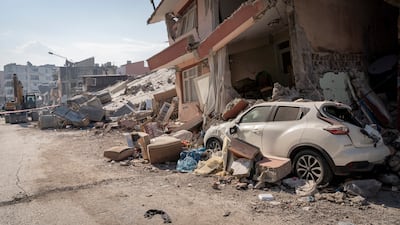
Many bodies have not yet been pulled out of damaged buildings, or from under the rubble -
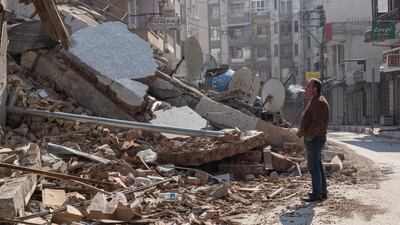
A man stands outside what was once his clothing shop


“It took them 48 hours to come, it was slower than everywhere else,” he said.
“They left us to die here, all hope is gone, life has ended here,” he added, his voice breaking and tears filling his eyes. “I have no words left.”
Every day is a struggle for survival for the father of two. “We lost our loved ones, for them it’s over, for those left the pain is only starting for us,” he said.
A town left behind
More than a week after the catastrophe, there is still little presence of government assistance in the city, home to Armenian, Alawite, Christian and Arab minorities.
Residents of Samandag say authorities have failed them. Much of the humanitarian aid that came to distribute food, medicine and clothes are co-ordinated and distributed by local NGOs and political and religious groups. The town’s mayor, they said, has not even shown up since the earthquake.
Yet the city has been devastated. In the centre, most of the buildings are reduced to ruins. The usually busy streets are now empty, filled with rubbish, broken glass and debris.
Most of the residents with families in other cities have left. Those who stayed are waiting for bodies to be pulled out or contemplating with grief what they have lost.
On the side of a heap of rocks, a woman is searching under the rubble of what used to be her house. “It’s a souvenir,” she said, showing children’s toys in her hands.
Looting is now taking place to add to the desolation.
“The broken windows here, they are not from the earthquake: I saw with my own eyes people entering damaged shops to steal anything they could find,” said Baris Yapar, a 27-year-old student from Samandag, pointing at a boutique with a pile of shoeboxes cluttering the entrance.
As he walks through deserted streets to where his grandfather's house once stood, a police officer asks him to leave, warning that the remaining buildings might collapse at any moment.
“Where were they when people were dying under the rubble?” he asked with frustration.
'I could still hear their voices'
Left on their own, civilians had no other choice but to dig through the rubble and carry their loved ones to the grave.
Baris's father, Habip Yapar, said they waited 60 hours before official emergency rescuers finally pulled out his parents' bodies from their collapsed building.
"We called everyone we could for help, NGOs, political parties. They said they were coming but no one showed up,” the father said. With no one to help, they had to dig themselves out of the collapsed house in the pouring rain.
“I could still hear their voices on the first day; they were alive,” he said.
When the rescue teams finally reached the town two days later, they did not have the appropriate equipment to delve through the debris.
"We gave them a generator, a driller and the other tools they needed,” Habip said.
Hours later, they finally accessed the bodies. But it was too late, his parents did not survive.
He said he could see his mother's corpse lying half outside the debris for hours before the rescuers could pull her out completely.
“They came so late, it's like they never came,” he said.
The family called the municipality for a funeral carriage but no one answered.
"We had to carry the corpses in body bags in the trunk of a car to the morgue,” Habip said.
A few days later, he returned to the morgue where he found a crowd of mourning families searching for their dead relatives to bury them. He had to open several body bags before finding those of his parents.
"We did everything on our own: first, we uncovered our dead, then we carried them to the grave,” Baris said.

The family slept in their vehicle in the car park in front of the quake-damaged house, around other makeshift settlements. Baris said they had to stay close by because of looting in the area.
"We are constantly watching in case someone tries to break in," he said.
He said they would soon move to a tent which his father is setting up.
"We also had to buy it ourselves thanks to parents and friends,” he said.
Frustration and despair
For Samandag residents, the slow emergency response from the central government raises painful questions.
They said Hatay province, unique in Turkey for its richness of culture and various sects, has been historically overlooked by authorities.
The Samandag municipality, they said, is affiliated with Turkey's main opposition party.
On social media, the dire situation sparked unconfirmed rumours that aid from associations belonging to the opposition were blocked, while officials from Samandag district were accused of stealing relief sent by the central authorities.
But as they are mourning their dead, some are cautious to engage in political speculation.
"I don't know why we are left behind,” said Habip. "I would rather think it's pure incompetence than discrimination. But the result is the same: we had to do everything on our own."

