Syria earthquake: 'Every hour we’re losing more lives,' say rescuers


  • English
  • Arabic

Follow the latest on the earthquake in Turkey

Living conditions in Syria's rebel-held north-west, already difficult, have been severely aggravated by the deadly earthquake that rocked Turkey and neighbouring Syria on Monday and has so far claimed more than 6,000 lives.

The 7.8-magnitude earthquake bulldozed vast parts of north-western Syria, destroyed hundreds of buildings and exacerbated the hardships of millions in the rebel holdout, already afflicted by Syria's 12-year civil war and its subsequent refugee crisis.

The death toll in the north-west — which is currently more than 900 — rises hourly as exhausted rescue workers struggle to free people from the rubble using rudimentary equipment and, in some cases, their own hands.

Rescue workers operating in freezing temperatures say they do not have the resources for such large-scale rescue efforts, while residents whose homes have been destroyed struggle to find accommodation.

“It depends on each person and what options they have in front of them,” said Ismail Abdullah, 36, a volunteer with the White Helmets civil defence organisation in Sarmada, near the Syrian border with Turkey.

“Some colleagues are going to refugee camps where they have relatives. Some people are going to makeshift shelters and some people are holed up in masjids.”

Relatives, friends, neighbours and mosques across north-western Syria have opened their doors to those displaced. Makeshift camps have cropped up overnight to house hundreds of people.

Mr Abdullah’s home was severely damaged by Monday's quake, but he said he had no choice but to return to it for now.

It had already been badly damaged in a previous bombardment by Syrian government forces and their Russian allies — a still-common occurrence as the country’s civil war, now in its 12th year, continues in parts of the country, including the north-west.

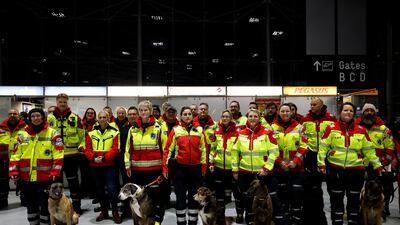
  • Members of International Search and Rescue Germany board a charter plane with a search dog at Cologne-Bonn airport, Germany. Reuters
    Members of International Search and Rescue Germany board a charter plane with a search dog at Cologne-Bonn airport, Germany. Reuters
  • Members of the Dutch search and rescue team USAR arrive at Eindhoven Air Base to board a cargo plane. AFP
    Members of the Dutch search and rescue team USAR arrive at Eindhoven Air Base to board a cargo plane. AFP
  • Fifty members of the HUNOR Hungarian Rescue Team in Budapest prepare to depart for Turkey. EPA
    Fifty members of the HUNOR Hungarian Rescue Team in Budapest prepare to depart for Turkey. EPA
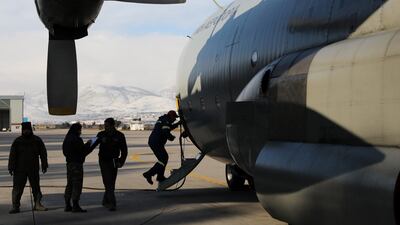
  • Greek firefighters with rescue dogs wait to board a military plane at Elefsina Air Force Base, in western Athens, Greece. AP
    Greek firefighters with rescue dogs wait to board a military plane at Elefsina Air Force Base, in western Athens, Greece. AP
  • Czech urban search and rescue firefighters at Leos Janacek Airport in Czech Republic. AP
    Czech urban search and rescue firefighters at Leos Janacek Airport in Czech Republic. AP
  • Members of International Search and Rescue Germany at Cologne-Bonn airport, Germany. Reuters
    Members of International Search and Rescue Germany at Cologne-Bonn airport, Germany. Reuters
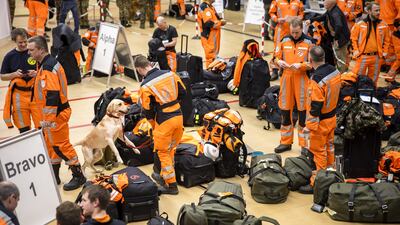
  • Swiss team with rescue dogs at Zurich Airport. EPA
    Swiss team with rescue dogs at Zurich Airport. EPA
  • A Greek rescue team departs from Elefsina military airport to arrive at the Incirlik airport base in Turkey. EPA
    A Greek rescue team departs from Elefsina military airport to arrive at the Incirlik airport base in Turkey. EPA
  • Spanish firefighters with their equipment at Barajas international airport in Madrid, Spain. AP
    Spanish firefighters with their equipment at Barajas international airport in Madrid, Spain. AP
  • Romanian rescue workers arrive at the military airbase near Bucharest, Romania, for a last briefing before being sent to southern Turkey. EPA
    Romanian rescue workers arrive at the military airbase near Bucharest, Romania, for a last briefing before being sent to southern Turkey. EPA

“It was split in some areas after the earthquake. We’re scared aftershocks will bring the whole building down,” he said.

Still in shock, he struggled with his words as he described a neighbouring residential building which was reduced to rubble, killing more than 17 people inside. His words echoed feelings of frustration and futility from other rescue workers as they sought to dig victims from the rubble with insufficient or nonexistent equipment.

“We have huge difficulties. We don't have enough bulldozers, we don’t have enough lorries or cranes,” Mr Abdullah told The National. “Instead of spending 24 hours breaking through a roof to find people, we should just be able to remove the roof with a crane.”

“We're doing what we can. We are not superheroes. Every hour we’re losing more lives,” he added. “I can only hold my tears back for so long.”

The humanitarian situation in north-west Syria, the last remaining rebel holdout, was dire even before the quake. The overcrowded enclave accommodates nearly two million internally displaced Syrians in camps and informal sites across the region.

Over four million residents in the northwest already faced unbearable living conditions, with many homes already damaged or destroyed due to bombardment, cross-border aid shortages, few job opportunities and little access to a strained health system mostly run by NGOs.

Cut off from government areas, Syria’s northwest is heavily dependent on aid from neighboring Turkey. But Turkey, the epicenter of the earthquake, is itself overwhelmed and struggling to mount an emergency response as the search for survivors continues.

“The situation is bleak and catastrophic on a humanitarian level,” said Oubadah Alwan, a media coordinator for the White Helmets.

“Before the earthquake we already suffered from a lack of resources, medical equipment, diesel fuel to power equipment … all of these factors are hindering response efforts on the ground now.”

“We were already spread thin. This is beyond the capacity of our organisation.”

A White Helmets team pulls a person from the rubble as the search for survivors continues in Al Atareb, Syria. Reuters

Mr Alwan spoke as reports poured in that the Bab al Hawa border crossing — usually the sole humanitarian crossing point between Turkey and north-western Syria — was closed due to severe road damage, further limiting the flow of supplies into the rebel-held region.

Numerous local humanitarian organisations told The National the need for resources was critical.

“People in Jindiris are digging for survivors in the rubble with their own hands,” Mr Abdullah added.

Death and displacement

Abdel Mueen, in his 50s, is hosting four families who have fled from neighbouring Jindiris, which he said was “now 80 per cent rubble”. He added: “They've lost everything.”

Among the families is 13-year-old Elisar Al Masri.

“It was the first time I ever saw someone die in front of me,” she told The National after seeing her 10-year-old nephew, Malek, under a pile of rubble when their family home's balcony fell on top of him during the first overnight earthquake.

She was carrying Malek's younger brother, who survived.

“I felt like it was judgment day when it happened. The building began to shake and the stairs began to crumble as we were trying to run to escape.”

“Now, I am at my uncle's house. He's the only one we have left.”

Her aunt and four children were also killed in the earthquake. They lived in a four-storey building in Afrin, one of the worst-hit areas of Syria.

“When we were running barefoot, we kept seeing buildings fall and people crying, with bodies and blood everywhere. Now we are literally homeless.

“We are living the trauma every second. It's impossible to forget.”

This is not the first time the family has been displaced. They are originally from Hama but like many others in the north-west, they had to flee their home several times due to Syria's war.

Makeshift camps

In Jindiris, the town’s local council created the Iwaa' camp overnight to shelter those displaced in the earthquake.

Ahlam, an employee of the World Vision humanitarian aid agency in the north-west, described a situation of chaos as those displaced in the quake clamoured for tents and blankets, both limited in number, in the bone-chilling cold.

"They're only giving one blanket per person," Ahlam said. "It's chaos. And people are still emerging from the rubble. Not to mention the people who are dying because search and rescue teams just don't have the resources and equipment needed to save people who are still trapped."

"May god help us. We emerged from war only to fall straight into an earthquake."

Notable Yas events in 2017/18

October 13-14 KartZone (complimentary trials)

December 14-16 The Gulf 12 Hours Endurance race

March 5 Yas Marina Circuit Karting Enduro event

March 8-9 UAE Rotax Max Challenge

Abu Dhabi GP schedule

Friday: First practice - 1pm; Second practice - 5pm

Saturday: Final practice - 2pm; Qualifying - 5pm

Sunday: Etihad Airways Abu Dhabi Grand Prix (55 laps) - 5.10pm

Top 10 in the F1 drivers' standings

1. Sebastian Vettel, Ferrari 202 points

2. Lewis Hamilton, Mercedes-GP 188

3. Valtteri Bottas, Mercedes-GP 169

4. Daniel Ricciardo, Red Bull Racing 117

5. Kimi Raikkonen, Ferrari 116

6. Max Verstappen, Red Bull Racing 67

7. Sergio Perez, Force India 56

8. Esteban Ocon, Force India 45

9. Carlos Sainz Jr, Toro Rosso 35

10. Nico Hulkenberg, Renault 26

Persuasion
%3Cp%3E%3Cstrong%3EDirector%3A%20%3C%2Fstrong%3ECarrie%20Cracknell%C2%A0%3C%2Fp%3E%0A%3Cp%3E%3Cstrong%3EStars%3A%20%3C%2Fstrong%3EDakota%20Johnson%2C%20Cosmo%20Jarvis%2C%20Richard%20E%20Grant%2C%20Henry%20Golding%20and%20Nikki%20Amuka-Bird%3C%2Fp%3E%0A%3Cp%3E%3Cstrong%3ERating%3A%3C%2Fstrong%3E%201.5%2F5%3C%2Fp%3E%0A

Our Time Has Come
Alyssa Ayres, Oxford University Press

Types of bank fraud

1) Phishing

Fraudsters send an unsolicited email that appears to be from a financial institution or online retailer. The hoax email requests that you provide sensitive information, often by clicking on to a link leading to a fake website.

2) Smishing

The SMS equivalent of phishing. Fraudsters falsify the telephone number through “text spoofing,” so that it appears to be a genuine text from the bank.

3) Vishing

The telephone equivalent of phishing and smishing. Fraudsters may pose as bank staff, police or government officials. They may persuade the consumer to transfer money or divulge personal information.

4) SIM swap

Fraudsters duplicate the SIM of your mobile number without your knowledge or authorisation, allowing them to conduct financial transactions with your bank.

5) Identity theft

Someone illegally obtains your confidential information, through various ways, such as theft of your wallet, bank and utility bill statements, computer intrusion and social networks.

6) Prize scams

Fraudsters claiming to be authorised representatives from well-known organisations (such as Etisalat, du, Dubai Shopping Festival, Expo2020, Lulu Hypermarket etc) contact victims to tell them they have won a cash prize and request them to share confidential banking details to transfer the prize money.

Tributes from the UAE's personal finance community

• Sebastien Aguilar, who heads SimplyFI.org, a non-profit community where people learn to invest Bogleheads’ style

“It is thanks to Jack Bogle’s work that this community exists and thanks to his work that many investors now get the full benefits of long term, buy and hold stock market investing.

Compared to the industry, investing using the common sense approach of a Boglehead saves a lot in costs and guarantees higher returns than the average actively managed fund over the long term. 

From a personal perspective, learning how to invest using Bogle’s approach was a turning point in my life. I quickly realised there was no point chasing returns and paying expensive advisers or platforms. Once money is taken care off, you can work on what truly matters, such as family, relationships or other projects. I owe Jack Bogle for that.”

• Sam Instone, director of financial advisory firm AES International

"Thought to have saved investors over a trillion dollars, Jack Bogle’s ideas truly changed the way the world invests. Shaped by his own personal experiences, his philosophy and basic rules for investors challenged the status quo of a self-interested global industry and eventually prevailed.  Loathed by many big companies and commission-driven salespeople, he has transformed the way well-informed investors and professional advisers make decisions."

• Demos Kyprianou, a board member of SimplyFI.org

"Jack Bogle for me was a rebel, a revolutionary who changed the industry and gave the little guy like me, a chance. He was also a mentor who inspired me to take the leap and take control of my own finances."

• Steve Cronin, founder of DeadSimpleSaving.com

"Obsessed with reducing fees, Jack Bogle structured Vanguard to be owned by its clients – that way the priority would be fee minimisation for clients rather than profit maximisation for the company.

His real gift to us has been the ability to invest in the stock market (buy and hold for the long term) rather than be forced to speculate (try to make profits in the shorter term) or even worse have others speculate on our behalf.

Bogle has given countless investors the ability to get on with their life while growing their wealth in the background as fast as possible. The Financial Independence movement would barely exist without this."

• Zach Holz, who blogs about financial independence at The Happiest Teacher

"Jack Bogle was one of the greatest forces for wealth democratisation the world has ever seen.  He allowed people a way to be free from the parasitical "financial advisers" whose only real concern are the fat fees they get from selling you over-complicated "products" that have caused millions of people all around the world real harm.”

• Tuan Phan, a board member of SimplyFI.org

"In an industry that’s synonymous with greed, Jack Bogle was a lone wolf, swimming against the tide. When others were incentivised to enrich themselves, he stood by the ‘fiduciary’ standard – something that is badly needed in the financial industry of the UAE."

Ten tax points to be aware of in 2026

1. Domestic VAT refund amendments: request your refund within five years

If a business does not apply for the refund on time, they lose their credit.

2. E-invoicing in the UAE

Businesses should continue preparing for the implementation of e-invoicing in the UAE, with 2026 a preparation and transition period ahead of phased mandatory adoption. 

3. More tax audits

Tax authorities are increasingly using data already available across multiple filings to identify audit risks. 

4. More beneficial VAT and excise tax penalty regime

Tax disputes are expected to become more frequent and more structured, with clearer administrative objection and appeal processes. The UAE has adopted a new penalty regime for VAT and excise disputes, which now mirrors the penalty regime for corporate tax.

5. Greater emphasis on statutory audit

There is a greater need for the accuracy of financial statements. The International Financial Reporting Standards standards need to be strictly adhered to and, as a result, the quality of the audits will need to increase.

6. Further transfer pricing enforcement

Transfer pricing enforcement, which refers to the practice of establishing prices for internal transactions between related entities, is expected to broaden in scope. The UAE will shortly open the possibility to negotiate advance pricing agreements, or essentially rulings for transfer pricing purposes. 

7. Limited time periods for audits

Recent amendments also introduce a default five-year limitation period for tax audits and assessments, subject to specific statutory exceptions. While the standard audit and assessment period is five years, this may be extended to up to 15 years in cases involving fraud or tax evasion. 

8. Pillar 2 implementation 

Many multinational groups will begin to feel the practical effect of the Domestic Minimum Top-Up Tax (DMTT), the UAE's implementation of the OECD’s global minimum tax under Pillar 2. While the rules apply for financial years starting on or after January 1, 2025, it is 2026 that marks the transition to an operational phase.

9. Reduced compliance obligations for imported goods and services

Businesses that apply the reverse-charge mechanism for VAT purposes in the UAE may benefit from reduced compliance obligations. 

10. Substance and CbC reporting focus

Tax authorities are expected to continue strengthening the enforcement of economic substance and Country-by-Country (CbC) reporting frameworks. In the UAE, these regimes are increasingly being used as risk-assessment tools, providing tax authorities with a comprehensive view of multinational groups’ global footprints and enabling them to assess whether profits are aligned with real economic activity. 

Contributed by Thomas Vanhee and Hend Rashwan, Aurifer

Updated: February 07, 2023, 5:26 PM