


Egypt will conduct a major family planning survey this year, following previous studies in 2009 and 2014, as it struggles with overpopulation.
The study by the US non-profit group Population Council, in collaboration with the Egyptian government, will survey 17,000 young people starting in February on attitudes towards a wide range of topics related to population trends.
In 2022, Egypt’s population grew by nearly 1.6 million people to reach a total of about 104.4 million at the start of this year, according to the country’s statistics agency Capmas. A baby was born every 14.4 seconds on average.
Although Egypt has managed to bring down its fertility rate from 3.5 births per woman in 2014 to 2.8 in 2021, the population continues to grow at a pace that presents significant challenges to social stability and the economy.
“The efforts are paying off, but the important thing is to keep going with these efforts,” said Dr Nahla Abdel Tawab, director of the Population Council’s Egypt office.
“We will continue to increase because we have a large base of women in their reproductive years, so those women will have to have children.”
The Arab world’s most populous country is projected to grow to 160 million people by 2050, a report from Egypt’s Information and Decision centre found.
On a global scale, the UN says Egypt is currently the 14th most populous and one of eight countries driving more than half of population growth up to 2050 — the others being Democratic Republic of Congo, Ethiopia, India, Nigeria, Pakistan, the Philippines and Tanzania.
The worldwide population will increase from its current 8 billion people to 9.7 billion in 2050, the UN estimates.
Population Council surveys
The Population Council, founded by American philanthropist John D Rockefeller in New York in 1952, conducts research and programmes in more than 50 countries to address critical health and development issues.
The organisation has 13 country offices outside the US, including two in South America, four in Asia and seven in Africa. Its Egypt office opened in 1978.
The two previous surveys conducted by the Population Council in 2009 and 2014 asked young Egyptians about various aspects of their lives through a 100-page questionnaire.
The topics included education, employment, marriage and family formation, migration aspirations, sexual harassment, female genital mutilation and family planning.
Between 2009 and 2014, Egypt’s fertility rate went up from 3.1 to 3.5 and the attitudes of young people were consistent with this increase.
“There was a change towards the larger family size. Young people, whether married or unmarried, expressed a preference for a three-child family,” Dr Abdel Tawab said.
-

Houses cover a hillside in the Petare neighbourhood of Caracas, Venezuela. The world's population hit an estimated eight billion people on November 15, according to the United Nations. AP -
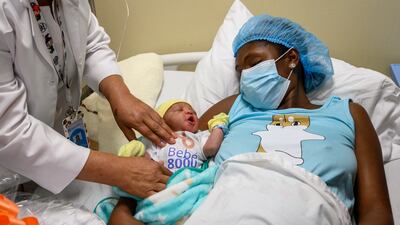
Damaris Ferrera with her baby at Damian Ferrera Altagracia Hospital – in Santo Domingo, Dominican Republic – which symbolically named him the eight billionth inhabitant of the world. AP -
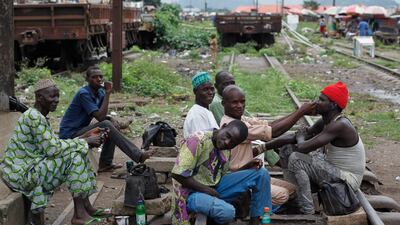
Barbers on an abandoned train track in Abeokuta, about 70km outside Lagos, Nigeria. More than half of the projected increase in the global population up to 2050 will be concentrated in eight countries: the Democratic Republic of Congo, Egypt, Ethiopia, India, Nigeria, Pakistan, the Philippines and Tanzania. EPA -

Newborn babies at Hotel Dieu hospital in Beirut, Lebanon, as the world population surges past eight billion. Reuters -

Crowds on Takeshita Street in Tokyo, considered to be the world's most populous metropolitan area. AFP -

Nigeria is a significant contributor to world population growth. Countries in sub-Saharan Africa are expected to contribute more than half of the increase anticipated up to 2050, according to the UN. AP -

A packed Ipanema beach in Rio de Janeiro, Brazil. AP -

Traffic chaos at Ojodu-Berger bus station in Lagos, Nigeria's commercial capital, which has a population of about 15 million. AFP -

A crowded market in Jalandhar, India. AFP -

A family taking pictures at the Temple of Heaven in Beijing. AP -

Commuters waiting for buses in Manila, Philippines, where the city's 12 million population swells by three million during working hours. AFP -

Mexico City is home to more than 20 million people. Reuters -

Times Square in Manhattan. About nine million people live in New York's five boroughs. Reuters -

A busy market in New Delhi, India, part of an urban area where the population is estimated to be 32 million. AP -

Commuters at a train station in Hong Kong. AFP -

Indian commuters get off trains at the Church Gate railway station in Mumbai, India. AP -

A subway station in Seoul. The South Korean capital has a population approaching 10 million. AFP


That could be partly related to Egypt going through a major transformation in between the two surveys, starting with the January 2011 uprising against president Hosni Mubarak until the July 2013 overthrow of president Mohammed Morsi.
“Between 2011 until 2013, there were no government efforts to support the family planning programme,” Dr Abdel Tawab explained.
The 2014 survey also showed that grassroots efforts to stop FGM were starting to have results, as support for the practice went down slightly. However, 70 per cent of young men and women still believed that FGM was necessary.
FGM has a direct link with population growth, as the majority of families who expose their daughters to the procedure also marry them off early.
The Population Council interviewed people aged between 10 and 29 in 2009 and the same people for the 2014 survey when they were four years older (the data was collected in 2013).
In 2023, the researchers will return to the original survey participants at nine years older, as well as a fresh sample of people aged 10 to 22 and for the first time young people with disabilities aged 10 to 29.
Dr Abdel Tawab secured the support of Capmas and the Ministry of Planning for its third study.
“When we work closely with government agencies, we identify problems together, we conduct research, we share the results with them and then we come up with joint recommendations,” she said.
Data collection will take place in February and March, and the final report is expected to be released later this year after the results are analysed.
“I expect this time that since the fertility rates have gone down, the desired fertility will be lower among young people,” Dr Abdel Tawab said.

Supply and demand issues
In recent years, the Ministry of Health and Population has encouraged families to have fewer children, launching an initiative called Two Is Enough in 2020 and offering family planning methods for free or at a discount.
Hussein Abdel Aziz, adviser to the head of Capmas, said in October that the goal was to reduce the fertility rate even further, from 2.8 to 1.6.
However, there is still much work to be done on both the “supply and demand side”, Dr Abdel Tawab said.
director of the Population Council's Egypt office
For example, while the health ministry offers free and subsidised family planning services, a strong private sector is needed to provide family planning methods at affordable prices.
There are cultural beliefs that persist, Dr Abdel Tawab said, such as “having a boy is better than having a girl”, which results in a husband “pushing his wife to have a third and a fourth child until they have a male”, and “the bigger the family is, the stronger it is”.
“Demand side means changing social norms to be gender equitable and to condone the two-child family norm,” she said. “It can’t be a campaign for a while that ‘two is enough’ and then it’s business as usual.”
The ways to achieve such goals range from offering education opportunities for girls to creating non-agricultural jobs for boys.
On a more practical level, health ministry surveys have shown that the main barrier for women who are not using family planning methods is not religious beliefs, but fear of contraception side effects.
Dr Abdel Tawab said some doctors were scaring women, spreading false claims that oral pills cause cancer or injections cause infertility. She suggested teaching family planning at medical schools.
The cost of having children is a factor to consider, but it is not as straightforward as one might think.
As Egyptians face the economic repercussions of the Russian invasion of Ukraine, such as double-digit inflation and a plunging currency, there is more awareness that the cost of living is increasing.
While the government has increased social protection measures to cushion the blow, population growth is putting an additional strain on resources and initiatives to improve the lives of citizens.
Yet, the expense of having more children is a consideration among families in urban areas who have higher expectations, but less so in rural areas. For example, those in urban areas may want their children to go to a private school, while those in rural areas might not expect that their children complete their education at all, Dr Abdel Tawab said.
“It’s a multifaceted intervention,” she said. “It’s not only to tell people not to have children. You need to show them evidence that by having fewer children, your children are better off and the whole family is better off.”

