The Arab and Jewish citizens behind the Going Together To Vote campaign are trying to drum up the Arab vote ahead of Israel's elections. Photos: Suheil Diab
Going Together To Vote says it addresses voters in Arabic and Hebrew with messages of 'common principles of peace, equality and social justice'.
Tuesday's vote is the fifth Israel general election in four years, and Going Together To Vote believes Israeli Arab voters can help to break a deadlock in their country's elections.
Banners and vuvuzelas were part of the campaigning as the group arrived to talk to football fans at an Israeli second division match between teams from Haifa District and Nazarth.
Statistics show that election participation by Arab Israeli and Palestinian Israeli voters is low. They make up about 20 per cent of Israel's population but less than half plan to cast a ballot. Apathy is one of Going Together To Vote's biggest hurdles.
The Arab and Jewish campaigners of Going Together To Vote put on a brave face. They fear the rise of far-right politicians in Israel, whose popularity is soaring in this campaign.
Two hours before the kick-off between Israeli second division football teams Hapoel Umm Al Fahm and Maccabi Ahi Nazareth, Suheil Diab and his fellow volunteers were busy unfurling banners and unwrapping vuvuzelas in the car park of Acre’s football stadium, in the north of the country.
They were up and ready long before the trickle of supporters started to arrive.
The group, Going Together To Vote, was made up of Arab and Jewish campaigners who were trying to encourage Israel’s Arab community to participate in Tuesday's elections.
Mr Diab said the match between two Arab teams was a perfect chance to tell his community why he chooses to vote and why they should, too.
“I am a Palestinian citizen of Israel. I think the interest of our society is to participate more in elections and bring more representatives for Arabs in the Knesset,” he said.
“Our organisation is unique because it is a collaboration of Arabs and Jews,” he said, flipping over a bilingual pamphlet.
“The messages we try to convey in Arabic we do in Hebrew, too. Most of the main parties in Israel are talking to either Jews or Arabs, not both at the same time. This separation has been forced on us since 1948. We want to change it.”
For Mr Diab and his colleagues, the first step in doing so is “starting from the grass roots of Jewish and Arab communities, underpinning our messages with the common principles of peace equality and social justice”.
Rather than just ideological, he also highlighted the immediate technical importance of the Arab vote during these elections.
“Through better democratic participation, Arabs and Jews can come together to conclude the endless cycle of elections that we have seen during the past three years.”
Tuesday's vote is the fifth in four years after repeated failures to form governments or keep them stable to the end of their terms. Analysts said that failure to deliver a clear winner could put Israel on course for a sixth round of voting.
Participation of Arab Israeli and Palestinian Israeli voters is low — while they make up about 20 per cent of Israel's population, polls show less than half plan to cast a ballot. That figure is down significantly from 2016's 63.5 per cent turnout for the community.
But Going Together To Vote puts on a brave face.
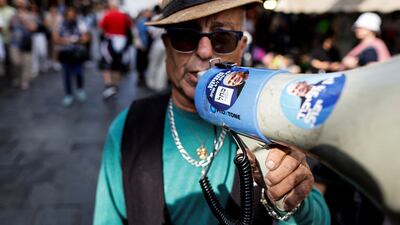
A supporter of former Israeli prime minister Benjamin Netanyahu's Likud party on the campaign trail at Mahane Yehuda market in Jerusalem on polling day's eve. Reuters
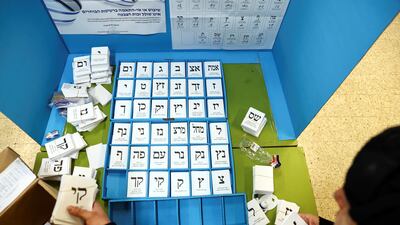
Officials sort ballot papers before a polling station opens to the voters of Kiryat Arba, a Jewish settlement in Hebron in the Israeli-occupied West Bank. Reuters
Far-right politician Itamar Ben-Gvir at the ballot box on general election day in Kiryat Arba, a Jewish settlement in Hebron in the Israeli-occupied West Bank. Reuters
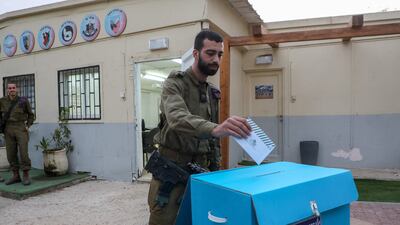
An Israeli soldier casts a ballot at Kerem Shalom Army Base in the south of Israel, close to the border with the Gaza strip. AFP
An election campaign billboard by Blue and White party on a bridge in Ramat Gan, Tel Aviv. Reuters
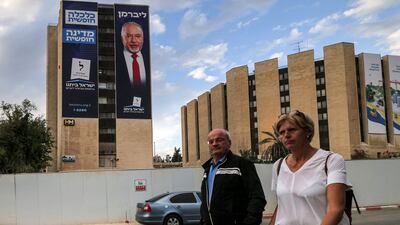
A billboard for Finance Minister Avigdor Lieberman's Yisrael Beiteinu party in Jerusalem. AFP
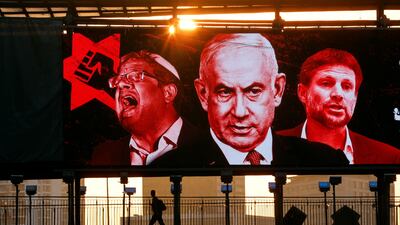
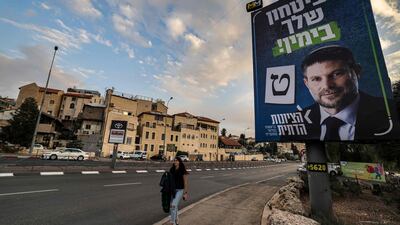
An billboard for the far-right Religious Zionist party led by Bezalel Smotrich. AFP
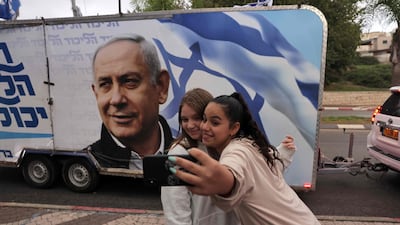
An election campaign bandwagon and a chance for a selfie as Benjamin Netanyahu aims to return Likud to power. AFP
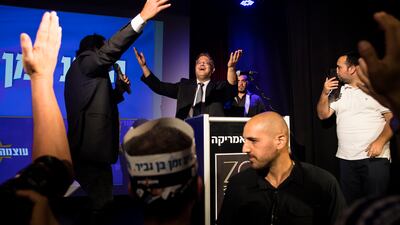
Itamar Ben-Gvir, Israeli far-right politician and leader of the Otzma Yehudit (Jewish power) party, greets supporters. AFP
Israelis hang a poster of Likud party candidate Benjamin Netanyahu in the southern city of Beersheva in the run up to Israel's election on November 1. AFP
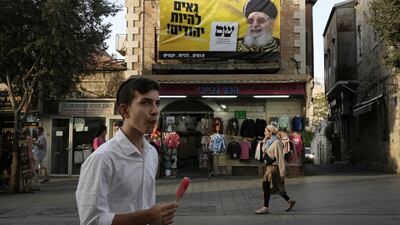
A popsicle break beneath an election campaign hoarding for Israel's ultra-Orthodox Shas political party near Mahane Yehuda market in Jerusalem. Israelis are back at the polls for a fifth time in less than four years. AP
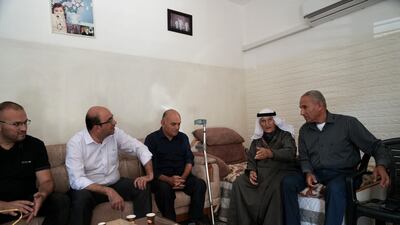
Knesset member Sami Abu Shehadeh, second left, head of the nationalist Balad party, meets Israel's Palestinian citizens during his election campaign tour in Musmus village. AP
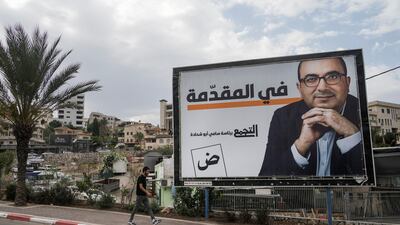
An election hoarding for Sami Abu Shehadeh's Balad party campaign in Umm Al Fahm. Israel’s Palestinian citizens could be central to breaking the country’s political deadlock. AP
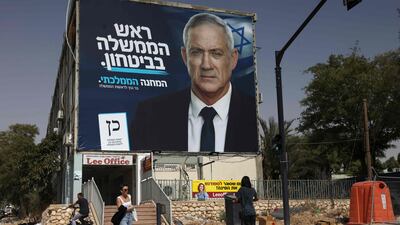
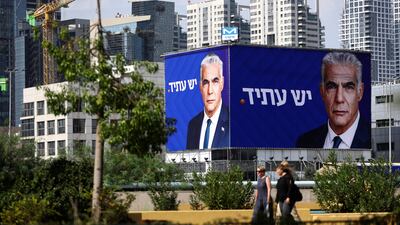
A campaign poster of National Unity Party leader Benny Gantz in the southern city of Beersheva. AFP
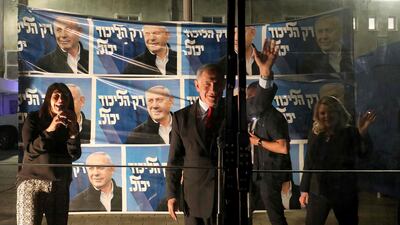
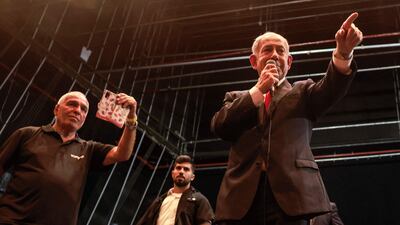
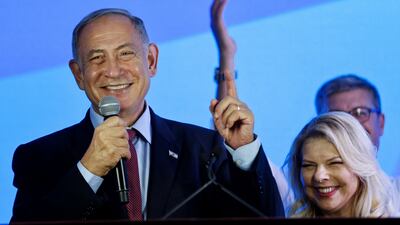
Benjamin Netanyahu addresses supporters from behind a security screen beside his wife Sara, right, and Likud member Miri Regev during a campaign rally in the northern city of Tirat Carmel. AFP
Itamar Ben-Gvir, Israeli far-right politician and leader of the Otzma Yehudit, at an event in Tel Aviv. Getty
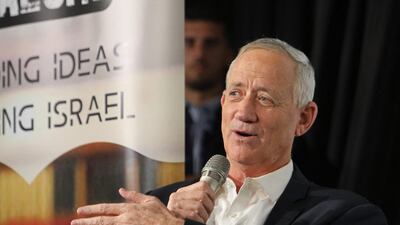
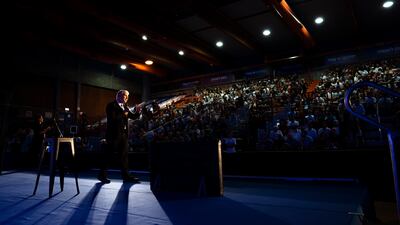
National Unity leader Benny Gantz makes an address in Tel Aviv. AFP
Since 2019, Israel has had four inconclusive elections, which resulted in two short-lived coalition governments. AFP
Likud's Benjamin Netanyahu speaks at a campaign rally at Migdal HaEmek in the Northern District of Israel. AFP
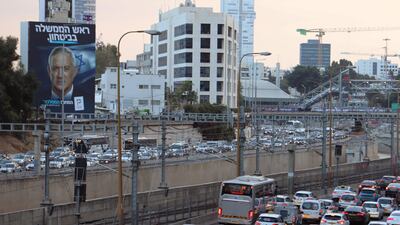
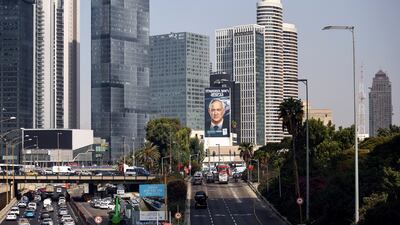
A giant image of National Unity's Benny Gantz looks over one of the motorways into Tel Aviv. Reuters
Israeli Prime Minister Yair Lapid leads a fragmented coalition spanning left to right. Reuters
Polls suggest Prime Minister Yair Lapid's camp is set for a weaker showing than in the last election. AP
Prime Minister Yair Lapid speaks at an event in the city of Rishon Lezion in Gush Dan. AP
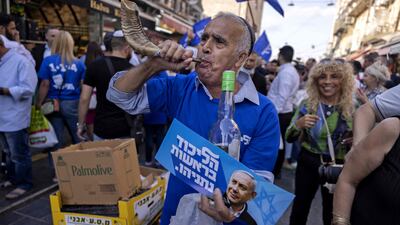
In Jerusalem, a Netanyahu supporter blows a shofar, made of a ram's horn. AFP
Benjamin Netanyahu has pledged to form a 'strong, stable and national' government. Reuters
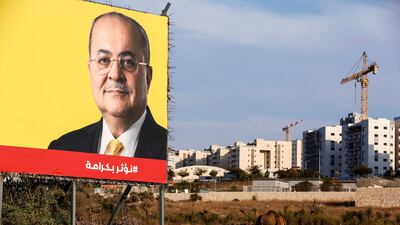
A poster of Arab politician Ahmad Tibi of the Ta'al party in his home town of Taibe in Gilboa region. Reuters
They say they fear the rise of far-right politicians, a number of whom have enjoyed soaring popularity in this campaign.
Itamar Ben-Gvir is running on a manifesto that includes the complete annexation of the West Bank and the formation of a government body to encourage Palestinian migration.
If Mr Ben-Gvir’s opponents fail to win enough seats on Tuesday, he still stands a good chance of being part of Israel’s next government. Therefore, they see the Arab vote as essential in preventing this.
Arab political leaders have been campaigning hard, imploring the community to vote.
“I am certainly aware that most members of Arab society want the extreme right to remain in the opposition,” Mansour Abbas, leader of the Arab party Ra’am and the first Israeli Arab party member of an Israeli Cabinet, said on Sunday.
Some at the match outside the stadium in Acre are receptive to this message.
But that is not always the case. In Acre’s old city, a half-hour walk away, the reception in the run-up to the election was less warm.
Itamar, one of the group’s volunteers, said he is still shaken by the experience as he explains people were shouting at him that they would not take part and nor would their families.
“Honestly, we felt resentment. People were hurting. You could see the pain in their eyes. Staring at me, knowing I was Jewish, they considered me as part of the problem,” he said.
And even in the calmer atmosphere in the stadium’s car park, some in the crowd still expressed reservations.
While Itamar was setting out a detailed survey of how Israeli politics went wrong in recent years, two Arab teenagers came over to ask which party Going Together To Vote was campaigning for.
“We don’t want you to vote for a particular party, we just want you to vote full stop,” Itamar told them.
The boys asked him what he meant.
The exchange highlights the challenge for groups like Going Together To Vote. They face not just voter fatigue after multiple rounds of voting but are trying to overcome deep suspicion and distrust of the entire system.
Itamar said he is sticking to his cause.
“We are in this together. Israel needs its Arab voters to keep the far-right out. I, a liberal Zionist who cares about the future of my country, need them personally. There may not be a second chance,” he said.
When the crowd had passed into the stadium, the campaigners started to pack up as the drumbeat and cheers from inside grew louder and the game began.
In the end, the Arab supporters got a lively match in which a player was sent off and a 3-0 victory for Hapoel Um El Fahem was the result.
The committed members of Going Together To Vote, along with all liberals in the country, will be hoping for a similar rally from Arab voters to head off the far right and prevent the need for a further election.

Who's who in Yemen conflict
Houthis: Iran-backed rebels who occupy Sanaa and run unrecognised government
Yemeni government: Exiled government in Aden led by eight-member Presidential Leadership Council
Southern Transitional Council: Faction in Yemeni government that seeks autonomy for the south
Habrish 'rebels': Tribal-backed forces feuding with STC over control of oil in government territory
The White Lotus: Season three
Creator: Mike White
Starring: Walton Goggins, Jason Isaacs, Natasha Rothwell
Rating: 4.5/5
Key facilities
Olympic-size swimming pool with a split bulkhead for multi-use configurations, including water polo and 50m/25m training lanes
Premier League-standard football pitch
400m Olympic running track
NBA-spec basketball court with auditorium
600-seat auditorium
Spaces for historical and cultural exploration
An elevated football field that doubles as a helipad
Specialist robotics and science laboratories
AR and VR-enabled learning centres
Disruption Lab and Research Centre for developing entrepreneurial skills
Fixtures and results:
Wed, Aug 29:
Malaysia bt Hong Kong by 3 wickets
Oman bt Nepal by 7 wickets
UAE bt Singapore by 215 runs
Thu, Aug 30:
UAE bt Nepal by 78 runs
Hong Kong bt Singapore by 5 wickets
Oman bt Malaysia by 2 wickets
Sat, Sep 1: UAE v Hong Kong; Oman v Singapore; Malaysia v Nepal
Sun, Sep 2: Hong Kong v Oman; Malaysia v UAE; Nepal v Singapore
Tue, Sep 4: Malaysia v Singapore; UAE v Oman; Nepal v Hong Kong
The Federal Tax Authority will track shisha imports with electronic markers to protect customers and ensure levies have been paid.
Khalid Ali Al Bustani, director of the tax authority, on Sunday said the move is to "prevent tax evasion and support the authority’s tax collection efforts".
The scheme’s first phase, which came into effect on 1st January, 2019, covers all types of imported and domestically produced and distributed cigarettes. As of May 1, importing any type of cigarettes without the digital marks will be prohibited.
He said the latest phase will see imported and locally produced shisha tobacco tracked by the final quarter of this year.
"The FTA also maintains ongoing communication with concerned companies, to help them adapt their systems to meet our requirements and coordinate between all parties involved," he said.
Mercer, the investment consulting arm of US services company Marsh & McLennan, expects its wealth division to at least double its assets under management (AUM) in the Middle East as wealth in the region continues to grow despite economic headwinds, a company official said.
Mercer Wealth, which globally has $160 billion in AUM, plans to boost its AUM in the region to $2-$3bn in the next 2-3 years from the present $1bn, said Yasir AbuShaban, a Dubai-based principal with Mercer Wealth.
“Within the next two to three years, we are looking at reaching $2 to $3 billion as a conservative estimate and we do see an opportunity to do so,” said Mr AbuShaban.
Mercer does not directly make investments, but allocates clients’ money they have discretion to, to professional asset managers. They also provide advice to clients.
“We have buying power. We can negotiate on their (client’s) behalf with asset managers to provide them lower fees than they otherwise would have to get on their own,” he added.
Mercer Wealth’s clients include sovereign wealth funds, family offices, and insurance companies among others.
From its office in Dubai, Mercer also looks after Africa, India and Turkey, where they also see opportunity for growth.
Wealth creation in Middle East and Africa (MEA) grew 8.5 per cent to $8.1 trillion last year from $7.5tn in 2015, higher than last year’s global average of 6 per cent and the second-highest growth in a region after Asia-Pacific which grew 9.9 per cent, according to consultancy Boston Consulting Group (BCG). In the region, where wealth grew just 1.9 per cent in 2015 compared with 2014, a pickup in oil prices has helped in wealth generation.
BCG is forecasting MEA wealth will rise to $12tn by 2021, growing at an annual average of 8 per cent.
Drivers of wealth generation in the region will be split evenly between new wealth creation and growth of performance of existing assets, according to BCG.
Another general trend in the region is clients’ looking for a comprehensive approach to investing, according to Mr AbuShaban.
“Institutional investors or some of the families are seeing a slowdown in the available capital they have to invest and in that sense they are looking at optimizing the way they manage their portfolios and making sure they are not investing haphazardly and different parts of their investment are working together,” said Mr AbuShaban.
Some clients also have a higher appetite for risk, given the low interest-rate environment that does not provide enough yield for some institutional investors. These clients are keen to invest in illiquid assets, such as private equity and infrastructure.
“What we have seen is a desire for higher returns in what has been a low-return environment specifically in various fixed income or bonds,” he said.
“In this environment, we have seen a de facto increase in the risk that clients are taking in things like illiquid investments, private equity investments, infrastructure and private debt, those kind of investments were higher illiquidity results in incrementally higher returns.”
The Abu Dhabi Investment Authority, one of the largest sovereign wealth funds, said in its 2016 report that has gradually increased its exposure in direct private equity and private credit transactions, mainly in Asian markets and especially in China and India. The authority’s private equity department focused on structured equities owing to “their defensive characteristics.”
Dust and sand storms compared
Sand storm
Particle size: Larger, heavier sand grains
Visibility: Often dramatic with thick "walls" of sand
Duration: Short-lived, typically localised
Travel distance: Limited
Source: Open desert areas with strong winds
Dust storm
Particle size: Much finer, lightweight particles
Visibility: Hazy skies but less intense
Duration: Can linger for days
Travel distance: Long-range, up to thousands of kilometres
Source: Can be carried from distant regions
Key findings of Jenkins report
Founder of the Muslim Brotherhood, Hassan al Banna, "accepted the political utility of violence"
Views of key Muslim Brotherhood ideologue, Sayyid Qutb, have “consistently been understood” as permitting “the use of extreme violence in the pursuit of the perfect Islamic society” and “never been institutionally disowned” by the movement.
Muslim Brotherhood at all levels has repeatedly defended Hamas attacks against Israel, including the use of suicide bombers and the killing of civilians.
Laying out the report in the House of Commons, David Cameron told MPs: "The main findings of the review support the conclusion that membership of, association with, or influence by the Muslim Brotherhood should be considered as a possible indicator of extremism."
Aryan Lakra (captain), Vriitya Aravind, Deshan Chethyia, Mohammed Farazuddin, Jonathan Figy, Osama Hassan, Karthik Meiyappan, Rishabh Mukherjee, Ali Naseer, Wasi Shah, Alishan Sharafu, Sanchit Sharma, Kai Smith, Akasha Tahir, Ansh Tandon
Other must-tries
Tomato and walnut salad
A lesson in simple, seasonal eating. Wedges of tomato, chunks of cucumber, thinly sliced red onion, coriander or parsley leaves, and perhaps some fresh dill are drizzled with a crushed walnut and garlic dressing. Do consider yourself warned: if you eat this salad in Georgia during the summer months, the tomatoes will be so ripe and flavourful that every tomato you eat from that day forth will taste lacklustre in comparison.
Badrijani nigvzit
A delicious vegetarian snack or starter. It consists of thinly sliced, fried then cooled aubergine smothered with a thick and creamy walnut sauce and folded or rolled. Take note, even though it seems like you should be able to pick these morsels up with your hands, they’re not as durable as they look. A knife and fork is the way to go.
Pkhali
This healthy little dish (a nice antidote to the khachapuri) is usually made with steamed then chopped cabbage, spinach, beetroot or green beans, combined with walnuts, garlic and herbs to make a vegetable pâté or paste. The mix is then often formed into rounds, chilled in the fridge and topped with pomegranate seeds before being served.
Some of Darwish's last words
"They see their tomorrows slipping out of their reach. And though it seems to them that everything outside this reality is heaven, yet they do not want to go to that heaven. They stay, because they are afflicted with hope." - Mahmoud Darwish, to attendees of the Palestine Festival of Literature, 2008
His life in brief: Born in a village near Galilee, he lived in exile for most of his life and started writing poetry after high school. He was arrested several times by Israel for what were deemed to be inciteful poems. Most of his work focused on the love and yearning for his homeland, and he was regarded the Palestinian poet of resistance. Over the course of his life, he published more than 30 poetry collections and books of prose, with his work translated into more than 20 languages. Many of his poems were set to music by Arab composers, most significantly Marcel Khalife. Darwish died on August 9, 2008 after undergoing heart surgery in the United States. He was later buried in Ramallah where a shrine was erected in his honour.
Blackpink World Tour [Born Pink] In Cinemas
Starring: Rose, Jisoo, Jennie, Lisa
Directors: Min Geun, Oh Yoon-Dong
Rating: 3/5
The specs
Engine: 3.0-litre twin-turbo flat-six
Power: 480hp at 6,500rpm
Torque: 570Nm from 2,300-5,000rpm
Transmission: 8-speed dual-clutch auto
Fuel consumption: 10.4L/100km
Price: from Dh547,600
On sale: now
Our family matters legal consultant
Name: Hassan Mohsen Elhais
Position: legal consultant with Al Rowaad Advocates and Legal Consultants.