

Turkey’s status as host to the world’s largest refugee population was once a badge of pride — a display of compassion for those fleeing war and poverty across the border in Syria, as well as a way of underlining the West’s ambivalent response to refugee crises.
But for a long time the welcome once extended to their southern neighbours has been wearing thin.
With elections on the horizon and anti-migrant political rhetoric on the rise, many of the 3.7 million Syrians living in Turkey — by far the largest group among the country’s 4 million-strong refugee population — see an increasingly uncertain future in the land they have made home over the last decade.
“I don’t know how much longer we will be able to stay here,” said Hassan Khalaf, a 39-year-old Syrian working at a cafe in Istanbul’s Kucukcekmece district. “Every day our problems seem to grow and life becomes more difficult.”
Mr Khalaf, a father of two who came to Turkey nine years ago, described a growing antipathy among Turks towards Syrians, as well as stricter restrictions on those living in Istanbul.
“People often make comments to me about how I should go back to Syria. They ask why we are taking jobs from Turks or using their public services like hospitals,” he said.
“I know people who’ve been stopped in the street [in Istanbul] by police and put on buses to other parts of Turkey. Of course, we’ve all heard about others who have been forced to return to Syria against their will.”
Syrians live in Turkey under the status of “temporary protection” and are allocated a province in which to live. Travel outside their province is highly regulated but many still move to cities such as Istanbul for work.
But those job opportunities are becoming increasingly scarce as Turkey faces its worst economic crisis in 20 years, with inflation exceeding 80 per cent and unemployment passing 22 per cent last month.

“I used to work as a cleaner but now I can’t find anything,” said Fatma, 47, who declined to give her surname. “People prefer not to hire Syrians now but also there are less jobs because people cannot afford to give work to someone to clean their home.”
Turkey’s opposition parties have long called for the repatriation of Syrians to areas under the control of the Turkish military.
Meral Aksener, who leads the nationalist Iyi Party that is the second-largest in the four-party opposition bloc, earlier this month vowed to eject all Syrian refugees by 2026, saying Turkey had become an “immigrant warehouse” and a “near garbage dump” for Europe.
But it is a former Iyi Party executive, Umit Ozdag, who has truly weaponised anti-migrant sentiment. In the space of a year, support for his newly formed Zafer Party has risen to 2.2 per cent.
Syrians in Idlib join 'peace convoy' to seek asylum in Europe — in pictures
-
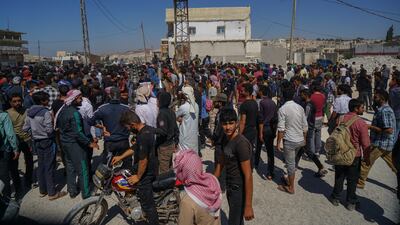
Syrians plead with local authorities to open the way for them to reach Turkey via the Bab al-Hawa border crossing. All photos: Moawia Atrash for The National -
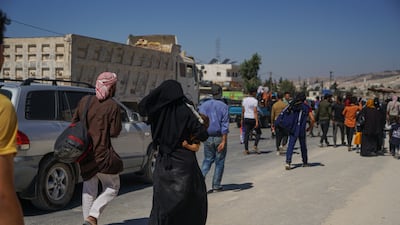
A man and his wife run towards the Syrian-Turkish border in a peace convoy called Al Salam, the organisers of which aim to enable Syrians to leave Idlib and the civil war behind for pastures new in Europe. -
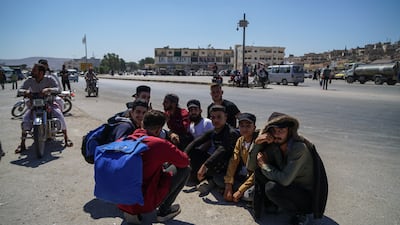
People wait for permission to approach the crossing and ask that Turkey open its terminal so that they can cross into Europe and escape the scourge of war. -
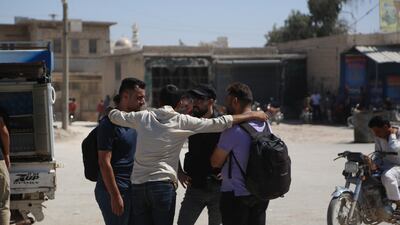
These Syrian friends are unsure when or even if they will see each other again. -

The civil war in Syria has been raging for more than 11 years. -
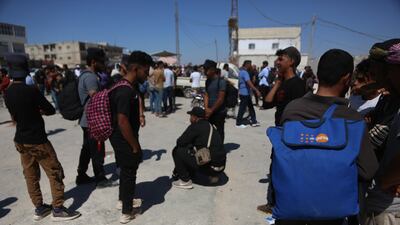
Thousands who want to leave head for the Bab al-Hawa crossing. -
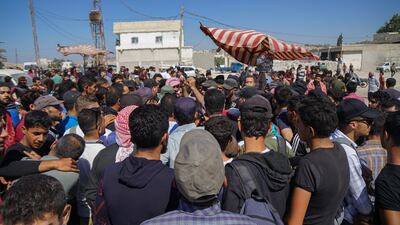
Syrians seeking asylum in Europe via Turkey demonstrate under the name of the Peace Caravan at Bab al-Hawa. -
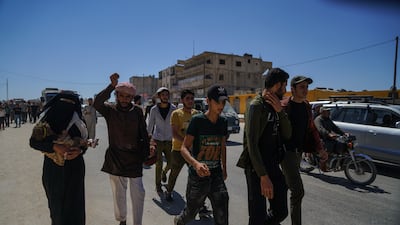
A man, his wife and their infant child join the peace convoy. -
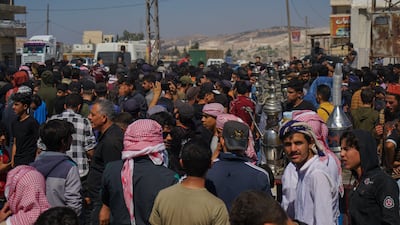
Escaping the conflict, as well as poverty and a lack of money, are the main drivers for the influx of people. -

The hope is for a better life away from the clutches of Bashar Al Assad's regime.


The rising anti-refugee rhetoric has had tragic consequences for Syrians, according to migrant support groups.
Earlier this month a 17-year-old Syrian was stabbed to death in the southern city of Antakya after a workplace disagreement.
“All parties, especially the opposition parties, are talking about returning to Syria under the current [Syrian] government,” said Metin Corabatir, president of the Research Centre on Asylum and Migration in Ankara.
“It makes electoral profit, as Umit Ozdag’s rise in the polls shows. This has a very traumatic impact on refugees. Threatening to send them back to a risky country of origin also leads to physical threats and harassment, even killings. You can see the impact at all levels of society.”
With elections due within 10 months, President Recep Tayyip Erdogan, whose poll ratings have dropped as the economy has worsened, has moved closer to the opposition’s position.
In May he announced plans to build 200,000 homes in Syria for 1 million returnees. Some 500,000 had already returned to areas close to the Turkish border, Mr Erdogan said, adding that 20,000 Syrians had been deported for breaching residency rules.
Further alarming those who fled President Bashar Al Assad’s regime, Mr Erdogan last month indicated a softening of Ankara’s stance towards the Syrian government.
“Political dialogue and diplomacy cannot be cut off between states,” he said about the administration he cut ties with in 2011. Foreign Minister Mevlut Cavusoglu had earlier revealed talks with his Syrian counterpart.
Plans for returning Syrians, however, could contravene international law against “refoulement”. The United Nations’ refugee agency said return to Syria is prevented by continuing human rights abuses, insecurity, disruption of essential services and internal displacement.
“Only a political solution would allow many people to go back to their homes in their country, which is the best solution for any refugee situation,” spokeswoman Selin Unal said.
Amid rising xenophobia in Turkey — a March survey by MetroPoll found 82 per cent of voters wanted refugees to leave — many migrants are looking for alternatives.
Last week it emerged that refugees were organising a “Caravan of Light” to head for Europe. However, the planned exodus showed no sign of materialising, perhaps due to the violent reaction of Greek security forces when thousands headed to the border in early 2020.
However, according to Mr Corabatir, the initiative showed “there is real frustration in Turkey and a desire to go to the West.”

