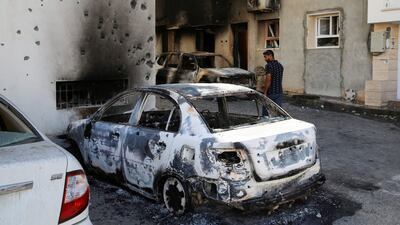
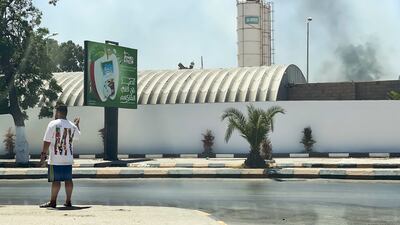
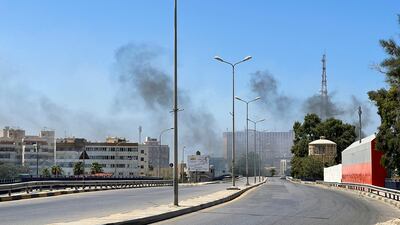
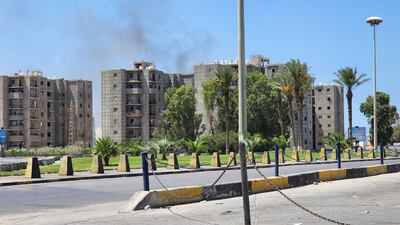
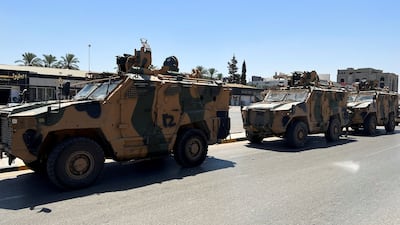
Fighters loyal to Libya's Government of National Unity pass a burning car on a street in Tripoli following clashes between militias. AFP

Libya’s rival governments blame each other for bloody clashes


Ahmed Maher
  • English
  • Arabic

Libya’s rival governments have sought to avoid blame for bloody clashes in the capital Tripoli that brought the country’s political crisis to a fresh nadir.

The fighting that broke out on Saturday pitted militias loyal to the Tripoli-based government led by Abdul Hamid Dbeibah against armed groups allied with the government of Fathi Bashagha, which is based in the central city of Sirte. At least 32 people were killed and 159 wounded.

The armed groups set buildings on fire and spread panic across the streets of the capital, which has witnessed sporadic clashes in recent months.

Mr Dbeibah and Mr Bashagha held each other responsible for the violence in messages released after the fighting subsided on Sunday.

“Elections are the only solution to the political crisis in Libya,” Mr Dbeibah said in a statement posted on his Facebook page.

“I want to reassure you [the Libyan people] that the aggression is over. The dream of elections is approaching. And I would like to tell them [the Bashagha camp] the Libyans have rejected to extend the rule of your government, which has lost its legitimacy.”

The violence took place despite the meetings held last month in Tripoli by senior military figures from Libya's eastern and western power bases in a bid to unify command over militias and troops, as well as to discuss the issue of mercenaries and foreign fighters.

  • A car burnt during clashes in Tripoli. Reuters
    A car burnt during clashes in Tripoli. Reuters
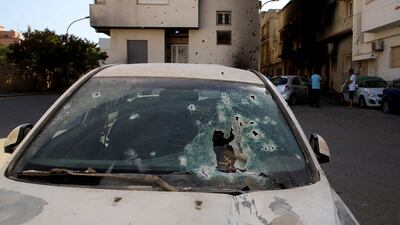
  • A car's smashed windshield. Reuters
    A car's smashed windshield. Reuters
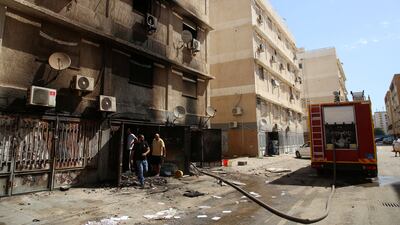
  • Firefighters put out a fire inside a shop. Reuters
    Firefighters put out a fire inside a shop. Reuters
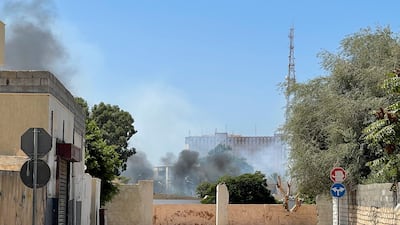
  • A burning building. Reuters
    A burning building. Reuters
  • Empty bullets are found on the ground. Reuters
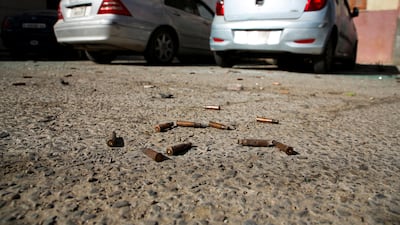
    Empty bullets are found on the ground. Reuters
  • A man surveys the damage from clashes in the Libyan capital of Tripoli. AP
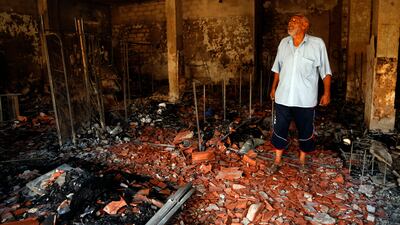
    A man surveys the damage from clashes in the Libyan capital of Tripoli. AP
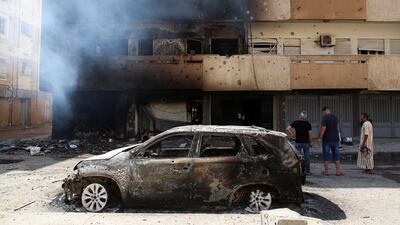
  • A car burns in the street. Reuters
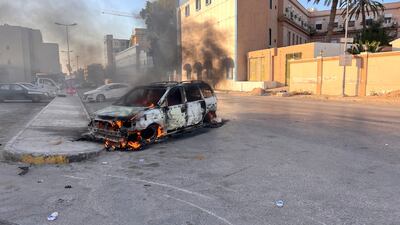
    A car burns in the street. Reuters
  • Fighters loyal to the head of Libya's Government of National Unity gather in the street. Reuters
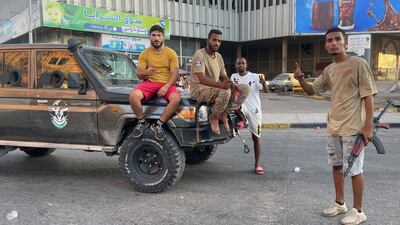
    Fighters loyal to the head of Libya's Government of National Unity gather in the street. Reuters
  • Fighters loyal to the Government of National Unity following clashes between rival Libyan groups. AFP
    Fighters loyal to the Government of National Unity following clashes between rival Libyan groups. AFP
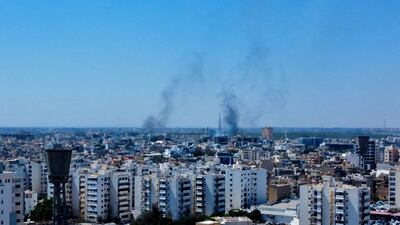
  • Smoke rises following the fighting. Reuters
    Smoke rises following the fighting. Reuters
  • Clashes broke out on Saturday between rival militias, a health official said. AP
    Clashes broke out on Saturday between rival militias, a health official said. AP
  • The fighting broke out in various districts of Tripoli, as two rival governments yet again vie for power in the oil-rich but impoverished North African country. AFP
    The fighting broke out in various districts of Tripoli, as two rival governments yet again vie for power in the oil-rich but impoverished North African country. AFP
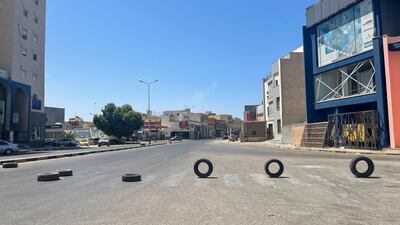
  • Tyres are used to section off a road in Tripoli. AFP
    Tyres are used to section off a road in Tripoli. AFP
  • The fighting wounded civilians and raised fears of all-out conflict in a country facing a grave political crisis. AFP
    The fighting wounded civilians and raised fears of all-out conflict in a country facing a grave political crisis. AFP
  • Smoke billows as gunfire rings out in the capital. AFP
    Smoke billows as gunfire rings out in the capital. AFP
  • Fighting has left Tripoli completely deserted. AFP
    Fighting has left Tripoli completely deserted. AFP
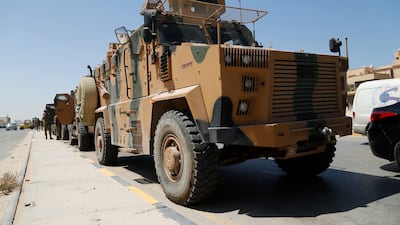
  • Military vehicles of the 444 Brigade, backing the Government of National Unity patrol the streets. Reuters
    Military vehicles of the 444 Brigade, backing the Government of National Unity patrol the streets. Reuters

Mr Dbeibah's government was installed last year through a UN-backed process, with the task of leading the country to the first presidential election in Libya’s history. The poll was scheduled for December but was not held amid disputes over election laws and controversial candidates.

Parliament appointed the government led by Mr Bashagha earlier this year, saying the mandate for Mr Dbeibah's government had expired.

Mr Bashagha laid the blame for the weekend's violence with the Tripoli camp, adding that Mr Dbeibah ticked all the boxes of a dictatorship.

“The so-called Abdul Hamid Dbeibah and his special advisers from members of his ruling family and armed gangs with him are responsible for the bloodshed,” he said in a statement published by Libya media outlets supporting his government.

“What happened was the result of their obsession with money and power. They are clinging to the office despite the people’s will and rejected the principle of peaceful transfer of power.”

In a move that could provoke a full-blown conflict, the military prosecutor of the Dbeibah government, Massoud Rahouma Muftah, placed a travel ban on Mr Bashagha and ordered his arrest along with his military and civilian aides over the violence in Tripoli.

Mr Bashagha’s supporters dismissed the orders as impractical and called the military prosecutor in Tripoli “worthless”.

The resurgence of fighting in the capital comes as living conditions deteriorate for ordinary Libyans, mainly because of fuel shortages in the oil-rich nation caused by recurring shutdowns of oil facilities by militias backed by tribal leaders.


Mountain%20Boy
%3Cp%3E%3Cstrong%3EDirector%3A%3C%2Fstrong%3E%20Zainab%20Shaheen%3C%2Fp%3E%0A%3Cp%3E%3Cstrong%3EStarring%3A%3C%2Fstrong%3E%20Naser%20Al%20Messabi%3C%2Fp%3E%0A%3Cp%3E%3Cstrong%3ERating%3C%2Fstrong%3E%3A%203%2F5%3C%2Fp%3E%0A
Who was Alfred Nobel?

The Nobel Prize was created by wealthy Swedish chemist and entrepreneur Alfred Nobel.

  • In his will he dictated that the bulk of his estate should be used to fund "prizes to those who, during the preceding year, have conferred the greatest benefit to humankind".
  • Nobel is best known as the inventor of dynamite, but also wrote poetry and drama and could speak Russian, French, English and German by the age of 17. The five original prize categories reflect the interests closest to his heart.
  • Nobel died in 1896 but it took until 1901, following a legal battle over his will, before the first prizes were awarded.
The burning issue

The internal combustion engine is facing a watershed moment – major manufacturer Volvo is to stop producing petroleum-powered vehicles by 2021 and countries in Europe, including the UK, have vowed to ban their sale before 2040. The National takes a look at the story of one of the most successful technologies of the last 100 years and how it has impacted life in the UAE. 

Read part four: an affection for classic cars lives on

Read part three: the age of the electric vehicle begins

Read part two: how climate change drove the race for an alternative 

David Haye record

Total fights: 32
Wins: 28
Wins by KO: 26
Losses: 4

Mercer, the investment consulting arm of US services company Marsh & McLennan, expects its wealth division to at least double its assets under management (AUM) in the Middle East as wealth in the region continues to grow despite economic headwinds, a company official said.

Mercer Wealth, which globally has $160 billion in AUM, plans to boost its AUM in the region to $2-$3bn in the next 2-3 years from the present $1bn, said Yasir AbuShaban, a Dubai-based principal with Mercer Wealth.

Within the next two to three years, we are looking at reaching $2 to $3 billion as a conservative estimate and we do see an opportunity to do so,” said Mr AbuShaban.

Mercer does not directly make investments, but allocates clients’ money they have discretion to, to professional asset managers. They also provide advice to clients.

“We have buying power. We can negotiate on their (client’s) behalf with asset managers to provide them lower fees than they otherwise would have to get on their own,” he added.

Mercer Wealth’s clients include sovereign wealth funds, family offices, and insurance companies among others.

From its office in Dubai, Mercer also looks after Africa, India and Turkey, where they also see opportunity for growth.

Wealth creation in Middle East and Africa (MEA) grew 8.5 per cent to $8.1 trillion last year from $7.5tn in 2015, higher than last year’s global average of 6 per cent and the second-highest growth in a region after Asia-Pacific which grew 9.9 per cent, according to consultancy Boston Consulting Group (BCG). In the region, where wealth grew just 1.9 per cent in 2015 compared with 2014, a pickup in oil prices has helped in wealth generation.

BCG is forecasting MEA wealth will rise to $12tn by 2021, growing at an annual average of 8 per cent.

Drivers of wealth generation in the region will be split evenly between new wealth creation and growth of performance of existing assets, according to BCG.

Another general trend in the region is clients’ looking for a comprehensive approach to investing, according to Mr AbuShaban.

“Institutional investors or some of the families are seeing a slowdown in the available capital they have to invest and in that sense they are looking at optimizing the way they manage their portfolios and making sure they are not investing haphazardly and different parts of their investment are working together,” said Mr AbuShaban.

Some clients also have a higher appetite for risk, given the low interest-rate environment that does not provide enough yield for some institutional investors. These clients are keen to invest in illiquid assets, such as private equity and infrastructure.

“What we have seen is a desire for higher returns in what has been a low-return environment specifically in various fixed income or bonds,” he said.

“In this environment, we have seen a de facto increase in the risk that clients are taking in things like illiquid investments, private equity investments, infrastructure and private debt, those kind of investments were higher illiquidity results in incrementally higher returns.”

The Abu Dhabi Investment Authority, one of the largest sovereign wealth funds, said in its 2016 report that has gradually increased its exposure in direct private equity and private credit transactions, mainly in Asian markets and especially in China and India. The authority’s private equity department focused on structured equities owing to “their defensive characteristics.”

Desert Warrior

Starring: Anthony Mackie, Aiysha Hart, Ben Kingsley

Director: Rupert Wyatt

Rating: 3/5

UAE currency: the story behind the money in your pockets
A%20MAN%20FROM%20MOTIHARI
%3Cp%3E%3Cstrong%3EAuthor%3A%20%3C%2Fstrong%3EAbdullah%20Khan%0D%3Cbr%3E%3Cstrong%3EPublisher%3A%20%3C%2Fstrong%3EPenguin%20Random%20House%3Cbr%3E%3Cstrong%3EPages%3A%20%3C%2Fstrong%3E304%0D%3Cbr%3E%3Cstrong%3EAvailable%3A%20%3C%2Fstrong%3ENow%0D%3Cbr%3E%3C%2Fp%3E%0A
Updated: August 29, 2022, 8:25 AM