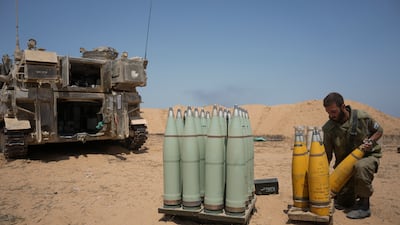
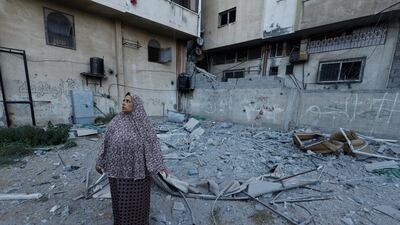
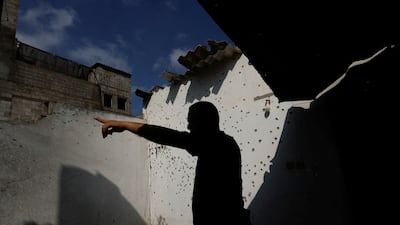
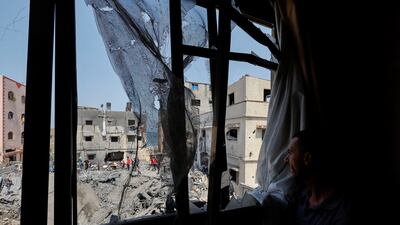
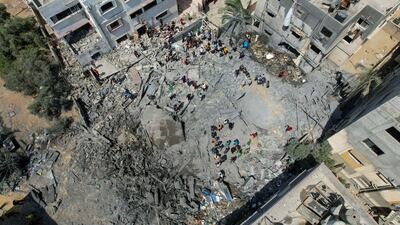
With empty streets and drawn curtains, Gaza feels like a ghost town. Its residents, tested by repeated wars, feel like they are living the same scenes again and again.
Before Israel launched its “pre-emptive” strikes on militants in the Gaza Strip, the Palestinian territory was enjoying a summer unlike any other in recent years.
Gaza's beaches, long deemed too polluted with waste water for swimming, had been declared mostly usable again, allowing swimmers and surfers to rediscover the joys of the sea.
All that came to an abrupt halt on Friday, when Israel again bombarded the territory, citing threats from Islamic Jihad militants.
“We were living in peace and suddenly the bombardment began,” said Mohammed Hamami, 40.
“Enough! Enough!” he said. “Each month or each year there is a war.”
There have been four conflicts since 2007 between Israel and armed groups from Gaza.
The beach promenade, one of the impoverished and densely populated territory's rare leisure spots, crowded less than 24 hours earlier, was desolate on Saturday.
Street sellers stayed at home and cafes were shut.
Fifteen months after the last conflict between Israel and armed groups in the territory brought devastation to countless Gazans, Mr Hamami said he was “surprised” that Israel had attacked again.
Twice in July, Israeli jets had struck Gaza after what the military said was rocket and rifle fire from the territory. But this time the military said it was preparing for a week-long operation.
Israel has placed Gaza under a blockade since 2007, the year Hamas took power in the territory.
Israel's army said its latest campaign was targeting militant sites and fighters, estimating that 15 combatants had been killed.
Palestinian militants retaliated with rocket fire.
The Hamas-run health ministry has reported 13 deaths from Israeli fire including a 5-year-old girl, Alaa Kaddum, who was killed on Friday. Her father carried her at her funeral, with a wound on her forehead and a pink bow in her hair.
More than 110 other people have been wounded, the ministry said.
For Gazans, the long night and second day of Israeli strikes stirred familiar and unwelcome emotions.
This latest escalation brings back images of fear, anxiety, and the feeling that we are all alone
Dounia Ismail,
Gaza City resident
“This latest escalation brings back images of fear, anxiety, and the feeling that we are all alone,” said Dounia Ismail, a Gaza city resident.
The incessant explosions and air strikes had kept her up all night, she said.
“It has become a habit for Palestinians in Gaza to prepare a survival bag, which contains a few important things, like photos, documents and some money and medicine,” in case they have to flee their homes, Ms Ismail said.
“I hope this escalation won't turn into a bigger conflict and I hope the Egyptian mediation will restore calm.”
In Jabalia, in Gaza's north, Fouad Farajallah inspected what remained of his home, hit by an Israeli strike on Friday.
The living room had turned into a mass of sheet metal and rubble, the fan dangling from the ceiling.
“I was sitting here on the sofa, with my wife and children, and suddenly it all fell on us,” he said.
“My wife broke her hand and my son was wounded by shrapnel.”
Even when silence returns between bombardments, something else fills the air: the buzzing of Israeli drones.

The Brutalist
Director: Brady Corbet
Stars: Adrien Brody, Felicity Jones, Guy Pearce, Joe Alwyn
Rating: 3.5/5
Cultural fiesta
What: The Al Burda Festival
When: November 14 (from 10am)
Where: Warehouse421, Abu Dhabi
The Al Burda Festival is a celebration of Islamic art and culture, featuring talks, performances and exhibitions. Organised by the Ministry of Culture and Knowledge Development, this one-day event opens with a session on the future of Islamic art. With this in mind, it is followed by a number of workshops and “masterclass” sessions in everything from calligraphy and typography to geometry and the origins of Islamic design. There will also be discussions on subjects including ‘Who is the Audience for Islamic Art?’ and ‘New Markets for Islamic Design.’ A live performance from Kuwaiti guitarist Yousif Yaseen should be one of the highlights of the day.
The UAE squad for the Asian Indoor and Martial Arts Games
The jiu-jitsu men’s team: Faisal Al Ketbi, Zayed Al Kaabi, Yahia Al Hammadi, Taleb Al Kirbi, Obaid Al Nuaimi, Omar Al Fadhli, Zayed Al Mansoori, Saeed Al Mazroui, Ibrahim Al Hosani, Mohammed Al Qubaisi, Salem Al Suwaidi, Khalfan Belhol, Saood Al Hammadi.
Women’s team: Mouza Al Shamsi, Wadeema Al Yafei, Reem Al Hashmi, Mahra Al Hanaei, Bashayer Al Matrooshi, Hessa Thani, Salwa Al Ali.
EA Sports FC 24
UAE currency: the story behind the money in your pockets
Other ways to buy used products in the UAE
UAE insurance firm Al Wathba National Insurance Company (AWNIC) last year launched an e-commerce website with a facility enabling users to buy car wrecks.
Bidders and potential buyers register on the online salvage car auction portal to view vehicles, review condition reports, or arrange physical surveys, and then start bidding for motors they plan to restore or harvest for parts.
Physical salvage car auctions are a common method for insurers around the world to move on heavily damaged vehicles, but AWNIC is one of the few UAE insurers to offer such services online.
For cars and less sizeable items such as bicycles and furniture, Dubizzle is arguably the best-known marketplace for pre-loved.
Founded in 2005, in recent years it has been joined by a plethora of Facebook community pages for shifting used goods, including Abu Dhabi Marketplace, Flea Market UAE and Arabian Ranches Souq Market while sites such as The Luxury Closet and Riot deal largely in second-hand fashion.
At the high-end of the pre-used spectrum, resellers such as Timepiece360.ae, WatchBox Middle East and Watches Market Dubai deal in authenticated second-hand luxury timepieces from brands such as Rolex, Hublot and Tag Heuer, with a warranty.
Mercer, the investment consulting arm of US services company Marsh & McLennan, expects its wealth division to at least double its assets under management (AUM) in the Middle East as wealth in the region continues to grow despite economic headwinds, a company official said.
Mercer Wealth, which globally has $160 billion in AUM, plans to boost its AUM in the region to $2-$3bn in the next 2-3 years from the present $1bn, said Yasir AbuShaban, a Dubai-based principal with Mercer Wealth.
“Within the next two to three years, we are looking at reaching $2 to $3 billion as a conservative estimate and we do see an opportunity to do so,” said Mr AbuShaban.
Mercer does not directly make investments, but allocates clients’ money they have discretion to, to professional asset managers. They also provide advice to clients.
“We have buying power. We can negotiate on their (client’s) behalf with asset managers to provide them lower fees than they otherwise would have to get on their own,” he added.
Mercer Wealth’s clients include sovereign wealth funds, family offices, and insurance companies among others.
From its office in Dubai, Mercer also looks after Africa, India and Turkey, where they also see opportunity for growth.
Wealth creation in Middle East and Africa (MEA) grew 8.5 per cent to $8.1 trillion last year from $7.5tn in 2015, higher than last year’s global average of 6 per cent and the second-highest growth in a region after Asia-Pacific which grew 9.9 per cent, according to consultancy Boston Consulting Group (BCG). In the region, where wealth grew just 1.9 per cent in 2015 compared with 2014, a pickup in oil prices has helped in wealth generation.
BCG is forecasting MEA wealth will rise to $12tn by 2021, growing at an annual average of 8 per cent.
Drivers of wealth generation in the region will be split evenly between new wealth creation and growth of performance of existing assets, according to BCG.
Another general trend in the region is clients’ looking for a comprehensive approach to investing, according to Mr AbuShaban.
“Institutional investors or some of the families are seeing a slowdown in the available capital they have to invest and in that sense they are looking at optimizing the way they manage their portfolios and making sure they are not investing haphazardly and different parts of their investment are working together,” said Mr AbuShaban.
Some clients also have a higher appetite for risk, given the low interest-rate environment that does not provide enough yield for some institutional investors. These clients are keen to invest in illiquid assets, such as private equity and infrastructure.
“What we have seen is a desire for higher returns in what has been a low-return environment specifically in various fixed income or bonds,” he said.
“In this environment, we have seen a de facto increase in the risk that clients are taking in things like illiquid investments, private equity investments, infrastructure and private debt, those kind of investments were higher illiquidity results in incrementally higher returns.”
The Abu Dhabi Investment Authority, one of the largest sovereign wealth funds, said in its 2016 report that has gradually increased its exposure in direct private equity and private credit transactions, mainly in Asian markets and especially in China and India. The authority’s private equity department focused on structured equities owing to “their defensive characteristics.”
Pieces of Her
Stars: Toni Collette, Bella Heathcote, David Wenham, Omari Hardwick
Director: Minkie Spiro
Rating:2/5
Match info
Manchester United 4
(Pogba 5', 33', Rashford 45', Lukaku 72')
Bournemouth 1
(Ake 45 2')
Red card: Eric Bailly (Manchester United)
Scoreline
UAE 2-1 Saudi Arabia
UAE Mabkhout 21’, Khalil 59’
Saudi Al Abed (pen) 20’
Man of the match Ahmed Khalil (UAE)
Jordan cabinet changes
In
- Raed Mozafar Abu Al Saoud, Minister of Water and Irrigation
- Dr Bassam Samir Al Talhouni, Minister of Justice
- Majd Mohamed Shoueikeh, State Minister of Development of Foundation Performance
- Azmi Mahmud Mohafaza, Minister of Education and Minister of Higher Education and Scientific Research
- Falah Abdalla Al Ammoush, Minister of Public Works and Housing
- Basma Moussa Ishakat, Minister of Social Development
- Dr Ghazi Monawar Al Zein, Minister of Health
- Ibrahim Sobhi Alshahahede, Minister of Agriculture and Minister of Environment
- Dr Mohamed Suleiman Aburamman, Minister of Culture and Minister of Youth
Out
- Dr Adel Issa Al Tawissi, Minister of High Education and Scientific Research
- Hala Noaman “Basiso Lattouf”, Minister of Social Development
- Dr Mahmud Yassin Al Sheyab, Minister of Health
- Yahya Moussa Kasbi, Minister of Public Works and Housing
- Nayef Hamidi Al Fayez, Minister of Environment
- Majd Mohamed Shoueika, Minister of Public Sector Development
- Khalid Moussa Al Huneifat, Minister of Agriculture
- Dr Awad Abu Jarad Al Mushakiba, Minister of Justice
- Mounir Moussa Ouwais, Minister of Water and Agriculture
- Dr Azmi Mahmud Mohafaza, Minister of Education
- Mokarram Mustafa Al Kaysi, Minister of Youth
- Basma Mohamed Al Nousour, Minister of Culture
The specs
Engine: 4.0-litre flat-six
Torque: 450Nm at 6,100rpm
Transmission: 7-speed PDK auto or 6-speed manual
Fuel economy, combined: 13.8L/100km
On sale: Available to order now
You might also like to read
Brief scores:
Newcastle United 1
Perez 23'
Wolverhampton Rovers 2
Jota 17', Doherty 90' 4
Red cards: Yedlin 57'
Man of the Match: Diogo Jota (Wolves)
England's lowest Test innings
- 45 v Australia in Sydney, January 28, 1887
- 46 v West Indies in Port of Spain, March 25, 1994
- 51 v West Indies in Kingston, February 4, 2009
- 52 v Australia at The Oval, August 14, 1948
- 53 v Australia at Lord's, July 16, 1888
- 58 v New Zealand in Auckland, March 22, 2018
The biog
Favourite Emirati dish: Fish machboos
Favourite spice: Cumin
Family: mother, three sisters, three brothers and a two-year-old daughter