Riad Salameh has come under intense scrutiny since the Lebanese economy collapsed in 2019. AP

Lebanon security forces sent to raid home of central bank governor


  • English
  • Arabic

Lebanon's state security forces on Wednesday raided a home belonging to central bank governor Riad Salameh after an overnight stakeout.

Judge Ghada Aoun, the Mount Lebanon state prosecutor who has charged the central bank governor, along with his brother Raja Salameh, with illicit enrichment, also participated in Wednesday's raid by state security forces.

Ms Aoun, who personally oversaw the search of Mr Salameh's property, was accompanied by a treasury expert with equipment used to break into safes, local media reported.

Wednesday marks the first successful raid on the governor's property. Mr Salameh, the subject of two separate corruption investigations in Lebanon, has failed to appear at several hearings.

During the stakeout, a judicial source had called Mr Salameh's reluctance to co-operate with the judiciary a “provocation” and told The National further action would be taken soon.

“We have to do our work. We will take all legal measures to ensure our work is done,” the source said.

Mr Salameh was reportedly not at the property in the town of Rabieh, on the northern edge of Greater Beirut, at the time of the raid.

Earlier this year, Ms Aoun issued a subpoena after Mr Salameh failed to appear for questioning three times.

State security failed to locate him in February when they tried to raid his Rabieh home, sparking a controversy with another security agency that is accused of protecting him.

Lebanese security forces outside a house owned by central bank governor Riad Salameh, in Rabieh. Reuters

Mr Salameh has come under intense scrutiny since the country’s financial collapse in 2019, which has pushed more than three quarters of the country into poverty.

The raid comes at a time of heightened tension between Mr Salameh and the Lebanese judiciary.

Lebanese media reported in early June that prosecutor Ghassan Oueidat had issued charges against Mr Salameh and his younger brother, Raja, for misappropriation of funds, money laundering and tax evasion, among other charges.

This came two days after the brothers filed a lawsuit against Mr Oueidat for gross misconduct.

Raja Salameh was released on May 22 after spending nearly a month in detention on a record bail of 100 billion Lebanese pounds ($3.7 million).

Ms Aoun ordered him to be detained after questioning him over apartments bought in Paris, charging the brothers with illicit enrichment.

  • November 1, 2019: Banks implement capital controls after shutting for two weeks. Reuters
    November 1, 2019: Banks implement capital controls after shutting for two weeks. Reuters
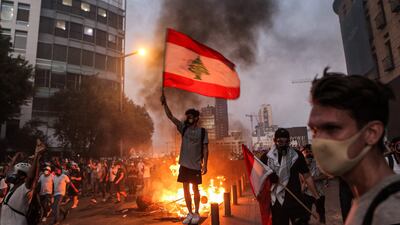
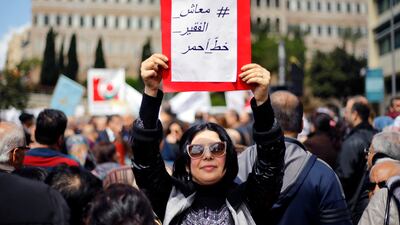
  • March 2020: Lebanon defaults on its sovereign debt for the first time in its history, amid protests in the country. AFP
    March 2020: Lebanon defaults on its sovereign debt for the first time in its history, amid protests in the country. AFP
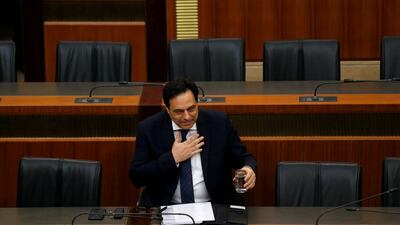
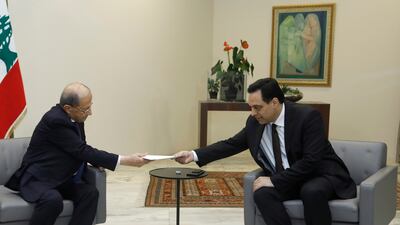
  • April 2020: The government of Hassan Diab, prime minister at the time, pictured with President Michel Aoun, approves a financial recovery plan. Reuters
    April 2020: The government of Hassan Diab, prime minister at the time, pictured with President Michel Aoun, approves a financial recovery plan. Reuters
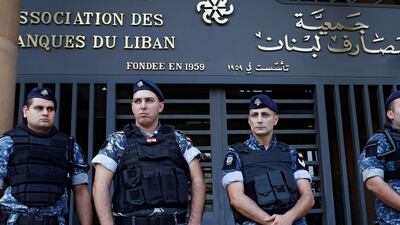
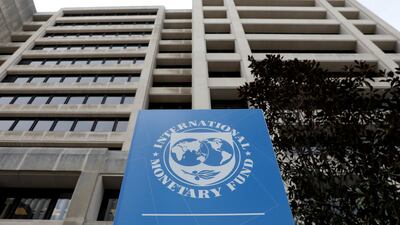
  • May 1, 2020: Mr Diab's government requests assistance from the International Monetary Fund. The Association of Banks in Lebanon rejects the plan. Reuters
    May 1, 2020: Mr Diab's government requests assistance from the International Monetary Fund. The Association of Banks in Lebanon rejects the plan. Reuters
  • May 20, 2020: the ABL presents an alternative plan. Reuters
    May 20, 2020: the ABL presents an alternative plan. Reuters
  • July 1, 2020: a Parliamentary fact-finding committee backs the ABL. The IMF suspends negotiations with Lebanon. AP
    July 1, 2020: a Parliamentary fact-finding committee backs the ABL. The IMF suspends negotiations with Lebanon. AP
  • August 10, 2020: Mr Diab resigns following a devastating explosion at Beirut’s port, in which at least 232 people died and 7,000 were injured. AP
    August 10, 2020: Mr Diab resigns following a devastating explosion at Beirut’s port, in which at least 232 people died and 7,000 were injured. AP
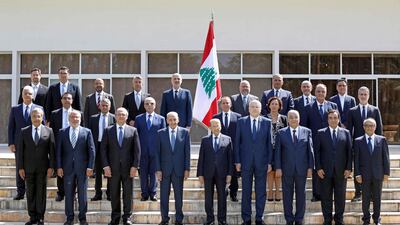
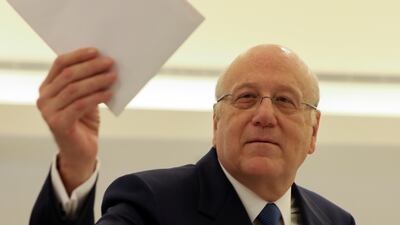
  • September 10, 2021: Najib Mikati, fourth from right, forms a government. AFP
    September 10, 2021: Najib Mikati, fourth from right, forms a government. AFP
  • January 2022: Lebanon re-starts negotiations with the IMF. Reuters
    January 2022: Lebanon re-starts negotiations with the IMF. Reuters
  • April 7, 2022: The IMF and Lebanon reach a staff-level agreement. AFP
    April 7, 2022: The IMF and Lebanon reach a staff-level agreement. AFP
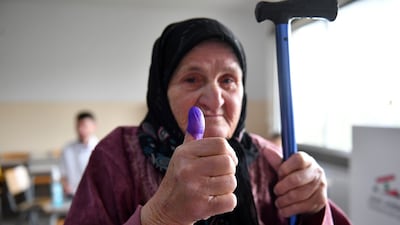
  • May 15, 2022: Lebanon holds parliamentary elections. EPA
    May 15, 2022: Lebanon holds parliamentary elections. EPA
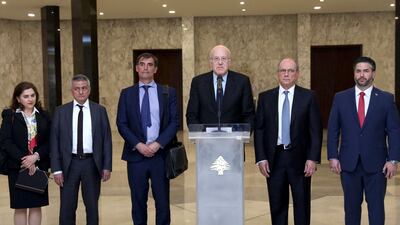
  • May 20, 2022: Mr Mikati’s government approves a new financial recovery plan. Reuters
    May 20, 2022: Mr Mikati’s government approves a new financial recovery plan. Reuters
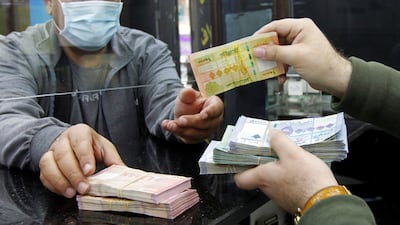
  • May 24, 2022: The ABL rejects the plan. The local currency hits the record low of 34,000 Lebanese pounds to the dollar – 95 per cent lower than the official rate. Reuters
    May 24, 2022: The ABL rejects the plan. The local currency hits the record low of 34,000 Lebanese pounds to the dollar – 95 per cent lower than the official rate. Reuters

Mercer, the investment consulting arm of US services company Marsh & McLennan, expects its wealth division to at least double its assets under management (AUM) in the Middle East as wealth in the region continues to grow despite economic headwinds, a company official said.

Mercer Wealth, which globally has $160 billion in AUM, plans to boost its AUM in the region to $2-$3bn in the next 2-3 years from the present $1bn, said Yasir AbuShaban, a Dubai-based principal with Mercer Wealth.

Within the next two to three years, we are looking at reaching $2 to $3 billion as a conservative estimate and we do see an opportunity to do so,” said Mr AbuShaban.

Mercer does not directly make investments, but allocates clients’ money they have discretion to, to professional asset managers. They also provide advice to clients.

“We have buying power. We can negotiate on their (client’s) behalf with asset managers to provide them lower fees than they otherwise would have to get on their own,” he added.

Mercer Wealth’s clients include sovereign wealth funds, family offices, and insurance companies among others.

From its office in Dubai, Mercer also looks after Africa, India and Turkey, where they also see opportunity for growth.

Wealth creation in Middle East and Africa (MEA) grew 8.5 per cent to $8.1 trillion last year from $7.5tn in 2015, higher than last year’s global average of 6 per cent and the second-highest growth in a region after Asia-Pacific which grew 9.9 per cent, according to consultancy Boston Consulting Group (BCG). In the region, where wealth grew just 1.9 per cent in 2015 compared with 2014, a pickup in oil prices has helped in wealth generation.

BCG is forecasting MEA wealth will rise to $12tn by 2021, growing at an annual average of 8 per cent.

Drivers of wealth generation in the region will be split evenly between new wealth creation and growth of performance of existing assets, according to BCG.

Another general trend in the region is clients’ looking for a comprehensive approach to investing, according to Mr AbuShaban.

“Institutional investors or some of the families are seeing a slowdown in the available capital they have to invest and in that sense they are looking at optimizing the way they manage their portfolios and making sure they are not investing haphazardly and different parts of their investment are working together,” said Mr AbuShaban.

Some clients also have a higher appetite for risk, given the low interest-rate environment that does not provide enough yield for some institutional investors. These clients are keen to invest in illiquid assets, such as private equity and infrastructure.

“What we have seen is a desire for higher returns in what has been a low-return environment specifically in various fixed income or bonds,” he said.

“In this environment, we have seen a de facto increase in the risk that clients are taking in things like illiquid investments, private equity investments, infrastructure and private debt, those kind of investments were higher illiquidity results in incrementally higher returns.”

The Abu Dhabi Investment Authority, one of the largest sovereign wealth funds, said in its 2016 report that has gradually increased its exposure in direct private equity and private credit transactions, mainly in Asian markets and especially in China and India. The authority’s private equity department focused on structured equities owing to “their defensive characteristics.”

INDIA SQUADS

India squad for third Test against Sri Lanka
Virat Kohli (capt), Murali Vijay, Lokesh Rahul, Shikhar Dhawan, Cheteshwar Pujara, Ajinkya Rahane, Rohit Sharma, Wriddhiman Saha, Ravichandran Ashwin, Ravindra Jadeja, Kuldeep Yadav, Mohammed Shami, Umesh Yadav, Ishant Sharma, Vijay Shankar

India squad for ODI series against Sri Lanka
Rohit Sharma (capt), Shikhar Dhawan, Ajinkya Rahane, Shreyas Iyer, Manish Pandey, Kedar Jadhav, Dinesh Karthik, Mahendra Singh Dhoni, Hardik Pandya, Axar Patel, Kuldeep Yadav, Yuzvendra Chahal, Jasprit Bumrah, Bhuvneshwar Kumar, Siddarth Kaul

HOW TO WATCH

Facebook: TheNationalNews 

Twitter: @thenationalnews 

Instagram: @thenationalnews.com 

TikTok: @thenationalnews   

Updated: June 22, 2022, 5:01 PM