

Iran is escalating its uranium enrichment further by preparing to use advanced IR-6 centrifuges at its underground Fordow site that can more easily switch between enrichment levels, according to a UN nuclear watchdog report seen by Reuters.
IAEA inspectors verified on Saturday that Iran was ready to feed uranium hexafluoride (UF6) gas, the material centrifuges enrich, into the second of two cascades, or clusters, of IR-6 centrifuges installed at Fordow, a site dug into a mountain, the confidential IAEA report to member states said.
Reuters said on Monday the IAEA has confirmed the report is authentic.
Iran has also not told the agency clearly what purity the cascade will enrich to after passivation. Iran previously informed the IAEA that the two IR-6 cascades could be used to enrich to 5 per cent or 20 per cent purity.
"The agency has yet to receive clarification from Iran as to which mode of production it intends to implement for the aforementioned cascade, following the completion of passivation," the report said.
Passivation is a chemical treatment for stainless steel and other alloys that enhances the ability of the treated surfaces to resist corrosion.
Iran informed the IAEA on Monday that passivation of the cascade, a process that precedes enrichment and also involves feeding UF6 into the machines, began on Sunday.
Importantly, the 166-machine cascade is the only one to have so-called "modified sub-headers", which make it easier to switch to enriching to other purity levels. Western diplomats have long pointed to that equipment as a source of concern since it could enable Iran to quickly enrich to higher levels, Reuters said.
Iran's nuclear sites - in picures
-
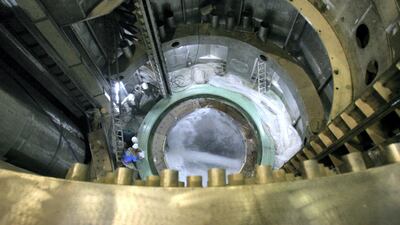
Russian contractors work at the Bushehr nuclear reactor site in 2007. The plant opened four years later. Bloomberg -
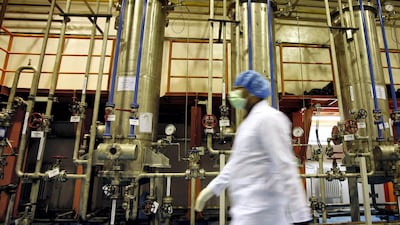
An Iranian technician at the International Atomic Energy Agency inspects the country's Isfahan plant in 2007. Tehran is no longer co-operating with the agency at nuclear sites across the country. EPA -

Workers wait to begin constructing a second reactor at the Bushehr nuclear power plant in 2019. AFP -
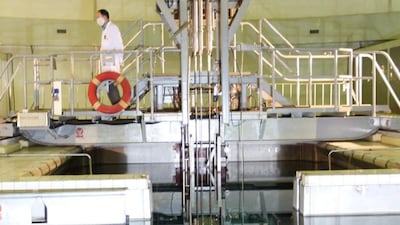
A metal-encased rod with 20 per cent enriched nuclear fuel is inserted into a reactor in Tehran in 2012. AFP -
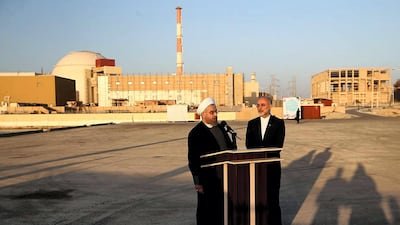
Fomer Iranian President Hassan Rouhani and the country's Atomic Energy Organisation chief Ali Akbar Salehi speak at the Bushehr nuclear site in 2015. AFP -
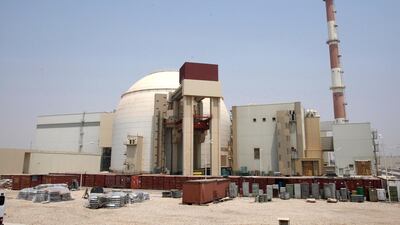
Iran's Bushehr nuclear plant has been restarted. EPA -
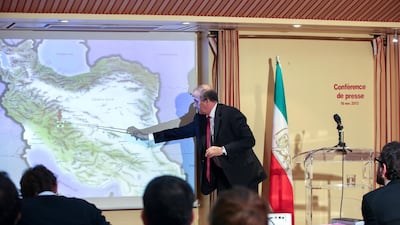
Mehdi Abrichamtchi, chairman of the Peace and Security Committee at the National Council of Resistance of Iran, shows journalists the location of a secret nuclear site in Iran in 2013. AFP -
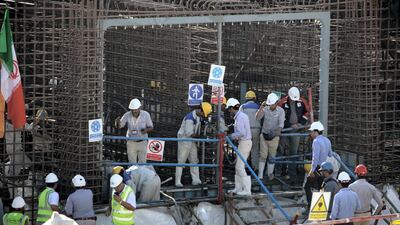
Workers prepare to begin the construction of a second reactor at the Bushehr site. AFP


The move is the latest of several steps Iran had long threatened to take but held off carrying out until 30 of the 35 countries on the International Atomic Energy Agency's board of governors backed a resolution this month criticising it for failing to explain uranium traces found at undeclared sites.
With indirect US-Iran talks on reviving the 2015 Iran nuclear deal long stalled, any further escalation in Tehran's standoff with the West risks killing off hopes of reining in the Islamic republic's nuclear advances and lifting US sanctions against it.
At a different site, Iran is already enriching up to 60 per cent, close to the roughly 90 per cent of weapons-grade and far above the 2015 deal's cap of 3.67 per cent.
Iran has breached many of the deal's limits in response to the US withdrawal from the deal in 2018 and its reimposition of sanctions. Iran denies seeking nuclear weapons.
In response to the board of governors' resolution, Iran has ordered the removal of IAEA cameras installed under the 2015 deal and pressed ahead with the installation of IR-6 centrifuges at an underground plant at Natanz, where the deal lets it enrich but only with far less efficient IR-1 machines.

