


A top US energy envoy arrived in Beirut on Monday afternoon amid a maritime boundary dispute between Lebanon and Israel that has threatened to reignite existing tensions between the two neighbours.
Amos Hochstein has been mediating indirect demarcation talks between Israel and Lebanon, which do not have diplomatic relations, since 2020.
He was invited to Beirut by senior Lebanese officials after Israel moved a vessel, operated by London-listed Energean, to the Karish gasfield last Sunday. That offshore field in the eastern Mediterranean is partly claimed by Lebanon, something Israel rejects.
Lebanese President Michel Aoun said on Monday that Israel was acting in contravention to international law. He added that Lebanon would not waive its right to invest in its oil and gas wealth, but insisted his country wanted to return to the demarcation talks.
Mr Hochstein will meet Mr Aoun on Tuesday morning.
Iran-backed militant group and political party Hezbollah has a strong presence in southern Lebanon and has threatened violence if arch-foe Israel does not withdraw the ship.
On Sunday, Israel’s military chief threatened an unprecedented level of violence if a fresh conflict with Hezbollah reignited.
“We will deal very big strikes in the war, but we will warn the residents and allow them to leave the areas,” Aviv Kochavi told a defence conference in Israel.
He threatened to hit “every target” associated with missiles and rocket launches. Hezbollah has amassed a huge arsenal of rockets.
“A house in which a missile is located or located near a missile, an activist who deals with a missile, a command headquarters that deals with a missile, or electricity connected to a group of missiles — all of this network will be hit on the day of the war,” Mr Kochavi said.
On Monday, the Israeli army said it had uncovered a Hezbollah forward command based near the Blue Line, which demarcates Lebanon and Israel by land and is patrolled by a UN peacekeeping mission. It claimed that Hezbollah operatives were gathering intelligence while claiming to be working for an environmental NGO that is itself accused of links to the Iran-backed group.
According to a US State Department note confirming Mr Hochstein’s trip to Beirut, he “will underscore the Biden administration’s hope that Lebanon and Israel can reach a decision on the delimitation of the maritime boundary.
-

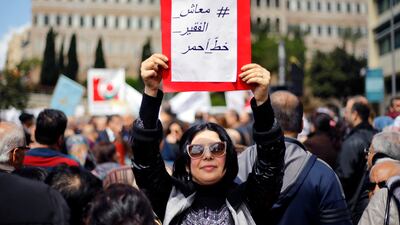
November 1, 2019: Banks implement capital controls after shutting for two weeks. Reuters -
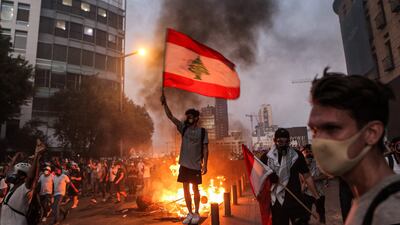
March 2020: Lebanon defaults on its sovereign debt for the first time in its history, amid protests in the country. AFP -
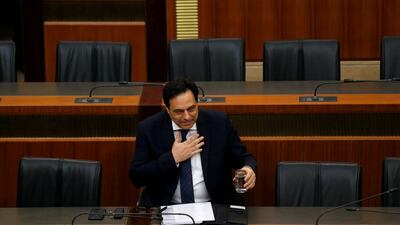
April 2020: The government of Hassan Diab, prime minister at the time, pictured with President Michel Aoun, approves a financial recovery plan. Reuters -
May 1, 2020: Mr Diab's government requests assistance from the International Monetary Fund. The Association of Banks in Lebanon rejects the plan. Reuters -
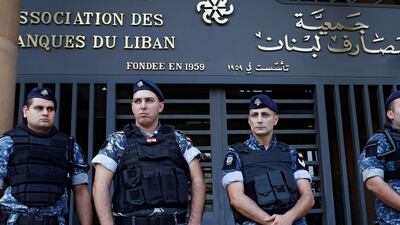
May 20, 2020: the ABL presents an alternative plan. Reuters -
July 1, 2020: a Parliamentary fact-finding committee backs the ABL. The IMF suspends negotiations with Lebanon. AP -
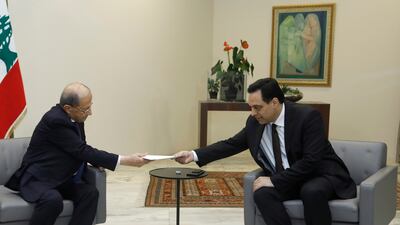
August 10, 2020: Mr Diab resigns following a devastating explosion at Beirut’s port, in which at least 232 people died and 7,000 were injured. AP -
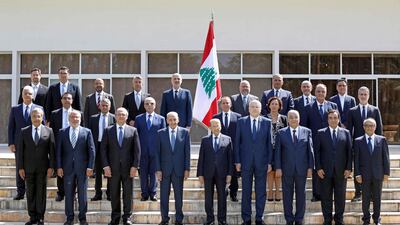
September 10, 2021: Najib Mikati, fourth from right, forms a government. AFP -
January 2022: Lebanon re-starts negotiations with the IMF. Reuters -
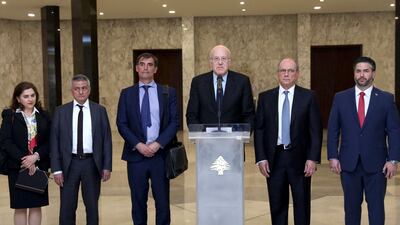
April 7, 2022: The IMF and Lebanon reach a staff-level agreement. AFP -
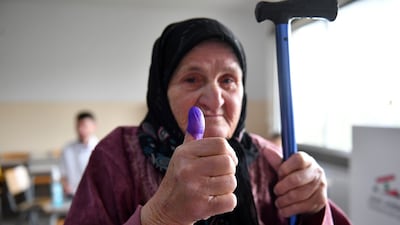
May 15, 2022: Lebanon holds parliamentary elections. EPA -
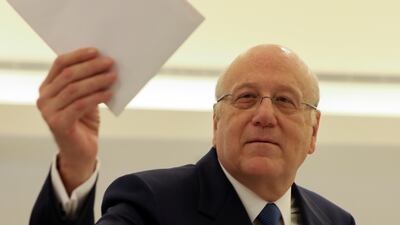
May 20, 2022: Mr Mikati’s government approves a new financial recovery plan. Reuters -
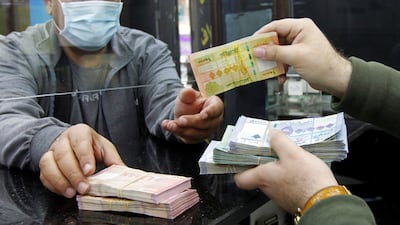
May 24, 2022: The ABL rejects the plan. The local currency hits the record low of 34,000 Lebanese pounds to the dollar – 95 per cent lower than the official rate. Reuters


“The administration welcomes the consultative and open spirit of the parties to reach a final decision, which has the potential to yield greater stability, security, and prosperity for both Lebanon and Israel, as well as for the region.”
Mr Aoun has said Lebanon wants Mr Hochstein to “resume efforts to relaunch indirect negotiations” with Israel.
Lebanon wants a deal that would allow it to “invest in its offshore oil and gas resources and safeguard security and stability in the border area,” Mr Aoun added.
The indirect talks had been on hold since last May and had made little progress.
Energean hopes to start extraction will at the Karish field later this year. Israel believes the field, about 80 kilometres west of Haifa, is part of its exclusive economic zone, while Lebanon says it lies within the disputed waters.
Lebanon initially demanded 860 square kilometres of territory in the disputed maritime area. But the US-mediated negotiations were complicated last year when Beirut expanded its claim in the disputed zone by around 1,400 square km, including part of Karish.
Saturday saw hundreds of people and a number of MPs demonstrate in south Lebanon against Israel moving the gas production vessel to the Karish field.
“We absolutely refuse to neglect Lebanon's maritime resources, which belong to all Lebanese,” said Firas Hamdan, reading a joint statement from 13 independent MPs, most of whom were newly elected last month.
Israel has said that Karish “is a strategic asset of the state of Israel” and stressed it was “prepared to defend” the site.
Lebanon is undergoing a severe economic collapse, with much of country plunging into poverty. The local currency has lost more than 90 per cent of its value, while the state electricity provider is able to give out only a few hours of power a day — if that — forcing people to turn to expensive private generators.

