


With dust turning skies ochre across the Middle East, Israel’s southern desert region is one hot spot where residents face surging air pollution when the storms hit.
On a hilltop overlooking Beer Sheva, the largest city in the Negev desert, Prof Victor Novack looks out over the haze.
“Dust is coming from the Sahara, in this direction,” he said, an arm sweeping to the south.
“During the transitional periods — spring, [autumn] — it’s just blowing all over the Middle East and southern European countries,” said Prof Novack, who is head of clinical research at Beer Sheva’s Soroka University Medical Centre, ahead of World Environment Day on June 5.
Such storms in recent weeks prompted the Israeli government to issue air pollution warnings, telling vulnerable groups to avoid outdoor exercise.
While natural dust has been sweeping across the region for millennia, in recent decades human activity has increasingly been a source of dust storms.
The World Bank attributed this to “land-use changes and human-induced climate change” in a 2019 report.
In Beer Sheva, construction cranes dot the skyline as the city of more than 200,000 residents expands further.
Although the Negev is Israel’s driest region, a government alert from April warned of “high air pollution in most parts of the country” as the result of a dust storm crossing the eastern border.
There has been an increase in dust coming from the east over the past decade, according to Israel’s Environmental Protection Ministry, but, notably, a reduction in dust from the west.
“We saw a decrease in the [overall] number of dust storms approaching us,” Eitan Maza, an air quality forecaster at the ministry, told The National.
In an agricultural community a few kilometres north of Beer Sheva, one resident said the sizable growth in car use is affecting the area.
“The biggest problem is from vehicles on the roads,” said Ron Cohen, the agricultural manager of Kibbutz Lahav and surrounding communities.
“There is a lot of dust from the vehicles, there is also a lot of dust in the air. Why? Because it’s near the desert and because of the winds,” he said.
While overseeing the growing of fruit, vegetables and nuts, Mr Cohen over the past few years has noticed a rise in temperatures and gradual delays to the start of the winter rainfall.
For elderly Negev residents or those with health issues, such as diabetes or lung conditions, the onset of a dust storm brings significant risks.
Dust storm hits Idlib province in Syria – in pictures
-
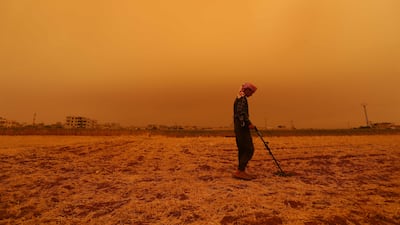
A youth uses a metal detector during a dust storm over Zardana in the countryside of Idlib province, Syria. All photos: AFP -
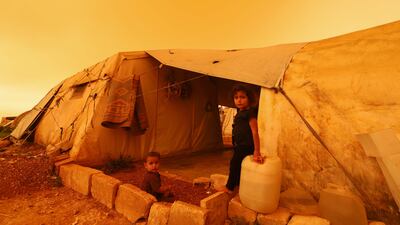
Displaced children sit next to their tent during the dust storm in Zardana. -
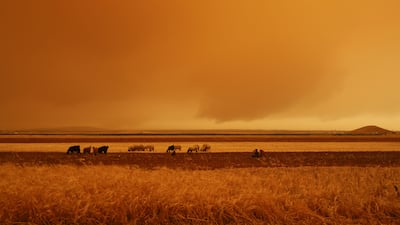
A shepherd guides his flock through the storm. -
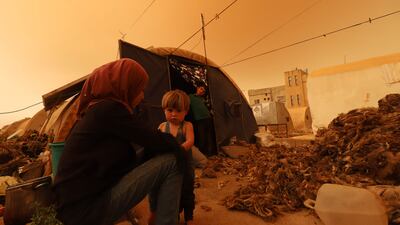
A family takes shelter in Zardana as the storm sweeps across Idlib province, north-western Syria. -
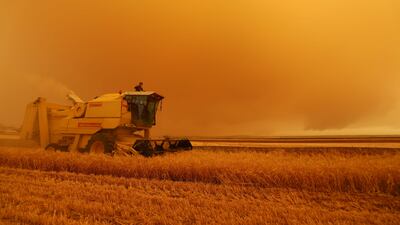
The harvest continues in Zardana, as the dust storm blows in. -
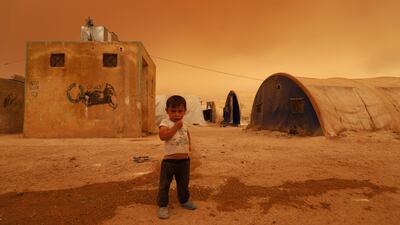
The dust storm turns the sky orange. -
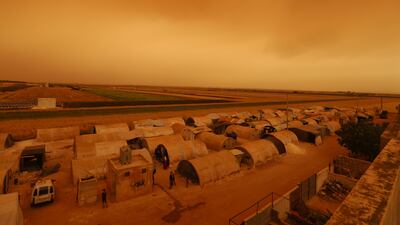
The storm blows in over north-western Syrian. -

Syrians ride horses during a dust storm on the outskirts of the rebel-held town of Dana, in the north-western Idlib province, near the Turkish border. -
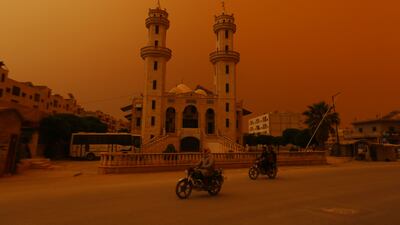
Visibility is poor for these drivers in Dana. -
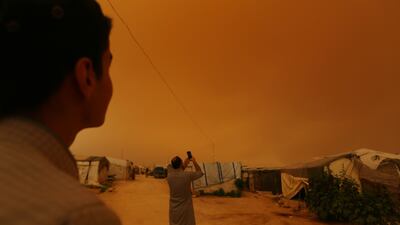
A displaced Syrian takes a picture of the sky during the dust storm. -

The storm blows over a makeshift camp in Dana, Syria. -
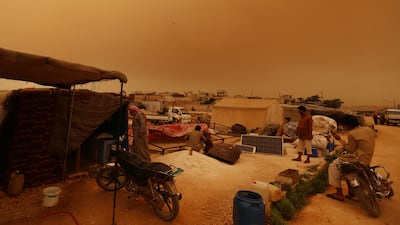
The rebel-held town of Dana is coated in dust and sand. -
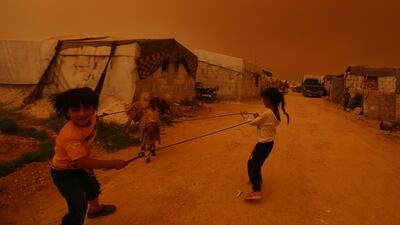
Displaced children play with goats during the dust storm in Dana.


“We looked at the purchase of inhalers [for asthmatics], the day of the dust storm, the day after. It goes up by 100 per cent,” Prof Novack said.
There is a 20 per cent increase in patients admitted to Soroka hospital with pulmonary diseases during the storms, he said.
Israel’s Ministry of Health did not provide figures on patients treated for dust-related problems over the years, when contacted by The National.
However, a study on Israel, Greece and Cyprus published last year by the World Health Organisation, reported that dust storms affect the respiratory system and those with allergies and asthma.
Globally, the World Bank estimates that dust emissions “have increased by 25 per cent to 50 per cent over the past century”.
If the trend continues, more countries may soon need to adapt their healthcare systems to address the effects.
For Prof Novack, data being gathered now in Israel and the wider Middle East could prove invaluable.
“We need to be ready, and probably the solutions will come from this part of the world," he said. “Getting aware of what everyone will experience.”

