

Turkey’s President Recep Tayyip Erdogan has said Ankara remains committed to rooting out a Syrian Kurdish militia from northern Syria.
“Like I always say, we’ll come down on them suddenly one night. And we must,” Turkish President Recep Tayyip Erdogan told reporters on his plane following his Saturday visit to Azerbaijan.
Without giving a specific timescale, Mr Erdogan said that Turkey would launch a cross-border operation against the Syrian Kurdish People’s Protection Units, or YPG. It considers this a terrorist organisation linked to an outlawed Kurdish group that has led an insurgency against Turkey since 1984. That conflict with the Kurdistan Workers' Party, PKK, has killed tens of thousands of people.
-

A group of PKK soldiers walk near their base camp high in the mountains of northern Iraq on June 1, 2004. Reuters -
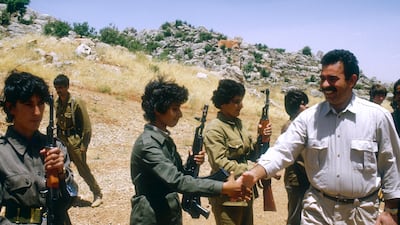
Kurdistan Workers' Party (PKK) leader Abdullah Ocalan greets women soldiers at the Mahsun Korkmaz Academy military training camp in Lebanon on June, 18, 1988. Getty Images -

Peshmerga and Turkish soldiers prepare to storm a hill on October 23, 1992, near a stronghold held by the PKK in Hakurk Valley. AFP -

Abdullah Ocalan was abducted in Nairobi in 1999 by the Turkish National Intelligence Agency (MIT), with assistance from the US, and taken to Turkey. Reuters -

Turkish riot police detain a Kurdish protester following a demonstration in central Istanbul on April 2, 2006. Reuters -
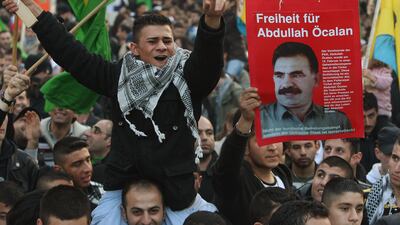
A man holds a sign demanding freedom for imprisoned Kurdish leader Abdullah Ocalan at a protest of mostly Kurdish demonstrators on November 4, 2007, in Berlin, Germany. Getty Images -
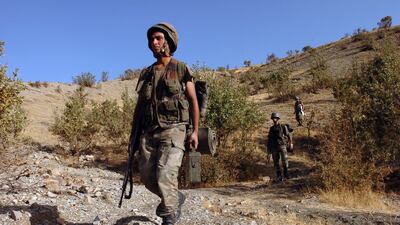
Turkish army commandos on patrol near the Iraq border on October 27, 2007, in the Uludere district of Sirnak province, south-eastern Turkey. Getty Images -
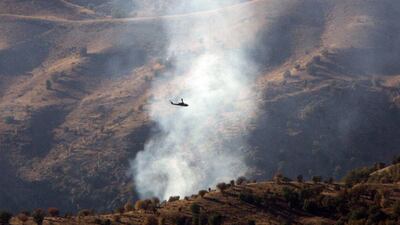
A Turkish helicopter flies over the Cudi Mountains during an attack on an outlawed PKK camp October 30, 2007, in Sirnak province, near the Iraq border. AFP -
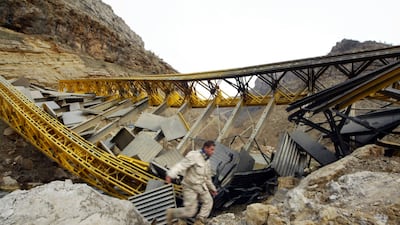
A ruined bridge lies in northern Iraq's Kurdistan region during fighting between Turkish forces and PKK fighters on February 24, 2008. AFP -
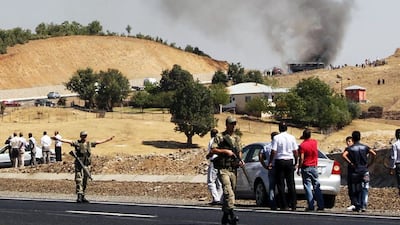
Turkish soldiers stand guard as smokes rises from a bus that was attacked by members of the PKK on September 18, 2012, in Bingol. AFP -
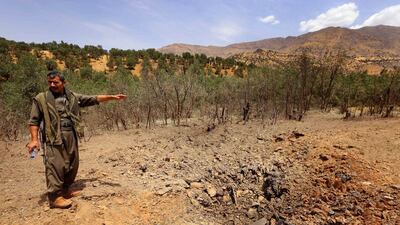
A member of the PKK inspects a crater reportedly caused by an air strike by Turkish warplanes on July 29, 2015, in the Qandil Mountains in northern Iraq. AFP -
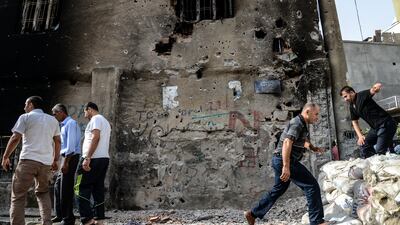
Locals assess the damage following clashes between Turkish forces and PKK militants in the Kurdish-majority city of Cizre, in south-eastern Turkey, on September 12, 2015. AFP -
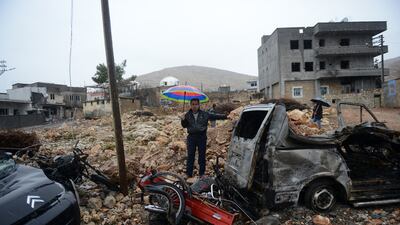
People return to their homes in Dargecit after a curfew imposed by the Turkish government was lifted on December 30, 2015, in Mardin province. AFP -
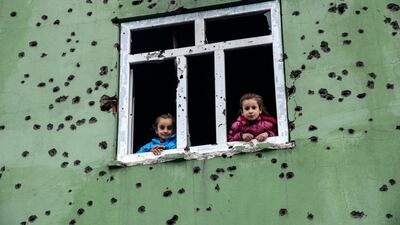
Children look out from a window of a bullet-scarred house in the Kurdish town of Silopi in south-eastern Turkey, near the border with Iraq, on January 19, 2016. AFP -
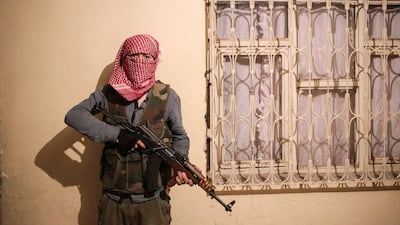
A member of the Patriotic Revolutionary Youth Movement (YDG-H), a division of the PKK, stands guard in the south-eastern Turkish city of Nusaybin on February 25, 2016. Getty Images


However, the YPG forms the backbone of US-led forces in the fight against ISIS in Syria.
American support for the group has infuriated Ankara and remains a major issue in their relations. Turkey considers the PKK and the YPG to be one and the same.
“All coalition forces, leading with the US, have provided these terror groups with a serious amount of weapons, vehicles, tools and ammunition — and they continue to do so," Mr Erdogan said. "The US has given them thousands of trucks.”
He warned that Turkey would not need anyone’s permission to fight terror.
“If the US is not fulfilling its duty in combating terror, what will we do? We will take care of it ourselves,” he said.
Ankara has launched four cross-border operations into Syria since 2016. In 2019, an incursion into north-east Syria against the YPG drew widespread international condemnation, prompting Finland, Sweden and others to restrict arms sales to Turkey.
Now Turkey is blocking the two Nordic countries' historic bid to join Nato because of the weapons ban and their alleged support for the Kurdish groups.
Turkey has stepped up military operations against the PKK in northern Iraq where they are based. The PKK is considered a terror group by Turkey, the US and the European Union.
“Just as we are conducting operations in northern Iraq against the PKK and PKK's offspring, the same situation applies even more to Syria and is much more important,” Mr Erdogan said.

