

The Middle East and North Africa needs a freer flow of people, goods and $2.5 trillion in spending if the region is to produce its fair share of global GDP, a report has said.
Better-performing universities and a stronger private sector is needed, a Majid Al Futtaim and McKinsey study found, in a region where growth is largely led by government spending.
While 8.5 per cent of the world's population live in the Middle East, North Africa and Pakistan (Menap) region, it accounts for 3.4 per cent of global GDP.
"Research shows an incremental $2.5 trillion would need to be generated for the region to produce its fair share of GDP," said the report, The Time is Now: A Perspective on Economic Integration in Menap.
Majid Al Futtaim chief executive
Likewise, 8 per cent of the world's university students come from the region but it is home to just 1.5 per cent of the top 500 learning institutes.
Speaking to The National, Alain Bejjani, chief executive of Majid Al Futtaim, said governments need to consider harmonising their laws and regulations and dropping — not raising — barriers to the flow of trade and people.
"The reality is each one of us in the Middle East only produces half of what the global average is," he said at the report's publication in Davos, Switzerland, where the World Economic Forum was held.
"And the question is why, why aren't we as productive, why don't we have economies that are as efficient [as other regions]?
"The answer is simple, it's because we are fragmented, because we don't have harmonisation of legislation, because we do not regulate but build barriers, because we don't have free flow of people, capital, data."
European Union-style integration
Mr Bejjani, whose company employs more than 41,000 people in the Middle East, said strong growth in the Gulf often eclipsed what is a sluggish and underproductive region.
With the exception of a handful of trade and VAT agreements in the Gulf, the Menap region has few cross-border deals.
The McKinsey report said "trade costs, including costs related to transportation, time delays, border controls etc, represent 20 per cent to 40 per cent of the final delivered price" for non-oil goods, negatively affecting businesses and the consumer.
Migration of workers between markets is all facilitated by a complex set of differing visa rules in each country, which typically come with fees.
Mr Bejjani said the European Union, North American nations and even China and its ASEAN neighbours were instances in which governments had come together to allow greater movement of goods and people.
"We see countries that don't see eye-to-eye politically but understand the importance of economic growth [forging deals]," he said.
"These countries can't grow on their own and they saw why it's important to come together and allow greater integration for economic growth. I think we should emulate them.
"This is an imperative, we don't shed enough light on what we are missing in our region."
Freer movement of people

The MAF and McKinsey report uses the European Union as the "most advanced example" of an integrated market in which people can buy and sell goods, and work in any country they wish.
"This frictionless trade is a key enabler of economic growth," and the economic benefits amount to about 8.5 per cent of the EU's total GDP, it said.
By allowing people to move across borders and work in different markets, they are able to take advantage of more job vacancies and better opportunities.
The governments of the Mena region, with one of the world's youngest populations, should consider a similar arrangement, Mr Bejjani said.
"Our region is going to produce, in the next 15 years, 120 million newcomers to the workforce that need jobs.
"If we don't have an answer for them, what are they going to do? This becomes a ticking time bomb."
Growth and integration cannot all come from decision-makers in government, it was up to major private sector companies to play their part, he said.
"As private sector companies, if we do not have markets how are we doing to grow. The only way to grow is to grow the pie, we cannot continue to compete by dividing and slicing the pie.
"What we should do as private sector companies is come together and constructively put forward a road map, how to grow the pie, grow our markets and naturally compete."
'Bringing down barriers, welcoming the world'
Mr Bejjani used Dubai, where his company has headquarters, and the wider UAE as an example of where barriers were being torn down.
"We are blessed to have some of the economies, like the UAE economy, they are soaring and doing very well," he said.
"The oil prices, a fundamental for the region, have gotten much better so we can invest the surplus and drive economic growth, fuelling the private sector."
A range of flexible visas and long-term residency has attracted large numbers of new arrivals amid a population boom.
Mr Bejjani said: "It's bringing down barriers, it's welcoming the world."
-

Dubai's post-pandemic boom has made it one of the most visited places in the world today. Further to that, the city has seen tens of thousands of new residents arrive to settle down. Reuters -
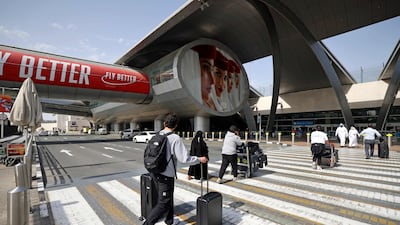
Between late 2020 and spring 2022, the city's population grew by close to 100,000 people. Karim Sahib / AFP -

Lifestyle and a growing jobs market has attracted many residents to flashy communities such as Jumeirah Beach Residence. Reuters -
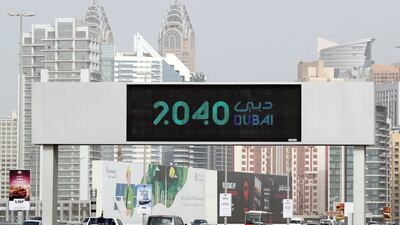
Population growth is a major part of Dubai's 2040 Urban Plan, which seeks to boost the population to 5.8 million. Chris Whiteoak / The National -
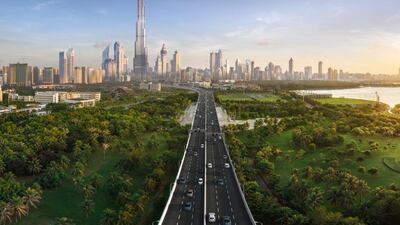
There are plans to physically expand Dubai, creating new beaches and parks for the larger population. The government wants 60 per cent of the city to be green parks and reserves. Photo: Dubai Media Office -
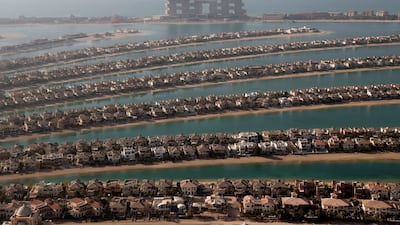
The past two years have \seen a rush of foreign investors looking to buy new property in places such as Palm Jumeirah, where prices have risen significantly. AP Photo / Kamran Jebreili -

Landmarks such as Bluewaters Island and Ain Dubai, the world’s largest observation wheel, have put Dubai on the map as a global lifestyle destination. Reuters



