

Britain's Prime Minister Boris Johnson and other world leaders have announced they will travel to the UAE to offer their condolences on the death of Sheikh Khalifa.
Mr Johnson's visit on Sunday will also serve to "reinforce the close bond" between Britain and the UAE which will continue under the presidency of Sheikh Mohamed bin Zayed, the UK government said.
The US will be represented by Vice President Kamala Harris, who will travel to Abu Dhabi on Monday, meet Sheikh Mohamed and "underscore the strength of the partnership" between the two nations, the White House said.
The announcement came after US President Joe Biden congratulated Sheikh Mohamed and said Washington was "determined to honour the memory of the late president" by continuing to strengthen relations.
Jordan's King Abdullah, who had been on a working visit to the United States, arrived in the UAE on Friday to offer his condolances.
Egypt President Abdel Fattah El Sisi left Cairo for the UAE on Saturday, spokesman Bassam Rady said on the Egyptian Presidency's Facebook page.
-
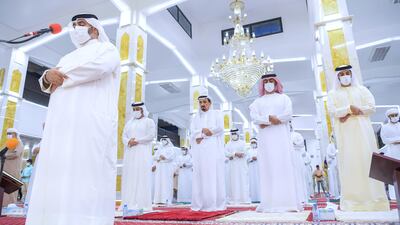
Sheikh Humaid bin Rashid Al Nuaimi, Ruler of Ajman, performs a funeral prayer. All photos: Wam -

Prayers are said for Sheikh Khalifa, the second President of the UAE and the 16th Ruler of Abu Dhabi. -

Sheikh Saud bin Rashid Al Mualla, Ruler of Umm Al Quwain, performs a funeral prayer for Sheikh Khalifa, who died on Friday. -

Funeral prayers for Sheikh Khalifa, who died on Friday after nearly 20 years as President of the UAE. -

Leaders from across the Gulf region, Middle East and around the world have offered their condolences on the death of Sheikh Khalifa.


Among other world leaders, French President Emmanuel Macron will travel to the UAE on Sunday to pay tribute to Sheikh Khalifa and “express his support" to his brother and successor, President Sheikh Mohamed bin Zayed, and the Emirati people, his administration said.
Other leaders are also expected in Abu Dhabi to express their condolences over the passing of Sheikh Khalifa, who was laid to rest on Friday evening in the UAE capital.
Lebanon's Prime Minister Najib Mikati left Beirut on Saturday afternoon with a delegation including the Minister of Foreign Affairs and Emigrants Abdullah Bou Habib and Fouad Dandan, Lebanese ambassador to the UAE, the National News Agency said.
Tunisia’s President Kais Saied boarded a flight to the UAE at dawn on Saturday, the Tunisian presidency said on its Facebook page.
Rashid Al Mansouri, UAE ambassador to Tunisia, was among the dignitaries who saw Mr Saied off at the Tunis-Carthage International Airport, the presidency said.
Algeria is sending Prime Minister Aymen Benabderrahmane to deliver condolences, the Algerian presidency said on Twitter.
Turkey’s President Recep Tayyip Erdogan said in a message of sympathy on Friday that he intended to visit the UAE to offer his condolences in person.
-
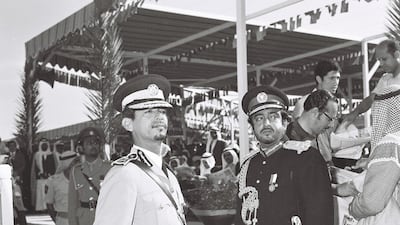
Sheikh Khalifa, right, and dignitaries watch a parade on Abu Dhabi Corniche to celebrate Accession Day, on November 28 1971. Photo: Al Ittihad -
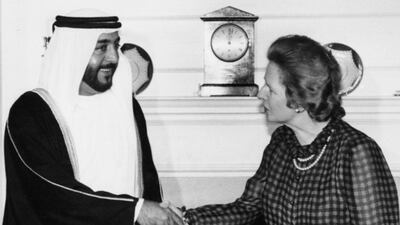
British Prime Minister Margaret Thatcher greets Sheikh Khalifa, Crown Prince of Abu Dhabi, at 10 Downing Street in London, on July 18, 1984. Keystone / Hulton Archive -
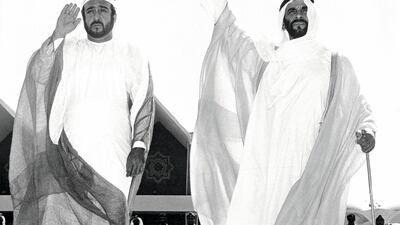
UAE Founding Father, the late Sheikh Zayed bin Sultan Al Nahyan, and Sheikh Khalifa. Photo: Al Ittihad -
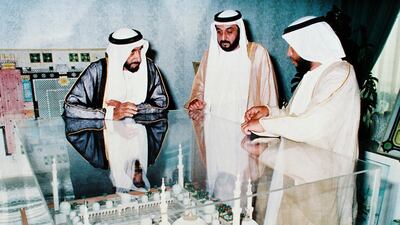
Sheikh Zayed inspects plans for the Sheikh Zayed Grand Mosque in Abu Dhabi, with his sons Sheikh Khalifa and Sheikh Sultan. Photo: Al Ittihad -
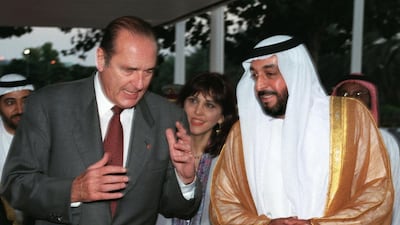
French President Jacques Chirac speaks to Sheikh Khalifa, Crown Prince of Abu Dhabi, at the end of his visit to the UAE on December 16, 1997. Reuters -
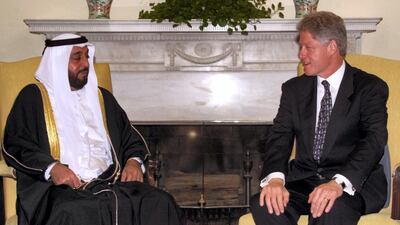
US President Bill Clinton meets Sheikh Khalifa, Crown Prince of Abu Dhabi, in the Oval Office of the White House on May 12, 1998. Reuters -
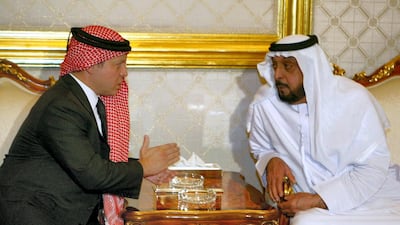
Jordan's King Abdullah II speaks to President Sheikh Khalifa, on the sidelines Sheikh Zayed's funeral in Abu Dhabi on November 3, 2004. AFP -

President Sheikh Khalifa stands for a photo with the UAE national football team at the Presidential Palace in Abu Dhabi on January 31, 2007, after the team beat Oman to win the Gulf Cup for the first time. AFP -
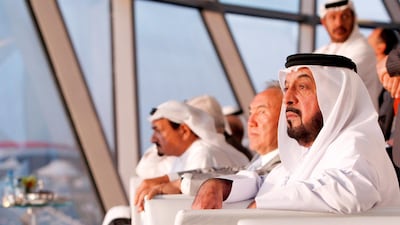
President Sheikh Khalifa watches the first Abu Dhabi Grand Prix at Yas Marina Circuit on November 1, 2009, with Nursultan Nazarbayev, President of Kazakstan, and Sheikh Humaid bin Rashid Al Nuaimi, Ruler of Ajman. Ryan Carter / The National -
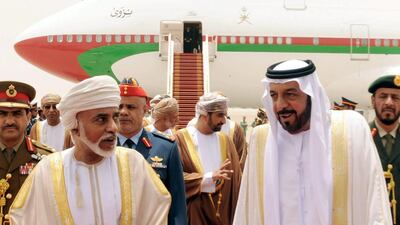
President Sheikh Khalifa greets Oman's leader, Sultan Qaboos, at Al Ain airport on July 11, 2011. Wam -
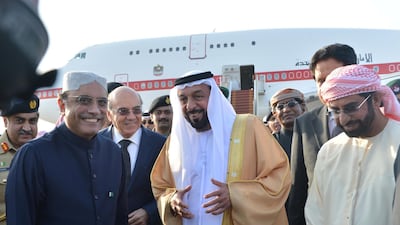
President Sheikh Khalifa leaves Al Ain on December 30, 2012, for a private visit to Pakistan. Wam -
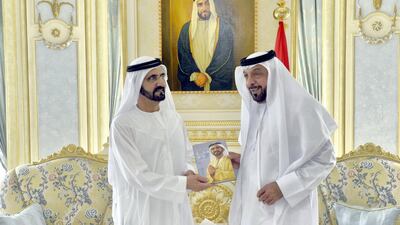
Sheikh Mohammed bin Rashid, Vice President and Ruler of Dubai, presents the first copy of his new book 'Flashes of Thought' to President Sheikh Khalifa in 2013. Wam -
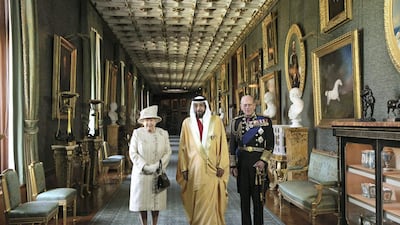
Britain's Queen Elizabeth II and Prince Philip with President Sheikh Khalifa at Windsor Castle in southern England on April 30, 2013. Reuters -
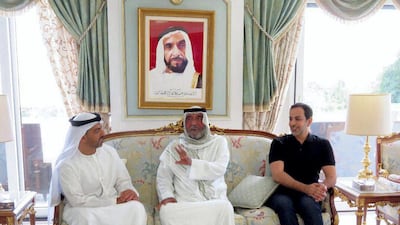
President Sheikh Khalifa meets family members at his home in Evian, France, in 2014. Wam -
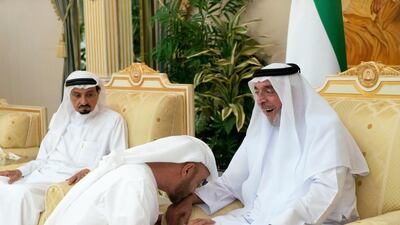
President Sheikh Khalifa receives Sheikh Mohamed bin Zayed, Crown Prince of Abu Dhabi and Deputy Supreme Commander of the UAE Armed Forces, at the Presidential Palace in Al Bateen, Abu Dhabi, on May 8, 2019. Also present is Sheikh Humaid bin Rashid Al Nuaimi, Ruler of Ajman. Ministry of Presidential Affairs -
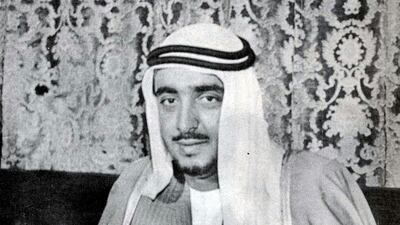
Sheikh Khalifa. Wam -

President Sheikh Khalifa. Wam -
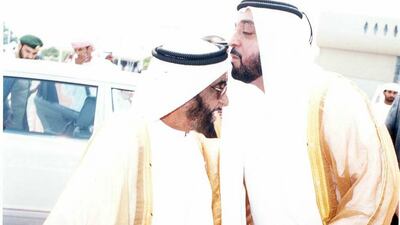
Sheikh Zayed and Sheikh Khalifa. Wam -
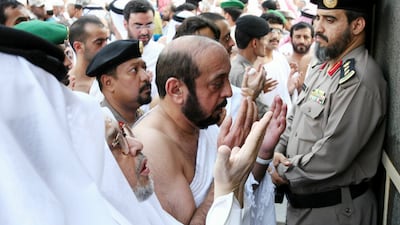
Sheikh Khalifa performing Umrah. Wam -
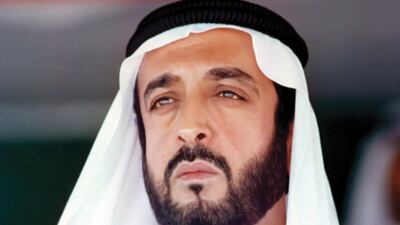
Sheikh Khalifa. Wam -

President Sheikh Khalifa receives Sheikh Dr Sultan bin Muhammad Al Qasimi, Ruler of Sharjah; Sheikh Humaid bin Rashid Al Nuaimi, Ruler of Ajman; Sheikh Hamad bin Mohammed Al Sharqi, Ruler of Fujairah; Sheikh Saud bin Rashid Al Mualla, Ruler of Umm Al Quwain; and Sheikh Saud bin Saqr Al Qasimi, Ruler of Ras Al Khaimah. Wam



