

The journey of the Palestinian who opened fire at a streetside bar in Tel Aviv last week, killing three young Israeli men, began a two-hour drive away in an impoverished refugee camp inside the occupied West Bank.
Twenty years after Jenin became the site of one of the biggest battles of the second Palestinian uprising, Israel is once again launching near-daily raids into the camp and trading fire with armed refugees.
Decades of dispossession, poverty and violence have strengthened the camp's reputation as a bastion of armed struggle against Israeli rule.
Tyres, gutted appliances and rubble are piled up near the entrances to the camp, which is transformed into a fortress at night, when the raids usually occur. Narrow roads wind through a maze of squat concrete homes built on a hillside, some adorned with portraits of dead Palestinians and the flags of armed factions.
Palestinians have killed 14 Israelis in a series of attacks in recent weeks, and violence at the Al Aqsa Mosque compound in Jerusalem on Friday raised tensions higher.
-
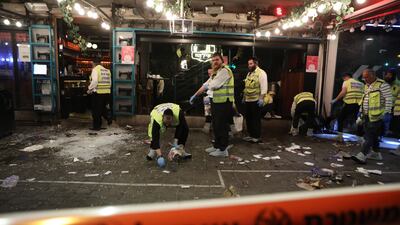
Israeli emergency teams clean up blood on the floor of a restaurant and bar on Dizengoff Street in Tel Aviv. EPA -
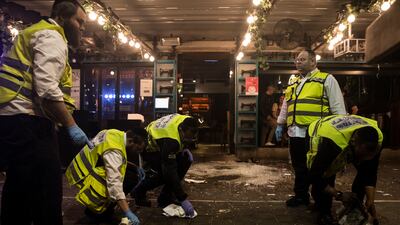
A Palestinian gunman shot dead two Israelis at the restaurant and wounded more than 10 others, three of them seriously. Getty -
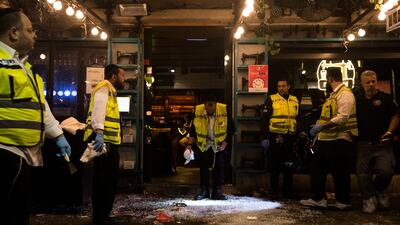
Dizengoff Street, at the centre of the Mediterranean coastal city, is known for its bars and restaurants. Getty -
Israeli security forces are on high alert after a series of attacks left 11 people dead within eight days at the end of March. AFP -
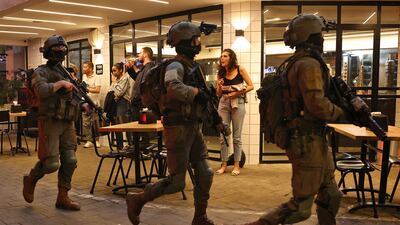
The attacker was hunted down and killed in an exchange of gunfire with Israeli police. AFP -
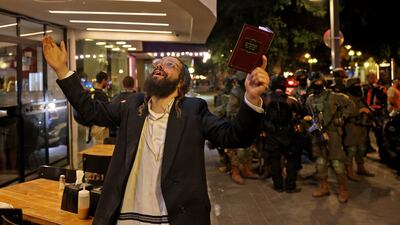
An ultra-Orthodox Jewish man reacts outside the scene of the shooting. AFP -
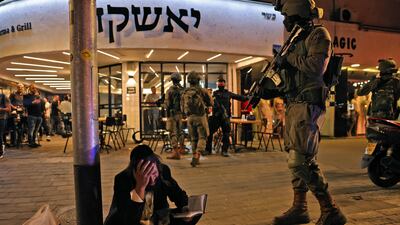
The attack on the bar caused scenes of mass panic in the Mediterranean coastal city. AFP -
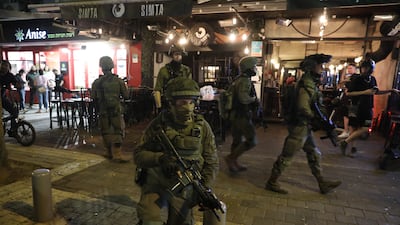
Police closed roads and ordered public transport to be shut down during the search for the man, who was later found hiding near a mosque in Jaffa. EPA -

Israeli forces killed six Palestinians in the occupied West Bank in the last week of March after a surge in violence. Reuters -

A forensics expert gathers evidence at the restaurant in Tel Aviv. AFP -
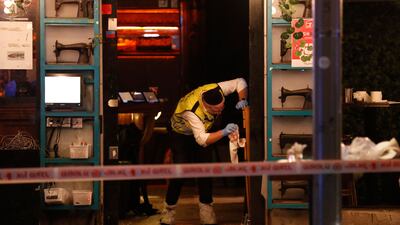
One police official there was a lot of blood and shattered glass shattered after the shooting. AFP -
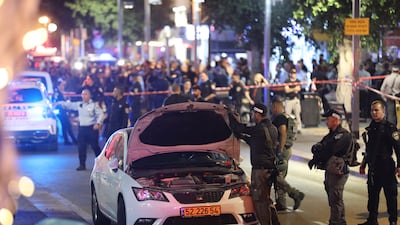
Most patrons of the restaurant did not fully comprehend what had happened in the immediate aftermath of the shooting. EPA -
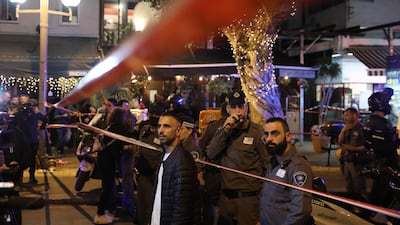
Israeli security forces patrol Dizengoff Street after the shooting on Thursday night. EPA -
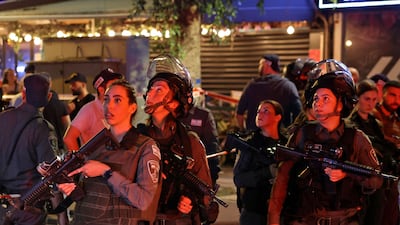
Defence Minister Benny Gantz said Israel will broaden its operations against the 'wave of terror' and that the attackers and those who send them will pay a 'heavy price'. AFP -
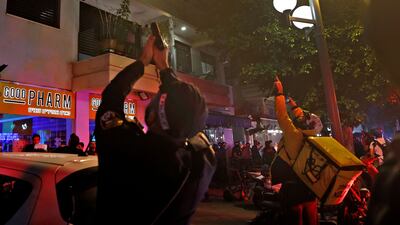
Security forces take aim outside the restaurant on Dizengoff Street immediately after the attack. AFP


Last Thursday, Raad Hazem, 28, from the Jenin camp, attacked the bar in central Tel Aviv and eluded a manhunt for hours before police shot and killed him near a mosque.
A poster celebrating Hazem as a martyr to the Palestinian cause was hung over the main entrance to the camp after the attack, praising him for “imposing a curfew” on the seaside metropolis.
Israel has launched a wave of arrest raids across the West Bank, igniting clashes with Palestinians. At least 25 Palestinians were killed, many of whom had carried out attacks or were involved in the clashes, but also an unarmed woman and a lawyer who appears to have been killed in error. Twelve were from in or around Jenin.
The renewed violence came as little surprise to Ahmed Tobasi, the artistic director of the Freedom Theatre, which was co-founded by a militant and offers drama classes, performance facilities and a safe space for young Palestinians in the camp.
“What do you expect from a child who grows up in a refugee camp, who sees army raids morning, noon and night?” he said. “His father’s a prisoner, his brother’s a prisoner, his mother has been detained, his friends are prisoners or martyrs.”
“There’s no opportunity to be anything else,” he said.
The camp is home to Palestinian families who fled or were driven out of what is now Israel during the 1948 war surrounding Israel's creation. Like other camps across the Middle East, it has grown into a crowded, built-up neighbourhood where a UN agency provides basic services.
Jenin emerged as a militant stronghold during the 2000-2005 intifada, when Palestinians launched scores of suicide bombings and other attacks against civilians, and Israel imposed closures and carried out deadly raids.
On March 27, 2002, a suicide bomber struck a Passover gathering in the coastal city of Netanya, killing at least 30 people and wounding 140 others.
Days later, Israeli troops launched an operation in the Jenin camp. For eight days and nights they fought militants street by street, using armoured bulldozers to destroy rows of homes, many of which had been booby-trapped.
An AP reporter who visited the camp afterward said it looked like an earthquake had hit.
At least 52 Palestinians, up to half of whom may have been civilians, were killed in the fighting, according to the UN. Twenty-three Israeli soldiers were killed, including 13 in a single ambush.
Two decades later, the Palestinians' dream of an independent state in the West Bank, East Jerusalem and Gaza — territories Israel captured in the 1967 Middle East war — is more remote than before.

Peace talks ground to a halt more than a decade ago, and Israel continues to build and expand Jewish settlements in the West Bank and East Jerusalem, which it unilaterally annexed and considers part of its capital.
Gaza is ruled by the militant and political group Hamas, and the Palestinian Authority's limited self-rule is confined to West Bank cities and towns.
Israeli Prime Minister Naftali Bennett is opposed to Palestinian statehood and supports the settlements, but his government has taken steps to improve economic conditions, including easing some movement restrictions and issuing thousands of work permits to Palestinians in the West Bank and Gaza.
Israel had hoped such measures would help to prevent a repeat of last year, when protests and clashes in Jerusalem during Ramadan started an 11-day Gaza war.
Now, after the attacks, Israel is tightening restrictions around Jenin and calling on the Palestinian Authority, which co-ordinates with it on security matters, to take action.
But the Palestinian Authority is in a crisis of legitimacy that would grow even worse if it is seen to side with Israel. Palestinian officials said the relentless Israeli raids in Jenin only undermine it further.

governor of Jenin
“We are ready in principle to work on enforcing law and order, and to implement our agreements with the Israelis, but in exchange for what?” Jenin's governor, Akram Rajoub, told Associated Press.
“I don’t work for the Israelis. If I don’t see a political solution on the horizon, then why should I do anything?”
Yossi Kuperwasser, a retired Israeli general who held senior positions in the West Bank during the intifada and is now at the Jerusalem Centre for Public Affairs, said it is the other way around.
“You’re looking at the chicken and the egg here. We operate there because they don’t,” he said.
Palestinian President Mahmoud Abbas condemned the Tel Aviv attack, but other officials did not.
Mr Rajoub visited the mourning tent of the attacker's family and gave a speech filled with praise that he later posted to Facebook.
“That’s something very disturbing,” Mr Kuperwasser said. “The Palestinian Authority still thinks it’s in an continuing struggle against Zionism and against Israel as the state of the Jewish people.”

In the Jenin camp, the Palestinian Authority is regarded as a public service provider at best, and at worst as collaborators with the occupation.
Few expect another full-blown uprising. Israeli officials said the recent attacks appear to have been carried out by lone assailants with perhaps some accomplices, rather than by militant groups such as Hamas and Islamic Jihad.
On the streets of Jenin, the tyres are piled up in anticipation of another confrontation.
“We are going to live on our land and die with dignity, and we aren’t going to surrender to the occupation,” Mr Rajoub said.

