Saudi Arabia's King Salman meets Egyptian President Abdel Fattah El Sisi during his visit to Riyadh last month. Photo: Saudi Royal Court

Gulf countries pledge $22bn to help Egypt avoid economic crisis amid Russia-Ukraine war


Nada El Sawy
  • English
  • Arabic

Egypt’s Gulf allies have pledged as much as $22 billion to help the country cope with the effects of the war in Ukraine.

The aid from Qatar, Saudi Arabia and the UAE will come in the form of central bank deposits and investments, according to government and media reports, which didn't specify the period over which the amount will be disbursed.

This will be the third time in less than a decade that Gulf states have stepped up financial support for the most populous Arab state.

“It’s very much needed and it’s a very natural course — we’ve seen it over the last decade or so that the Arab Gulf states support Egypt,” said Ashraf Naguib, chief executive of Cairo-based think tank Global Trade Matters. “Overall, a stable Egypt equates to a stable region."

As one of the Middle East’s most indebted nations with about half of its population living near or below the World Bank’s poverty line, Egypt was already in a precarious position, made worse by the ongoing conflict in Europe that has strained its food supplies.

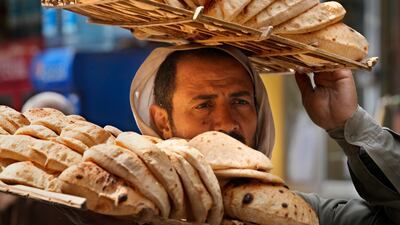
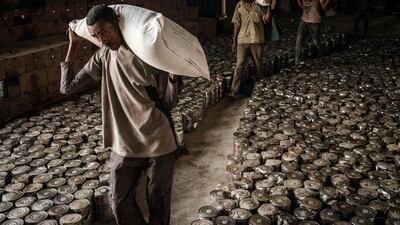
Russia’s invasion of Ukraine has had a drastic effect on Egypt’s food security with the warring countries accounting for 80 per cent of its wheat imports.

Also, Egypt is suffering from rising import costs and energy prices, decreasing foreign currency reserves and tourist inflows.

The nation's annual urban inflation rate rose to 8.8 per cent in February, the fastest in almost three years, due to surging food prices.

Overall, a stable Egypt equates to a stable region
Ashraf Naguib,
chief executive of Global Trade Matters
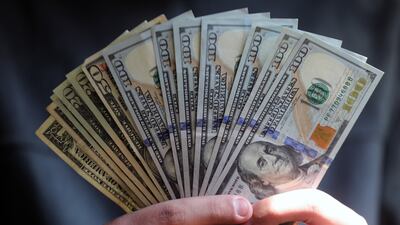
  • On Monday, Egypt devalued the currency from 15.7 pounds to the dollar, where it had remained mostly steady since November 2020. AP Photo
    On Monday, Egypt devalued the currency from 15.7 pounds to the dollar, where it had remained mostly steady since November 2020. AP Photo
  • The Egyptian pound slid to about 18.50 to the US dollar on Tuesday from 18.27, a day after the country devalued its currency by 14 per cent, Refinitiv data showed. EPA
    The Egyptian pound slid to about 18.50 to the US dollar on Tuesday from 18.27, a day after the country devalued its currency by 14 per cent, Refinitiv data showed. EPA
  • The latest depreciation brings the total devaluation since Monday morning to slightly more than 15 per cent, close to the amount by which at least some analysts had estimated it was overvalued. EPA
    The latest depreciation brings the total devaluation since Monday morning to slightly more than 15 per cent, close to the amount by which at least some analysts had estimated it was overvalued. EPA
  • Egypt plans to restructure its public budget for fiscal year 2022/23 to cope with the global crisis resulting from the war in Ukraine, a cabinet statement said. Reuters
    Egypt plans to restructure its public budget for fiscal year 2022/23 to cope with the global crisis resulting from the war in Ukraine, a cabinet statement said. Reuters
  • The Egyptian Prime Minister Moustafa Madbouly said: 'Prices increased in an unprecedented way. We saw how fuel and food prices have significantly increased which put a huge pressure on our resources because now, we need to secure as much resources as we can to provide needed goods.' Reuters
    The Egyptian Prime Minister Moustafa Madbouly said: 'Prices increased in an unprecedented way. We saw how fuel and food prices have significantly increased which put a huge pressure on our resources because now, we need to secure as much resources as we can to provide needed goods.' Reuters
  • 'Prices are still the same over the past 10 days or two weeks. There are goods now sold at somehow reduced prices in government-owned shops in order to beat [traders] who raise prices, who use this opportunity [currency devaluation] to raise prices. This is a good step by the government to support citizens,' said one Egyptian citizen. Reuters
    'Prices are still the same over the past 10 days or two weeks. There are goods now sold at somehow reduced prices in government-owned shops in order to beat [traders] who raise prices, who use this opportunity [currency devaluation] to raise prices. This is a good step by the government to support citizens,' said one Egyptian citizen. Reuters
  • The central bank raised its overnight lending and borrowing rates by one percentage point, state banks began selling one-year certificates of deposit to the public with a yield of 18 per cent and the government announced an economic relief package. Reuters
    The central bank raised its overnight lending and borrowing rates by one percentage point, state banks began selling one-year certificates of deposit to the public with a yield of 18 per cent and the government announced an economic relief package. Reuters

Saudi Arabia pledged $15bn. The kingdom deposited $5bn in Egypt’s central bank, the state-run Saudi Press Agency reported on March 30.

Saudi Arabia’s Public Investment Fund is weighing $10bn of investments in Egypt’s healthcare, education, agriculture and financial sectors, according to an Egyptian cabinet statement.

Qatar agreed to sign investment deals worth $5bn, the Egyptian cabinet said in a statement on March 29.

Abu Dhabi wealth fund ADQ last month made a deal of approximately $2bn to buy Egyptian state-held stakes in publicly-listed companies.

ADQ’s investments could include acquiring stakes in both listed and unlisted Egyptian companies, Ayman Soliman, the chief executive officer of The Sovereign Fund of Egypt, told Al Arabiya TV on Monday. Details may be announced within days, he said, declining to name specific companies.

Saudi Arabia’s Public Investment Fund may buy stakes in military-owned Wataniya Petroleum and three Siemens-built power plants as part of its pledged $10bn investment in Egypt, Mr Soliman said.

To mitigate the economic shocks caused by supply chain disruptions and shore up foreign currency reserves, Egypt recently introduced a 130bn Egyptian pound ($7.1bn) relief package, raised interest rates, let its currency weaken sharply and asked for support from the International Monetary Fund.

The central bank raised interest rates for the first time since 2017 and allowed the pound — which had been stable against the dollar for about two years — to weaken by more than 15 per cent. The currency closed at 18.19 pounds to the dollar on Monday.

Unlocking IMF support

Egypt has started discussions with the IMF on new support that may include a loan. The country has turned to the Washington-based lender three times in the past six years, borrowing $12bn in 2016-2019 under an economic reform package and a further $8bn in 2020 during the pandemic.

“We welcome Egypt’s response to head off the balance of payments shock and impact of rising prices,” Gerry Rice, director of communications at IMF, said on Friday.

“IMF staff are working closely with the Egyptian authorities to prepare for programme discussions with a view to supporting these shared goals of economic stability and sustainable job-rich growth and inclusive medium-term growth for Egypt.”

The backing of Gulf countries could help unlock IMF support by covering part of the expected funding gap, as it is typically a requirement that the recipient line up funds from other sources.

In addition to rocketing commodity prices, Egypt is facing $3bn to $4bn of lost revenue from fewer Russian and Ukrainian tourists, said Allen Sandeep, director of research at investment bank Naeem Holding in Cairo.

“All in all, Egypt is facing a funding gap of roughly $15bn in the next 12 months,” Mr Sandeep said.

“The $5bn deposit from KSA will add a lot of confidence in terms of exchange-rate stability, in terms of liquidity,” he added. “We’re still waiting to see what form the rest of the money will be in. This will take a longer time to filter down into the economy.”

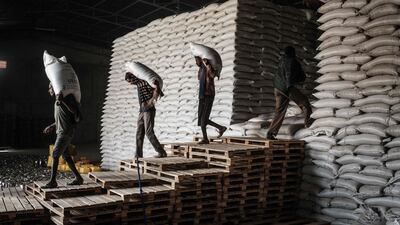
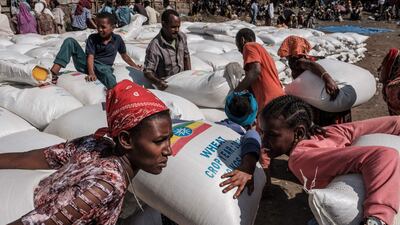
  • Workers carry sacks of wheat for distribution to more than 4,500 people who fled violence in Ethiopia's Tigray region. AFP
    Workers carry sacks of wheat for distribution to more than 4,500 people who fled violence in Ethiopia's Tigray region. AFP
  • Ethiopia's government on March 24 declared 'an indefinite humanitarian truce effective immediately', saying it hoped to help hasten delivery of emergency aid to the Tigray region. AFP
    Ethiopia's government on March 24 declared 'an indefinite humanitarian truce effective immediately', saying it hoped to help hasten delivery of emergency aid to the Tigray region. AFP
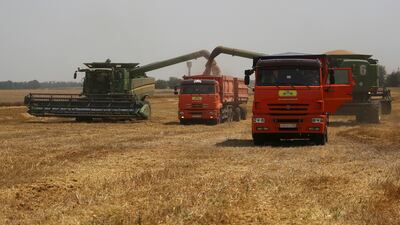
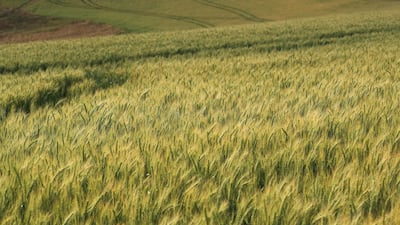
  • Farmers harvest with combines in a wheat field near the village Tbilisskaya, Russia. AP
    Farmers harvest with combines in a wheat field near the village Tbilisskaya, Russia. AP
  • A worker collects Egyptian traditional 'baladi' flatbread at a bakery in El Sharabia, in Cairo, Egypt. AP
    A worker collects Egyptian traditional 'baladi' flatbread at a bakery in El Sharabia, in Cairo, Egypt. AP
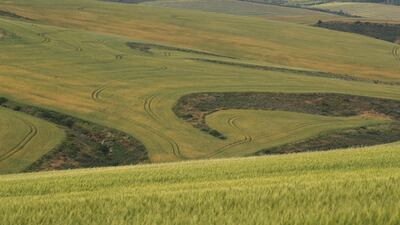
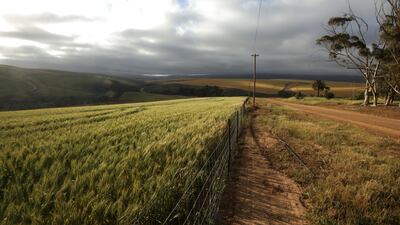
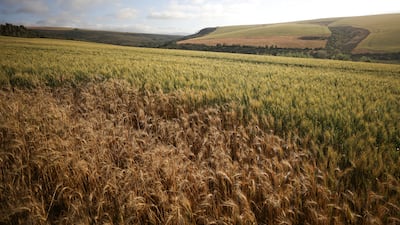
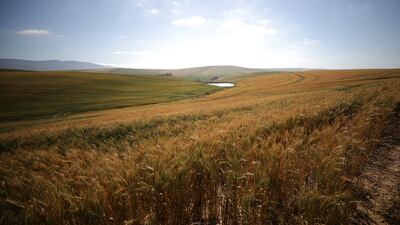
  • Fields of barley and wheat are seen outside Caledon near Cape Town, South Africa. Reuters
    Fields of barley and wheat are seen outside Caledon near Cape Town, South Africa. Reuters
  • Farmers harvest with combines in a wheat field near the village of Tbilisskaya, Russia. AP
    Farmers harvest with combines in a wheat field near the village of Tbilisskaya, Russia. AP
  • Women carry sacks of wheat during a food distribution programme organised by the Ethiopian government in the city of Alamata, Ethiopia. AFP
    Women carry sacks of wheat during a food distribution programme organised by the Ethiopian government in the city of Alamata, Ethiopia. AFP
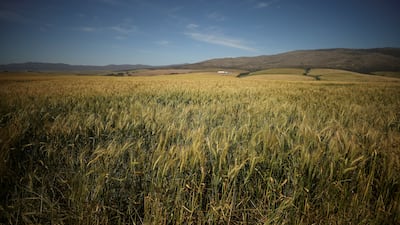
  • Barley and wheat fields outside Caledon near Cape Town, South Africa. Reuters
    Barley and wheat fields outside Caledon near Cape Town, South Africa. Reuters
  • Wheat and barley fields in South Africa. Reuters
    Wheat and barley fields in South Africa. Reuters
  • Grain fields in South Africa. Reuters
    Grain fields in South Africa. Reuters
  • Grain fields in South Africa. Reuters
    Grain fields in South Africa. Reuters
  • Fields of barley and wheat in Caledon, South Africa. Reuters
    Fields of barley and wheat in Caledon, South Africa. Reuters
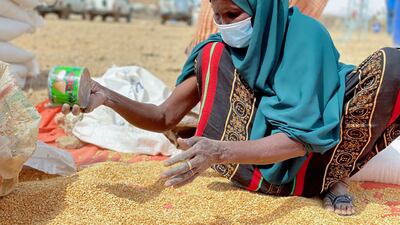
  • An Ethiopian woman sifts through distributed food supplies in a camp for the internally displaced in Adadle, in the Somali Region of Ethiopia. WFP via AP
    An Ethiopian woman sifts through distributed food supplies in a camp for the internally displaced in Adadle, in the Somali Region of Ethiopia. WFP via AP
  • A child looks after his family's animals in the Shabelle zone of the Somali region of Ethiopia. Unicef via AP
    A child looks after his family's animals in the Shabelle zone of the Somali region of Ethiopia. Unicef via AP

Political stability

Egypt’s food subsidy bill, which was budgeted at 88bn pounds ($4.8bn) before the Ukraine war, is likely to increase because of higher prices of commodities in general. The country’s subsidised programme includes providing cheap bread for 70 million people and increasing the price is a highly charged prospect.

The interrelation between food security and political stability is a key motivation for the financial support of Gulf Arab states.

“They’re hyper-aware that 11 years ago, food prices were part of the reason that the Arab Spring happened,” said Ryan Bohl, Mena analyst at the Rane Network’s geopolitical platform Stratfor.

Egypt’s January 2011 revolution led to the removal of then-president Hosni Mubarak from power and the election of Islamist President Mohammed Morsi in 2013.

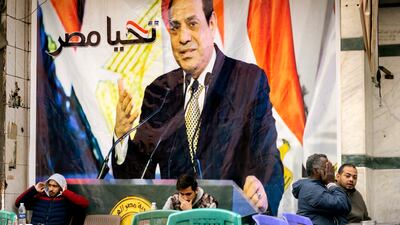
The ousting of Morsi in mid-2013 was led by Abdel Fattah El Sisi, then-army chief and now president. In an apparent sign of approval, Kuwait, Saudi Arabia and the UAE sent $23bn in grants, cash deposits and fuel shipments in the 18 months following the rebellion against Morsi.

While at the time this was tied to the perceived threat of the Muslim Brotherhood to security and stability in Egypt, similar incentives remain.

“The Arab world and mainly the Gulf world got the lesson of 2011 and beyond,” said Mohamed Farahat, director of Al Ahram Centre for Political and Strategic Studies. “The main lesson is that a strong economy and a strong state in Egypt is very important for stability in general in the region.”

In 2016, when Egypt devalued the pound by half, Saudi Arabia deposited about $3bn and the UAE $1bn in the central bank prior to the IMF agreement, UAE state news agency WAM reported.

Economic incentives

This time, the dynamic is slightly different in that the financial support is coming more in the form of investments.

“It’s the perfect balance between supporting the Egyptian people for stability and at the same time to make viable investments in a country that is growing and will give you a return,” said Mr Naguib of Global Trade Matters.

In Qatar’s case, it is also a signal of improved relations after the two countries ended a years-long feud in early 2021. Bahrain, Egypt, Saudi Arabia and the UAE froze relations and cut ties with Qatar in 2017 over accusations that it supported extremists.

“This is Qatar’s way of reintegrating into the Arab diplomatic fabric,” Mr Bohl said.

The $5bn investment package was announced after Egyptian Foreign Minister Sameh Shoukry met his Qatari counterpart last week. One of the points of discussion was reportedly reopening the Al Jazeera network bureau in Cairo after almost a decade of closure.

While investments and financial support are not explicitly tied to a quid pro quo, they often help.

“This is true for any government around the world that loans or provides aid to another country; there are usually some kind of strings attached, in one way or another,” said Amy Hawthorne, deputy director for research at the Project for Middle East Democracy.

The issue is how sustainable this model is for Egypt, which continues to rely heavily on foreign funding to keep its economy afloat.

“Once again, it’s on the precipice of crisis. Once again, it’s going back to the IMF and having to fill the gap with support from Gulf countries," said Ms Hawthorne.

"It’s the same cycle of problems that seems to be repeating itself.”

Game Changer

Director: Shankar 

Stars: Ram Charan, Kiara Advani, Anjali, S J Suryah, Jayaram

Rating: 2/5

Profile

Company: Libra Project

Based: Masdar City, ADGM, London and Delaware

Launch year: 2017

Size: A team of 12 with six employed full-time

Sector: Renewable energy

Funding: $500,000 in Series A funding from family and friends in 2018. A Series B round looking to raise $1.5m is now live.

Who's who in Yemen conflict

Houthis: Iran-backed rebels who occupy Sanaa and run unrecognised government

Yemeni government: Exiled government in Aden led by eight-member Presidential Leadership Council

Southern Transitional Council: Faction in Yemeni government that seeks autonomy for the south

Habrish 'rebels': Tribal-backed forces feuding with STC over control of oil in government territory

Keep it fun and engaging

Stuart Ritchie, director of wealth advice at AES International, says children cannot learn something overnight, so it helps to have a fun routine that keeps them engaged and interested.

“I explain to my daughter that the money I draw from an ATM or the money on my bank card doesn’t just magically appear – it’s money I have earned from my job. I show her how this works by giving her little chores around the house so she can earn pocket money,” says Mr Ritchie.

His daughter is allowed to spend half of her pocket money, while the other half goes into a bank account. When this money hits a certain milestone, Mr Ritchie rewards his daughter with a small lump sum.

He also recommends books that teach the importance of money management for children, such as The Squirrel Manifesto by Ric Edelman and Jean Edelman.

The Sand Castle

Director: Matty Brown

Stars: Nadine Labaki, Ziad Bakri, Zain Al Rafeea, Riman Al Rafeea

Rating: 2.5/5

White hydrogen: Naturally occurring hydrogenChromite: Hard, metallic mineral containing iron oxide and chromium oxideUltramafic rocks: Dark-coloured rocks rich in magnesium or iron with very low silica contentOphiolite: A section of the earth’s crust, which is oceanic in nature that has since been uplifted and exposed on landOlivine: A commonly occurring magnesium iron silicate mineral that derives its name for its olive-green yellow-green colour

Fight card

1. Bantamweight: Victor Nunes (BRA) v Siyovush Gulmamadov (TJK)

2. Featherweight: Hussein Salim (IRQ) v Shakhriyor Juraev (UZB)

3. Catchweight 80kg: Rashed Dawood (UAE) v Khamza Yamadaev (RUS)

4. Lightweight: Ho Taek-oh (KOR) v Ronald Girones (CUB)

5. Lightweight: Arthur Zaynukov (RUS) v Damien Lapilus (FRA)

6. Bantamweight: Vinicius de Oliveira (BRA) v Furkatbek Yokubov (RUS)

7. Featherweight: Movlid Khaybulaev (RUS) v Zaka Fatullazade (AZE)

8. Flyweight: Shannon Ross (TUR) v Donovon Freelow (USA)

9. Lightweight: Mohammad Yahya (UAE) v Dan Collins (GBR)

10. Catchweight 73kg: Islam Mamedov (RUS) v Martun Mezhulmyan (ARM)

11. Bantamweight World title: Jaures Dea (CAM) v Xavier Alaoui (MAR)

12. Flyweight World title: Manon Fiorot (FRA) v Gabriela Campo (ARG)

COMPANY PROFILE
Name: Akeed

Based: Muscat

Launch year: 2018

Number of employees: 40

Sector: Online food delivery

Funding: Raised $3.2m since inception 

Name: Colm McLoughlin

Country: Galway, Ireland

Job: Executive vice chairman and chief executive of Dubai Duty Free

Favourite golf course: Dubai Creek Golf and Yacht Club

Favourite part of Dubai: Palm Jumeirah


Living in...

This article is part of a guide on where to live in the UAE. Our reporters will profile some of the country’s most desirable districts, provide an estimate of rental prices and introduce you to some of the residents who call each area home.

Pearls on a Branch: Oral Tales
​​​​​​​Najlaa Khoury, Archipelago Books

UAE currency: the story behind the money in your pockets
The burning issue

The internal combustion engine is facing a watershed moment – major manufacturer Volvo is to stop producing petroleum-powered vehicles by 2021 and countries in Europe, including the UK, have vowed to ban their sale before 2040. The National takes a look at the story of one of the most successful technologies of the last 100 years and how it has impacted life in the UAE. 

Read part four: an affection for classic cars lives on

Read part three: the age of the electric vehicle begins

Read part one: how cars came to the UAE


Ten tax points to be aware of in 2026

1. Domestic VAT refund amendments: request your refund within five years

If a business does not apply for the refund on time, they lose their credit.

2. E-invoicing in the UAE

Businesses should continue preparing for the implementation of e-invoicing in the UAE, with 2026 a preparation and transition period ahead of phased mandatory adoption. 

3. More tax audits

Tax authorities are increasingly using data already available across multiple filings to identify audit risks. 

4. More beneficial VAT and excise tax penalty regime

Tax disputes are expected to become more frequent and more structured, with clearer administrative objection and appeal processes. The UAE has adopted a new penalty regime for VAT and excise disputes, which now mirrors the penalty regime for corporate tax.

5. Greater emphasis on statutory audit

There is a greater need for the accuracy of financial statements. The International Financial Reporting Standards standards need to be strictly adhered to and, as a result, the quality of the audits will need to increase.

6. Further transfer pricing enforcement

Transfer pricing enforcement, which refers to the practice of establishing prices for internal transactions between related entities, is expected to broaden in scope. The UAE will shortly open the possibility to negotiate advance pricing agreements, or essentially rulings for transfer pricing purposes. 

7. Limited time periods for audits

Recent amendments also introduce a default five-year limitation period for tax audits and assessments, subject to specific statutory exceptions. While the standard audit and assessment period is five years, this may be extended to up to 15 years in cases involving fraud or tax evasion. 

8. Pillar 2 implementation 

Many multinational groups will begin to feel the practical effect of the Domestic Minimum Top-Up Tax (DMTT), the UAE's implementation of the OECD’s global minimum tax under Pillar 2. While the rules apply for financial years starting on or after January 1, 2025, it is 2026 that marks the transition to an operational phase.

9. Reduced compliance obligations for imported goods and services

Businesses that apply the reverse-charge mechanism for VAT purposes in the UAE may benefit from reduced compliance obligations. 

10. Substance and CbC reporting focus

Tax authorities are expected to continue strengthening the enforcement of economic substance and Country-by-Country (CbC) reporting frameworks. In the UAE, these regimes are increasingly being used as risk-assessment tools, providing tax authorities with a comprehensive view of multinational groups’ global footprints and enabling them to assess whether profits are aligned with real economic activity. 

Contributed by Thomas Vanhee and Hend Rashwan, Aurifer

COMPANY PROFILE

Name: Lamsa

Founder: Badr Ward

Launched: 2014

Employees: 60

Based: Abu Dhabi

Sector: EdTech

Funding to date: $15 million

It Was Just an Accident

Director: Jafar Panahi

Stars: Vahid Mobasseri, Mariam Afshari, Ebrahim Azizi, Hadis Pakbaten, Majid Panahi, Mohamad Ali Elyasmehr

Rating: 4/5

Profile of Bitex UAE

Date of launch: November 2018

Founder: Monark Modi

Based: Business Bay, Dubai

Sector: Financial services

Size: Eight employees

Investors: Self-funded to date with $1m of personal savings

UAE rugby in numbers

5 - Year sponsorship deal between Hesco and Jebel Ali Dragons

700 - Dubai Hurricanes had more than 700 playing members last season between their mini and youth, men's and women's teams

Dh600,000 - Dubai Exiles' budget for pitch and court hire next season, for their rugby, netball and cricket teams

Dh1.8m - Dubai Hurricanes' overall budget for next season

Dh2.8m - Dubai Exiles’ overall budget for next season

Federer's 11 Wimbledon finals

2003 Beat Mark Philippoussis

2004 Beat Andy Roddick

2005 Beat Andy Roddick

2006 Beat Rafael Nadal

2007 Beat Rafael Nadal

2008 Lost to Rafael Nadal

2009 Beat Andy Roddick

2012 Beat Andy Murray

2014 Lost to Novak Djokovic

2015 Lost to Novak Djokovic

2017 Beat Marin Cilic

WWE TLC results

Asuka won the SmackDown Women's title in a TLC triple threat with Becky Lynch and Charlotte Flair

Dean Ambrose won the Intercontinental title against Seth Rollins

Daniel Bryan retained the WWE World Heavyweight Championship against AJ Styles

Ronda Rousey retained the Raw Women's Championship against Nia Jax

Rey Mysterio beat Randy Orton in a chairs match

Finn Balor defeated Drew McIntyre

Natalya beat Ruby Riott in a tables match

Braun Strowman beat Baron Corbin in a TLC match

Sheamus and Cesaro retained the SmackDown Tag Titles against The Usos and New Day

R-Truth and Carmella won the Mixed Match Challenge by beating Jinder Mahal and Alicia Fox

England squad

Goalkeepers: Jordan Pickford, Nick Pope, Aaron Ramsdale 

Defenders: Trent Alexander-Arnold, Conor Coady, Marc Guehi, Reece James, Harry Maguire, Tyrone Mings, Luke Shaw, John Stones, Ben White

Midfielders: Jude Bellingham, Conor Gallagher, Mason Mount, Jordan Henderson, Declan Rice, James Ward-Prowse

Forwards: Tammy Abraham, Phil Foden, Jack Grealish, Harry Kane, Bukayo Saka, Emile Smith Rowe, Raheem Sterling

Red flags
  • Promises of high, fixed or 'guaranteed' returns.
  • Unregulated structured products or complex investments often used to bypass traditional safeguards.
  • Lack of clear information, vague language, no access to audited financials.
  • Overseas companies targeting investors in other jurisdictions - this can make legal recovery difficult.
  • Hard-selling tactics - creating urgency, offering 'exclusive' deals.

Courtesy: Carol Glynn, founder of Conscious Finance Coaching

VEZEETA PROFILE

Date started: 2012

Founder: Amir Barsoum

Based: Dubai, UAE

Sector: HealthTech / MedTech

Size: 300 employees

Funding: $22.6 million (as of September 2018)

Investors: Technology Development Fund, Silicon Badia, Beco Capital, Vostok New Ventures, Endeavour Catalyst, Crescent Enterprises’ CE-Ventures, Saudi Technology Ventures and IFC

Gender equality in the workplace still 200 years away

It will take centuries to achieve gender parity in workplaces around the globe, according to a December report from the World Economic Forum.

The WEF study said there had been some improvements in wage equality in 2018 compared to 2017, when the global gender gap widened for the first time in a decade.

But it warned that these were offset by declining representation of women in politics, coupled with greater inequality in their access to health and education.

At current rates, the global gender gap across a range of areas will not close for another 108 years, while it is expected to take 202 years to close the workplace gap, WEF found.

The Geneva-based organisation's annual report tracked disparities between the sexes in 149 countries across four areas: education, health, economic opportunity and political empowerment.

After years of advances in education, health and political representation, women registered setbacks in all three areas this year, WEF said.

Only in the area of economic opportunity did the gender gap narrow somewhat, although there is not much to celebrate, with the global wage gap narrowing to nearly 51 per cent.

And the number of women in leadership roles has risen to 34 per cent globally, WEF said.

At the same time, the report showed there are now proportionately fewer women than men participating in the workforce, suggesting that automation is having a disproportionate impact on jobs traditionally performed by women.

And women are significantly under-represented in growing areas of employment that require science, technology, engineering and mathematics skills, WEF said.

* Agence France Presse

The specs: 2018 Jeep Grand Cherokee Trackhawk


Price, base: Dh399,999
Engine: Supercharged 6.2-litre V8
Gearbox: Eight-speed automatic
Power: 707hp @ 6,000rpm
Torque: 875Nm @ 4,800rpm
Fuel economy, combined: 16.8L / 100km (estimate)

AndhaDhun

Director: Sriram Raghavan

Producer: Matchbox Pictures, Viacom18

Cast: Ayushmann Khurrana, Tabu, Radhika Apte, Anil Dhawan

Rating: 3.5/5

Indika
%3Cp%3E%3Cstrong%3EDeveloper%3A%3C%2Fstrong%3E%2011%20Bit%20Studios%3Cbr%3E%3Cstrong%3EPublisher%3A%3C%2Fstrong%3E%20Odd%20Meter%3Cbr%3E%3Cstrong%3EConsole%3A%3C%2Fstrong%3E%20PlayStation%205%2C%20PC%20and%20Xbox%20series%20X%2FS%3Cbr%3E%3Cstrong%3ERating%3A%3C%2Fstrong%3E%204%2F5%3C%2Fp%3E%0A
Key developments in maritime dispute

2000: Israel withdraws from Lebanon after nearly 30 years without an officially demarcated border. The UN establishes the Blue Line to act as the frontier. 

2007: Lebanon and Cyprus define their respective exclusive economic zones to facilitate oil and gas exploration. Israel uses this to define its EEZ with Cyprus

2011: Lebanon disputes Israeli-proposed line and submits documents to UN showing different EEZ. Cyprus offers to mediate without much progress.

2018: Lebanon signs first offshore oil and gas licencing deal with consortium of France’s Total, Italy’s Eni and Russia’s Novatek.

2018-2019: US seeks to mediate between Israel and Lebanon to prevent clashes over oil and gas resources.

Company%20profile
%3Cp%3EName%3A%20Tabby%3Cbr%3EFounded%3A%20August%202019%3B%20platform%20went%20live%20in%20February%202020%3Cbr%3EFounder%2FCEO%3A%20Hosam%20Arab%2C%20co-founder%3A%20Daniil%20Barkalov%3Cbr%3EBased%3A%20Dubai%2C%20UAE%3Cbr%3ESector%3A%20Payments%3Cbr%3ESize%3A%2040-50%20employees%3Cbr%3EStage%3A%20Series%20A%3Cbr%3EInvestors%3A%20Arbor%20Ventures%2C%20Mubadala%20Capital%2C%20Wamda%20Capital%2C%20STV%2C%20Raed%20Ventures%2C%20Global%20Founders%20Capital%2C%20JIMCO%2C%20Global%20Ventures%2C%20Venture%20Souq%2C%20Outliers%20VC%2C%20MSA%20Capital%2C%20HOF%20and%20AB%20Accelerator.%3Cbr%3E%3C%2Fp%3E%0A
The five pillars of Islam

1. Fasting 

2. Prayer 

3. Hajj 

4. Shahada 

5. Zakat 

The more serious side of specialty coffee

While the taste of beans and freshness of roast is paramount to the specialty coffee scene, so is sustainability and workers’ rights.

The bulk of genuine specialty coffee companies aim to improve on these elements in every stage of production via direct relationships with farmers. For instance, Mokha 1450 on Al Wasl Road strives to work predominantly with women-owned and -operated coffee organisations, including female farmers in the Sabree mountains of Yemen.

Because, as the boutique’s owner, Garfield Kerr, points out: “women represent over 90 per cent of the coffee value chain, but are woefully underrepresented in less than 10 per cent of ownership and management throughout the global coffee industry.”

One of the UAE’s largest suppliers of green (meaning not-yet-roasted) beans, Raw Coffee, is a founding member of the Partnership of Gender Equity, which aims to empower female coffee farmers and harvesters.

Also, globally, many companies have found the perfect way to recycle old coffee grounds: they create the perfect fertile soil in which to grow mushrooms. 

Updated: April 12, 2022, 1:34 PM