


A diplomatic drive led by Jordan’s King Abdullah II to calm tension in Palestine relies on the outsize influence of the small kingdom but faces limits in a region full of big players.
As attacks by Palestinian extremists killed a dozen people in Israel this month, both Israel’s president and defence minister visited King Abdullah’s palace on the outskirts of Amman.
In an apparent nod to Jordanian demands to ease restrictions on Muslims in Jerusalem during Ramadan, Israeli President Isaac Herzog told the king that “we must move towards enabling everyone to practice their beliefs in safety, in security, in calm circumstances".
Ramadan is expected to start around April 1. Israeli actions against Palestinians at Al Aqsa Mosque resulted in an 11-day war last Ramadan that resulted in hundreds of deaths.
The conflict soured ties between Jordan and Israel, which signed a peace treaty in 1994, and allowed the Iran-backed militant group Hamas to tout their claim that only force guarantees Palestinian rights.
Officials from Jordan and Israel also discussed in recent weeks detailed Jordanian proposals on how Israel can lift restrictions on Palestinians that hamper economic activity and their daily lives, a Jordanian official said.
-
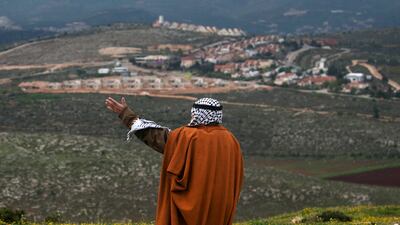
Abdallah Haj Mohamad, head of Jalud village's council, stands in front of the Jewish settlement of Shvut Rachel during a tour organised by Palestinian authorities to show the development of Israeli settlements in the occupied West Bank, on March 16, 2017. All photos: AFP -
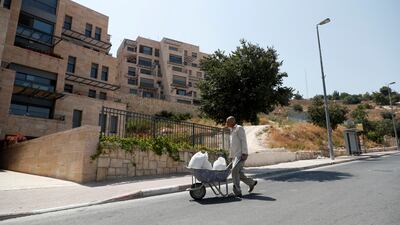
A picture taken on September 10, 2017 from Jabel Mukaber, a Palestinian neighbourhood In Israeli-occupied East Jerusalem, shows a worker pushing a cart in the Israeli settlement of Nof Zion. -
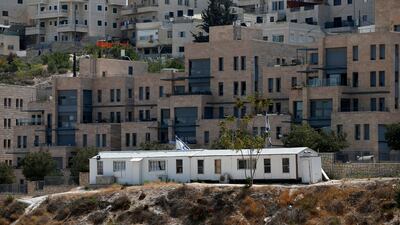
Another picture taken on September 10, 2017 from Jabel Mukaber shows the Israeli settlement of Nof Zion in the foreground. -
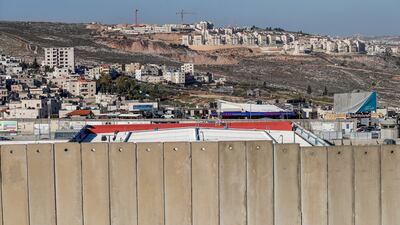
This picture taken on February 13, 2020 shows a section of Israel's separation barrier on the outskirts of Israeli-annexed East Jerusalem in the foreground, the Qalandia camp for Palestinian refugees in the occupied West Bank behind, and Israeli construction cranes at work on new housing units in the Jewish settlement of Kochav Ya'akov in the background. -

This picture taken on September 11, 2018 shows a view of the Palestinian Bedouin village of Khan al-Ahmar, located in a strategic spot in the occupied West Bank east of Jerusalem along the road to the Dead Sea near Israeli settlements. -
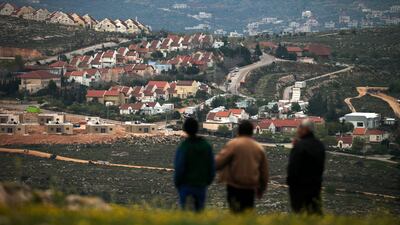
People look at the Jewish settlement of Shvut Rachel during a tour organised by the Palestinian authorities for ambassadors based in Tel Aviv and consuls based in Jerusalem to show the development of Israeli settlements in the occupied West Bank, on March 16, 2017. -

A picture taken on February 2, 2020, shows a general view of the Israeli settlement of Alon, in the Judaean desert, east of Jerusalem in the Israeli-occupied West Bank. -

A picture taken on January 27, 2020 shows the Israeli settlement Neve Yaakov, one of Jerusalem's neighbourhoods that falls between east Jerusalem and al-Ram in the occupied West Bank. -
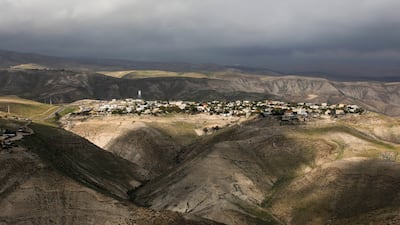
A picture taken on February 2, 2020, shows a general view of the Israeli settlement of Alon, in the Judaean desert, east of Jerusalem in the Israeli-occupied West Bank. -
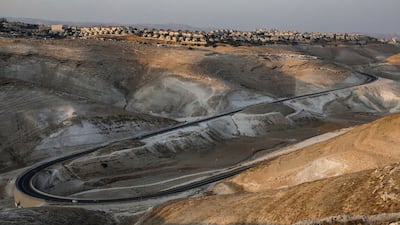
This picture taken from the Palestinian village of al-Sawahre, near the village of Abu Dis in the occupied West Bank on September 20, 2019 shows a view of the Israeli settlement of Maale Adumim.


These include allowing prayer assembly in Jerusalem during Ramadan, giving Palestinians more work permits and easing Israeli roadblocks, he said.
“The political and economic horizon for the Palestinians has become so narrow that any incident can lead a new war with regional magnifications,” the official said on condition of anonymity.
“Restoring calm is essential,” he said. “We are trying to prevent the sparks from flying.”
Historical balancing act
Jordan regards its interests as tied to the political fortunes of Palestinians across the River Jordan, whom it views as under threat of another Israeli expulsion.
Many of Jordan’s 10 million people are of Palestinian origin, whose ancestors fled to Jordan, mainly amid the conflicts in 1948 and 1967. Amman is a second home to Palestinian President Mahmoud Abbas, who heads the Palestinian Authority in Ramallah.

The war last year undermined Mr Abbas by making him appear as a bystander, although he briefly suspended security co-operation with Israel.
The official suggested that another war could be too much for an already beleaguered Palestinian Authority.
Israeli security forces killed two Palestinians in a West Bank raid on Thursday, while a third Palestinian was killed after reportedly trying to stab passengers on a bus.
Hamas said that its response would be “escalating the resistance and confrontations with the occupation".
“The PA are under a lot of pressure,” the Jordanian official said and added that there the kingdom had no political contacts with Hamas.
Jordan has close security contacts with Israel and relies on the country to supply it with water.
But since the prelude to the Hamas-Israel war last year, Jordanian officials have been vocal in criticising Israeli actions they say could lead to another wave of Palestinian refugees in Jordan, making it an “alternative homeland” that enables a complete Israeli takeover of Palestine.
The alternative homeland scenario also has domestic ramifications in Jordan, particularly among tribes that underpin the political and security system and seek to preserve their influence in the kingdom.
The Jordanian official said Amman has vital domestic factors to consider when it comes to Palestine and Israel.
But he suggested that the kingdom's foreign policy has to take into account its alliance with the US and Washington's vital contribution in shoring up the economy of Jordan, which retreated sharply in the past decade.
Watching Israeli politics
Relations between Jordan and Israel have improved since the departure of the ultra-hardline government of Benjamin Netanyahu in mid-2021.
But the Jordanian official indicated that the current Israeli Cabinet is too fragmented to make a major break with legacy Netanyahu policies. This could hold back the resumption of peace talks between the Israelis and Palestinians, he said.
Attention to the Palestinian issue has also been affected by Arab normalisation with Israel and the war in Ukraine.
Jordan was invited — but did not attend — an Iran-centric international meeting in Negev, Israel, this week. The meeting was between senior ministers from the UAE, Israel, Bahrain, Morocco, Egypt and the US.
A diplomat in Amman said that had a Jordanian delegation gone to Negev, its presence would have been at odds with policy of focusing on the Palestinian issue.
“The image would have been not right,” the diplomat said.
Jordan has been banking on other regional initiatives to improve its strategic position, seeking to improve ties with the regime of President Al Assad in Syria, as well as Iraq and Lebanon.
A US regional plan to supply power-starved Lebanon with electricity envisioned running Jordanian electricity supplies through Syrian regime areas.
Jordanian officials said that the electricity would be flowing to Lebanon by March.
But another diplomat in Beirut said Lebanon has not yet obtained World Bank funding to pay for the electricity.
“It is complicated,” the diplomat said. “The electricity might flow in a few months, or never.”
In Lebanon and Palestine, as well as Syria and Iraq, Jordanian officials may have underestimated the dysfunction plaguing the region.

