



Ramadan preparations are well under way across the Middle East as people insist Covid-19 measures will not hamper their celebrations.
In the Egyptian capital Cairo, streets have already begun to mark Ramadan, with billboards of coming TV shows and traditional lanterns on sale at markets alongside Ramadan foodstuffs.
Egypt's Ministry of Health said on March 12 that daily infections and deaths had been on the decline for the month, but have nonetheless asked that people adhere to Covid-19 regulations.
Antique salesman Omar Ibrahim, 37, said he does not see much worry over the virus. He said restrictions could hamper Ramadan traditions in the capital.
“Covid-19 is much less of a concern for Egyptians now than it was two years ago," he said. "I think it’s because in the beginning there was no information about it at all, so people imagined the worst. But when studies were conducted and they told us on TV how it works and what we can do to protect ourselves, things changed."
In Jordan, the government lifted most coronavirus restrictions for Eid Al Fitr last year. This year's Ramadan will be the first without any curbs since the pandemic began.
But the mood in Jordan in the run-up to Ramadan is gloomy as the war in Ukraine raises fears of food shortages.
Prime Minister Bisher Al Khasawneh said this week that prices of basic goods in Jordan remained lower than those in neighbouring countries because of a decades-old state policy of stockpiling.
“Jordan has preserved safe food levels in the face of the Ukrainian-Russian crisis,” he said on a tour of the desert governorate of Mafraq.
-
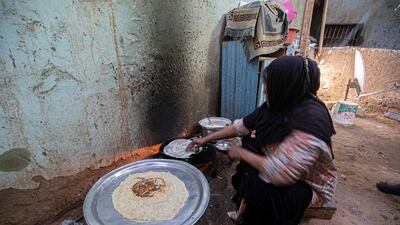
Umm Abdo prepares bread for the family in her home on the west bank of the Nile, by Egypt's southern city of Aswan. All photos: AFP -
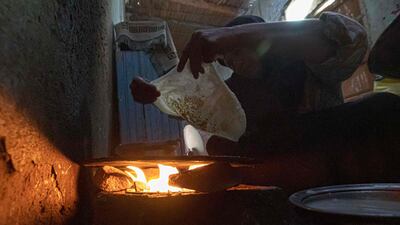
Russia's invasion of Ukraine has disrupted wheat imports to many countries, fuelling fears of higher prices and shortages. -

With global supply chains already under strain due to the Covid-19 pandemic, a wheat-buying frenzy in Egypt, Libya, Tunisia, Algeria and Morocco – all of which depend heavily on imported wheat to feed their populations – lays bare the magnitude of the challenge governments face amid sharp rises in food prices. -
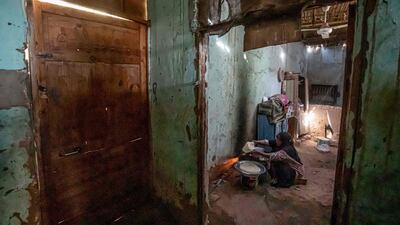
The crisis was highlighted by the UN food agency, which this week predicted that poorer countries in northern Africa, Asia and the Middle East that depend heavily on wheat imports risk suffering significant food insecurity because of the war in Ukraine. -
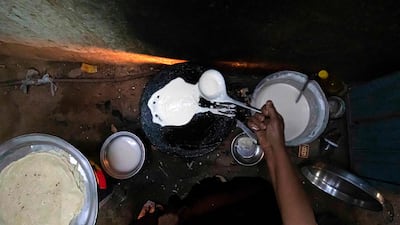
Of the five nations in northern Africa, Egypt’s wheat predicament is perhaps the gravest. The world’s largest wheat importer with a population of 102 million, Egypt relies on Russia and Ukraine for 80 per cent of its supply. -
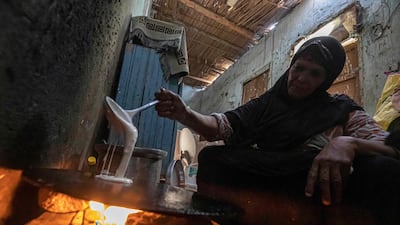
Egypt’s wheat is chiefly used to make the flatbreads provided for about 60 million citizens who are entitled to subsidised food.


'I am concerned about prices, not Covid'
The Iraqi government has yet to declare coronavirus-related restrictions, but with the significant decrease in daily cases, the government is expected to further ease its measures during Ramadan.
The announced government measures are changing little in markets which are already seeing few shoppers every day, in part because of food shortages.
Some hypermarkets are offering food items at affordable prices, but put limitations on the number of items taken by each family.
Like many Iraqis, Ahmed Ali, a government employee, is not worried about the pandemic.
“To be honest, I have little concern about coronavirus this year, but instead [I am concerned] about the prices,” he said.
Prices of many food items and construction materials, mainly those imported from Ukraine, have increased by 20 to 50 per cent since Russian started its military campaign on February 24.
“We and all the world have coexisted with coronavirus and we know to deal with it, so it’s not a source of concern any more,” he said.
Pilgrims rejoice over removal of Covid restrictions
In the Gulf, Muslims celebrated the easing of Covid-19 measures. In Saudi Arabia, pilgrims no longer need to book a prayer slot nor show proof of vaccination to enter the Grand Mosque in Makkah or the Prophet’s Mosque in Madinah.
This announcement came after the kingdom's news that confirmed Covid-19 cases have dropped by 90 per cent, while critical cases have fallen by 45 per cent in the past few weeks.
“I am most excited to go to the Haram [Grand Mosque in Makkah] for taraweeh this Ramadan. The last two years have been so hard due to the lockdown and restrictions so I wasn't able to go for the most important prayers of the year to Makkah as much as I used to. Now that there are no bookings and no social distancing.” said Momina Khalid, a Pakistani resident of the kingdom.
"I am craving the joy of being in Makkah among thousands of Muslims and praying my taraweeh prayers there.”
-

Muslim pilgrims walk around the Kaaba during the minor pilgrimage, known as Umrah, in Makkah after Saudi Arabia eased most Covid-19 restrictions. All photos: AP -

The kingdom has issued more than 29.4 million permits to the Grand Mosque in Makkah over the past seven months. -

More pilgrims plan to attend Umrah, with demand expected to surge beyond pre-pandemic levels. -
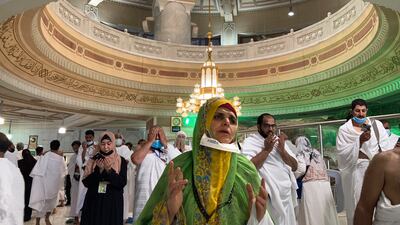
Social-distancing rules at the Grand Mosque of Makkah, the Prophet’s Mosque in Madinah and other mosques have been suspended. -

Workers remove social-distancing signs at the Grand Mosque of Makkah.


Samer Abbas, a Lebanese resident, in Saudi Arabia was mostly looking forward to seeing the streets filled with families and people being able to go out and do more for the community.
The past two years have seen only a limited number of volunteers distributing iftar meals every day.
“Ramadan helps people reconnect the most, locals to expats, everyone is able to spend more time with each other, be it praying or breaking fast with family and friends we don't get to see over the year,” said Mr Abbas.
After two years scarred by the coronavirus pandemic and violence, Palestinians in Jerusalem's Old City are wishing for a calm Ramadan next month.
“Hopefully it will be a nice Ramadan, after coronavirus,” said Ziyad Nabulsi, who works in a shop selling handicrafts.
When the pandemic hit some two years ago, the heavy metal doors of the Old City shops were pulled shut.
“You could not feel the atmosphere of Ramadan during the pandemic. Because it was always quarantine, people were sick. Now, thank God, it’s better,” said Mr Nabulsi, 19.

The Al Aqsa Mosque, the third holiest site in Islam, was closed to worshippers during Ramadan two years ago.
While some coronavirus restrictions remained in place last year, worshippers returned to the famous holy site in occupied East Jerusalem.
But celebrations were marred by Israeli security forces clashing with protesters, with more than 1,000 Palestinians and dozens of police officers wounded during Ramadan.
On a street leading to the Old City’s Damascus Gate, a focal point of demonstrations last year, Noor Abu Shabeer hoped violence would not be repeated.
“People don’t want problems, people want to enjoy themselves,” he said, working in the Al Najah sweet shop.
Lights for Ramadan are already on sale in Jerusalem and the streets are starting to bustle.
“Of course, people are preparing for Ramadan,” said Mr Abu Shabeer. “They buy sweets, they buy things, they fill their shelves for this month.”

