


With no access to running water, Assam Abu Murad says he and his neighbours may soon face death or displacement from their West Bank village.
“We want to have water all the time. Not – one day it’s finished [so] we drink mud. Tomorrow we drink I don’t know what,” the 60-year-old Palestinian told The National ahead of World Water Day on Tuesday March 22. The day is to raise awareness of the planet's two billion people who live without access to safe water.
Mr Abu Murad is one of fewer than 300 residents in Susiya, a village in the southern West Bank, who rely on water brought by lorries down dirt tracks.
About 14,000 Palestinians in areas of the West Bank fully controlled by Israel have no access to the water network, according to a UN report from September.
While pipes carry water into Israeli settlements, in Susiya the villagers face frequent shortages.
“Sometimes we wait for a couple of days. This year, I took drinking water from Abu Mohammed’s house,” Mr Abu Murad said of his neighbour.
The community of herders say they hold documents proving land ownership in the area which date to the Ottoman era, decades before Israel took control of the West Bank in the 1967 Arab-Israeli war.
From the hillside where they now live, villagers can see the ancient site of Susiya, from where they were forcibly evicted by the military in the 1980s.

Nearby is the Israeli settlement of the same name, which has a swimming pool. Most of the international community considers West Bank settlements illegal, although Israel disputes this.
The Har Hevron Regional Council, which administers Susiya settlement and others, did not respond to an interview request.
Israel’s military wing dealing with civilian affairs in the Palestinian territories, Cogat, did not comment on why rural Palestinian communities were not provided with water.
In Susiya village, Palestinians are cut off from more than 20 wells situated in a declared military zone.
They collect rainwater during the winter months, which is unpredictable, and their reliance on water lorries is costly. Residents say they pay around 25 shekels ($7.6) per cubic metre, compared with the Israeli Water Authority rate of between 7.4 and 13.5 shekels.

Gidon Ariel, a resident of Maale Hever settlement north-west of Susiya, said he and his neighbours do not encounter such problems.
“We get the bill from our community, from the regional council, and they get the water from the Israeli water [authority],” he said.
Mr Ariel, 58, said the community rarely encountered water shortages, although he mentioned instances of Palestinians allegedly tapping into pipes and diverting water.
Despite the arid climate, the Maale Hever resident suggested water should not be scarce owing to Israel’s impressive network of desalination plants.
“There’s plenty of water in the Mediterranean Sea for everybody,” Mr Ariel said.
In the meantime, he suggested those without water relocate to an urban area.
“If you want to live in a place that has organised water, that you turn on the faucet and you get the water all the time, then live in Bani Naim,” he said, referring to a town where services are managed by the Palestinian Authority.
In one Palestinian village a few kilometres away, however, running water has finally reached the residents.
“Now, thank God, we’re in a good period,” said Lina Najar, 38, in Shib Al Butum.
It has been about a year since the village was connected to mains water, with the support of children’s agency Unicef and the Action Against Hunger charity.

Despite it being in an area under full Israeli control, the water is funnelled from the Palestinian town of Al Karmel.
In Shib Al Butum, Ms Najar remembered having to wait up to 10 days for water in the past.
“We would get thirsty while waiting for the car to bring us water,” she said.
Ms Najar recalled feeling lethargic after drinking water before, when the villagers relied on tanks and wells.
“The little kids would get diarrhoea, vomiting, stomach aches. They had allergies too, now it’s stopped,” she said.
The cost has also plummeted, with the community paying about six shekels per cubic metre for the piped water.
Without having to worry about water any more, residents say they have a fresh outlook on life and are able to lavish the rainwater on trees and plants.
Meanwhile, in nearby Susiya, Mr Abu Murad fears the community could be uprooted if they do not have greater access to water.
“Without water, there’s no life,” he said, for the villagers or their flocks.
“If the situation continues, without having a water network permanently, we’ll all be dead sooner or later.”
World Water Day around the world - in pictures
-
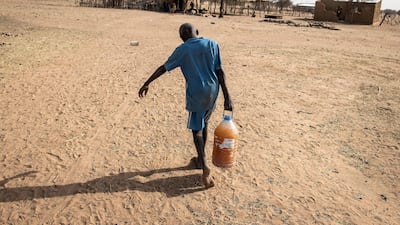
A boy carries a bottle of drinking water to his home in the village of Madina Torobe, in the Matam region of Senegal. Maintaining access to drinking water in the country's north-west is a constant concern. Through the months of November to August no rain will fall, and rivers and natural lakes dry up. Not all areas have drinking wells and flowing taps. Where they di exist, the water is sometimes dirty or used specifically for animals. Fulani pastoralists and families living in these remote villages sometimes resort to digging large holes in dried river beds in search of cleaner drinking water from themselves and their animals. AFP -
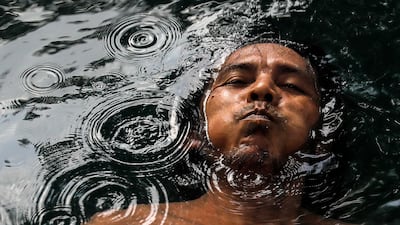
A man holds his breath while he swims in a hot spring near Kuala Lumpur, Malaysia. World Water Day, marked annually on March 22, raises awareness of the 2.2 billion people living without access to safe water. EPA -
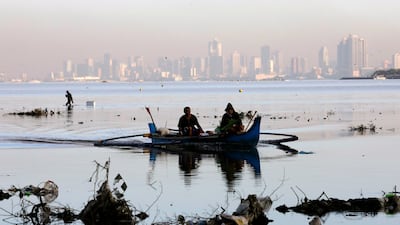
Fishermen steer a boat through debris off the shore of Manila, Philippines. The archipelago is surrounded by vast body of water, but finding potable sources is a challenge for many. EPA -
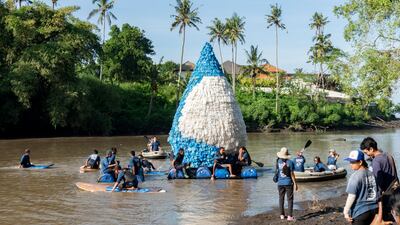
Environmental activists in Bali, Indonesia, float a sculpture made of waste plastic and depicting a droplet to mark World Water Day. The day is used to advocate the sustainable management of freshwater resources. EPA -
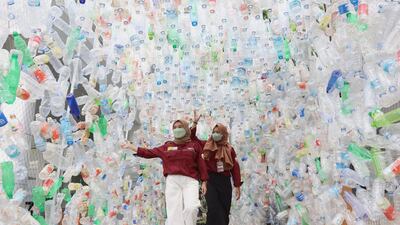
People walk through an art installation made of plastic water bottles as part of an awareness drive in Malang, East Java. AFP -
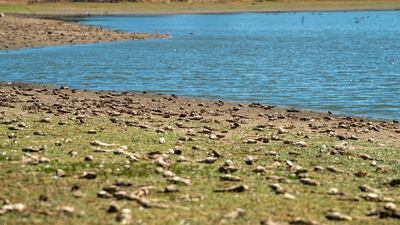
Dead carp fish lie on the dried lakebed of the Peñuelas Lake, a reservoir in Chile's Valparaiso Region. The reservoir, which supplies drinking water to Valparaiso and Viña del Mar, accumulates 0.2 per cent of its total water capacity. The central zone of Chile is facing one of the most extensive droughts documented. Despite its total capacity of 95 million cubic metres, the lake holds only 170 thousand cubic metres today. AFP -

Bikram Shah, 18, digs about six metres underground to build a well in Kathmandu, Nepal. On the backdrop of rapid urban population growth, industrialisation and uncertainties caused by climate change, the city becomes short of water in the winter and spring seasons. The theme of this year’s World Water Day is Groundwater – Making the Invisible Visible. EPA -
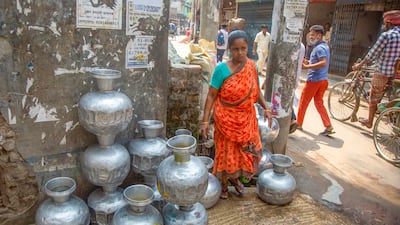
A woman collects drinking water from the city corporation water tap, on the occasion of World Water Day in Dhaka, Bangladesh. World Water Day is observed annually on 22 March to call attention and raise efforts for global access to clean water. This year's theme is Groundwater - Making the Invisible Visibible. EPA -
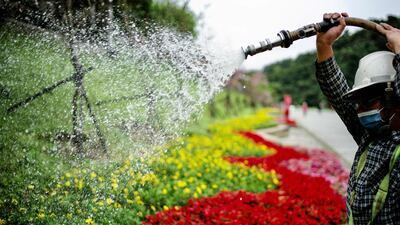
Flowers are watered in Bitan, a tourist hot spot in New Taipei City, Taiwan. AFP -
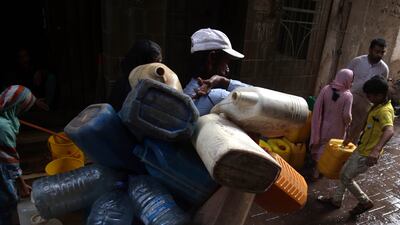
A man carries jerrycans to be filled with water in Karachi, Pakistan. EPA -
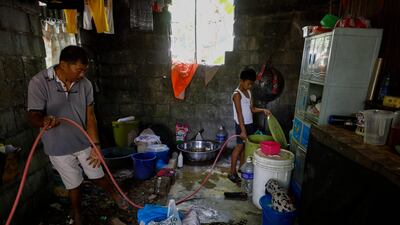
Eduardo Capillan and his son, Neo, control a hose that is funnelling water from a pump outside into their house in Sitio Bakal along the outskirts of Quezon City, Metro Manila, Philippines. With assistance from government and non-government agencies, an emergency water disinfection and filtration system is providing clean drinking water to the remote community. EPA -
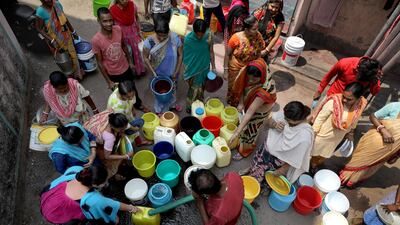
People in a slum in Kolkata, India, collect drinking water from a municipal container tank. EPA -
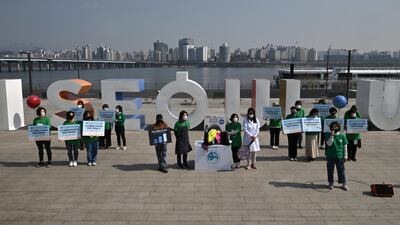
South Korean environmental activists hold placards reading ‘I will protect the sea from microplastics’ during a campaign to mark World Water Day at a park along the Han River in Seoul. AFP -
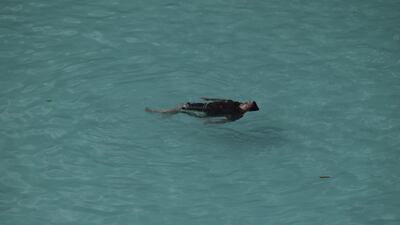
A man bathes in ‘Los Chorros’ pools formed by a natural spring of water, in Colón, El Salvador. AFP -
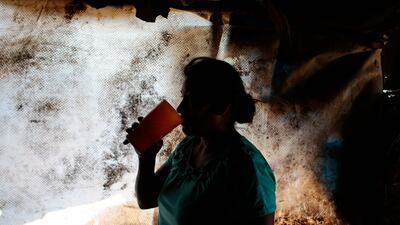
A woman drinks water distributed by a tanker to El Crucero, a town on the outskirts of Managua, Nicaragua. AFP



