


Israeli Prime Minister Naftali Bennett on Sunday said a nuclear deal between Iran and world powers could be reached “shortly”.
The negotiations have gathered pace in recent days, and Tehran said it was ready for an agreement as soon as possible.
Mr Bennett said talks were “advancing quickly” and an accord may be reached “shortly”, without giving a precise time frame.
“The new apparent agreement is shorter and weaker than the previous one,” he said at the start of a Cabinet meeting.
-
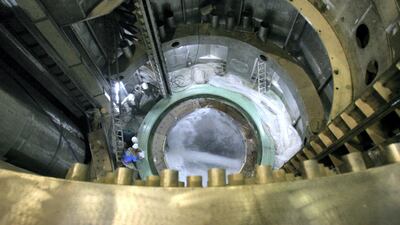
Russian contractors work at the Bushehr nuclear reactor site in 2007. The plant opened four years later. Bloomberg -
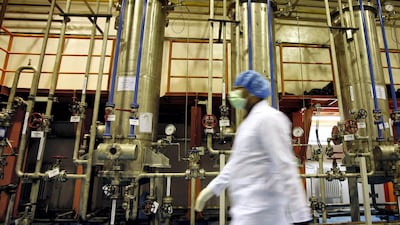
An Iranian technician at the International Atomic Energy Agency inspects the country's Isfahan plant in 2007. Tehran is no longer co-operating with the agency at nuclear sites across the country. EPA -

Workers wait to begin constructing a second reactor at the Bushehr nuclear power plant in 2019. AFP -
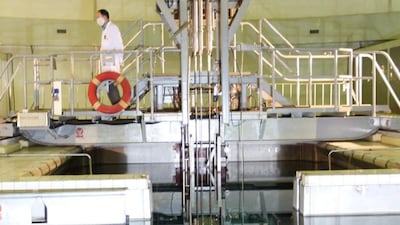
A metal-encased rod with 20 per cent enriched nuclear fuel is inserted into a reactor in Tehran in 2012. AFP -
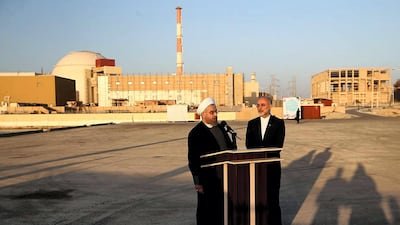
Fomer Iranian President Hassan Rouhani and the country's Atomic Energy Organisation chief Ali Akbar Salehi speak at the Bushehr nuclear site in 2015. AFP -
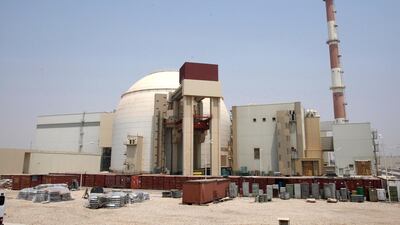
Iran's Bushehr nuclear plant has been restarted. EPA -
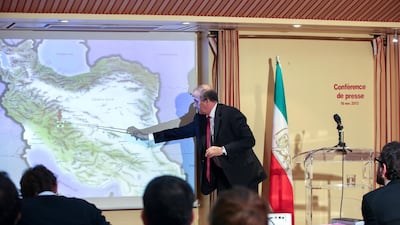
Mehdi Abrichamtchi, chairman of the Peace and Security Committee at the National Council of Resistance of Iran, shows journalists the location of a secret nuclear site in Iran in 2013. AFP -
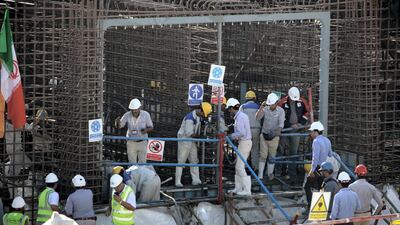
Workers prepare to begin the construction of a second reactor at the Bushehr site. AFP


The Israeli Prime Minister said the tabled agreement runs until 2025. He did not say how he obtained that information.
Israel was opposed to the 2015 deal between Iran and six other countries: China, France, Germany, Russia, the UK and the US.
Tehran received sanctions relief under the accord, in exchange for curbing its nuclear programme. The deal was weakened in 2018 when then-president Donald Trump withdrew US support.
Washington subsequently reimposed financial measures, prompting Iran to breach the limits set on its nuclear activity.
Efforts to revive the deal have been under way in Vienna since last April, with Iranian Foreign Minister Hossein Amirabdollahian saying his country remains “very serious” about the negotiations.
Tehran is “ready to achieve a good deal at the earliest possible time if the other side makes the needed political decision,” he said on Saturday at the Munich Security Conference.
German Chancellor Olaf Scholz said the talks had reached “the moment of truth”.
"We now have the chance to reach an agreement that will allow sanctions to be lifted. But if we do not succeed very quickly, the negotiations risk failing," he said in Munich on Saturday.
Israel, which is not a party to the talks, has called for a tougher agreement which goes beyond 2025.
The country regards Iran’s nuclear programme as an existential threat, and Tehran has repeatedly accused Israel of sabotaging its facilities.
Mr Bennett said his government was preparing for “the day after” a new accord is reached.
“In all dimensions, so that we can maintain the security of the citizens of Israel by ourselves,” he said.
Agencies contributed to this report

