


As Covid-19 rages across Israel, there are signs of hope at a maternity ward where infected women are giving birth without the sickness seen earlier in the pandemic.
Face masks and bottle teats are piled up at the entrance to the coronavirus maternity unit at Sheba Medical Centre, Israel’s largest hospital, where there are currently nine patients with their newborn babies.
“The likelihood of a woman being positive is much higher than in previous outbreaks,” said Prof Eyal Sivan, director of the hospital’s gynaecology and maternity centre.
“But all of them are feeling fairly well,” he said of patients who tested positive on arrival at the hospital near Tel Aviv.
While coronavirus regulations remain strict on the ward, where a nurse does her rounds in full protective gear, the patients are all expected to be home within days.
Supplies of medical equipment are stored in a side room, while nappies, tea and coffee are available in the corridor.
The situation stands in stark contrast to previous waves of the coronavirus in Israel, when doctors were seeing more premature births and pregnant women on ventilators.
“[It] makes life very difficult, because you’re actually treating two patients at the same time,” said Prof Sivan of monitoring a ventilated patient and her unborn baby.
The lack of severe symptoms currently seen on the ward could be down to a number of factors, including patients being vaccinated and some experiencing coronavirus for a second time.

The dominant Omicron variant of Covid-19 is also associated with less severe disease, but its rapid spread has put Israel’s health system under strain.
The number of severely ill patients in hospital reached 1,135 on Monday, health ministry data shows, approaching the peak of 1,193 seen in January 2021.
The caseload, meanwhile, has smashed records.
Israel recorded more than 1.5 million coronavirus cases last month, out of a population of 9.4 million – nearly seven times the figures from January last year.
Everyone who tests positive must isolate for at least five days, which has led to staff shortages at Sheba and other hospitals.
Prof Tal Biron-Shental, director of obstetrics and gynaecology at Meir Medical Centre in Kfar Saba, called it a “crazy burden”.
“The main problem right now is not medical,” she said.
“People [are] working hours and hours, on Saturdays and Sundays, around the clock.”
Coronavirus in Israel - in pictures
-
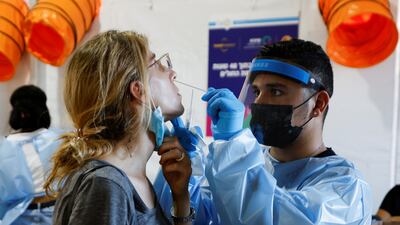
A health worker tests a person for Covid-19 at Rabin Square in Tel Aviv, Israel. -

Israeli government data shows the Pfizer-BioNTech Covid-19 vaccine was less effective against the Delta strain. -
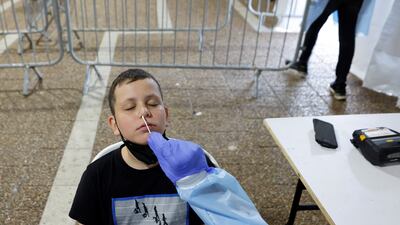
Israel led the way with one of the world’s most effective coronavirus inoculation drives. -
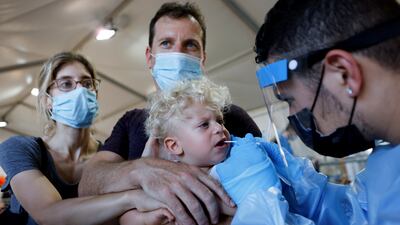
The country is now encouraging its young people to get vaccinated and offering third booster shots to the most vulnerable of its population. -
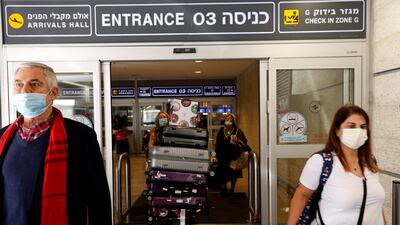
Masked travellers exit Israel's Ben Gurion International Airport. -

Israel reimposed indoor mask-wearing less than two weeks after lifting the measure because of the surge of the Delta strain. -

A health worker prepares a vaccine against Covid-19, as Israel continues to fight against the spread of the Delta variant, in Tel Aviv. -

Israel's pandemic response task force said the rise in cases was not matched by increasing hospital admissions or deaths. -
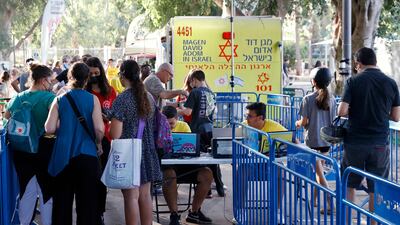
Israeli youths arrive to receive a dose of the Pfizer-BioNTech Covid-19 vaccine in Tel Aviv. -

The campaign to encourage the vaccination of teenagers is well under way in Tel Aviv. -
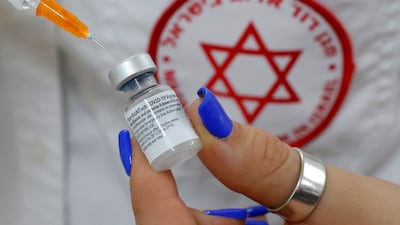
An Israeli medical worker prepares a dose of the Pfizer-BioNTech Covid-19 shot. -
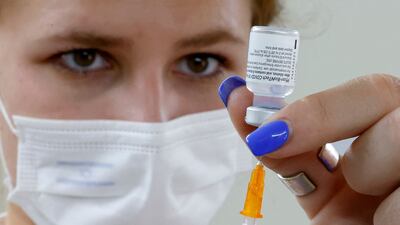
Despite the indications of increased infections in Israel, data shows vaccines are providing strong protection from severe illness.


Prime Minister Naftali Bennett admitted on Tuesday the surge of cases would continue, forecasting “another difficult week-and-a-half”. The government has not introduced significant curbs on daily life to stop the spread of coronavirus.
Despite the staffing pressures, Prof Biron-Shental said medics have become far better equipped to treat the virus.
“We feel much more confident knowing what to do with them,” she said, having gained a wealth of knowledge through treating patients and scientific studies.
While evidence cited by the World Health Organisation shows pregnant women are at a higher risk of developing severe symptoms than women of a similar age, research has also shown they can safely be vaccinated against Covid-19.
Despite this, international studies have shown lower vaccine uptake rates in pregnant women than the general population.
One of Prof Biron-Shental’s patients, Cristina Polunina, chose not to get the jab when it became available during her third trimester last January.
“I was scared that something would happen to the baby,” she said, after hearing mixed advice on television, before being hospitalised with Covid-19.
“I couldn’t breathe, I thought I would die,” said Ms Polunina, 40, who remembers coughing up blood.
She gave birth during her 10-day hospitalisation and recovered, along with her baby, Angela.
“If you want to see your kids grow up, you must take the vaccine – your life depends on it,” Ms Polunina said.
Prof Biron-Shental said most patients now follow her recommendation to get vaccinated.
The need to deliver babies early because of their sick mothers has “decreased dramatically”, she said. There are constantly a couple of patients with coronavirus, but they are all healthy.

