Eight years ago Jordanian artist Ghassan Mafadleh set out to restore public art in Jordan with a sculpture outside each major city. Today, only two remain.
Art in public spaces is rare in the country, although some of humankind's earliest sculptures were discovered here. A few modernist sculptures from the 1980s were removed long ago as Jordan became more religiously conservative. Instead, roundabouts and public parks were filled with nationalistic symbols, mainly large flags.
Mafadleh says the lack of public art is damaging to the country’s development and to official efforts to portray Jordan as a centre of moderation in the Middle East.
“Public space breaks the barrier of displaying work in galleries. But it is dominated by fanatics,” says Mafadleh from his home in Jabal Al Weibdeh, one of Amman’s original seven hills.
Undaunted by his previous lack of success, he is now proposing to set up new works in Irbid, Jordan’s third largest city, which was recently named the Arab Capital of Culture for 2022.
“It is a struggle,” he says. “If the mentality remains the same, art will not develop in Jordan, neither will life."
Unrealised project
In 2013, Mafadleh obtained funding from the Ministry of Culture for a project he called "the human being and the place".
It envisaged putting a sculpture at the entrance of each of Jordan's 12 provincial capitals, inspired by their heritage and surrounding nature.
But he still needed municipal approval; only three cities gave him the go-ahead: Jerash and Ajloun in the north and Tafileh in the south.
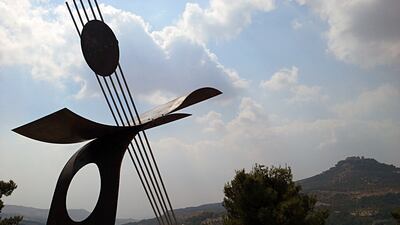
Four months after putting up an 8-metre high work by Mafadleh in 2014, the Jerash municipality removed it, without giving a reason.
I discovered that modern art can be closer to people, especially if you use material that people are familiar with and reproduce it in a contemporary vision
Ghassan Mafadleh
The work was composed of three pipes and rusted metal sheets, twisted and cut into shapes inspired by nature in the area. Jerash, Mafadleh's home region, is where the Romans built one of their main cities in the Levant.
The two other works from the project are still standing, in a way.
The one in Tafileh, also of metal, was painted gold by the municipality without informing Mafadleh.
His sculpture in the mountain city of Ajloun was designed to be interactive, but no longer works after parts of it were stolen.
Mafadleh says he was pleased with the work because it appealed to people’s tastes, “however instinctive and spontaneous”, and intends to repair it.
“It was interactive. It moved and bounced with the wind and people could climb on to it.
“I discovered that modern art can be closer to people, especially if you use material that people are familiar with and reproduce it in a contemporary vision.”
The mixed reaction to his works has also shown that some parts of Jordan are more open to art than others, he says.
Rust as a medium
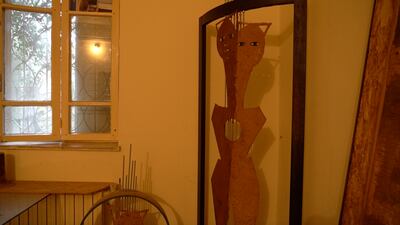
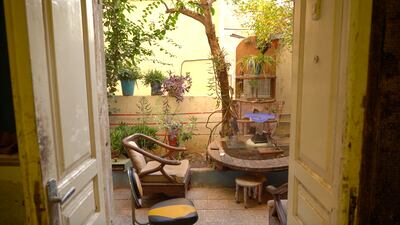
The garden of Mafadleh’s ground-floor flat is full of his works, and street cats.
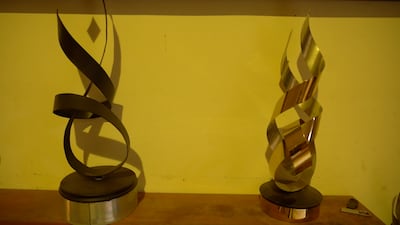
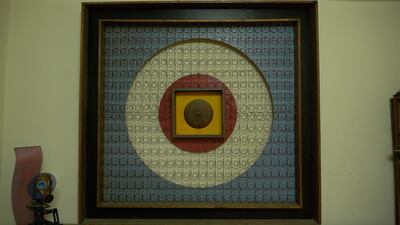
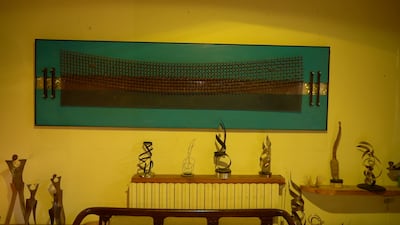
He re-forms used metal or wood, including parts of discarded machines and tools, to make his sculptures.
The works are bare, reflecting the parched landscape of Jordan. The brutalist appearance masks flowing forms, and the sculptures often have moving parts.
One work hanging on a wall in his flat is made from a large metal mesh used for sifting stones from sand, which Mafadleh has bent and placed against a painted blue background.
His work table is made from a large wooden reel used for power cables.
Another artwork is a piece of unaltered salt rock from the Dead Sea that Mafadleh placed on stand in such a way as to appear like a sculpture.
He likes to use rusted components because they “take new colours and shapes”.
“Rusted material is expressionist. It has a relation to time,” says the bearded sculptor, who also paints and publishes frequently on art.
During coronavirus lockdowns he made a sculpture from old tools that resembles a chemical warfare mask, with a rolled saw blade looking like its outlet valve.
“It is a new age with the coronavirus. The rhythm of life is different,” he says.
Failing a legacy
Now in his late 50s, Mafadleh developed interest in art while studying mathematics and computer science at the University of Jordan in the 1980s. The country's main university did not have an arts college until 2004.
He says neglect of art by the government as well as the broader society is a disservice to national heritage.
He recalls how statues and busts from 7,000BC to 8,000BC were discovered while building a motorway from Amman to Jordan's second city of Zarqa in the 1970s.
The 30 or so statues of Ain Ghazal are among the oldest sculptures in the world of the full human figure. One of them is on display at the Louvre in Abu Dhabi.
Today there are only half a dozen modern sculptures in public spaces in Jordan, including the two by Mafadleh in Ajloun and Tafileh.
It is an underwhelming output, he says.
"Jordan is 100 years old but its heritage is 10,000 years old," he says of the country created during Europe's 20th-century scramble for territorial control of the Middle East.
In recent years large graffiti works have appeared on the facades of about 30 buildings in Amman, funded by European countries as part of expanded aid packages to Jordan.
The art form has been spreading in the Middle East, mainly since the Arab uprisings that began in Tunisia in 2010, but Mafadleh is unimpressed.
"There is an element of showmanship to it. But it is better than nothing," he says.
“There needs to be a real platform to help bring people closer to beauty and lessen extremism and exclusion.”

Ten tax points to be aware of in 2026
1. Domestic VAT refund amendments: request your refund within five years
If a business does not apply for the refund on time, they lose their credit.
2. E-invoicing in the UAE
Businesses should continue preparing for the implementation of e-invoicing in the UAE, with 2026 a preparation and transition period ahead of phased mandatory adoption.
3. More tax audits
Tax authorities are increasingly using data already available across multiple filings to identify audit risks.
4. More beneficial VAT and excise tax penalty regime
Tax disputes are expected to become more frequent and more structured, with clearer administrative objection and appeal processes. The UAE has adopted a new penalty regime for VAT and excise disputes, which now mirrors the penalty regime for corporate tax.
5. Greater emphasis on statutory audit
There is a greater need for the accuracy of financial statements. The International Financial Reporting Standards standards need to be strictly adhered to and, as a result, the quality of the audits will need to increase.
6. Further transfer pricing enforcement
Transfer pricing enforcement, which refers to the practice of establishing prices for internal transactions between related entities, is expected to broaden in scope. The UAE will shortly open the possibility to negotiate advance pricing agreements, or essentially rulings for transfer pricing purposes.
7. Limited time periods for audits
Recent amendments also introduce a default five-year limitation period for tax audits and assessments, subject to specific statutory exceptions. While the standard audit and assessment period is five years, this may be extended to up to 15 years in cases involving fraud or tax evasion.
8. Pillar 2 implementation
Many multinational groups will begin to feel the practical effect of the Domestic Minimum Top-Up Tax (DMTT), the UAE's implementation of the OECD’s global minimum tax under Pillar 2. While the rules apply for financial years starting on or after January 1, 2025, it is 2026 that marks the transition to an operational phase.
9. Reduced compliance obligations for imported goods and services
Businesses that apply the reverse-charge mechanism for VAT purposes in the UAE may benefit from reduced compliance obligations.
10. Substance and CbC reporting focus
Tax authorities are expected to continue strengthening the enforcement of economic substance and Country-by-Country (CbC) reporting frameworks. In the UAE, these regimes are increasingly being used as risk-assessment tools, providing tax authorities with a comprehensive view of multinational groups’ global footprints and enabling them to assess whether profits are aligned with real economic activity.
Contributed by Thomas Vanhee and Hend Rashwan, Aurifer
Groom and Two Brides
Director: Elie Semaan
Starring: Abdullah Boushehri, Laila Abdallah, Lulwa Almulla
Rating: 3/5
Key figures in the life of the fort
Sheikh Dhiyab bin Isa (ruled 1761-1793) Built Qasr Al Hosn as a watchtower to guard over the only freshwater well on Abu Dhabi island.
Sheikh Shakhbut bin Dhiyab (ruled 1793-1816) Expanded the tower into a small fort and transferred his ruling place of residence from Liwa Oasis to the fort on the island.
Sheikh Tahnoon bin Shakhbut (ruled 1818-1833) Expanded Qasr Al Hosn further as Abu Dhabi grew from a small village of palm huts to a town of more than 5,000 inhabitants.
Sheikh Khalifa bin Shakhbut (ruled 1833-1845) Repaired and fortified the fort.
Sheikh Saeed bin Tahnoon (ruled 1845-1855) Turned Qasr Al Hosn into a strong two-storied structure.
Sheikh Zayed bin Khalifa (ruled 1855-1909) Expanded Qasr Al Hosn further to reflect the emirate's increasing prominence.
Sheikh Shakhbut bin Sultan (ruled 1928-1966) Renovated and enlarged Qasr Al Hosn, adding a decorative arch and two new villas.
Sheikh Zayed bin Sultan (ruled 1966-2004) Moved the royal residence to Al Manhal palace and kept his diwan at Qasr Al Hosn.
Sources: Jayanti Maitra, www.adach.ae
Sour%20Grapes
%3Cp%3E%3Cstrong%3EAuthor%3A%20%3C%2Fstrong%3EZakaria%20Tamer%3Cbr%3E%3Cstrong%3EPublisher%3A%20%3C%2Fstrong%3ESyracuse%20University%20Press%3Cbr%3E%3Cstrong%3EPages%3A%20%3C%2Fstrong%3E176%3C%2Fp%3E%0A
First-round leaderbaord
-5 C Conners (Can)
-3 B Koepka (US), K Bradley (US), V Hovland (Nor), A Wise (US), S Horsfield (Eng), C Davis (Aus);
-2 C Morikawa (US), M Laird (Sco), C Tringale (US)
Selected others: -1 P Casey (Eng), R Fowler (US), T Hatton (Eng)
Level B DeChambeau (US), J Rose (Eng)
1 L Westwood (Eng), J Spieth (US)
3 R McIlroy (NI)
4 D Johnson (US)
How to watch Ireland v Pakistan in UAE
When: The one-off Test starts on Friday, May 11
What time: Each day’s play is scheduled to start at 2pm UAE time.
TV: The match will be broadcast on OSN Sports Cricket HD. Subscribers to the channel can also stream the action live on OSN Play.
The biog
Favourite books: 'Ruth Bader Ginsburg: A Life' by Jane D. Mathews and ‘The Moment of Lift’ by Melinda Gates
Favourite travel destination: Greece, a blend of ancient history and captivating nature. It always has given me a sense of joy, endless possibilities, positive energy and wonderful people that make you feel at home.
Favourite pastime: travelling and experiencing different cultures across the globe.
Favourite quote: “In the future, there will be no female leaders. There will just be leaders” - Sheryl Sandberg, COO of Facebook.
Favourite Movie: Mona Lisa Smile
Favourite Author: Kahlil Gibran
Favourite Artist: Meryl Streep
Tips for taking the metro
- set out well ahead of time
- make sure you have at least Dh15 on you Nol card, as there could be big queues for top-up machines
- enter the right cabin. The train may be too busy to move between carriages once you're on
- don't carry too much luggage and tuck it under a seat to make room for fellow passengers
Tamkeen's offering
- Option 1: 70% in year 1, 50% in year 2, 30% in year 3
- Option 2: 50% across three years
- Option 3: 30% across five years
What is graphene?
Graphene is extracted from graphite and is made up of pure carbon.
It is 200 times more resistant than steel and five times lighter than aluminum.
It conducts electricity better than any other material at room temperature.
It is thought that graphene could boost the useful life of batteries by 10 per cent.
Graphene can also detect cancer cells in the early stages of the disease.
The material was first discovered when Andre Geim and Konstantin Novoselov were 'playing' with graphite at the University of Manchester in 2004.
COMPANY%20PROFILE
%3Cp%3E%3Cstrong%3ECompany%3A%3C%2Fstrong%3E%20Eco%20Way%3Cbr%3E%3Cstrong%3EStarted%3A%3C%2Fstrong%3E%20December%202023%3Cbr%3E%3Cstrong%3EFounder%3A%3C%2Fstrong%3E%20Ivan%20Kroshnyi%3Cbr%3E%3Cstrong%3EBased%3A%3C%2Fstrong%3E%20Dubai%2C%20UAE%3Cbr%3E%3Cstrong%3EIndustry%3A%3C%2Fstrong%3E%20Electric%20vehicles%3Cbr%3E%3Cstrong%3EInvestors%3A%3C%2Fstrong%3E%20Bootstrapped%20with%20undisclosed%20funding.%20Looking%20to%20raise%20funds%20from%20outside%3Cbr%3E%3C%2Fp%3E%0A
COMPANY%20PROFILE
%3Cp%3E%3Cstrong%3ECompany%20name%3A%20%3C%2Fstrong%3ESupy%0D%3Cbr%3E%3Cstrong%3EStarted%3A%20%3C%2Fstrong%3E2021%0D%3Cbr%3E%3Cstrong%3EFounders%3A%20%3C%2Fstrong%3EDani%20El-Zein%2C%20Yazeed%20bin%20Busayyis%2C%20Ibrahim%20Bou%20Ncoula%0D%3Cbr%3E%3Cstrong%3EBased%3A%20%3C%2Fstrong%3EDubai%0D%3Cbr%3E%3Cstrong%3EIndustry%3A%20%3C%2Fstrong%3EFood%20and%20beverage%2C%20tech%2C%20hospitality%20software%2C%20Saas%0D%3Cbr%3E%3Cstrong%3EFunding%20size%3A%20%3C%2Fstrong%3EBootstrapped%20for%20six%20months%3B%20pre-seed%20round%20of%20%241.5%20million%3B%20seed%20round%20of%20%248%20million%0D%3Cbr%3E%3Cstrong%3EInvestors%3A%20%3C%2Fstrong%3EBeco%20Capital%2C%20Cotu%20Ventures%2C%20Valia%20Ventures%20and%20Global%20Ventures%3C%2Fp%3E%0A
Jetour T1 specs
Engine: 2-litre turbocharged
Power: 254hp
Torque: 390Nm
Price: From Dh126,000
Available: Now
Key findings of Jenkins report
- Founder of the Muslim Brotherhood, Hassan al Banna, "accepted the political utility of violence"
- Views of key Muslim Brotherhood ideologue, Sayyid Qutb, have “consistently been understood” as permitting “the use of extreme violence in the pursuit of the perfect Islamic society” and “never been institutionally disowned” by the movement.
- Muslim Brotherhood at all levels has repeatedly defended Hamas attacks against Israel, including the use of suicide bombers and the killing of civilians.
- Laying out the report in the House of Commons, David Cameron told MPs: "The main findings of the review support the conclusion that membership of, association with, or influence by the Muslim Brotherhood should be considered as a possible indicator of extremism."
Straightforward ways to reduce sugar in your family's diet
- Ban fruit juice and sodas
- Eat a hearty breakfast that contains fats and wholegrains, such as peanut butter on multigrain toast or full-fat plain yoghurt with whole fruit and nuts, to avoid the need for a 10am snack
- Give young children plain yoghurt with whole fruits mashed into it
- Reduce the number of cakes, biscuits and sweets. Reserve them for a treat
- Don’t eat dessert every day
- Make your own smoothies. Always use the whole fruit to maintain the benefit of its fibre content and don’t add any sweeteners
- Always go for natural whole foods over processed, packaged foods. Ask yourself would your grandmother have eaten it?
- Read food labels if you really do feel the need to buy processed food
- Eat everything in moderation
Sunday's games
Liverpool v West Ham United, 4.30pm (UAE)
Southampton v Burnley, 4.30pm
Arsenal v Manchester City, 7pm
The years Ramadan fell in May
More from Neighbourhood Watch:
Dust and sand storms compared
Sand storm
- Particle size: Larger, heavier sand grains
- Visibility: Often dramatic with thick "walls" of sand
- Duration: Short-lived, typically localised
- Travel distance: Limited
- Source: Open desert areas with strong winds
Dust storm
- Particle size: Much finer, lightweight particles
- Visibility: Hazy skies but less intense
- Duration: Can linger for days
- Travel distance: Long-range, up to thousands of kilometres
- Source: Can be carried from distant regions