Several high profile politicians have been accused of committing election fraud. Reuters

High profile Tunisian politicians charged with electoral crimes


Erin Clare Brown
  • English
  • Arabic

A Tunis court announced on Wednesday it was launching prosecutions against 19 people, including parliament speaker Rached Ghannouchi and many high profile former ministers and politicians, for alleged crimes related to the 2019 presidential and parliamentary elections.

Several former prime ministers — including Youssef Chahed, Elyès Fakhfakh, and Mehdi Jomaa, a former minister of defence, former president Moncef Marzouki, the president of political party Qalb Tounes, and Nabil Kharoui, who ran against President Kais Saied in 2019 — were also among those whom the court said would be charged with “political advertising, illegal advertising via social media, and violation of electoral silence”.

Mr Saied has long called for those listed in a 2019 report from the Court of Auditors into election fraud to be prosecuted. The report details irregularities ranging from nomination fraud to the receipt of foreign funding to illegal advertising on social media.

Mr Saied is also listed in the report, for both nomination fraud and illegal campaign spending, but is not currently facing charges.

Worker's Party Secretary General Hamma Hammami, who is facing charges, called for the president to “lift his immunity and respond to what appeared in the report”, to which the president retorted “the only sum I spent is 50 dinars ($17), in addition to a few coffees”.

If convicted, the accused will face fines, though Mr Saied has pressed for more serious sentences. The accused may also be barred from running in elections or holding public office in the future.

The case highlights the complicated nature of Tunisia's electoral law, which forbids advertising and demands large lists of physical signatures to secure a nomination. Mr Saied has vowed to change the law before new parliamentary elections next December, though he has yet to give any indication of what the new laws will be.

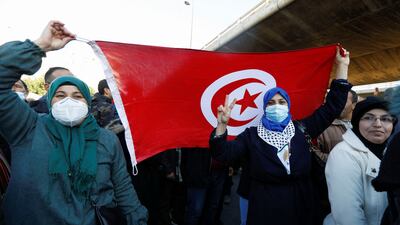
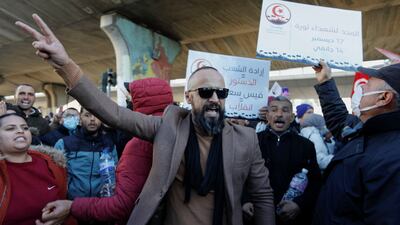
Tunisians protest on the anniversary of the 2011 uprising

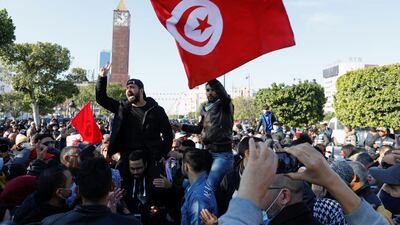
  • Tunisians shout slogans as they protest against President Kais Saied in the capital Tunis on the 10th anniversary of the start of the 2011 uprising. AFP
    Tunisians shout slogans as they protest against President Kais Saied in the capital Tunis on the 10th anniversary of the start of the 2011 uprising. AFP
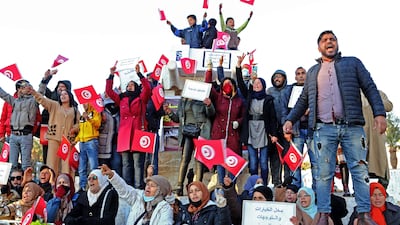
  • Demonstrators in Tunisian capital Tunis protest against President Kais Saied seizing governing power. Reuters
    Demonstrators in Tunisian capital Tunis protest against President Kais Saied seizing governing power. Reuters
  • Unemployed Tunisian graduates during a demonstration to mark the 10th anniversary of the start of the 2011 uprising in central city Sidi Bouzid. AFP
    Unemployed Tunisian graduates during a demonstration to mark the 10th anniversary of the start of the 2011 uprising in central city Sidi Bouzid. AFP
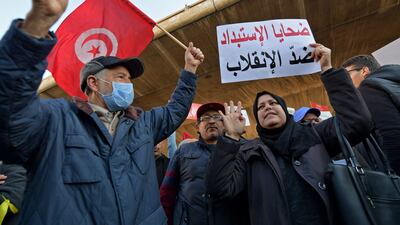
  • Opponents of Tunisian President Kais Saied slam his decision to extend the suspension of parliament. AFP
    Opponents of Tunisian President Kais Saied slam his decision to extend the suspension of parliament. AFP
  • Protesters against Tunisian President Kais Saied. AFP
    Protesters against Tunisian President Kais Saied. AFP
  • People protest in Tunis. Reuters
    People protest in Tunis. Reuters
  • Protestors hold the Tunisian flag in Tunis. Reuters
    Protestors hold the Tunisian flag in Tunis. Reuters
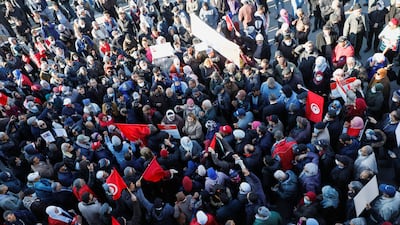
  • People march and hold signs in Tunis. Reuters
    People march and hold signs in Tunis. Reuters
  • Tunisian police block the entrances to the city centre at a protest against President Kais Saied in Tunis. AFP
    Tunisian police block the entrances to the city centre at a protest against President Kais Saied in Tunis. AFP
A new relationship with the old country

Treaty of Friendship between the United Kingdom of Great Britain and Northern Ireland and the United Arab Emirates

The United kingdom of Great Britain and Northern Ireland and the United Arab Emirates; Considering that the United Arab Emirates has assumed full responsibility as a sovereign and independent State; Determined that the long-standing and traditional relations of close friendship and cooperation between their peoples shall continue; Desiring to give expression to this intention in the form of a Treaty Friendship; Have agreed as follows:

ARTICLE 1 The relations between the United Kingdom of Great Britain and Northern Ireland and the United Arab Emirates shall be governed by a spirit of close friendship. In recognition of this, the Contracting Parties, conscious of their common interest in the peace and stability of the region, shall: (a) consult together on matters of mutual concern in time of need; (b) settle all their disputes by peaceful means in conformity with the provisions of the Charter of the United Nations.

ARTICLE 2 The Contracting Parties shall encourage education, scientific and cultural cooperation between the two States in accordance with arrangements to be agreed. Such arrangements shall cover among other things: (a) the promotion of mutual understanding of their respective cultures, civilisations and languages, the promotion of contacts among professional bodies, universities and cultural institutions; (c) the encouragement of technical, scientific and cultural exchanges.

ARTICLE 3 The Contracting Parties shall maintain the close relationship already existing between them in the field of trade and commerce. Representatives of the Contracting Parties shall meet from time to time to consider means by which such relations can be further developed and strengthened, including the possibility of concluding treaties or agreements on matters of mutual concern.

ARTICLE 4 This Treaty shall enter into force on today’s date and shall remain in force for a period of ten years. Unless twelve months before the expiry of the said period of ten years either Contracting Party shall have given notice to the other of its intention to terminate the Treaty, this Treaty shall remain in force thereafter until the expiry of twelve months from the date on which notice of such intention is given.

IN WITNESS WHEREOF the undersigned have signed this Treaty.

DONE in duplicate at Dubai the second day of December 1971AD, corresponding to the fifteenth day of Shawwal 1391H, in the English and Arabic languages, both texts being equally authoritative.

Signed

Geoffrey Arthur  Sheikh Zayed

Gertrude Bell's life in focus

A feature film

At one point, two feature films were in the works, but only German director Werner Herzog’s project starring Nicole Kidman would be made. While there were high hopes he would do a worthy job of directing the biopic, when Queen of the Desert arrived in 2015 it was a disappointment. Critics panned the film, in which Herzog largely glossed over Bell’s political work in favour of her ill-fated romances.

A documentary

A project that did do justice to Bell arrived the next year: Sabine Krayenbuhl and Zeva Oelbaum’s Letters from Baghdad: The Extraordinary Life and Times of Gertrude Bell. Drawing on more than 1,000 pieces of archival footage, 1,700 documents and 1,600 letters, the filmmakers painstakingly pieced together a compelling narrative that managed to convey both the depth of Bell’s experience and her tortured love life.

Books, letters and archives

Two biographies have been written about Bell, and both are worth reading: Georgina Howell’s 2006 book Queen of the Desert and Janet Wallach’s 1996 effort Desert Queen. Bell published several books documenting her travels and there are also several volumes of her letters, although they are hard to find in print. Original documents are housed at the Gertrude Bell Archive at the University of Newcastle, which has an online catalogue.
 

De De Pyaar De

Produced: Luv Films, YRF Films
Directed: Akiv Ali
Cast: Ajay Devgn, Tabu, Rakul Preet Singh, Jimmy Sheirgill, Jaaved Jaffrey
Rating: 3.5/5 stars

THE TWIN BIO

Their favourite city: Dubai

Their favourite food: Khaleeji

Their favourite past-time : walking on the beach

Their favorite quote: ‘we rise by lifting others’ by Robert Ingersoll

Company%20profile
%3Cp%3EName%3A%20Tabby%3Cbr%3EFounded%3A%20August%202019%3B%20platform%20went%20live%20in%20February%202020%3Cbr%3EFounder%2FCEO%3A%20Hosam%20Arab%2C%20co-founder%3A%20Daniil%20Barkalov%3Cbr%3EBased%3A%20Dubai%2C%20UAE%3Cbr%3ESector%3A%20Payments%3Cbr%3ESize%3A%2040-50%20employees%3Cbr%3EStage%3A%20Series%20A%3Cbr%3EInvestors%3A%20Arbor%20Ventures%2C%20Mubadala%20Capital%2C%20Wamda%20Capital%2C%20STV%2C%20Raed%20Ventures%2C%20Global%20Founders%20Capital%2C%20JIMCO%2C%20Global%20Ventures%2C%20Venture%20Souq%2C%20Outliers%20VC%2C%20MSA%20Capital%2C%20HOF%20and%20AB%20Accelerator.%3Cbr%3E%3C%2Fp%3E%0A
Who's who in Yemen conflict

Houthis: Iran-backed rebels who occupy Sanaa and run unrecognised government

Yemeni government: Exiled government in Aden led by eight-member Presidential Leadership Council

Southern Transitional Council: Faction in Yemeni government that seeks autonomy for the south

Habrish 'rebels': Tribal-backed forces feuding with STC over control of oil in government territory

Updated: June 17, 2023, 7:35 AM