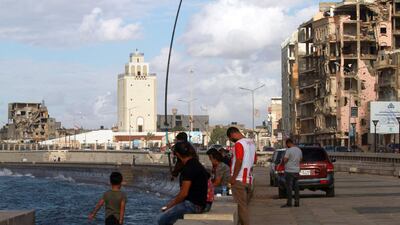
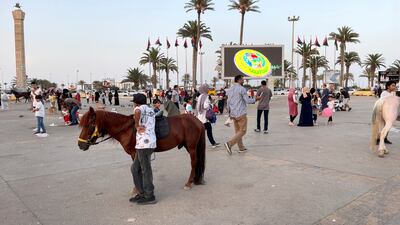
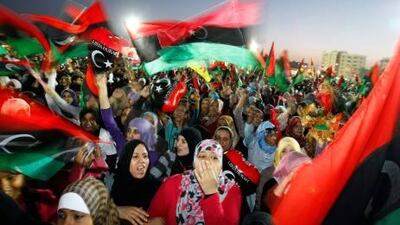
Local NGO activists gather for a demonstration at Algeria Square in the Libyan capital on December 15 to protest against any possible postponement of the elections scheduled for December 24. AFP

Libya’s elections in doubt as politics of division lingers on


Ahmed Maher
  • English
  • Arabic

Political turmoil is making crucial elections in Libya that could end years of turmoil, divisions and fighting in just eight days' time appear increasingly unlikely, even though no official postponement has been announced.

With just over a week to go before the December 24 presidential and parliamentary elections, the final list of presidential candidates is yet to be published and armed groups took to the streets of the capital on Thursday in a show of force.

Abu Bakr Marada, a member of Libya's electoral commission, told media on Thursday that it was now "impossible" to hold the elections on time.

But no delay has been announced, even as electoral rules state those running must be given 14 days to campaign.

Many hoped the election would end the past decade of chaos in Libya left after the uprising against longtime autocrat Muammar Qaddafi by bringing in a political leadership with national legitimacy after years of factional division.

Ninety-eight candidates registered to run for president, including controversial figures central to Qaddafi's regime and the fighting that has torn Libya apart in the decade since.

Judges have wrangled over the disqualification of some top fighters, yet appeals have also been successful.

Libya is awash with competing factions and interests.

Even the economy and public finances are fragmented into two entities, with a rivalry between the governor of the central bank, in the west, and his deputy, in the east. Talks between both men to settle old scores are still at an early stage.

December's election and the preceding UN-led peace talks represent a fresh bid to stitch the country together.

Officials said that the official postponement would likely be decided soon.

“In fact, the issue of postponement is subject to a large number of variables, most of which are directly related to the implementation of the electoral process. They may be political, technical or legal variables. But the current House of Representatives will have the final say in the days to come,” said Imad Al Sayeh, head of the High Election Commission.

In February, an interim unity government was chosen to oversee the elections. The UN-backed administration put an end to two rival administrations in the east and the west. But powerful militias that emerged from revolutionary and rebel groups that toppled Qaddafi still retain and wield enormous influence across the country.

Reconciliation talks in Tunis and Geneva have led to the appointment of a three-member presidential council. The new governing line-up followed a ceasefire reached last year.

Abdel Qadir Al Hewili, a senior member at the State Council, an advisory body to the interim government, said the elections cannot be held given the spiralling insecurity and the flawed elections laws that allowed the son of Qaddafi — who was sentenced to death by a Tripoli court in his absence in 2015 for war crimes committed during the failed battle to save his father's 40-year rule from a Nato-backed uprising — to run in the elections.

On Thursday, a military official told AFP that militias had “deployed heavily around sensitive sites in the capital,” after the commander of the Tripoli region was replaced by the Presidential Council.

“The Interior Ministry can simply ask for postponing or cancelling the elections as it can’t guarantee the safety of voters or provide the necessary protection to observers, monitors and election officials. Add to that, the controversial candidacy of Saif Al Islam Qaddafi and others like Gen Khalifa Haftar [of the eastern Libyan National Army] and the incumbent Prime Minister Abdul Hamid Mohammed Dbeibah, will give a great, strong argument to anyone who will dispute the results and we will be back to square one” Mr Al Hewili told The National.

Is federalism the answer?

Dozens of MPs and leaders of political parties have called for delaying the elections until next year for the same reasons, but they have also singled out the proliferation of militias that want to set their own conditions and handpick candidates as the main concern.

On Wednesday, the Security Directorate in the south-western city of Sabha accused militias of stealing 11 of its vehicles and arresting several policemen who were sent by the Interior Ministry as security reinforcements before the elections.

UN special advisor Stephanie Williams visited Tripoli on Sunday in a bid to sustain the momentum for elections. AFP

The elections are still being seen as a key milestone to drag Libya away from the civil war that allowed the emergence of ISIS, the intervention of foreign forces from countries like Russia and Turkey, and the country becoming a trafficking hub for migrants seeking to reach Europe across the Mediterranean.

For this reason, some are against any postponement.

On Wednesday, local activists gathered for a demonstration at Algeria Square outside the Tripoli Municipality in the Libyan capital to protest against any possible postponement of the elections. They carried placards reading: “yes to national reconciliation and get out mercenaries and international powers.”

The UN special adviser on Libya, Stephanie Williams, visited Tripoli on Sunday in a bid to sustain the momentum gained over the past year to hold the elections on time.

The American diplomat was appointed last week as Special Envoy Jan Kubis resigned on November 23 after only 10 months in the job. Some took his departure as a sign of foreboding for Libya's burgeoning democracy.

With the rising political tensions fuelled by tribalism, there have been renewed calls for adopting federalism or even dividing the country into three autonomous regions, as during the colonial era, when the British and French occupied Libya in 1943 and split it into three provinces: Tripolitania in the north-west, Cyrenaica in the east, and Fezzan-Ghadames in the south-west.

But Anas El Gomati, director of the Libyan Sadeq Institute think tank, told The National that would not solve the country’s problems.

“Federalism would not resolve the crux of a crisis between two irreconcilable visions of the future state; those who desire elections with a constitutional restraint on Libya’s president in a country with a legacy for authoritarians and those who reject this in favour of a powerful leader to restructure the state and its military as they see fit,” he said,” he said.


Who's who in Yemen conflict

Houthis: Iran-backed rebels who occupy Sanaa and run unrecognised government

Yemeni government: Exiled government in Aden led by eight-member Presidential Leadership Council

Southern Transitional Council: Faction in Yemeni government that seeks autonomy for the south

Habrish 'rebels': Tribal-backed forces feuding with STC over control of oil in government territory

SPEC%20SHEET
%3Cp%3E%3Cstrong%3EProcessor%3A%3C%2Fstrong%3E%20Apple%20M2%2C%208-core%20GPU%2C%2010-core%20CPU%2C%2016-core%20Neural%20Engine%3C%2Fp%3E%0A%3Cp%3E%3Cstrong%3EDisplay%3A%3C%2Fstrong%3E%2013.3-inch%20Retina%2C%202560%20x%201600%2C%20227ppi%2C%20500%20nits%2C%20True%20Tone%2C%20wide%20colour%3C%2Fp%3E%0A%3Cp%3E%3Cstrong%3EMemory%3A%3C%2Fstrong%3E%208%2F16%2F24GB%3C%2Fp%3E%0A%3Cp%3E%3Cstrong%3EStorage%3A%3C%2Fstrong%3E%20256%2F512GB%20%2F%201%2F2TB%3C%2Fp%3E%0A%3Cp%3E%3Cstrong%3EI%2FO%3A%3C%2Fstrong%3E%20Thunderbolt%203%20(2)%2C%203.5mm%20audio%3B%20Touch%20Bar%20with%20Touch%20ID%3C%2Fp%3E%0A%3Cp%3E%3Cstrong%3EConnectivity%3A%3C%2Fstrong%3E%20Wi-Fi%206%2C%20Bluetooth%205.0%3C%2Fp%3E%0A%3Cp%3E%3Cstrong%3EBattery%3A%3C%2Fstrong%3E%2058.2Wh%20lithium-polymer%2C%20up%20to%2020%20hours%3C%2Fp%3E%0A%3Cp%3E%3Cstrong%3ECamera%3A%3C%2Fstrong%3E%20720p%20FaceTime%20HD%3C%2Fp%3E%0A%3Cp%3E%3Cstrong%3EVideo%3A%3C%2Fstrong%3E%20Support%20for%20HDR%20with%20Dolby%20Vision%2C%20HDR10%2C%20ProRes%3C%2Fp%3E%0A%3Cp%3E%3Cstrong%3EAudio%3A%3C%2Fstrong%3E%20Stereo%20speakers%20with%20HDR%2C%20wide%20stereo%2C%20Spatial%20Audio%20support%2C%20Dolby%20support%3C%2Fp%3E%0A%3Cp%3E%3Cstrong%3EIn%20the%20box%3A%3C%2Fstrong%3E%20MacBook%20Pro%2C%2067W%20power%20adapter%2C%20USB-C%20cable%3C%2Fp%3E%0A%3Cp%3E%3Cstrong%3EPrice%3A%3C%2Fstrong%3E%20From%20Dh5%2C499%3C%2Fp%3E%0A
The specs

Engine: 2x201bhp AC Permanent-magnetic electric

Transmission: n/a

Power: 402bhp

Torque: 659Nm

Price estimate: Dh200,000

On sale: Q3 2022 

Profile of Tarabut Gateway

Founder: Abdulla Almoayed

Based: UAE

Founded: 2017

Number of employees: 35

Sector: FinTech

Raised: $13 million

Backers: Berlin-based venture capital company Target Global, Kingsway, CE Ventures, Entrée Capital, Zamil Investment Group, Global Ventures, Almoayed Technologies and Mad’a Investment.

Ruwais timeline

1971 Abu Dhabi National Oil Company established

1980 Ruwais Housing Complex built, located 10 kilometres away from industrial plants

1982 120,000 bpd capacity Ruwais refinery complex officially inaugurated by the founder of the UAE Sheikh Zayed

1984 Second phase of Ruwais Housing Complex built. Today the 7,000-unit complex houses some 24,000 people.  

1985 The refinery is expanded with the commissioning of a 27,000 b/d hydro cracker complex

2009 Plans announced to build $1.2 billion fertilizer plant in Ruwais, producing urea

2010 Adnoc awards $10bn contracts for expansion of Ruwais refinery, to double capacity from 415,000 bpd

2014 Ruwais 261-outlet shopping mall opens

2014 Production starts at newly expanded Ruwais refinery, providing jet fuel and diesel and allowing the UAE to be self-sufficient for petrol supplies

2014 Etihad Rail begins transportation of sulphur from Shah and Habshan to Ruwais for export

2017 Aldar Academies to operate Adnoc’s schools including in Ruwais from September. Eight schools operate in total within the housing complex.

2018 Adnoc announces plans to invest $3.1 billion on upgrading its Ruwais refinery 

2018 NMC Healthcare selected to manage operations of Ruwais Hospital

2018 Adnoc announces new downstream strategy at event in Abu Dhabi on May 13

Source: The National

Mercer, the investment consulting arm of US services company Marsh & McLennan, expects its wealth division to at least double its assets under management (AUM) in the Middle East as wealth in the region continues to grow despite economic headwinds, a company official said.

Mercer Wealth, which globally has $160 billion in AUM, plans to boost its AUM in the region to $2-$3bn in the next 2-3 years from the present $1bn, said Yasir AbuShaban, a Dubai-based principal with Mercer Wealth.

Within the next two to three years, we are looking at reaching $2 to $3 billion as a conservative estimate and we do see an opportunity to do so,” said Mr AbuShaban.

Mercer does not directly make investments, but allocates clients’ money they have discretion to, to professional asset managers. They also provide advice to clients.

“We have buying power. We can negotiate on their (client’s) behalf with asset managers to provide them lower fees than they otherwise would have to get on their own,” he added.

Mercer Wealth’s clients include sovereign wealth funds, family offices, and insurance companies among others.

From its office in Dubai, Mercer also looks after Africa, India and Turkey, where they also see opportunity for growth.

Wealth creation in Middle East and Africa (MEA) grew 8.5 per cent to $8.1 trillion last year from $7.5tn in 2015, higher than last year’s global average of 6 per cent and the second-highest growth in a region after Asia-Pacific which grew 9.9 per cent, according to consultancy Boston Consulting Group (BCG). In the region, where wealth grew just 1.9 per cent in 2015 compared with 2014, a pickup in oil prices has helped in wealth generation.

BCG is forecasting MEA wealth will rise to $12tn by 2021, growing at an annual average of 8 per cent.

Drivers of wealth generation in the region will be split evenly between new wealth creation and growth of performance of existing assets, according to BCG.

Another general trend in the region is clients’ looking for a comprehensive approach to investing, according to Mr AbuShaban.

“Institutional investors or some of the families are seeing a slowdown in the available capital they have to invest and in that sense they are looking at optimizing the way they manage their portfolios and making sure they are not investing haphazardly and different parts of their investment are working together,” said Mr AbuShaban.

Some clients also have a higher appetite for risk, given the low interest-rate environment that does not provide enough yield for some institutional investors. These clients are keen to invest in illiquid assets, such as private equity and infrastructure.

“What we have seen is a desire for higher returns in what has been a low-return environment specifically in various fixed income or bonds,” he said.

“In this environment, we have seen a de facto increase in the risk that clients are taking in things like illiquid investments, private equity investments, infrastructure and private debt, those kind of investments were higher illiquidity results in incrementally higher returns.”

The Abu Dhabi Investment Authority, one of the largest sovereign wealth funds, said in its 2016 report that has gradually increased its exposure in direct private equity and private credit transactions, mainly in Asian markets and especially in China and India. The authority’s private equity department focused on structured equities owing to “their defensive characteristics.”

What vitamins do we know are beneficial for living in the UAE

Vitamin D: Highly relevant in the UAE due to limited sun exposure; supports bone health, immunity and mood.Vitamin B12: Important for nerve health and energy production, especially for vegetarians, vegans and individuals with absorption issues.Iron: Useful only when deficiency or anaemia is confirmed; helps reduce fatigue and support immunity.Omega-3 (EPA/DHA): Supports heart health and reduces inflammation, especially for those who consume little fish.

Specs

Engine: 51.5kW electric motor

Range: 400km

Power: 134bhp

Torque: 175Nm

Price: From Dh98,800

Available: Now

The%20specs
%3Cp%3E%3Cstrong%3EEngine%3A%3C%2Fstrong%3E%201.5-litre%204-cylinder%3Cbr%3E%3Cstrong%3ETransmission%3A%20%3C%2Fstrong%3ECVT%3Cbr%3E%3Cstrong%3EPower%3A%20%3C%2Fstrong%3E119bhp%3Cbr%3E%3Cstrong%3ETorque%3A%20%3C%2Fstrong%3E145Nm%3Cbr%3E%3Cstrong%3EPrice%3A%20%3C%2Fstrong%3EDh%2C89%2C900%20(%2424%2C230)%3Cbr%3E%3Cstrong%3EOn%20sale%3A%20%3C%2Fstrong%3Enow%3C%2Fp%3E%0A
Grand Slam Los Angeles results

Men:
56kg – Jorge Nakamura
62kg – Joao Gabriel de Sousa
69kg – Gianni Grippo
77kg – Caio Soares
85kg – Manuel Ribamar
94kg – Gustavo Batista
110kg – Erberth Santos

Women:
49kg – Mayssa Bastos
55kg – Nathalie Ribeiro
62kg – Gabrielle McComb
70kg – Thamara Silva
90kg – Gabrieli Pessanha

Our legal consultant

Name: Hassan Mohsen Elhais

Position: legal consultant with Al Rowaad Advocates and Legal Consultants

Gulf Under 19s final

Dubai College A 50-12 Dubai College B

Updated: December 16, 2021, 5:34 PM