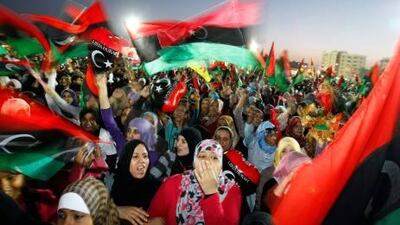
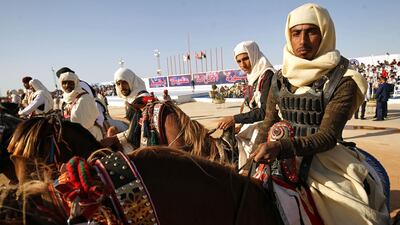
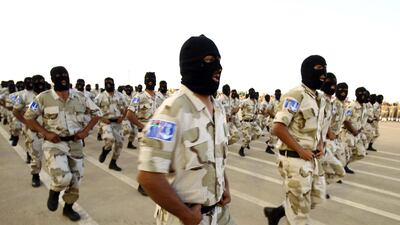
Libya is expected to hold its first presidential election late next week but the lack of a final list of candidates and bitter political divisions have cast doubts on the event.
Polling, which is set for December 24, was intended to mark a transition towards peace. However, there are now concerns it could reignite civil war, AFP reported.
The “elections may do more harm than good in Libya, given the deep societal and political fault lines”, said Jamal Benomar, a former UN under-secretary general.
“The necessary conditions for free and fair elections are not available, and Libyans are too divided to accept or agree on the results.”
The election, part of a UN-led peace process, comes after a year of relative calm following an October 2020 ceasefire between eastern and western camps.
A transitional administration took office in March to lead the oil-rich North African country to the polls.
But despite high hopes for peace, the UN has struggled to overcome deep, complex divisions left by a decade of fighting and foreign intervention since the 2011 Nato-backed uprising that toppled and killed Muammar Qaddafi.
Mr Benomar, who is chairman of the International Centre for Dialogue Initiatives think tank, issued a warning that fragmented state institutions and a lack of “unified or legitimate” security forces were destabilising the country.
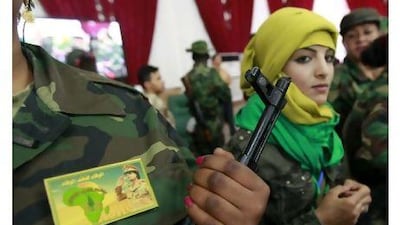
As an array of armed groups hold sway on the ground, few believe that voters will be able to freely cast their ballots.
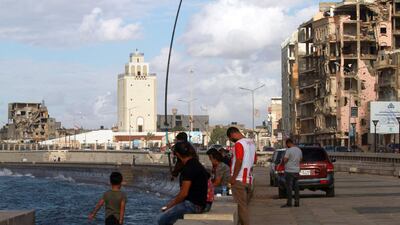
About 2.5 million voter registration cards have been collected but aside from posters urging other Libyans to do likewise, there are few signs in the seaside capital of Tripoli that a ballot is approaching.
With the election authority yet to publish a final list of candidates, campaigning has not officially begun, although some hopefuls are promoting themselves on social media.
The election comes after months of bitter disputes over their legal basis and who may stand, with several divisive figures in the running.
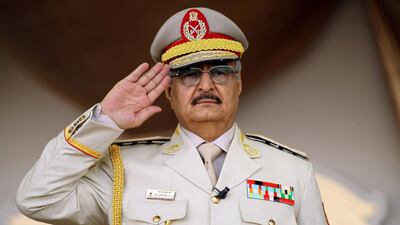
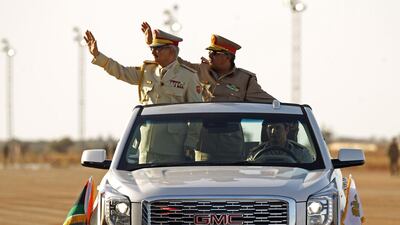
Among the most controversial is Field Marshal Khalifa Haftar, commander of the Libyan National Army, who controls much of eastern and southern Libya.
He is despised in the country's west after his year-long and ultimately failed assault on Tripoli between 2019 and 2020.
His candidacy was made possible by a contentious electoral law signed off by his ally, parliamentary speaker Aguila Saleh, in a process rivals say bypassed due process.
But for some, his rival Saif Al Islam Qaddafi's candidacy is equally problematic. The son of the toppled dictator who ruled Libya with an iron fist for four decades, Mr Qaddafi is accused by many – including International Criminal Court prosecutors – of war crimes.
Anas El Gomati, director of Libyan think tank the Sadeq Institute, said that “elections under these legal and political conditions will almost certainly destabilise Libya".
“An election victory by Saif or Haftar would bring war from those who stood against Qaddafi in 2011 or Haftar's assault on Tripoli in 2019,” he said, according to an AFP report.
Even interim prime minister Abdulhamid Dbeibah, a tycoon who heads the Tripoli-based transitional administration, faces claims that his candidacy is illegitimate.
After months of legal battles, “whoever wins, there is a risk that the losers will undermine the winners and say the election was not constitutionally valid”, said Peter Millett, a former UK ambassador to Libya.
As if these complexities were not enough, the UN's Libya envoy Jan Kubis quit his post a month before the poll.
A diplomat in New York, who asked not to be named, said Mr Kubis's insistence on holding the election on December 24 had caused a “breakdown” in his relationship with Secretary General Antonio Guterres, who doubted conditions were ripe.
Mr Kubis had even recognised the contentious September election law. That was “one of the big criticisms of his tenure”, said Amanda Kadlec, a former member of the UN Panel of Experts on Libya.
To avoid a vacuum, Mr Guterres appointed US diplomat Stephanie Williams, a former acting director of the UN's Libya mission, as “special adviser".
Parliamentary speaker Mr Saleh had also changed the electoral timetable to delay legislative polls, keeping himself in charge of the eastern-based parliament even if his ally Haftar were to lose the presidential vote, according to Mr El Gomati.
Yet, despite the danger of holding the election, experts said postponing it also carries risks.
If Mr Dbeibah stays in position without a ballot, his eastern rivals could again create their own government to compete with his, Ms Kadlec said.
Mr Millett sees a risk “that Libya is heading for a train crash on December 25, whether elections happen on schedule or not”.

MATCH INFO
Juventus 1 (Dybala 45')
Lazio 3 (Alberto 16', Lulic 73', Cataldi 90 4')
Red card: Rodrigo Bentancur (Juventus)
Everton%20Fixtures
%3Cp%3EApril%2015%20-%20Chelsea%20(A)%3Cbr%3EApril%2021%20-%20N.%20Forest%20(H)%3Cbr%3EApril%2024%20-%20Liverpool%20(H)%3Cbr%3EApril%2027%20-%20Brentford%20(H)%3Cbr%3EMay%203%20-%20Luton%20Town%20(A)%3Cbr%3EMay%2011%20-%20Sheff%20Utd%20(H)%3Cbr%3EMay%2019%20-%20Arsenal%20(A)%3C%2Fp%3E%0A
How to help
Send “thenational” to the following numbers or call the hotline on: 0502955999
2289 – Dh10
2252 – Dh 50
6025 – Dh20
6027 – Dh 100
6026 – Dh 200
UAE Falcons
Carly Lewis (captain), Emily Fensome, Kelly Loy, Isabel Affley, Jessica Cronin, Jemma Eley, Jenna Guy, Kate Lewis, Megan Polley, Charlie Preston, Becki Quigley and Sophie Siffre. Deb Jones and Lucia Sdao – coach and assistant coach.
The years Ramadan fell in May
Suggested picnic spots
Abu Dhabi
Umm Al Emarat Park
Yas Gateway Park
Delma Park
Al Bateen beach
Saadiyaat beach
The Corniche
Zayed Sports City
Dubai
Kite Beach
Zabeel Park
Al Nahda Pond Park
Mushrif Park
Safa Park
Al Mamzar Beach Park
Al Qudrah Lakes
Company%20Profile
%3Cp%3E%3Cstrong%3ECompany%20name%3A%3C%2Fstrong%3E%20myZoi%3Cbr%3E%3Cstrong%3EStarted%3A%3C%2Fstrong%3E%202021%3Cbr%3E%3Cstrong%3EFounders%3A%3C%2Fstrong%3E%20Syed%20Ali%2C%20Christian%20Buchholz%2C%20Shanawaz%20Rouf%2C%20Arsalan%20Siddiqui%2C%20Nabid%20Hassan%3Cbr%3E%3Cstrong%3EBased%3A%3C%2Fstrong%3E%20UAE%3Cbr%3E%3Cstrong%3ENumber%20of%20staff%3A%3C%2Fstrong%3E%2037%3Cbr%3E%3Cstrong%3EInvestment%3A%3C%2Fstrong%3E%20Initial%20undisclosed%20funding%20from%20SC%20Ventures%3B%20second%20round%20of%20funding%20totalling%20%2414%20million%20from%20a%20consortium%20of%20SBI%2C%20a%20Japanese%20VC%20firm%2C%20and%20SC%20Venture%3C%2Fp%3E%0A
Skoda Superb Specs
Engine: 2-litre TSI petrol
Power: 190hp
Torque: 320Nm
Price: From Dh147,000
Available: Now
Global state-owned investor ranking by size
|
1.
|
United States
|
|
2.
|
China
|
|
3.
|
UAE
|
|
4.
|
Japan
|
|
5
|
Norway
|
|
6.
|
Canada
|
|
7.
|
Singapore
|
|
8.
|
Australia
|
|
9.
|
Saudi Arabia
|
|
10.
|
South Korea
|
David Haye record
Total fights: 32
Wins: 28
Wins by KO: 26
Losses: 4
Tips to avoid getting scammed
1) Beware of cheques presented late on Thursday
2) Visit an RTA centre to change registration only after receiving payment
3) Be aware of people asking to test drive the car alone
4) Try not to close the sale at night
5) Don't be rushed into a sale
6) Call 901 if you see any suspicious behaviour
Where to donate in the UAE
The Emirates Charity Portal
You can donate to several registered charities through a “donation catalogue”. The use of the donation is quite specific, such as buying a fan for a poor family in Niger for Dh130.
The General Authority of Islamic Affairs & Endowments
The site has an e-donation service accepting debit card, credit card or e-Dirham, an electronic payment tool developed by the Ministry of Finance and First Abu Dhabi Bank.
Al Noor Special Needs Centre
You can donate online or order Smiles n’ Stuff products handcrafted by Al Noor students. The centre publishes a wish list of extras needed, starting at Dh500.
Beit Al Khair Society
Beit Al Khair Society has the motto “From – and to – the UAE,” with donations going towards the neediest in the country. Its website has a list of physical donation sites, but people can also contribute money by SMS, bank transfer and through the hotline 800-22554.
Dar Al Ber Society
Dar Al Ber Society, which has charity projects in 39 countries, accept cash payments, money transfers or SMS donations. Its donation hotline is 800-79.
Dubai Cares
Dubai Cares provides several options for individuals and companies to donate, including online, through banks, at retail outlets, via phone and by purchasing Dubai Cares branded merchandise. It is currently running a campaign called Bookings 2030, which allows people to help change the future of six underprivileged children and young people.
Emirates Airline Foundation
Those who travel on Emirates have undoubtedly seen the little donation envelopes in the seat pockets. But the foundation also accepts donations online and in the form of Skywards Miles. Donated miles are used to sponsor travel for doctors, surgeons, engineers and other professionals volunteering on humanitarian missions around the world.
Emirates Red Crescent
On the Emirates Red Crescent website you can choose between 35 different purposes for your donation, such as providing food for fasters, supporting debtors and contributing to a refugee women fund. It also has a list of bank accounts for each donation type.
Gulf for Good
Gulf for Good raises funds for partner charity projects through challenges, like climbing Kilimanjaro and cycling through Thailand. This year’s projects are in partnership with Street Child Nepal, Larchfield Kids, the Foundation for African Empowerment and SOS Children's Villages. Since 2001, the organisation has raised more than $3.5 million (Dh12.8m) in support of over 50 children’s charities.
Noor Dubai Foundation
Sheikh Mohammed bin Rashid Al Maktoum launched the Noor Dubai Foundation a decade ago with the aim of eliminating all forms of preventable blindness globally. You can donate Dh50 to support mobile eye camps by texting the word “Noor” to 4565 (Etisalat) or 4849 (du).
A MINECRAFT MOVIE
Director: Jared Hess
Starring: Jack Black, Jennifer Coolidge, Jason Momoa
Rating: 3/5
Russia's Muslim Heartlands
Dominic Rubin, Oxford
Living in...
This article is part of a guide on where to live in the UAE. Our reporters will profile some of the country’s most desirable districts, provide an estimate of rental prices and introduce you to some of the residents who call each area home.
UAE currency: the story behind the money in your pockets
Profile box
Company name: baraka
Started: July 2020
Founders: Feras Jalbout and Kunal Taneja
Based: Dubai and Bahrain
Sector: FinTech
Initial investment: $150,000
Current staff: 12
Stage: Pre-seed capital raising of $1 million
Investors: Class 5 Global, FJ Labs, IMO Ventures, The Community Fund, VentureSouq, Fox Ventures, Dr Abdulla Elyas (private investment)
Email sent to Uber team from chief executive Dara Khosrowshahi
From: Dara
To: Team@
Date: March 25, 2019 at 11:45pm PT
Subj: Accelerating in the Middle East
Five years ago, Uber launched in the Middle East. It was the start of an incredible journey, with millions of riders and drivers finding new ways to move and work in a dynamic region that’s become so important to Uber. Now Pakistan is one of our fastest-growing markets in the world, women are driving with Uber across Saudi Arabia, and we chose Cairo to launch our first Uber Bus product late last year.
Today we are taking the next step in this journey—well, it’s more like a leap, and a big one: in a few minutes, we’ll announce that we’ve agreed to acquire Careem. Importantly, we intend to operate Careem independently, under the leadership of co-founder and current CEO Mudassir Sheikha. I’ve gotten to know both co-founders, Mudassir and Magnus Olsson, and what they have built is truly extraordinary. They are first-class entrepreneurs who share our platform vision and, like us, have launched a wide range of products—from digital payments to food delivery—to serve consumers.
I expect many of you will ask how we arrived at this structure, meaning allowing Careem to maintain an independent brand and operate separately. After careful consideration, we decided that this framework has the advantage of letting us build new products and try new ideas across not one, but two, strong brands, with strong operators within each. Over time, by integrating parts of our networks, we can operate more efficiently, achieve even lower wait times, expand new products like high-capacity vehicles and payments, and quicken the already remarkable pace of innovation in the region.
This acquisition is subject to regulatory approval in various countries, which we don’t expect before Q1 2020. Until then, nothing changes. And since both companies will continue to largely operate separately after the acquisition, very little will change in either teams’ day-to-day operations post-close. Today’s news is a testament to the incredible business our team has worked so hard to build.
It’s a great day for the Middle East, for the region’s thriving tech sector, for Careem, and for Uber.
Uber on,
Dara
Mercer, the investment consulting arm of US services company Marsh & McLennan, expects its wealth division to at least double its assets under management (AUM) in the Middle East as wealth in the region continues to grow despite economic headwinds, a company official said.
Mercer Wealth, which globally has $160 billion in AUM, plans to boost its AUM in the region to $2-$3bn in the next 2-3 years from the present $1bn, said Yasir AbuShaban, a Dubai-based principal with Mercer Wealth.
“Within the next two to three years, we are looking at reaching $2 to $3 billion as a conservative estimate and we do see an opportunity to do so,” said Mr AbuShaban.
Mercer does not directly make investments, but allocates clients’ money they have discretion to, to professional asset managers. They also provide advice to clients.
“We have buying power. We can negotiate on their (client’s) behalf with asset managers to provide them lower fees than they otherwise would have to get on their own,” he added.
Mercer Wealth’s clients include sovereign wealth funds, family offices, and insurance companies among others.
From its office in Dubai, Mercer also looks after Africa, India and Turkey, where they also see opportunity for growth.
Wealth creation in Middle East and Africa (MEA) grew 8.5 per cent to $8.1 trillion last year from $7.5tn in 2015, higher than last year’s global average of 6 per cent and the second-highest growth in a region after Asia-Pacific which grew 9.9 per cent, according to consultancy Boston Consulting Group (BCG). In the region, where wealth grew just 1.9 per cent in 2015 compared with 2014, a pickup in oil prices has helped in wealth generation.
BCG is forecasting MEA wealth will rise to $12tn by 2021, growing at an annual average of 8 per cent.
Drivers of wealth generation in the region will be split evenly between new wealth creation and growth of performance of existing assets, according to BCG.
Another general trend in the region is clients’ looking for a comprehensive approach to investing, according to Mr AbuShaban.
“Institutional investors or some of the families are seeing a slowdown in the available capital they have to invest and in that sense they are looking at optimizing the way they manage their portfolios and making sure they are not investing haphazardly and different parts of their investment are working together,” said Mr AbuShaban.
Some clients also have a higher appetite for risk, given the low interest-rate environment that does not provide enough yield for some institutional investors. These clients are keen to invest in illiquid assets, such as private equity and infrastructure.
“What we have seen is a desire for higher returns in what has been a low-return environment specifically in various fixed income or bonds,” he said.
“In this environment, we have seen a de facto increase in the risk that clients are taking in things like illiquid investments, private equity investments, infrastructure and private debt, those kind of investments were higher illiquidity results in incrementally higher returns.”
The Abu Dhabi Investment Authority, one of the largest sovereign wealth funds, said in its 2016 report that has gradually increased its exposure in direct private equity and private credit transactions, mainly in Asian markets and especially in China and India. The authority’s private equity department focused on structured equities owing to “their defensive characteristics.”