



As former World Bank president James Wolfensohn flew in an Israeli army helicopter above a fenced crossing between the West Bank and Israel, he remarked that it reminded him of a similar set-up in his home country.
“In Australia, we use it for cattle,” he told the Israeli officer who was proudly pointing out the automated gates at the crossing near Jenin in 2005.
Wolfensohn at the time was serving as the special envoy for Gaza disengagement, representing the Quartet for Middle East Peace.
The quartet comprises the US, Russia, the EU and the UN.
Wolfensohn died at age 86, one year ago on Thursday.
He did not mince words in pursuing economic opportunities for the Palestinians and lobbying the world powers that hired him to provide a sense of normality in the Gaza Strip after Israel withdrew from the territory in August 2005.
It is a vision that has mostly disappeared from international efforts to improve conditions in Gaza in recent years. The efforts gain momentum after every war between Israel and Hamas, and then fade.
After the latest conflict in May, Qatar pledged about $500 million to rebuild Gaza. The aid so far has gone mostly towards rebuilding homes, compensating shop owners and paying for fuel to generate electricity and salaries in the Hamas-controlled administration.
-
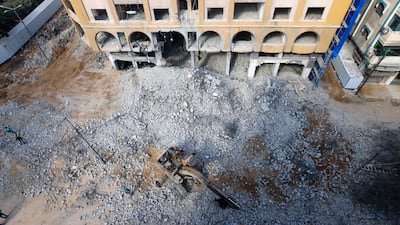
Palestinian workers clear the rubble of Al Jawhara Tower in Gaza City's Al Rimal neighbourhood. AFP -
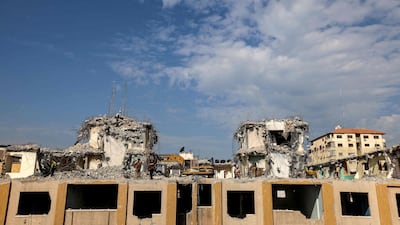
Al Jawhara Tower was targeted by Israeli airstrikes last May. AFP -

An excavator removes debris on a building damaged in Israeli air strikes in Gaza City during fighting between Israel and Hamas. Reuters -
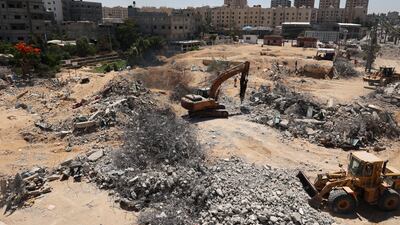
Palestinian workers clear the rubble of buildings in Beit Lahia in the northern Gaza Strip. AFP -
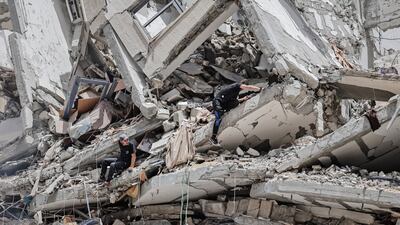
Palestinian workers clear the rubble and debris in Gaza City's Al Rimal neighbourhood. AFP -
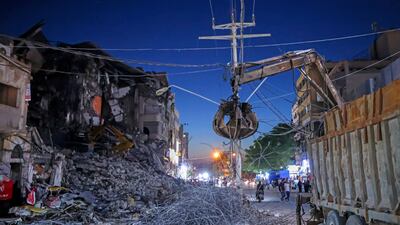
An excavator clears the rubble and debris in the Al Rimal neighbourhood. AFP -
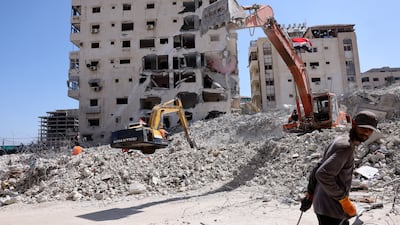
Excavators provided by Egypt help clear the rubble in Gaza City. AFP -

A Palestinian boy looks on as workers clear the rubble of a building destroyed by Israeli bombing last May, in Rafah in the southern Gaza Strip. AFP -

Workmen break rubble into pieces as they recycle salvaged construction materials from buildings destroyed during the May 2021 conflict between Hamas and Israel, at a rubble collection area in Gaza City's eastern suburb of Shujaiya. AFP -

Palestinian volunteers and municipal workers clear the rubble of the Hanadi compound in Gaza City's Rimal district. AFP


“Jim really believed that you could develop an economic opportunity into a political foothold for further peace endeavours,” says a former staff member, who is now a senior diplomat.
“He was disturbed by some practices of control at crossings that he felt were not in line with respecting the dignity of Palestinians as human beings.”
Wolfensohn mixed for decades with the rich and famous. But he was a self-deprecating man with a dry sense of humour who, despite his wealth, identified with the disadvantaged.
His eight-year tenure at the World Bank was marked by research and public campaigns that highlighted the damage corruption wreaks on development.
He even spent his own money to help Gaza.
In the months leading to Israel's withdrawal, Israeli settlers in Gaza threatened to destroy greenhouses that produced tomatoes and strawberries for sale in Israel. They regarded the compensation the Israeli government offered as too little.
Wolfensohn used his personal funds to fill the gap and persuaded Microsoft founder Bill Gates to contribute. He wanted the Palestinians to be able to benefit immediately from the existing market in Israel.
“At that time, we did not know where the money came from,” the staff member says.
He also envisaged a deep seaport in Gaza, an idea that completely evaporated for security reasons after Hamas won the Palestinian elections in early 2006 and captured Gaza in the Palestinian civil war from 2006-2007.
Wolfensohn resigned in May 2006 after his relationship with Washington soured. Unlike many in Israel and the US, he believed that peace could be pursued without first stopping rocket fire on Israel from Gaza.
“This would simply mean that Israel could always and easily reject talks,” the staff member says.
His ideas spanned the economic spectrum. One of them was to help import cows into Gaza to produce milk, but “the Palestinians did not show interest in the cows".
Although Wolfensohn was frank with the Israelis, he “was of the opinion that the rockets fired from Gaza on to Israel by the rejectionist groups were bad and should stop".
He had a temper, but “he eventually cooled down”, working on solutions that “would satisfy security needs of Israel and economic needs of the Palestinians”.
Aided by US pressure on Israel, Wolfensohn brokered the Gaza Border Crossings and Access deal in November 2005.
The deal briefly gave Palestinians better access between Gaza, the West Bank and Israel, and through Egypt.
The Hamas takeover prompted an enhanced siege on Gaza. Most of the territory's two million inhabitants live on handouts.
Some of Wolfensohn’s ideas, such as allowing Palestinians access to regional markets and scrapping restrictions on movement, were echoed in the defunct Middle East peace plan proposed by the Donald Trump administration.
Most of the Palestinian political players rejected the plan as incompatible with their hopes for statehood.
The staff member is unsure of Wolfensohn's views of the Trump plan. Wolfensohn's autobiography, published a decade before the plan was unveiled in 2020, has a chapter on his time as Quartet envoy.
But he was committed to the two-state solution, as called for by UN Security Council Resolution 242 of 1974.
“He hoped to facilitate a political peace process building on economic opportunity. We all know that history went into different direction,” the staff member says.
“His interest was genuine and not just for personal reasons.”

