


A former Tunisian diplomat has been arrested on suspicion of a fraud scheme that enabled foreigners to buy documents including passports, identity cards and birth certificates under false identities.
The former consul was arrested in the capital Tunis and is believed to have been at the centre of a network of government officials accused of abusing their power to sell the documents, sparking security concerns over who might be able to get hold of official papers.
The arrest came amid a sweeping anti-corruption campaign and at the end of months of investigation led by the anti-terrorism unit in the Ministry of Interior.
“The Public Prosecution has been assigned to investigate the fraudulent activities that included passports, birth certificates, identity cards and nationality documents, for foreigners of different nationalities during the period between 2015 and 2019,” Tunisia's Court of First Instance said.
The accused, who has not been named, is a former Tunisian consul for Syria.
The former head of the Foreign consular office, an employee of the Civil Registry and four interior ministry officials have also been arrested, the court said.
The investigation started after a member of Tunisia's suspended parliament, Mohamed Ammar, questioned Foreign Affairs Minister Othman Jerandi about the alleged fraud scheme in parliament in March.

Mr Ammar presented the Foreign Ministry with what he described as “hard evidence and documents with names” of suspects and copies of forged passports.
“I approached the Foreign Ministry with the leaked documents I have, which include details about the head of the network, a Tunisian-Syrian national. But unfortunately my complaints have fallen on deaf ears. I then submitted my request for an interrogation of the Foreign Minister,” Mr Ammar told Tunisia's IFM radio station on Wednesday.
“Whistleblowers have told me that the network charges $50,000 for a Tunisian passport.”
In 2021, Tunisia’s passport holders could enter a total of 71 countries either without a visa, through a visa on arrival, or via an Electronic Travel Authorisation, the Henley Passport Index showed. The Tunisian passport was ranked as the 78th most powerful in the world.
'Wrong decision'
With government salaries averaging at about $400 a month as Tunisia's economy continues to stagnate, many are struggling to afford high living costs.
Authorities admit that some desperate Tunisians have resorted to selling their passports and applying for new ones under the false pretence of losing their travel documents.
There are fears that these fake passports could fall into the hands of people inspired by extremist groups like Al Qaeda and ISIS.
Tunisia was among the first countries in the Arab world to cut diplomatic ties with Damascus in 2011, when the Arab League suspended Syria’s membership as part of an international effort to put pressure on Syrian President Bashar Al Assad.
“Severing ties with Syria under former president Moncef Marzouki was a wrong decision. This has affected co-operation in many fields, chiefly counter-terror measures by both countries,” former Foreign Minister Ahmed Wanis told The National. “Then his successor president Beji Caid Essebsi was elected in 2014 and changed the policy to bring an end to Syria’s isolation.”
The Tunisian government says that about 800 of its citizens have fought alongside extremist groups in Syria, although some estimates say the figure is much higher.
Protests and political tensions have rocked Tunisia in recent months, after President Kais Saied announced a power grab in July, denounced by his opponents as a coup.
Mr Saied suspended the country's parliament and parts of the constitution, fired top ministers and took over executive powers and supervision of prosecutors.
The president argues that he is saving a country suffering from corruption and trying to help an economy drifting deeper into trouble.
In Europe, countries close to Tunisia – most notably Italy – fear that the political and economic problems will produce a new wave of migrants using unsafe boats to cross the Mediterranean.
-
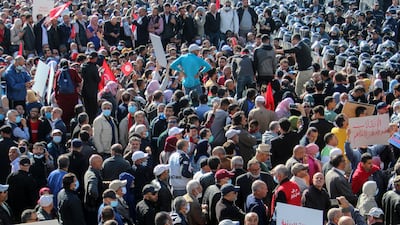
Demonstrators gather at a rally against Tunisian President Kais Saied in Tunis. AP -

Demonstrators with flags and placards at the protest. Reuters -

Thousands of Tunisians rally against a presidential power grab in the only democracy to have emerged from the Arab uprisings a decade ago. AP -
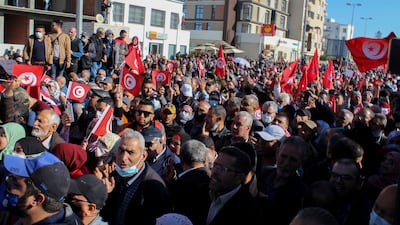
The streets of Tunis are filled with people and flags. AP -

Tunisian President Kais Saied suspended the country's Parliament and dismissed Hichem Mechichi as prime minister on July 25. EPA -
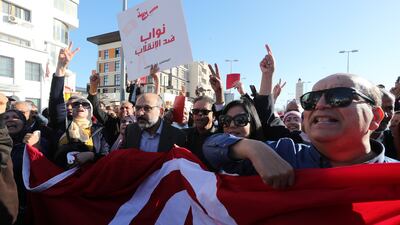
Protesters shout slogans during the demonstration. EPA -

Tunisian protesters rally against the president's seizure of governing powers. EPA -
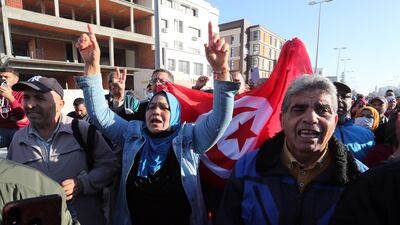
Men and women at the protest. EPA -

Thousands of people joined the protest. EPA -
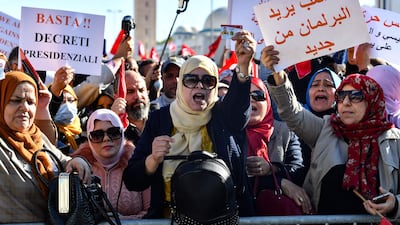
Mr Saied granted himself judicial powers in his power grab that opponents have called a coup. AFP -

Tunisian demonstrators remove metal barriers during scuffles with security forces. AFP -
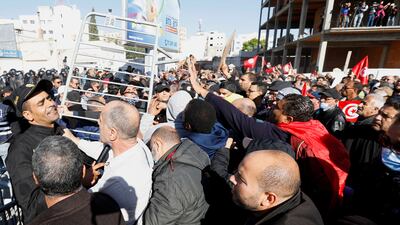
Crowds clash with security forces. Reuters -
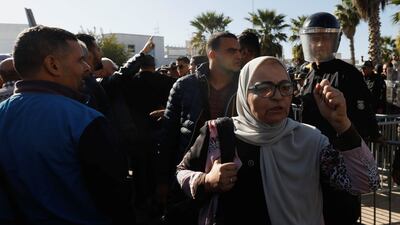
Security forces try to control the crowds. Reuters



