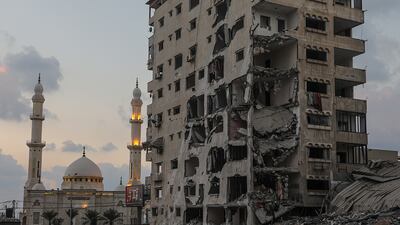
Six months after an 11-day conflict ravaged Gaza, Palestinian children remain burdened by trauma while their parents struggle to gain access to urgently needed care.
Sitting beside her father, eight-year-old Suzy Ishkontana wears a T-shirt with the slogan: “Girls are always strong."
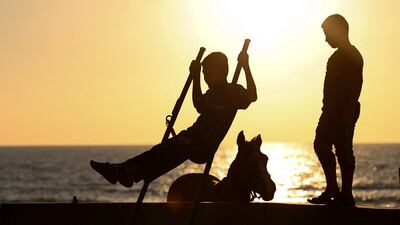
She talks in a whisper about life at school, where she likes to play on the swings and has a handful of friends.
“One is called Salma, one is called Nour, one is in the 10th grade,” she said, perched on a brown sofa in her grandmother’s apartment.
During the violence in Gaza, Suzy spent hours trapped under the rubble of her home. Her brother died beside her.
Israeli air strikes on the centre of Gaza city killed her mother and four siblings. Her father, Riad Ishkontana, survived.
“They would get up at six in the morning and play as a group,” he said, remembering his children. “They loved each other and would even share a packet of crisps among themselves.”
Mr Ishkontana has videos on his phone of his children dancing, while portraits printed since they died rest against a wall.
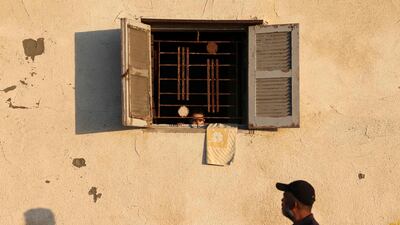
A few metres from the apartment block is a vast empty space. Piles of concrete and rebar from destroyed homes once lay there, but the debris has since been cleared.
Mr Ishkontana said he and his neighbours are scarred by the air strikes, which killed more than 40 people in one night.
“The grief remains, the place is gloomy because, regardless of the days passing, people remember,” he said.
“Because the people who died and were martyred, they’re the people of the neighbourhood.”
My daughter stopped laughing and stopped being happy.
Riad Ishkontana,
Palestinian father
Across Gaza, 67 children were among 261 Palestinians killed during the conflict. Two children and 11 adults were killed in Israel, UN figures show.
While Suzy has been able to return to the classroom, her father said she was suffering from the loss and trauma.
“She stopped laughing and stopped being happy. She wants little kids in the house because she used to be with her younger siblings," he said.
He said she once joined a children’s trip to the seaside, which was aimed at improving her mental health.
But the family does not know exactly how to help her.
“Sometimes I sit and cry about Suzy’s condition, but I don’t let her see me,” said her grandmother, Samira Al Dora.
Gazans reported incessant bombing throughout the conflict, during which the Israeli military said it struck more than 1,000 targets.
At least 4,000 rockets were fired by Hamas, the group that controls Gaza, the Israeli military said in May.
A fragile ceasefire has been pockmarked by outbreaks of violence, such as the numerous Israeli air strikes on Gaza in recent months.
The Israeli military said the strikes were a response to Palestinians flying incendiary balloons into Israeli territory, while rockets have been fired from Gaza on five occasions.
Such incidents increase fears of another conflict, hampering residents’ chances of recovering from the trauma they experienced in May.
“In the border areas it could be like a flashback to the same event every day, hearing the sound of [Israeli] drones and seeing the flare of bombs,” said Rania El Soussi, a psychologist at the Gaza Community Mental Health Programme (GCMHP).
“All this recalls the painful situation of living through the war, or the 2014 war, or before it, if they were older."
Gazan teenagers have experienced four wars fought with Israel since 2008.
In recent months, psychologists have reported an increase in symptoms related to post-traumatic stress disorder.
Children have suffered from symptoms such as wetting themselves, having nightmares and becoming aggressive or anxious.
Nour Abdel Wahed, a psychologist with the GCMHP, treats families who called its helpline or were referred by other organisations.
“I’m seeing a child who has post-traumatic stress disorder, then discover that his mother and father also have it,” she said.
“A lot of our cases were exposed to instances of direct bombardment … the whole family saw people killed and wounded."
The programme has 200 families on its waiting list. Staff have already treated hundreds more people this year than in 2020, when they dealt with 3,200 cases.
While many Gazan families are seeking to overcome their trauma six months on, some are still dealing with the physical effects of the conflict.
About 685 children were wounded in the war, along with more than 1,500 adults, UN records show.
One of the most seriously injured was four-year-old Sara Al Metrabei, whose spine was impaled with shrapnel in an Israeli air strike on her home.
Her father, Zaher Al Metrabei, recalled his daughter’s confusion in hospital as she asked: “Why did they burn my back, daddy? Why did they burn me?”
He broke down in tears as he showed photos of Sara’s wounds taken in May.
Days after the ceasefire, she became one of the few Gazan children to be granted permission to leave the Palestinian enclave for treatment in Jordan.
She screamed as she was lifted on to a trolley bed and wheeled out of hospital, her head resting on a pink pillow.
Mr Al Metrabei has not seen his daughter since, because he has been unable to obtain the necessary paperwork to travel with his son to be at her bedside.
Sara’s mother, Lina, is heavily pregnant and has been with her daughter throughout the treatment. Sara has undergone about 10 operations so far and remains unable to walk.
The uncertainty about whether her condition will improve, coupled with the family separation, has taken its toll on her father.
“I’m not able to do anything, neither taking any decisions or work in my life, because things for me are at a standstill,” he said.
War compounds tough conditions in Gaza
Charles Nelson, a professor of pediatrics and neuroscience at Harvard Medical School, said parents and relatives were vital to helping children recover mentally from trauma.
“Do they have adults that are looking out for them, adults that are supportive and sensitive to their needs? For those that do, they will likely do much better than those who don't," he said.
But despite their best intentions, some Gazans will struggle to provide support to their relatives because they are traumatised themselves.
“This fundamentally shapes what kind of parents they are. Those kids are at much higher risk of long-term challenges,” said Prof Nelson, who has extensively researched the effects of early adversity on brain development.
The conflict compounded the pressure on families in Gaza, which has been under an Israeli-led blockade since 2007.
There was the sound of thunder, my sisters thought it was bombing.
Mayssa Rabi Al Tanani,
counsellor
Few of Gaza’s nearly two million residents are able to leave the territory, while the arrival and departure of goods is also strictly limited.
“The alarming unemployment rate in Gaza is roughly 50 per cent and more than half of its population lives in poverty,” the World Bank said in July.
There are some community centres in the Palestinian territory where children and parents can receive private or group counselling.
At one centre in Gaza city, run by the Palestinian NGO Ma’an, children jump around and giggle while they play a game. A colourful picture on the wall shows different emotions, with tears rolling down one face.
“We teach the children a bit about things and behaviours, how to be able to deal with situations they face, how they can make friends, how they can overcome fear,” said counsellor Mayssa Rabi Al Tanani.
About two months ago, she noticed some of the children were showing symptoms of PTSD. They were suffering from nightmares and had become fearful, but avoided talking about the conflict.
“Yesterday when it rained a lot and there was the sound of thunder, my sisters thought it was bombing and were really scared,” she said.
A fear of loud noises has been widely observed in people by mental health experts and families in the months since the conflict.
Many of those at the Ma’an centre, which is funded by the UN children’s agency, had already sought support before the war.
Tamam Al Akawi has been caring for her 14-year-old son, who has a heart condition. Although he was able to travel for treatment in Nablus in the occupied West Bank, Ms Al Akawi said they were struggling to afford the medical costs in Gaza.
“Our situation is really, really bad,” she said.
“I’m appealing for anyone to help us with my son’s treatment and to help me with my children’s mental state.”
While counsellors have helped, Ms Al Akawi said her six children were deeply affected by air strikes on their home district and footage of attacks.
“The children were always sitting in front of the TV and saw bombs coming down on the towers,” she said.
The Israeli military destroyed four high-rise buildings during the conflict in strikes that Human Rights Watch said could amount to war crimes. Israel refutes the allegations.
Severe shortages affect trauma treatment
While some children have started to recover from the war, the acute lack of resources puts the mental health of many at risk. Dr Yasser Abu Jamei, director of the GCMHP, estimates that there are 3,500 unemployed psychology graduates in Gaza.
“We need resources in order to train them. They need equipped places, they need salaries … and this is not available,” he said.
He said bringing in more psychologists from abroad was unlikely to help unless they were fluent Arabic speakers and stayed for more than a few months.
Administering treatment is also particularly complex in Gaza, because patients’ symptoms are often related to numerous traumatic events over the years.
“We were not fine before May, and we are not fine today,” Dr Abu Jamei said.
He pointed out of his office window at the various parts of the district that were bombed.
Mr Al Metrabei said his daughter's mental health had improved slightly in Jordan.
“She has started to talk, started talking to people,” he said.
Opening his phone to show a video of Sara eating a pomegranate in her hospital bed, Mr Al Metrabei said he was in contact with his daughter every day.
In Gaza, he feels abandoned by those unaffected by the war.
“After a week, they were living their lives normally,” he said. “I’m not living, I’m just damaged.”
Mr Ishkontana has also expressed a need for more support.
The recovery of traumatised children will not only hinge on their long-term access to care, but also the treatment of their parents.
“Unless the dad gets access to resources that will help him, it is going to be hard for him to be a good dad,” Prof Nelson said.
“And worse yet, the one thing he’ll suffer from is guilt. He’ll think he’s not being a good dad.”
Mr Ishkontana said his daughter was not receiving one-on-one mental health treatment and remained isolated from her peers.
“Suzy wants to live like any child in the world and see her psychological state improve,” he said.
As she grows up, there is a risk she will develop survivor’s guilt or become overwhelmed by grief.
“There are few things that are worse than what she experienced," Prof Nelson said.
“Her experience won’t go away. The only thing we can hope for is that she gets the kind of counselling or psychological care that will be maintained."
She sits quietly beside her father as he talks about her future. Mr Ishkontana said he wished for a foreign government to grant his daughter a new nationality so she can flee Gaza.
He fears he will be unable to protect his only surviving child if violence flares again.
“Because if she’s not wounded in the next war, the sound of the war will kill her," he said.

MATCH INFO
Uefa Champions League semi-finals, first leg
Liverpool v Roma
When: April 24, 10.45pm kick-off (UAE)
Where: Anfield, Liverpool
Live: BeIN Sports HD
Second leg: May 2, Stadio Olimpico, Rome
COMPANY%20PROFILE
%3Cp%3E%3Cstrong%3EName%3A%20%3C%2Fstrong%3ETelr%3Cbr%3E%3Cstrong%3EBased%3A%20%3C%2Fstrong%3EDubai%2C%20UAE%3Cbr%3E%3Cstrong%3ELaunch%20year%3A%3C%2Fstrong%3E%202014%3Cbr%3E%3Cstrong%3ENumber%20of%20employees%3A%20%3C%2Fstrong%3E65%3Cbr%3E%3Cstrong%3ESector%3A%20%3C%2Fstrong%3EFinTech%20and%20payments%3Cbr%3E%3Cstrong%3EFunding%3A%20%3C%2Fstrong%3Enearly%20%2430%20million%20so%20far%3C%2Fp%3E%0A
Ten tax points to be aware of in 2026
1. Domestic VAT refund amendments: request your refund within five years
If a business does not apply for the refund on time, they lose their credit.
2. E-invoicing in the UAE
Businesses should continue preparing for the implementation of e-invoicing in the UAE, with 2026 a preparation and transition period ahead of phased mandatory adoption.
3. More tax audits
Tax authorities are increasingly using data already available across multiple filings to identify audit risks.
4. More beneficial VAT and excise tax penalty regime
Tax disputes are expected to become more frequent and more structured, with clearer administrative objection and appeal processes. The UAE has adopted a new penalty regime for VAT and excise disputes, which now mirrors the penalty regime for corporate tax.
5. Greater emphasis on statutory audit
There is a greater need for the accuracy of financial statements. The International Financial Reporting Standards standards need to be strictly adhered to and, as a result, the quality of the audits will need to increase.
6. Further transfer pricing enforcement
Transfer pricing enforcement, which refers to the practice of establishing prices for internal transactions between related entities, is expected to broaden in scope. The UAE will shortly open the possibility to negotiate advance pricing agreements, or essentially rulings for transfer pricing purposes.
7. Limited time periods for audits
Recent amendments also introduce a default five-year limitation period for tax audits and assessments, subject to specific statutory exceptions. While the standard audit and assessment period is five years, this may be extended to up to 15 years in cases involving fraud or tax evasion.
8. Pillar 2 implementation
Many multinational groups will begin to feel the practical effect of the Domestic Minimum Top-Up Tax (DMTT), the UAE's implementation of the OECD’s global minimum tax under Pillar 2. While the rules apply for financial years starting on or after January 1, 2025, it is 2026 that marks the transition to an operational phase.
9. Reduced compliance obligations for imported goods and services
Businesses that apply the reverse-charge mechanism for VAT purposes in the UAE may benefit from reduced compliance obligations.
10. Substance and CbC reporting focus
Tax authorities are expected to continue strengthening the enforcement of economic substance and Country-by-Country (CbC) reporting frameworks. In the UAE, these regimes are increasingly being used as risk-assessment tools, providing tax authorities with a comprehensive view of multinational groups’ global footprints and enabling them to assess whether profits are aligned with real economic activity.
Contributed by Thomas Vanhee and Hend Rashwan, Aurifer
WITHIN%20SAND
%3Cp%3EDirector%3A%20Moe%20Alatawi%3C%2Fp%3E%0A%3Cp%3EStarring%3A%20Ra%E2%80%99ed%20Alshammari%2C%20Adwa%20Fahd%2C%20Muhand%20Alsaleh%3C%2Fp%3E%0A%3Cp%3ERating%3A%203%2F5%3C%2Fp%3E%0A
Attacks on Egypt’s long rooted Copts
Egypt’s Copts belong to one of the world’s oldest Christian communities, with Mark the Evangelist credited with founding their church around 300 AD. Orthodox Christians account for the overwhelming majority of Christians in Egypt, with the rest mainly made up of Greek Orthodox, Catholics and Anglicans.
The community accounts for some 10 per cent of Egypt’s 100 million people, with the largest concentrations of Christians found in Cairo, Alexandria and the provinces of Minya and Assiut south of Cairo.
Egypt’s Christians have had a somewhat turbulent history in the Muslim majority Arab nation, with the community occasionally suffering outright persecution but generally living in peace with their Muslim compatriots. But radical Muslims who have first emerged in the 1970s have whipped up anti-Christian sentiments, something that has, in turn, led to an upsurge in attacks against their places of worship, church-linked facilities as well as their businesses and homes.
More recently, ISIS has vowed to go after the Christians, claiming responsibility for a series of attacks against churches packed with worshippers starting December 2016.
The discrimination many Christians complain about and the shift towards religious conservatism by many Egyptian Muslims over the last 50 years have forced hundreds of thousands of Christians to migrate, starting new lives in growing communities in places as far afield as Australia, Canada and the United States.
Here is a look at major attacks against Egypt's Coptic Christians in recent years:
November 2: Masked gunmen riding pickup trucks opened fire on three buses carrying pilgrims to the remote desert monastery of St. Samuel the Confessor south of Cairo, killing 7 and wounding about 20. IS claimed responsibility for the attack.
May 26, 2017: Masked militants riding in three all-terrain cars open fire on a bus carrying pilgrims on their way to the Monastery of St. Samuel the Confessor, killing 29 and wounding 22. ISIS claimed responsibility for the attack.
April 2017: Twin attacks by suicide bombers hit churches in the coastal city of Alexandria and the Nile Delta city of Tanta. At least 43 people are killed and scores of worshippers injured in the Palm Sunday attack, which narrowly missed a ceremony presided over by Pope Tawadros II, spiritual leader of Egypt Orthodox Copts, in Alexandria's St. Mark's Cathedral. ISIS claimed responsibility for the attacks.
February 2017: Hundreds of Egyptian Christians flee their homes in the northern part of the Sinai Peninsula, fearing attacks by ISIS. The group's North Sinai affiliate had killed at least seven Coptic Christians in the restive peninsula in less than a month.
December 2016: A bombing at a chapel adjacent to Egypt's main Coptic Christian cathedral in Cairo kills 30 people and wounds dozens during Sunday Mass in one of the deadliest attacks carried out against the religious minority in recent memory. ISIS claimed responsibility.
July 2016: Pope Tawadros II says that since 2013 there were 37 sectarian attacks on Christians in Egypt, nearly one incident a month. A Muslim mob stabs to death a 27-year-old Coptic Christian man, Fam Khalaf, in the central city of Minya over a personal feud.
May 2016: A Muslim mob ransacks and torches seven Christian homes in Minya after rumours spread that a Christian man had an affair with a Muslim woman. The elderly mother of the Christian man was stripped naked and dragged through a street by the mob.
New Year's Eve 2011: A bomb explodes in a Coptic Christian church in Alexandria as worshippers leave after a midnight mass, killing more than 20 people.
How to wear a kandura
Dos
- Wear the right fabric for the right season and occasion
- Always ask for the dress code if you don’t know
- Wear a white kandura, white ghutra / shemagh (headwear) and black shoes for work
- Wear 100 per cent cotton under the kandura as most fabrics are polyester
Don’ts
- Wear hamdania for work, always wear a ghutra and agal
- Buy a kandura only based on how it feels; ask questions about the fabric and understand what you are buying
The five pillars of Islam
Tamkeen's offering
- Option 1: 70% in year 1, 50% in year 2, 30% in year 3
- Option 2: 50% across three years
- Option 3: 30% across five years
Diriyah%20project%20at%20a%20glance
%3Cp%3E-%20Diriyah%E2%80%99s%201.9km%20King%20Salman%20Boulevard%2C%20a%20Parisian%20Champs-Elysees-inspired%20avenue%2C%20is%20scheduled%20for%20completion%20in%202028%0D%3Cbr%3E-%20The%20Royal%20Diriyah%20Opera%20House%20is%20expected%20to%20be%20completed%20in%20four%20years%0D%3Cbr%3E-%20Diriyah%E2%80%99s%20first%20of%2042%20hotels%2C%20the%20Bab%20Samhan%20hotel%2C%20will%20open%20in%20the%20first%20quarter%20of%202024%0D%3Cbr%3E-%20On%20completion%20in%202030%2C%20the%20Diriyah%20project%20is%20forecast%20to%20accommodate%20more%20than%20100%2C000%20people%0D%3Cbr%3E-%20The%20%2463.2%20billion%20Diriyah%20project%20will%20contribute%20%247.2%20billion%20to%20the%20kingdom%E2%80%99s%20GDP%0D%3Cbr%3E-%20It%20will%20create%20more%20than%20178%2C000%20jobs%20and%20aims%20to%20attract%20more%20than%2050%20million%20visits%20a%20year%0D%3Cbr%3E-%20About%202%2C000%20people%20work%20for%20the%20Diriyah%20Company%2C%20with%20more%20than%2086%20per%20cent%20being%20Saudi%20citizens%0D%3C%2Fp%3E%0A
Mercer, the investment consulting arm of US services company Marsh & McLennan, expects its wealth division to at least double its assets under management (AUM) in the Middle East as wealth in the region continues to grow despite economic headwinds, a company official said.
Mercer Wealth, which globally has $160 billion in AUM, plans to boost its AUM in the region to $2-$3bn in the next 2-3 years from the present $1bn, said Yasir AbuShaban, a Dubai-based principal with Mercer Wealth.
“Within the next two to three years, we are looking at reaching $2 to $3 billion as a conservative estimate and we do see an opportunity to do so,” said Mr AbuShaban.
Mercer does not directly make investments, but allocates clients’ money they have discretion to, to professional asset managers. They also provide advice to clients.
“We have buying power. We can negotiate on their (client’s) behalf with asset managers to provide them lower fees than they otherwise would have to get on their own,” he added.
Mercer Wealth’s clients include sovereign wealth funds, family offices, and insurance companies among others.
From its office in Dubai, Mercer also looks after Africa, India and Turkey, where they also see opportunity for growth.
Wealth creation in Middle East and Africa (MEA) grew 8.5 per cent to $8.1 trillion last year from $7.5tn in 2015, higher than last year’s global average of 6 per cent and the second-highest growth in a region after Asia-Pacific which grew 9.9 per cent, according to consultancy Boston Consulting Group (BCG). In the region, where wealth grew just 1.9 per cent in 2015 compared with 2014, a pickup in oil prices has helped in wealth generation.
BCG is forecasting MEA wealth will rise to $12tn by 2021, growing at an annual average of 8 per cent.
Drivers of wealth generation in the region will be split evenly between new wealth creation and growth of performance of existing assets, according to BCG.
Another general trend in the region is clients’ looking for a comprehensive approach to investing, according to Mr AbuShaban.
“Institutional investors or some of the families are seeing a slowdown in the available capital they have to invest and in that sense they are looking at optimizing the way they manage their portfolios and making sure they are not investing haphazardly and different parts of their investment are working together,” said Mr AbuShaban.
Some clients also have a higher appetite for risk, given the low interest-rate environment that does not provide enough yield for some institutional investors. These clients are keen to invest in illiquid assets, such as private equity and infrastructure.
“What we have seen is a desire for higher returns in what has been a low-return environment specifically in various fixed income or bonds,” he said.
“In this environment, we have seen a de facto increase in the risk that clients are taking in things like illiquid investments, private equity investments, infrastructure and private debt, those kind of investments were higher illiquidity results in incrementally higher returns.”
The Abu Dhabi Investment Authority, one of the largest sovereign wealth funds, said in its 2016 report that has gradually increased its exposure in direct private equity and private credit transactions, mainly in Asian markets and especially in China and India. The authority’s private equity department focused on structured equities owing to “their defensive characteristics.”
Andor
%3Cp%3E%3Cstrong%3ECreator%3A%3C%2Fstrong%3E%20Tony%20Gilroy%3Cbr%3E%3Cstrong%3EStars%3A%20%3C%2Fstrong%3EDiego%20Luna%2C%20Genevieve%20O'Reilly%2C%20Alex%20Ferns%3Cbr%3E%3Cstrong%3ERating%3A%205%3C%2Fstrong%3E%2F5%3C%2Fp%3E%0A
Skoda Superb Specs
Engine: 2-litre TSI petrol
Power: 190hp
Torque: 320Nm
Price: From Dh147,000
Available: Now
CONFIRMED%20LINE-UP
%3Cp%3EElena%20Rybakina%20(Kazakhstan)%3Cbr%3EOns%20Jabeur%20(Tunisia)%3Cbr%3EMaria%20Sakkari%20(Greece)%3Cbr%3EBarbora%20Krej%C4%8D%C3%ADkov%C3%A1%20(Czech%20Republic)%3Cbr%3EBeatriz%20Haddad%20Maia%20(Brazil)%3Cbr%3EJe%C4%BCena%20Ostapenko%20(Latvia)%3Cbr%3ELiudmila%20Samsonova%3Cbr%3EDaria%20Kasatkina%3Cbr%3EVeronika%20Kudermetova%3Cbr%3ECaroline%20Garcia%20(France)%3Cbr%3EMagda%20Linette%20(Poland)%3Cbr%3ESorana%20C%C3%AErstea%20(Romania)%3Cbr%3EAnastasia%20Potapova%3Cbr%3EAnhelina%20Kalinina%20(Ukraine)%3Cbr%3EJasmine%20Paolini%20(Italy)%3Cbr%3EEmma%20Navarro%20(USA)%3Cbr%3ELesia%20Tsurenko%20(Ukraine)%3Cbr%3EEmma%20Raducanu%20(Great%20Britain)%20%E2%80%93%20wildcard%3C%2Fp%3E%0A
European arms
Known EU weapons transfers to Ukraine since the war began: Germany 1,000 anti-tank weapons and 500 Stinger surface-to-air missiles. Luxembourg 100 NLAW anti-tank weapons, jeeps and 15 military tents as well as air transport capacity. Belgium 2,000 machine guns, 3,800 tons of fuel. Netherlands 200 Stinger missiles. Poland 100 mortars, 8 drones, Javelin anti-tank weapons, Grot assault rifles, munitions. Slovakia 12,000 pieces of artillery ammunition, 10 million litres of fuel, 2.4 million litres of aviation fuel and 2 Bozena de-mining systems. Estonia Javelin anti-tank weapons. Latvia Stinger surface to air missiles. Czech Republic machine guns, assault rifles, other light weapons and ammunition worth $8.57 million.
NBA Finals results
Game 1: Warriors 124, Cavaliers 114
Game 2: Warriors 122, Cavaliers 103
Game 3: Cavaliers 102, Warriors 110
Game 4: In Cleveland, Sunday (Monday morning UAE)
Wonka
%3Cp%3E%3Cstrong%3EDirector%3A%3C%2Fstrong%3E%C2%A0Paul%20King%3C%2Fp%3E%0A%3Cp%3E%3Cstrong%3EStarring%3A%C2%A0%3C%2Fstrong%3ETimothee%20Chalamet%2C%20Olivia%20Colman%2C%20Hugh%20Grant%3C%2Fp%3E%0A%3Cp%3E%3Cstrong%3ERating%3A%3C%2Fstrong%3E%202%2F5%3C%2Fp%3E%0A
More from Neighbourhood Watch:
Banned items
Dubai Police has also issued a list of banned items at the ground on Sunday. These include:
-
-
-
-
-
-
-
-
-
Political flags or banners
-
Bikes, skateboards or scooters
Why it pays to compare
A comparison of sending Dh20,000 from the UAE using two different routes at the same time - the first direct from a UAE bank to a bank in Germany, and the second from the same UAE bank via an online platform to Germany - found key differences in cost and speed. The transfers were both initiated on January 30.
Route 1: bank transfer
The UAE bank charged Dh152.25 for the Dh20,000 transfer. On top of that, their exchange rate margin added a difference of around Dh415, compared with the mid-market rate.
Total cost: Dh567.25 - around 2.9 per cent of the total amount
Total received: €4,670.30
Route 2: online platform
The UAE bank’s charge for sending Dh20,000 to a UK dirham-denominated account was Dh2.10. The exchange rate margin cost was Dh60, plus a Dh12 fee.
Total cost: Dh74.10, around 0.4 per cent of the transaction
Total received: €4,756
The UAE bank transfer was far quicker – around two to three working days, while the online platform took around four to five days, but was considerably cheaper. In the online platform transfer, the funds were also exposed to currency risk during the period it took for them to arrive.
A Cat, A Man, and Two Women
Junichiro Tamizaki
Translated by Paul McCarthy
Daunt Books
Paatal Lok season two
Directors: Avinash Arun, Prosit Roy
Stars: Jaideep Ahlawat, Ishwak Singh, Lc Sekhose, Merenla Imsong
Rating: 4.5/5
Dubai Bling season three
Cast: Loujain Adada, Zeina Khoury, Farhana Bodi, Ebraheem Al Samadi, Mona Kattan, and couples Safa & Fahad Siddiqui and DJ Bliss & Danya Mohammed
Rating: 1/5
SUCCESSION%20SEASON%204%20EPISODE%201
%3Cp%3E%3Cstrong%3ECreated%20by%3A%20%3C%2Fstrong%3EJesse%20Armstrong%3C%2Fp%3E%0A%3Cp%3E%3Cstrong%3EStars%3A%3C%2Fstrong%3E%20Brian%20Cox%2C%20Jeremy%20Strong%2C%20Kieran%20Culkin%2C%20Sarah%20Snook%2C%20Nicholas%20Braun%3C%2Fp%3E%0A%3Cp%3E%3Cstrong%3ERating%3A%3C%2Fstrong%3E%204%2F5%3C%2Fp%3E%0A
Sole survivors
- Cecelia Crocker was on board Northwest Airlines Flight 255 in 1987 when it crashed in Detroit, killing 154 people, including her parents and brother. The plane had hit a light pole on take off
- George Lamson Jr, from Minnesota, was on a Galaxy Airlines flight that crashed in Reno in 1985, killing 68 people. His entire seat was launched out of the plane
- Bahia Bakari, then 12, survived when a Yemenia Airways flight crashed near the Comoros in 2009, killing 152. She was found clinging to wreckage after floating in the ocean for 13 hours.
- Jim Polehinke was the co-pilot and sole survivor of a 2006 Comair flight that crashed in Lexington, Kentucky, killing 49.
RESULTS
1.45pm: Maiden Dh75,000 1,400m
Winner: Dirilis Ertugrul, Fabrice Veron (jockey), Ismail Mohammed (trainer)
2.15pm: Handicap Dh90,000 1,400m
Winner: Kidd Malibu, Sandro Paiva, Musabah Al Muhairi
2.45pm: Maiden Dh75,000 1,000m
Winner: Raakezz, Tadhg O’Shea, Nicholas Bachalard
3.15pm: Handicap Dh105,000 1,200m
Winner: Au Couer, Sean Kirrane, Satish Seemar
3.45pm: Maiden Dh75,000 1,600m
Winner: Rayig, Pat Dobbs, Doug Watson
4.15pm: Handicap Dh105,000 1,600m
Winner: Chiefdom, Royston Ffrench, Salem bin Ghadayer
4.45pm: Handicap Dh80,000 1,800m
Winner: King’s Shadow, Richard Mullen, Satish Seemar
SPECS
%3Cp%3EEngine%3A%20Supercharged%203.5-litre%20V6%0D%3Cbr%3EPower%3A%20400hp%0D%3Cbr%3ETorque%3A%20430Nm%0D%3Cbr%3EOn%20sale%3A%20Now%0D%3Cbr%3EPrice%3A%20From%20Dh450%2C000%0D%3Cbr%3E%3C%2Fp%3E%0A
Who's who in Yemen conflict
Houthis: Iran-backed rebels who occupy Sanaa and run unrecognised government
Yemeni government: Exiled government in Aden led by eight-member Presidential Leadership Council
Southern Transitional Council: Faction in Yemeni government that seeks autonomy for the south
Habrish 'rebels': Tribal-backed forces feuding with STC over control of oil in government territory
'I Want You Back'
Director:Jason Orley
Stars:Jenny Slate, Charlie Day
Rating:4/5
A%20QUIET%20PLACE
%3Cp%3E%3Cstrong%3EStarring%3A%3C%2Fstrong%3E%20Lupita%20Nyong'o%2C%20Joseph%20Quinn%2C%20Djimon%20Hounsou%3C%2Fp%3E%0A%3Cp%3E%3Cstrong%3EDirector%3A%20%3C%2Fstrong%3EMichael%20Sarnoski%3C%2Fp%3E%0A%3Cp%3E%3Cstrong%3ERating%3A%3C%2Fstrong%3E%204%2F5%3C%2Fp%3E%0A
Super%20Mario%20Bros%20Wonder
%3Cp%3E%3Cstrong%3EDeveloper%3A%20%3C%2Fstrong%3ENintendo%20EPD%3Cbr%3E%3Cstrong%3EPublisher%3A%20%3C%2Fstrong%3ENintendo%3Cbr%3E%3Cstrong%3EConsole%3A%20%3C%2Fstrong%3ENintendo%20Switch%3Cbr%3E%3Cstrong%3ERating%3A%20%3C%2Fstrong%3E4%2F5%3C%2Fp%3E%0A
2019 ASIAN CUP FINAL
Japan v Qatar
Friday, 6pm
Zayed Sports City Stadium, Abu Dhabi
2019 Asian Cup final
Japan v Qatar
Friday, 6pm
Zayed Sports City Stadium, Abu Dhabi
Frida%20
%3Cp%3E%3Cstrong%3EDirector%3A%20%3C%2Fstrong%3ECarla%20Gutierrez%3C%2Fp%3E%0A%3Cp%3E%3Cstrong%3EStarring%3A%3C%2Fstrong%3E%20Frida%20Kahlo%3C%2Fp%3E%0A%3Cp%3E%3Cstrong%3ERating%3A%3C%2Fstrong%3E%204%2F5%3C%2Fp%3E%0A
UAE v Ireland
1st ODI, UAE win by 6 wickets
2nd ODI, January 12
3rd ODI, January 14
4th ODI, January 16
The biog
Birthday: February 22, 1956
Born: Madahha near Chittagong, Bangladesh
Arrived in UAE: 1978
Exercise: At least one hour a day on the Corniche, from 5.30-6am and 7pm to 8pm.
Favourite place in Abu Dhabi? “Everywhere. Wherever you go, you can relax.”