• Fireworks explode during the opening ceremony for the restored Avenue of the Sphinxes, or Road of the Rams, a 3,000-year-old path that connects Luxor Temple with Karnak Temple, on November 25, 2021. Reuters
    Fireworks explode during the opening ceremony for the restored Avenue of the Sphinxes, or Road of the Rams, a 3,000-year-old path that connects Luxor Temple with Karnak Temple, on November 25, 2021. Reuters
  • After years of renovation and in a bid to reinvigorate Egypt's tourism sector, the 2,700-metre Avenue of the Sphinxes was reopened in a grand ceremony. Getty Images
    After years of renovation and in a bid to reinvigorate Egypt's tourism sector, the 2,700-metre Avenue of the Sphinxes was reopened in a grand ceremony. Getty Images
  • Performers dance during the official ceremony outside Luxor Temple. AFP
    Performers dance during the official ceremony outside Luxor Temple. AFP
  • The 2,700-metre Avenue of the Sphinxes is lit up for the event. Getty Images
    The 2,700-metre Avenue of the Sphinxes is lit up for the event. Getty Images
  • Egyptian President Abdel Fattah El Sisi attends the opening ceremony at Luxor Temple. EPA
    Egyptian President Abdel Fattah El Sisi attends the opening ceremony at Luxor Temple. EPA
  • Journalists wait by the pylon and remaining obelisk at the entrance of the temple. AFP
    Journalists wait by the pylon and remaining obelisk at the entrance of the temple. AFP
  • Egypt unveiled the sandstone-paved path lined with ram-headed statues and sphinxes dating back more than 3,000 years. AFP
    Egypt unveiled the sandstone-paved path lined with ram-headed statues and sphinxes dating back more than 3,000 years. AFP
  • Thousands of actors, dancers and drummers participated in the parade. Getty Images
    Thousands of actors, dancers and drummers participated in the parade. Getty Images
  • Dancers take part in the performance, which featured songs composed specially for the occasion. Getty Images
    Dancers take part in the performance, which featured songs composed specially for the occasion. Getty Images
  • A guard stands at the restored Avenue of Sphinxes. EPA
    A guard stands at the restored Avenue of Sphinxes. EPA
  • The grand ceremony marked the official reopening of the Avenue of Sphinxes. EPA
    The grand ceremony marked the official reopening of the Avenue of Sphinxes. EPA
  • A procession of hundreds of costumed performers set out from Luxor Temple to Karnak Temple. EPA
    A procession of hundreds of costumed performers set out from Luxor Temple to Karnak Temple. EPA
  • The procession winds its way between the two temples. EPA
    The procession winds its way between the two temples. EPA
  • The avenue has been carefully restored in a bid to reinvigorate Egypt's tourism sector. EPA
    The avenue has been carefully restored in a bid to reinvigorate Egypt's tourism sector. EPA
  • The avenue, as well as the two temples it connects, are set to be an open-air museum after years of excavation and restoration. EPA
    The avenue, as well as the two temples it connects, are set to be an open-air museum after years of excavation and restoration. EPA
  • The day after the parade, the entire length of the avenue and all the temples it includes opened to visitors free of charge. EPA
    The day after the parade, the entire length of the avenue and all the temples it includes opened to visitors free of charge. EPA
  • Luxor Temple before the start of the parade. Getty Images
    Luxor Temple before the start of the parade. Getty Images
  • Sphinxes sit near Luxor Temple before the celebration. Getty Images
    Sphinxes sit near Luxor Temple before the celebration. Getty Images
  • The entrance of the Avenue of the Sphinxes. Getty Images
    The entrance of the Avenue of the Sphinxes. Getty Images
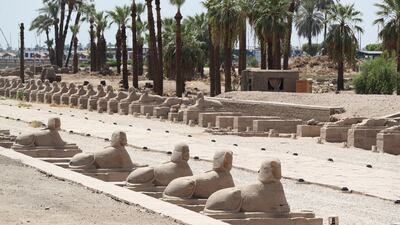
  • Sphinxes line the 2,700-meter avenue. Getty Images
    Sphinxes line the 2,700-meter avenue. Getty Images

Egypt’s Luxor ready for ‘spectacular’ Avenue of Sphinxes parade


Kamal Tabikha
  • English
  • Arabic

The city of Luxor will return to the spotlight on Thursday with an elaborate parade to mark the grand reopening of the Avenue of Sphinxes after years of painstaking restoration.

A procession of hundreds of performers in period costume will set out from the city's famous Karnak Temple – Egypt’s second most-visited heritage site after the Giza Pyramids – and head the 2.7 kilometres down the avenue to Luxor Temple.

In a bid to highlight as much of the city's pharaonic splendour as possible, the procession will wind its way past two other temples, the country's Tourism Ministry said.

The avenue, known as El Kebbash Road and known for the sphinx heads that flank both sides, has been carefully restored in a bid to reinvigorate Egypt's tourism sector, which was hit hard by the coronavirus pandemic.

Believed to be about 3,000 years old, the avenue, as well as the two temples it connects, are set to open as an open-air museum after years of excavation and restoration.

.
.

The day after the parade, the entire length of the avenue and all the temples it includes will be open to visitors free of charge, the Tourism Ministry said.

“This procession will be nothing short of spectacular,” said Dr Mostafa El Soghayar, who supervised the restoration.

“We expect it to surpass the grandeur of the Royal Mummies Parade,” he told The National, referring to the procession through Cairo in April of 22 ancient Egyptian mummies that were transported from the Egyptian Museum in Tahrir Square to the National Museum of Egyptian Civilisation.

“Karnak is one of the oldest and most beautiful sites in the world. We are happy that it is finally getting the care it deserves,” he said.

“Hundreds of the locals have been working day and night to bring the procession up to a level that will impress everyone watching it. We want to pay our respect to ancient Egyptian culture and there’s no better place to do that than Luxor,” he said.

Details on the ceremony have been shrouded in secrecy, with tourism and antiquities officials told not to reveal anything.

Nevine El Aref, a media adviser for Egypt’s Tourism Ministry, said the ceremony was “intended to be a complete surprise for everyone watching”.

However, videos posted on various social media platforms showed performers rehearsing choreographed dances in preparation for the event.

The Avenue of Sphinxes

  • The Egyptian government launched a campaign to rejuvenate Luxor before the southern city celebrates its national day in November. Reuters
    The Egyptian government launched a campaign to rejuvenate Luxor before the southern city celebrates its national day in November. Reuters
  • Columns in the Karnak Temple Complex, which dates back to about 2055 BC, are among the structures being restored. Reuters
    Columns in the Karnak Temple Complex, which dates back to about 2055 BC, are among the structures being restored. Reuters
  • Egyptian Prime Minister Mostafa Madbouly is given a tour of Karnak Temple. Reuters
    Egyptian Prime Minister Mostafa Madbouly is given a tour of Karnak Temple. Reuters
  • Karnak Temple is popular among tourists. Reuters
    Karnak Temple is popular among tourists. Reuters
  • The Ministry of Tourism and Antiquities and the Luxor governorate are overseeing the restoration work. Reuters
    The Ministry of Tourism and Antiquities and the Luxor governorate are overseeing the restoration work. Reuters
  • The Avenue of Sphinxes, a 2,700-metre corridor that connects Karnak Temple Complex and Luxor Temple, will be reopened to the public this year. Reuters
    The Avenue of Sphinxes, a 2,700-metre corridor that connects Karnak Temple Complex and Luxor Temple, will be reopened to the public this year. Reuters

The grand reopening was originally planned to coincide with the anniversary of the discovery, on November 4, 1922, of King Tutankhamun's tomb in the Valley of the Kings, Luxor. The date is celebrated each year as an official holiday in the province.

Thursday's ceremony will also be a modern recreation of the ancient Egyptian Opet Festival, which was predominantly celebrated in Thebes – as Luxor was known in the ancient world – and especially during the New Kingdom of 1550 to 1069 BCE.

The festival involved priests, civilians and noblemen making a processional walk from Luxor Temple to Karnak down the avenue during the second month of the Nile flooding season. The ritual was a tribute to the ancient Egyptian god Amun-Ra, who was the principal deity of the ancient city of Thebes.

The avenue that connects the temples is about 3,000 years old. Karnak is believed to have been built as a tribute to Amun-Ra.

Sphinxes stand guard at the Luxor Temples in Egypt. Victoria Hazou for The National

Unlike the sphinx at the Giza plateau, which has a human head, many of Karnak’s sphinxes have ram heads and lion bodies and are intended as guardians to the ancient temple.

At the other end of the avenue, closer to Luxor Temple, there are also several human-headed sphinxes lining the road.

Most of the surviving sphinxes date to the time of King Nectanebo, who reigned between 380 and 362 BCE.

Over the centuries, many of the ancient Egyptian relics were damaged or buried. Local people even built homes on sections of the avenue.

Structures that had to be taken down to make way for the excavations included a 115-year-old church and a 350-year-old mosque.

During its heyday, the avenue is believed to have been lined with 1,350 sphinxes. Of these, 650 have been unearthed, with many of the others believed to have been taken and repurposed during the Roman period and Middle Ages.


Updated: November 25, 2021, 12:40 PM