



Iraq’s new government could take months to form following the announcement of the general elections results, although backroom deals started before the first vote was made, experts told The National.
Preliminary results showed the political party of populist Shiite cleric Moqtada Al Sadr gaining the largest share of the vote, translating to more than 70 seats. The bloc is expected to hold major influence over Iraq’s direction and relationship with Iran and the West.
Mr Al Sadr’s party beat candidates from the Iran-backed Fatah Alliance, led by paramilitary leader Hadi Al Amiri, which has contested the results along with several other Shiite groups.
It was not immediately clear how many seats the Fatah Alliance had lost from the 48 they held after the 2018 election.
The period that follows the results is a crucial time for political parties to try to secure key ministries for their candidates.
“There will be an appeal process by the big losers and then we move to the selection of the speaker, president and prime minister as a package deal,” Michael Knights, a fellow at the Washington Institute for Near East Policy, told The National.
Mr Knights said political jockeying, as in previous rounds of elections, is expected.
“Some cabinet roles will be excluded from the party points system [including the prime minister role] and those excluded roles will be left to the prime minister to fill. Other ministries will be shared out using the points system,” he said.
Under Iraqi legislation, the party that wins the most seats is allowed to choose the country’s next prime minister, but it is unlikely any of the competing coalitions will secure a clear majority.
Without a clear majority, a lengthy process involving backroom negotiations will take place to select a consensus prime minister and agree on a new coalition government.
Negotiations over senior positions have already started, as gaining access to ministries is the key to moving forward for political parties, said Renad Mansour, a research fellow and director of the Iraq Initiative at London’s Chatham House.
“Even though there were elections, and they had some kind of measure that influences government formation, the government formation has already begun even before the first vote has been cast,” Mr Mansour told The National.
What makes the elections different this time round is not the focus on who will be the next prime minister, president or parliament speaker, but for political parties to assign their candidates to ministerial positions, he said.
What happens now?
-
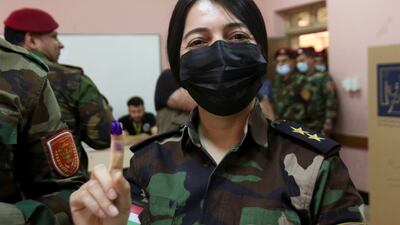
A member of Kurdish Peshmerga military forces shows her ink-stained finger after voting in a special process on October 8, 2021 in Erbil, two days before Iraq's parliamentary elections. Reuters -

An Iraqi federal policeman casts his vote in Baghdad. AP Photo -
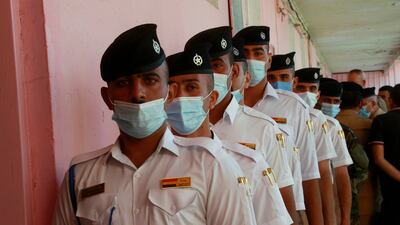
Members of Iraq's security forces wait to vote on Friday, two days before the country's parliamentary elections. AP Photo -

Security personnel in Baghdad gather to vote during early voting for security forces before Sunday's parliamentary election. AP Photo -
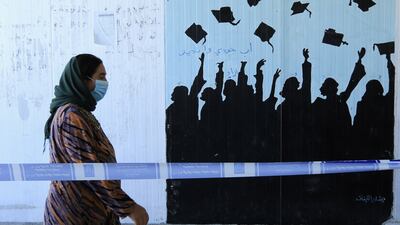
A displaced woman from the minority Yazidi sect arrives to cast her vote at the Sharya camp in Duhok, Iraq. Reuters -
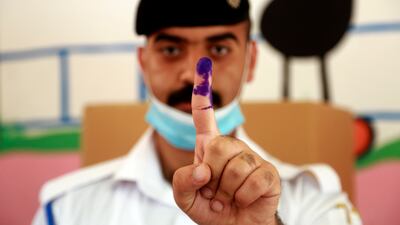
An Iraqi federal policeman after voting early in Iraq's parliamentary election. AP Photo -
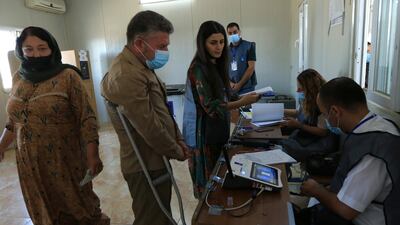
Displaced Yazidis prepare to vote at the Sharya camp in Duhok, Iraq. Reuters -
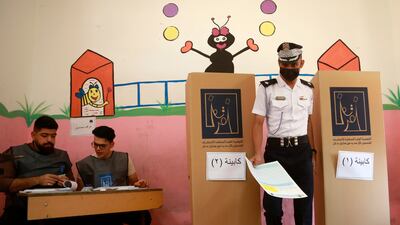
An Iraqi traffic policeman casts his vote at a polling centre in Basra. AP Photo -
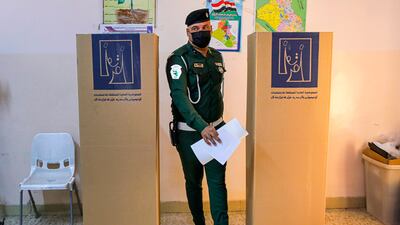
A police officer casts his vote in Basra, Iraq. AP Photo -
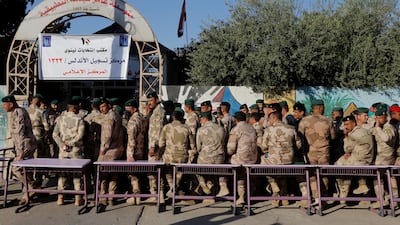
Members of Iraqi security forces outside a polling station in Mosul wait to cast their vote. Reuters -
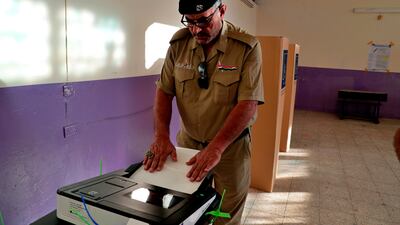
A soldier casts his vote in Baghdad. AP Photo -

One of many polling stations in Baghdad that opened on Friday to allow members of Iraq's security forces to vote early for Sunday's parliamentary election. Reuters -
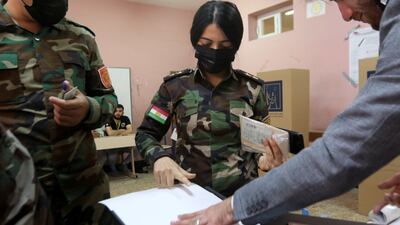
A member of the Kurdish Peshmerga military votes in Erbil. Reuters -
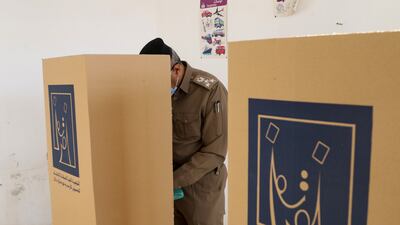
An Iraqi officer at a polling station in the capital, Baghdad. Reuters


There will be a period in which the public, candidates and political parties can contest the results, and request manual recounts, said Sajad Jiyad, an Iraqi fellow at the Century Foundation think tank.
The Independent High Electoral Commission (IHEC) has one month to certify the results, Mr Jiyad told The National.
“Once that’s done IHEC will present the results to the supreme court to certify and then within 15 days the next parliament is supposed to meet to choose its speaker,” he said.
It will take some time until the results are ratified and we see a new parliament session and new speaker, he said.
Experts predict it could take be least six months until a new government is formed.
Although Mr Al Sadr's gains were not a surprise, the margin was larger than predicted and Fatah's collapse in support shocked many, said Lahib Higel, Crisis Group’s senior analyst for Iraq.
"We will see some contestation of the election results. We have already seen that from Shiite parties. They have already had a meeting just last night to come up with a united front in terms of how they should deal with the situation,” Ms Higel told The National.
The outcome of the elections will make “this process a little longer because we are in a period that establishes what the smaller blocs actually look like,” she said.
“When we have a clear picture of how the blocs will look in parliament then the real negotiations over various ministries will begin.”

