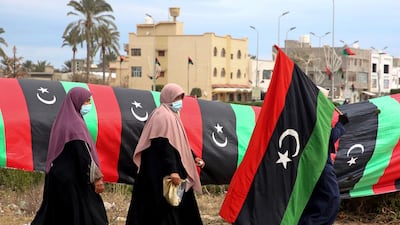
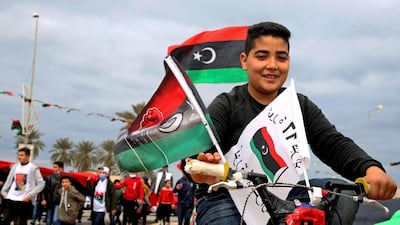
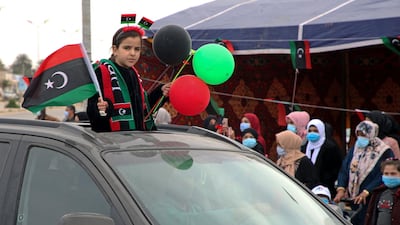
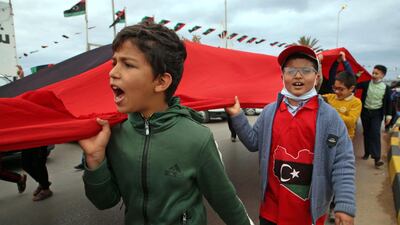
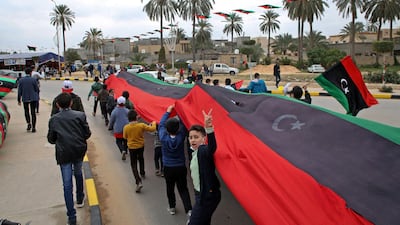
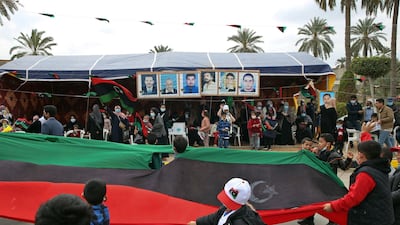
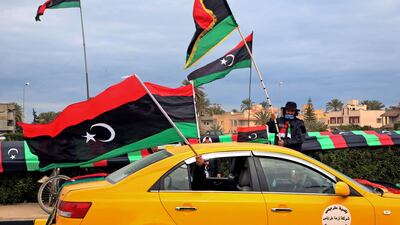
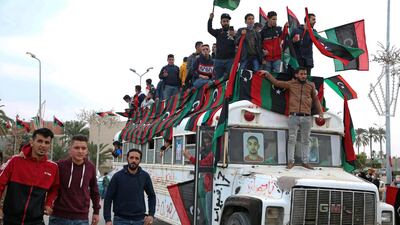
Libyan Parliament meet to discuss approving new government, in Sirte, Libya. Reuters

Libya’s parliament agrees to parliamentary election law


  • English
  • Arabic

Libya’s eastern-based parliament said on Monday it had agreed a law for a parliamentary election to take place a month after the presidential one planned for December 24.

The parliamentary spokesman, Abdullah Belhaiq, said the chamber had agreed each article in the law, which will keep parliament at the same number of members.

Disagreements on how voting should take place, mainly over a controversial law the parliament speaker issued for the presidential election, has raised concern it will not happen.

The UN-backed road map called for parliamentary and presidential elections on December 24 but did not specify a constitutional or legal basis for the vote.

Libya has been split since 2014 between warring eastern and western factions.

Last month, its parliament issued a law for the presidential election.

Critics said it was introduced to enable powerful figures to run for office without risking their existing positions, and that it had been passed without the necessary quorum.

The High State Council, a body that arose from a previous parliament and was given advisory powers in a 2015 political agreement, has rejected the presidential law. Some MPs said it was not voted upon properly.

Last week, the US House of Representatives passed a bill that could impose sanctions on many foreign actors supporting rival factions in Libya, should the unity government and current ceasefire fall apart.

That no-confidence vote could jeopardise the Libyan national elections in December.

Mr Belhaiq said the law agreed on Monday was voted on by 70 to 75 MPs who were present, out of about 200 elected in 2014.

He said the law was based on the existing parliamentary election rules but voting would now be for candidates rather than lists.

Egyptian President Abdel Fatah El Sisi and US National Security Adviser Jake Sullivan met in Cairo last week to discuss Libya’s internationally backed political road map.

In recent weeks, Egypt has been talking with Libya’s main political players to ensure the elections are held in December.

A fair and transparent vote, Cairo and other stakeholders believe, will help end the decade-long turmoil engulfing the energy-rich nation.


Skoda Superb Specs

Engine: 2-litre TSI petrol

Power: 190hp

Torque: 320Nm

Price: From Dh147,000

Available: Now

Mercer, the investment consulting arm of US services company Marsh & McLennan, expects its wealth division to at least double its assets under management (AUM) in the Middle East as wealth in the region continues to grow despite economic headwinds, a company official said.

Mercer Wealth, which globally has $160 billion in AUM, plans to boost its AUM in the region to $2-$3bn in the next 2-3 years from the present $1bn, said Yasir AbuShaban, a Dubai-based principal with Mercer Wealth.

Within the next two to three years, we are looking at reaching $2 to $3 billion as a conservative estimate and we do see an opportunity to do so,” said Mr AbuShaban.

Mercer does not directly make investments, but allocates clients’ money they have discretion to, to professional asset managers. They also provide advice to clients.

“We have buying power. We can negotiate on their (client’s) behalf with asset managers to provide them lower fees than they otherwise would have to get on their own,” he added.

Mercer Wealth’s clients include sovereign wealth funds, family offices, and insurance companies among others.

From its office in Dubai, Mercer also looks after Africa, India and Turkey, where they also see opportunity for growth.

Wealth creation in Middle East and Africa (MEA) grew 8.5 per cent to $8.1 trillion last year from $7.5tn in 2015, higher than last year’s global average of 6 per cent and the second-highest growth in a region after Asia-Pacific which grew 9.9 per cent, according to consultancy Boston Consulting Group (BCG). In the region, where wealth grew just 1.9 per cent in 2015 compared with 2014, a pickup in oil prices has helped in wealth generation.

BCG is forecasting MEA wealth will rise to $12tn by 2021, growing at an annual average of 8 per cent.

Drivers of wealth generation in the region will be split evenly between new wealth creation and growth of performance of existing assets, according to BCG.

Another general trend in the region is clients’ looking for a comprehensive approach to investing, according to Mr AbuShaban.

“Institutional investors or some of the families are seeing a slowdown in the available capital they have to invest and in that sense they are looking at optimizing the way they manage their portfolios and making sure they are not investing haphazardly and different parts of their investment are working together,” said Mr AbuShaban.

Some clients also have a higher appetite for risk, given the low interest-rate environment that does not provide enough yield for some institutional investors. These clients are keen to invest in illiquid assets, such as private equity and infrastructure.

“What we have seen is a desire for higher returns in what has been a low-return environment specifically in various fixed income or bonds,” he said.

“In this environment, we have seen a de facto increase in the risk that clients are taking in things like illiquid investments, private equity investments, infrastructure and private debt, those kind of investments were higher illiquidity results in incrementally higher returns.”

The Abu Dhabi Investment Authority, one of the largest sovereign wealth funds, said in its 2016 report that has gradually increased its exposure in direct private equity and private credit transactions, mainly in Asian markets and especially in China and India. The authority’s private equity department focused on structured equities owing to “their defensive characteristics.”

Ziina users can donate to relief efforts in Beirut

Ziina users will be able to use the app to help relief efforts in Beirut, which has been left reeling after an August blast caused an estimated $15 billion in damage and left thousands homeless. Ziina has partnered with the United Nations High Commissioner for Refugees to raise money for the Lebanese capital, co-founder Faisal Toukan says. “As of October 1, the UNHCR has the first certified badge on Ziina and is automatically part of user's top friends' list during this campaign. Users can now donate any amount to the Beirut relief with two clicks. The money raised will go towards rebuilding houses for the families that were impacted by the explosion.”

Updated: October 05, 2021, 5:52 AM