
The dire economic situation in Gaza is casting dark shadows upon the remaining horse clubs and breeders in the besieged coastal strip, where many youngsters dream of accompanying their horses to international contests but instead face a cruel reality.
The lack of proper training and equipment in addition to movement restrictions outside her home town of Gaza have limited young horse rider Noor Abu Sharia's ambitions.
“The horse-riding sport is so special, even if it is limited in Gaza,” said Noor, 17, who won her first tournament at the age of 9. She has a 15-year-old brown horse, aptly named Chocolate.
-
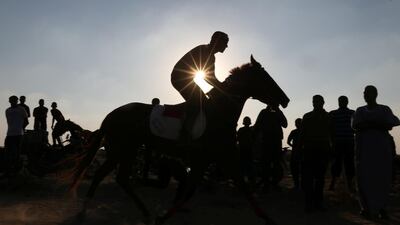
A man competes in a horse race in Rafah, southern Gaza Strip. Reuters -

Afghan journalists attend a meeting in the Tolo newsroom, in Kabul, Afghanistan. Reuters -

Smoke rises form the headquarters of Libyan state oil firm National Oil Corporation (NOC) after it was attacked by masked gunment. Reuters -

Visitors walk past flags as they arrive at the Damascus International Fair in the Syrian capital. AFP -
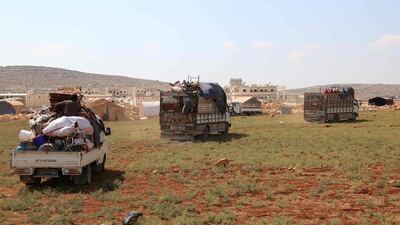
Displaced Syrians arrive at a camp in Kafr Lusin near the border with Turkey in the northern part of Syria's rebel-held Idlib. AFP -
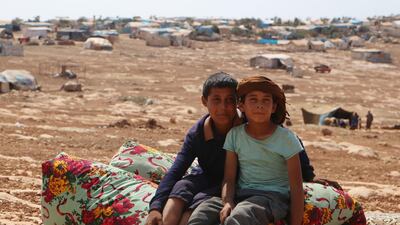
Displaced Syrian boys who fled from regime raids sit in a camp in Kafr Lusin. AFP -
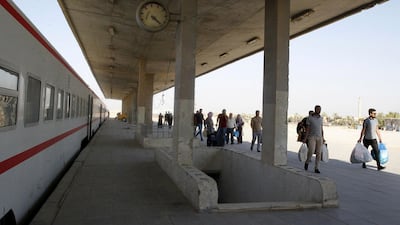
Iraqi rail passengers arrive in Fallujah in Anbar province, about 70 kilometres west of the capital. AFP -
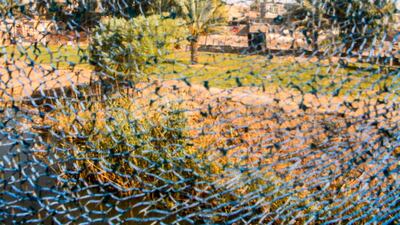
A picture taken on August 19, 2018 shows the view through a broken window on the train from the Iraqi capital Baghdad to the city of Fallujah in Anbar province, about 70 kilometres west. - The train connecting Baghdad to Falluja, crosses the landscapes of western Iraq through car cemeteries, charred tanks and collapsed buildings. AFP -
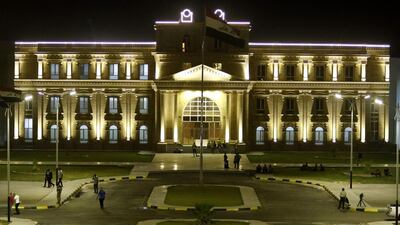
Iraqi security forces stand guard outside the new Basra governorate building after the old building was burned during demonstrations. AFP -
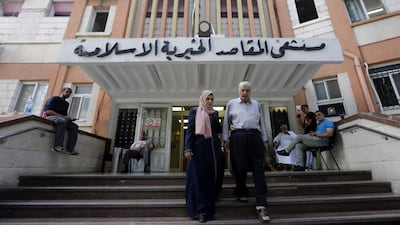
Palestinians leave the Makassed hospital in east Jerusalem. AP -
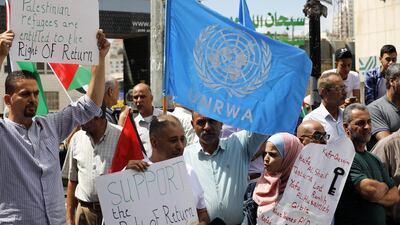
Palestinians hold placards alongside the UN and the Palestinian flags during a protest against US funding cuts for UNRWA in the West Bank city of Hebron. EPA


Along with 80 riders at Al Jawad Equestrian Club, south-west of Gaza city, Noor takes part in extensive training every week. Al Jawad is one of three clubs still open in Gaza after two closed because of the economic situation.
One of the club owners, Abed Mohammed Al Haiek, said they had 43 horses before the war with Israel in May, but now only 38 are left as the area is suffering from shortages of proper food, vital medicine and vaccines.
“The food for each horse costs about 300 shekels monthly [$93], besides extra expenses like medicine and salaries,” he said.
"With the bad economic situation, we face mounting challenges to keep the place running. I am going to expand the activities of the club and open a tennis court, so I can have extra income.”
Abed Al Aziz Abu Sharia, Noor’s father and the chairman of the technical committee of the Palestinian Equestrian Federation in Gaza, told The National they face obstacles such as providing routine veterinary treatment, food and medicine.
“Horses need special treatment and care, they need psychological and physical attention," he said.
“The big problem I face usually is when I have a sick horse and we cannot diagnose its illness because we don’t have suitable medical devices in Gaza.
“The lack of medicine forces me sometimes to choose between two horses.”
Breeders of Arabian and racehorses are suffering from the same problems.
“Gaza is under siege. We face many difficulties to import the necessary and special food, medication and vaccines needed to preserve the families of the Arabian horses and other horses we have here,” horse breeder Mohammed Maqadma told The National.
These problems result in poor health, death and sometimes the loss of some dynasties of Arabian horses left in the strip, he said.
The Israeli blockade on Gaza since 2007 and the closing of borders affect every aspect of life in the strip.
Horses in Gaza are under quarantine and not allowed to travel through two crossings – Rafah in the south, which is controlled by Egypt and Erez in the north, run by the Israelis.
Another member of Al Jawad club, Iyad Al Serk, 15, said he was disappointed because his options in Gaza were limited.
“What's the point of extensive training while knowing that I will reach a dead end?" Mr Al Serk told The National.
Iyad jumps 90-centimetre fences, but does not have his own horse because of the difficulties in bringing them into Gaza.
Prices for horses can start at $10,000 and the animals have to enter Gaza through Karem Shalom crossing, south of Gaza Strip, which is also controlled by the Israelis.
During the 11-day war in May, Noor and her brother Mohammed,15, had to leave their home because the tower next to their building was destroyed, partly damaging their own property.
“I was so worried about my horse during the war, because those are animals and can’t protect themselves," said Mohammed, who is also a rider.
The equestrian federation in Gaza lost about $50,000 during the war, through damage to buildings and equipment, as well as injury to horses, Mr Abu Sharia said.

