

Brown, rubbish-filled water flows slowly along an irrigation canal near Jordan’s border with Israel.
Shepherds by the side of the channel use the same water for their sheep.
“The water has been getting dirtier and it's level lower,” says one shepherd, Samer Mansour, 24. “It is our only source of water."
When work – with US funding – started on the East Ghor canal in the 1950s, the channel was mostly fed by the Jordan River, its Yarmouk tributary and rainwater.
By the time construction on the showcase infrastructure project finished in the late 1980s, treated wastewater had become the canal's main source.
Rapid population growth, over-farming, geopolitical changes and more frequent droughts have compounded Jordan’s water problems.
The 110-kilometre canal originates in northern Jordan's Yarmouk River Basin and feeds large parts of the Jordan Rift Valley. The valley is a very dry region, of which many parts are below sea level, and accounts for one third of the 100,000 hectares of irrigated land in the kingdom.
The water feeding the canal was relatively plentiful before Israel occupied the West Bank in 1967, consolidating its control of the River Jordan. Neighbouring Syria has increasingly dammed the Yarmouk since.
-
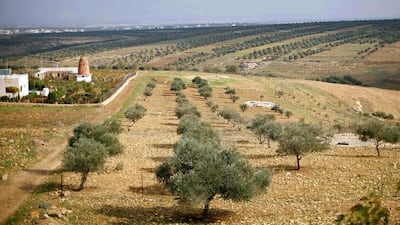
Olive farms in Irbid city, north of Amman. A lack of rain and higher temperatures this year has reduced the harvest of the olive fruit by about 20 per cent from last year. Reuters -
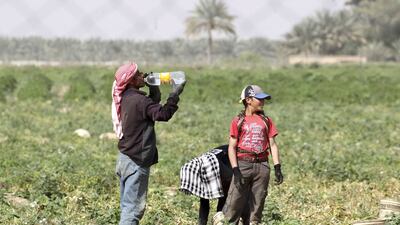
Syrian workers on a tomato farm in the northern Jordanian town of Shouneh. Arab countries account for more than five per cent of the world’s population, but have only one per cent of the global water resources. Reuters -
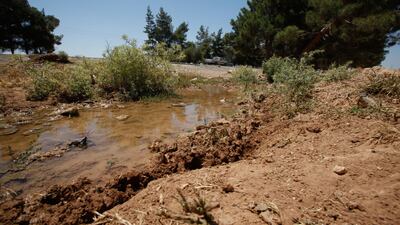
Water flows from a central pipe near the town of Madaba, south-west of Jordan's capital Amman. Salah Malkawi for The National -
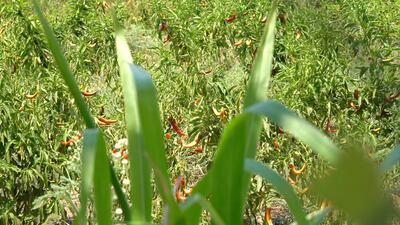
Crops in Al Ghawr, Jordan Valley, have suffered because of water scarcity. -

A farmland in Al Ghawr, Jordan Valley. Rapid population growth, over-farming, geopolitical changes and more frequent droughts have compounded Jordan’s water problems.


Better-quality water, a significant proportion of which comes from Israel under the 1994 Wadi Araba Treaty, has been diverted in the past decade to meet drinking requirements in Amman.
The shepherds, like Mr Mansour, receive water from the canal for free, as do the region's farmers.
But its declining water quality, and the smaller amounts being allocated to users, have contributed to a reduction in farm yields.
'Next year it will be worse'
Farm owner Abdulhadi Youssef says that the last good year for his tomatoes, cucumbers, bell peppers and aubergines was 2013.
Mr Youssef grows his crops in 50 plastic greenhouses near the canal. His farm's output has declined steadily to 60 per cent of its levels eight years ago.
Water from the canal no longer comes daily, and its low quality has affected the soil.
The season, from September to April, is two months shorter, and several neighbouring farms have gone bankrupt, he says.
“As soon the weather heats up, the crops go bad,” he says.
His tomato harvest has declined from 900 boxes annually to between 350 to 500 boxes.
“Next year it will be worse,” he says.
At 100 cubic metres each year, Jordan's per capita share of water is one of the lowest in the world.
Rainfall, which averages about 100 millimetres a year, is also among the lowest.
'Water poverty in Jordan is extreme'
In Jerash, north of Amman, farmer Rateb Silwan expects a poor season this year because of drought.
He forecasts that his two-hectare plot will bring in 600 to 800 litres of olive oil, compared with 1,200 litres last year. The same plot used to bring in nearly 2,000 litres in the 1970s.
“Droughts were almost unheard of then. Now they happen every four years or so,” he said.
Some farmers in the Jordan Rift Valley, who can afford the investment, have switched from vegetables to dates.
Dates consume less water and bring in more money because of demand from the Gulf.
“If there was more water in the canal there would have been more date farming for sure,” says Hassan Al Sawalha, who manages a date farm in the area.
But agriculture expanded significantly in the past decade in the desert areas above the Jordan Valley.
Farms above the Jordan Valley are fed by groundwater.
Olive, peach and almond farms straddle desert roads from the north to the south of the kingdom.
These desert regions are mostly inhabited by tribes that are a bedrock of support for the Hashemite monarchy that has ruled Jordan since the kingdom was founded with British support 100 years ago.

According to official figures, many of the wells in tribal areas are illegal. Data shows that theft and leaks account for 30 per cent of losses in the water network every year.
Last week, Irrigation Minister Mohammad Al Najjar said the kingdom’s groundwater “is being exhausted”.
He steered clear of identifying the specific regions with illegal wells, saying only that farmers "caught red-handed are transferred to the judiciary”.
The immediate solution, the minister said, is to carry out an as-yet unrealised plan to desalinate water from the Red Sea and pump it north.
Agriculture accounts for 5 per cent of Jordan’s gross domestic product while consuming about 55 per cent of the country’s fresh water.
However, most of the water consumed in the Jordan River Valley is treated water, in contrast to unsustainable groundwater consumption in the highlands.
Jawad Al Bakri, an agriculture professor at the University of Jordan says groundwater is being pumped at double the safe yield of 300 million cubic metres a year, at least.
“We lost some of the aquifers due to over pumping,” he says.
Jordan’s policies of “expanding agribusiness and utilising desert areas to produce food” need to be altered, he says.
Prof Al Bakri says worsening water quality could eradicate 5,000 hectares of citrus farming in the Jordan Rift Valley.
He is working with the German Corporation for International Co-operation, or GIZ, on a plan to reduce the size of irrigated areas while increasing yields.
Although the plan takes into consideration local conditions and divides the kingdom into agricultural zones, instead of more uniform policies covering the country, it still requires government diktat.
Prof Al Bakri says efficiency can be achieved "by adopting suitable cropping patterns and studying demand” for each zone.
“Why do we have huge amounts of tomatoes? There are other, strategic crops,” he says, suggesting potatoes, carrots and onions instead.
He also suggested that farmers in certain areas could move towards livestock or medicinal oils, which need less irrigation, and less land, than other widely grown crops.
“Water poverty in Jordan is extreme,” he says.

