


Lebanon’s Finance Minister Youssef Khalil, seen as one of the closest to the country’s controversial central bank governor, has all the technical know-how to implement banking reforms requested by the IMF, a person familiar with the matter told The National on Saturday. But does he have the will?
“He is undoubtedly the lynchpin of the financial systems set up by the central bank these last years,” said the source, who requested anonymity because he isn't authorised to speak to the media. “He knows the banking sector off by heart and is an excellent technician.”
Mr Khalil, who joined the central bank in 1982 as an economist, maintains a low public profile but is believed to be the main architect of the bank’s unorthodox financial engineering operations, which involved complex debt and currency swaps with local banks, alongside its long-term governor Riad Salameh.
Currently the director of the Lebanese central bank’s financial operations department, Mr Khalil is one of the few bankers to know the exact details of the financial engineering operations that began in 2016, the source said.
The operations were aimed at defending the local currency’s peg to the dollar, which has lost 90 per cent of its value in the past two years, but were criticised for allowing banks to rake in huge profits. Banks started implementing capital controls on depositors in late 2019, despite persistent rumours that well-connected clients were able to send millions out of the country.
Mr Khalil denied he took part in the financial engineering operations.
“The central bank means a lot to me and we have accomplished a lot over time and I did not participate in the development of plans," he told local media.
The central bank’s website describes the financial operations department’s responsibilities as including managing “domestic debt issues (treasury bills and bonds) and the securities accepted by the central bank in its credit operations”.
Mr Khalil was appointed finance minister on Friday as part of a cabinet formed by politician and billionaire Najib Mikati, exactly one year after the previous government resigned. Political wrangling over ministerial posts exacerbated Lebanon’s severe economic crisis, which pushed nearly 80 per cent of the population into poverty, according to the UN.
In his new role as finance minister, Mr Khalil will be a key figure in resuming discussions with the IMF for a bailout package that collapsed in July 2020 following a dispute between the government and the association of banks, backed by Mr Salameh, over the scale of their losses.
-

Lebanon's Prime Minister Najib Mikati gestures as he speaks to the press after meeting President Michel Aoun at the presidential palace in Baabda. Reuters -

President Michel Aoun meets Parliament Speaker Nabih Berri and Prime Minister-designate Najib Mikati at the presidential palace in Baabda before the announcement of the formation of a new government under Mr Mikati. Dalati and Nohra / AFP -
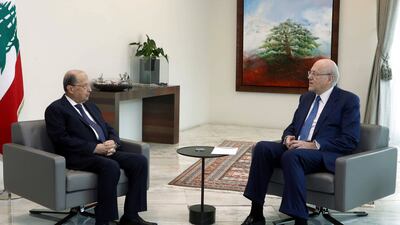
Mr Aoun (L) and Mr Mikati before the announcement of the formation of a new Lebanese government ending a 13-month vacancy. Dalati and Nohra / AFP -
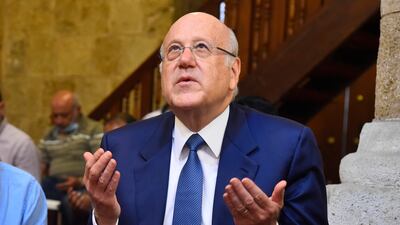
Lebanese Prime Minister Najib Mikat attends Friday prayers at a mosque in downtown Beirut. AP -
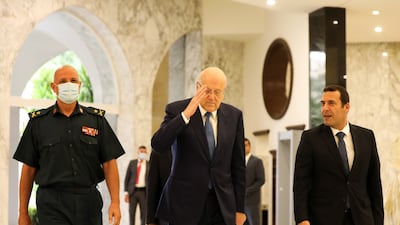
Najib Mikati arriving at the presidential palace in Baabda, Lebanon. Reuters -
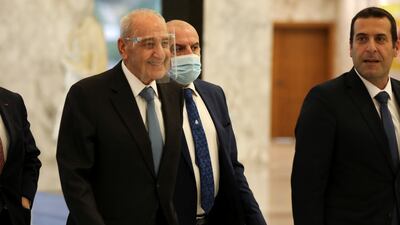
Lebanese Speaker of the Parliament Nabih Berri arrives at the presidential palace in Baabda. Reuters -
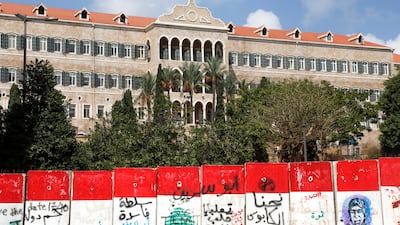
The government palace in Beirut, Lebanon. Reuters -
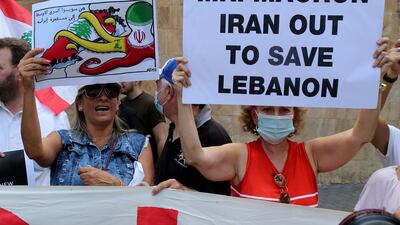
Protesters in Beirut. -
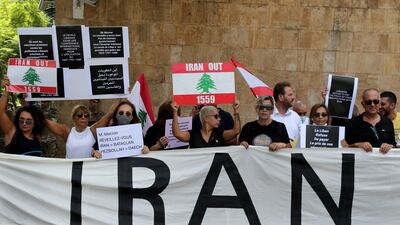
Anti-government protesters during a demonstration outside the French embassy in Beirut, Lebanon. EPA -
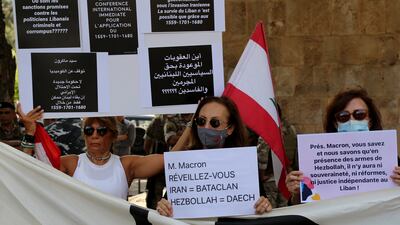
Demonstrators with placards appealing to French President Emmanuel Macron. EPA -
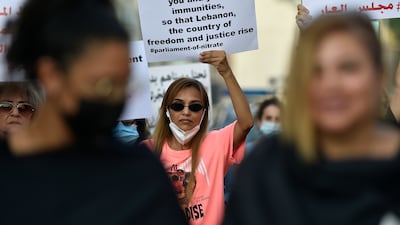
Protesters outside the French embassy in Beirut, Lebanon. EPA


Once hailed as one of the best central bank governors in the world, Mr Salameh, in office since 1993, has come under fire for his opaque management of the country’s finances since the start of the two-year crisis. The World Bank has ranked the crisis as among the top three most severe crises globally since the mid-19th century.
Mr Salameh has repeatedly blamed politicians for the crisis. He has pointed out that the banking sector has not collapsed despite the capital controls, the plunge in the local currency, the bans on international transfers and the flight of capital.
Mr Khalil’s silence during these recent developments did not bode well for future reforms, said Henri Chaoul, a former advisor to Lebanon’s finance ministry. “The key question is: will Mr Khalil have the independence to hold his former boss accountable?”
“I believe that such silence means that he was in agreement with the central bank’s policies and views on the banking sector,” said Mr Chaoul, who quit negotiations with the IMF shortly before they were put on hold, citing “no genuine will” to reform.
“Mr Khalil is part of the Serail, meaning that we never heard him being vocal about the necessity of structural reform or propose policies that would lead to reform, including the re-allocation of the banking sectors’ losses,” said Albert Kostanian, director of civil society group Kulluna Irada. “This is not very comforting.”
Mohammad Baassiri, one of the central bank’s four vice-governors from 2009 to 2019, disputed such claims.
“I have known Yusuf for a long time since the early eighties,” Mr Baassiri said. “He is a top-notch professional with the highest ethical standards. He is committed to reforms, including banking restructuring.”
Although analysts believe Mr Khalil is backed by veteran politician and parliament speaker Nabih Berri, Mr Baassiri said the new finance minister has no political ties. “He would be in a position to help fixing the national debt, unifying the exchange rate, and weighing in (on) the social impact of fiscal policies,” he said.
To be sure, Mr Khalil’s positions would become evident within a matter of weeks.
“There will be no period of uncertainty”, the source said. “He knows it all. He holds all the keys to solve the country’s financial problems. If he wants to, it can go very fast.”

